Kinetic Energy and the Work-Energy Theorem
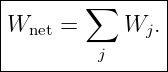
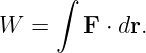
M03-01 introduced work as the scalar line integral
The present article develops the dynamical meaning of that integral.
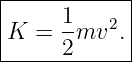
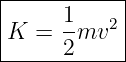
For a particle of constant mass m, the scalar quantity
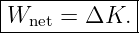
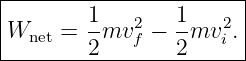
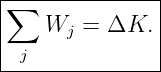
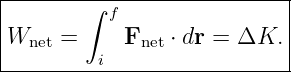
is called its kinetic energy. The work-energy theorem states that the net work done on the particle
equals the change in kinetic energy:
This relation is not an independent law added to Newtonian mechanics. It follows directly from
Newton’s second law. Its practical value is that it replaces a vector equation involving acceleration
with a scalar relation between work and speed. In many problems, that removes the need to solve
explicitly for time.
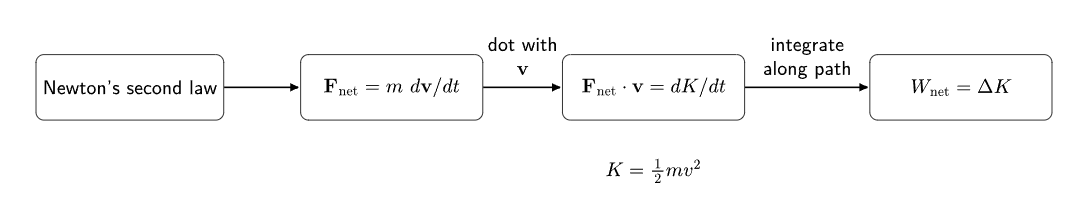
Figure 1. Newton’s second law can be projected along the instantaneous displacement. The
resulting scalar relation connects net work directly to the change in kinetic energy.
1 Kinetic energy
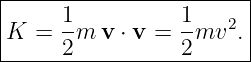
For a particle of mass m moving with velocity v,
The translational kinetic energy is
Several properties follow immediately.
- Kinetic energy is a scalar.
- For positive mass, K ≥ 0.
- Kinetic energy depends on speed, not on the direction of velocity.
- Reversing the velocity leaves the kinetic energy unchanged.
- Doubling the speed multiplies the kinetic energy by four.
- Kinetic energy depends on the reference frame because the measured velocity depends
on the reference frame.
The SI unit is the joule:
The dimensions are therefore
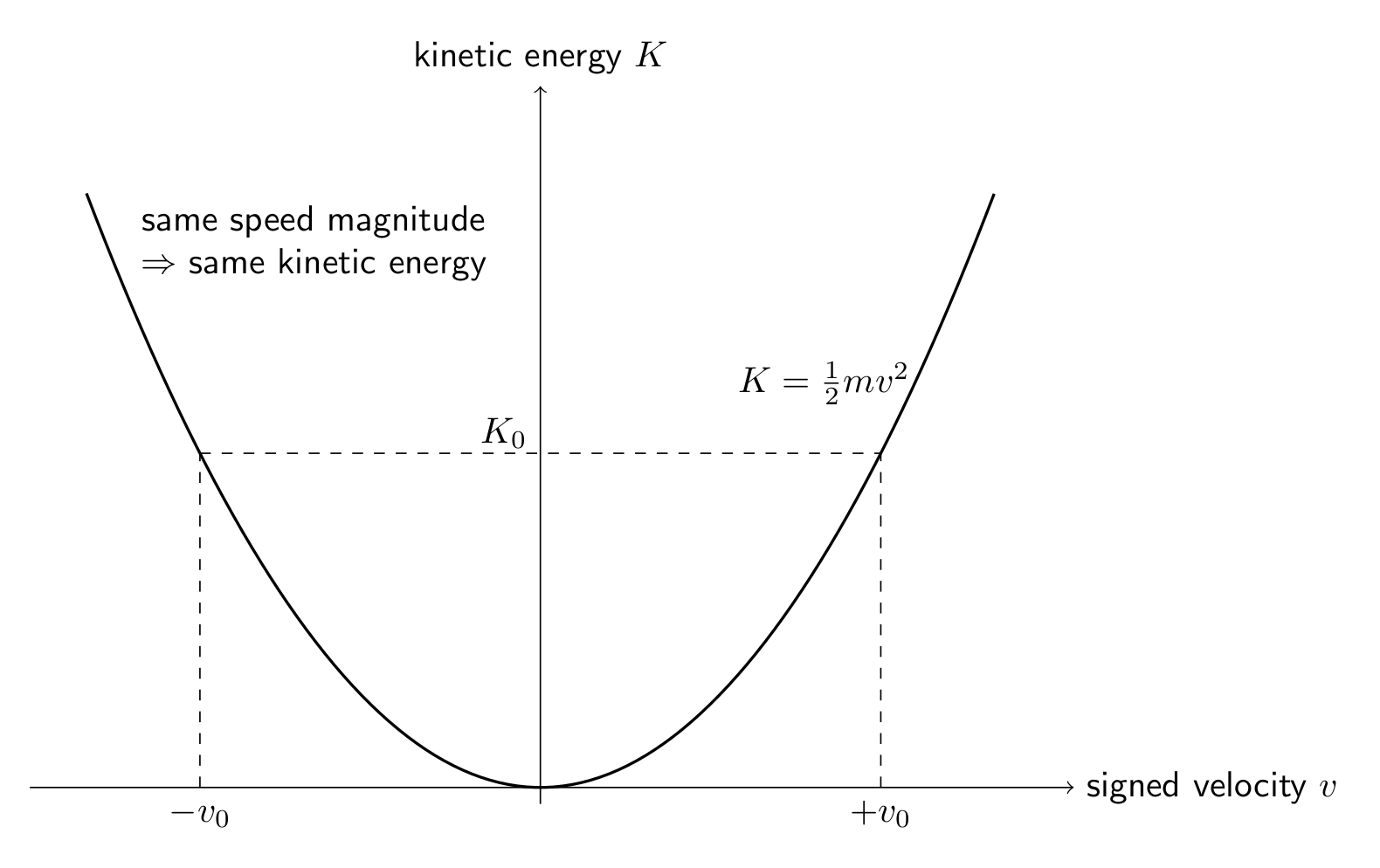
Figure 2. For fixed mass, K =  mv2 is a parabola when plotted against signed velocity. Opposite
velocities with equal magnitude have equal kinetic energy.
mv2 is a parabola when plotted against signed velocity. Opposite
velocities with equal magnitude have equal kinetic energy.
2 Derivation from Newton’s second law
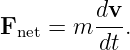
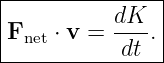
For a particle of constant mass,
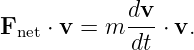
Take the scalar product with the velocity:
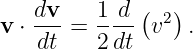
The derivative of v2 = v ⋅ v is
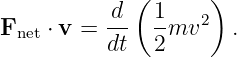
Hence
Substitution gives
Therefore
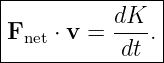
This is the differential form of the work-energy theorem. Since
we have
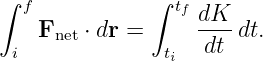
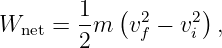
Integrating from an initial state i to a final state f,
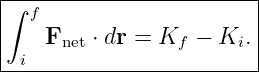
The right side is
Thus
By definition, the integral on the left is the net work:
3 One-dimensional derivation
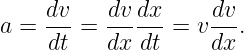
For one-dimensional motion along x,
Using the chain rule,
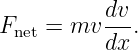
Therefore
Multiply by dx:
Integrating,
| ∫
xixf
Fnet dx | = m∫
vivf
v dv | (25)
|
| =  m m . . | (26) |
Thus
This form is especially useful when the force is known as a function of position.
4 Why the theorem uses net work
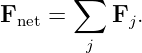
Suppose several forces act on the particle:
Then
| Wnet | = ∫
if ⋅ dr ⋅ dr | (29)
|
| = ∑
j ∫
ifF
j ⋅ dr. | (30) |
Therefore
The work-energy theorem concerns the sum of the work done by all forces:
An individual force may do positive work while another does negative work. The change in kinetic
energy is controlled by their total.
5 The sign of net work
Because
the sign of net work has an immediate interpretation.
| Wnet > 0 |  Kf > Ki, Kf > Ki, | (34)
|
| Wnet = 0 |  Kf = Ki, Kf = Ki, | (35)
|
| Wnet < 0 |  Kf < Ki. Kf < Ki. | (36) |
For constant mass this becomes
| Wnet > 0 |  vf > vi, vf > vi, | (37)
|
| Wnet = 0 |  vf = vi, vf = vi, | (38)
|
| Wnet < 0 |  vf < vi, vf < vi, | (39) |
where vi and vf denote speeds.
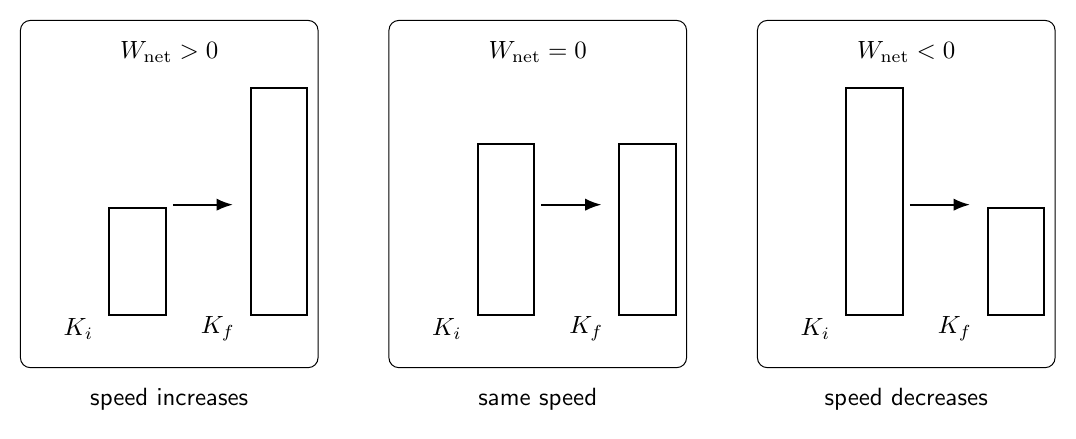
Figure 3. Positive net work increases kinetic energy, zero net work leaves kinetic energy
unchanged, and negative net work decreases kinetic energy.
A crucial point is that zero net work does not imply zero net force.
6 Zero net work does not imply zero acceleration
Uniform circular motion provides the standard example. The net radial force is perpendicular to
the instantaneous displacement:
Therefore
The kinetic energy and speed remain constant:
Nevertheless, the velocity vector continually changes direction, so the acceleration is not
zero:
The work-energy theorem tracks changes in speed through kinetic energy. It does not by itself
describe changes in the direction of velocity.
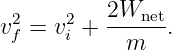
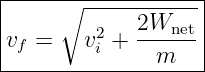
7 Solving directly for final speed
From
solve for vf2:
Thus
when only the final speed is required.
The square root emphasizes that kinetic energy gives speed, not the sign of a one-dimensional
velocity component. Direction must be obtained from the geometry and dynamics of the
problem.
8 Worked example 1: horizontal pull with friction
A 5.0 kg block moves 4.0 m along a horizontal floor. A constant horizontal pull of 20 N acts in the
direction of motion while kinetic friction of magnitude 8.0 N acts opposite the motion. The block
initially moves at 2.0 m∕s.
The work done by the pull is
The work done by Friction is
The Normal force and Weight are perpendicular to the horizontal displacement, so each does zero
work.
Hence
The initial kinetic energy is
Therefore
The final speed is
| vf | =  | (52)
|
| =  | (53)
|
| = 4.82 m∕s. | (54) |
9 Worked example 2: upward motion under gravity
A 0.50 kg ball moves upward from one point to another point 3.0 m higher. Its initial speed is
10.0 m∕s. Neglect air resistance.
Gravity is the only force that does work. Its work is
Thus
| Wnet | = −(0.50)(9.81)(3.0) | (56)
|
| = −14.7 J. | (57) |
The initial kinetic energy is
Hence
The final speed is
| vf | =  | (60)
|
| =  | (61)
|
| = 6.42 m∕s. | (62) |
No time of flight was required.
10 Worked example 3: constant-speed circular motion
A 2.0 kg mass moves at constant speed 5.0 m∕s in a horizontal circle of radius 3.0 m.
Its kinetic energy is
The inward net force has magnitude
This force is always perpendicular to the instantaneous displacement, so
Thus
even though the net force and acceleration are nonzero.
11 Reference-frame dependence
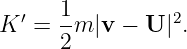
Kinetic energy is not invariant under a change of inertial reference frame.
Suppose frame S′ moves with constant velocity U relative to frame S. The particle velocities are
related by the Galilean transformation
Then
In general,
Work can also have different numerical values in different inertial frames because the displacement
during a force interaction can differ between frames. The important point is consistency: when
force, displacement, and kinetic energy are evaluated in the same inertial frame, the work-energy
theorem remains valid.
12 Work-energy theorem and Newton’s second law
The work-energy theorem is derived from Newton’s second law, so the two methods contain the
same Newtonian dynamics. They organize the calculation differently.
Newton’s second law is often preferred when the goal is acceleration, force, trajectory as a function
of time, or the direction of motion.
The work-energy theorem is often preferred when the goal is speed after a known displacement and
the work of the forces can be found directly.
Because kinetic energy is a scalar, the energy method can be much shorter than solving component
equations.
13 Common mistakes
- Using the work of one force instead of the net work.
- Forgetting that kinetic energy depends on speed squared.
- Assuming that zero net work means zero net force.
- Assuming that zero net work means the particle is at rest.
- Treating kinetic energy as a vector.
- Using velocity rather than speed in K =
 mv2 without recognizing that v2 means the
squared magnitude.
mv2 without recognizing that v2 means the
squared magnitude.
- Forgetting that a force perpendicular to the displacement does zero instantaneous work.
- Assuming that the work-energy theorem determines the direction of the final velocity.
- Mixing quantities measured in different reference frames.
14 Practice exercises
- A 3.0 kg particle speeds up from 2.0 m∕s to 6.0 m∕s. Find the net work done on it.
- A 4.0 kg object has K = 72 J. Find its speed.
- A 2.0 kg block initially moves at 5.0 m∕s. The net work on it over a certain displacement
is −9.0 J. Find its final speed.
- A particle moves at constant speed around a circle. State the net work done during
one quarter revolution and explain why.
- A 10 N force and a 6 N opposing force act on a particle that moves 5.0 m along their
common line. Find the net work.
- A 1.5 kg object is dropped through 4.0 m from rest. Neglect air resistance. Use the
work-energy theorem to find its speed after the fall.
- Show directly from K =
 mv2 that if speed is multiplied by a factor c, kinetic energy
is multiplied by c2.
mv2 that if speed is multiplied by a factor c, kinetic energy
is multiplied by c2.
- Explain why two particles can have the same kinetic energy but different momenta.
- A particle has the same speed at two points on its path. What can be concluded about
the net work between the points? What cannot be concluded about the net force during
the motion?
- Starting from Fnet = mdv∕dt, reproduce the vector derivation of Wnet = ΔK.
15 Summary
For a constant-mass particle,
Newton’s second law gives
Integrating along the path gives the work-energy theorem:
Therefore positive net work increases speed, negative net work decreases speed, and zero net work
leaves the speed unchanged. Zero net work does not require zero force because a force can change
the direction of the velocity without changing its magnitude.
The next article, M03-03, develops work by variable forces in more detail.
References
References
[1] J. R. Taylor, Classical Mechanics, University Science Books, 2005.
[2] D. Kleppner and R. Kolenkow, An Introduction to Mechanics, 2nd ed., Cambridge
University Press, 2014.
[3] H. D. Young and R. A. Freedman, University Physics with Modern Physics, 15th ed.,
Pearson, 2020.
[4] OpenStax, University Physics, Volume 1, Rice University, 2016.




![[K ] = M L2T −2.](https://images.physicslibrary.org/cache/objects/1371/make4ht/KineticEnergyAndTheWorkEnergyTheorem6x.png)