Electric Flux and Gauss’s Law
Purpose. This lesson develops Gauss’s Law from Coulomb’s inverse-square field and teaches when
the law can determine an electric field. The same theorem holds for symmetric and
asymmetric charge distributions, but it becomes an algebraic shortcut for the field only when
physical symmetry is sufficiently strong. This distinction is the key to using the law
correctly.
1 1. Physical meaning: measuring a field through a surface
An electric field is a vector at each location. A surface is a geometric region with an area and a
direction Normal to its local patch. To study the field’s passage through a surface, define the
oriented area element
where dA is a positive scalar area and n is a chosen unit normal. For a closed surface the
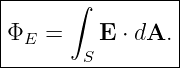
convention is that the normal points outward. The electric flux is
An outward-pointing field contributes positive flux; an inward-pointing field contributes negative
flux; a field tangent to the patch contributes zero. Flux has SI units N m2∕C, equivalently
V m.
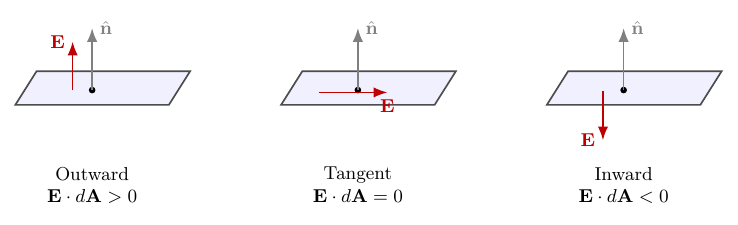
Figure 1. The sign of flux depends on the direction of the field relative to the chosen normal.
Reversing the normal reverses the signed flux, even though the physical field is unchanged.
1.1 1.1 Three elementary flux calculations
For a uniform field E = E0z through a flat area A with outward normal making angle 𝜃 to the
field,
If 𝜃 = 0, the field is normal and the flux is E0A. At 90∘ the field lies along the surface and the flux
vanishes. At 180∘ the field is inward and the flux is −E
0A. The negative sign is not a negative
amount of area. It is an orientation result from the dot product.
1.2 1.2 Closed versus open surfaces
The notation ∮
denotes an integral over a closed surface, such as a sphere or a complete box. An
open disk has a boundary curve and requires a separately chosen normal. A closed cube in a
uniform field has zero net flux because its positive and negative face contributions cancel. This
does not mean its local field is zero.
2 2. Deriving the law for a point charge
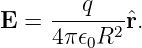
Consider a positive point charge q at the center of a spherical surface of radius R. Coulomb’s law
gives
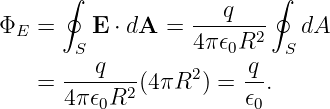
The field is parallel to the outward normal at every point and has constant magnitude over this
sphere. Therefore
The R−2 field and the R2 surface area cancel. The flux does not depend on the sphere’s radius. The
flux is negative when the source is negative.
2.1 2.1 Why the surface need not be spherical
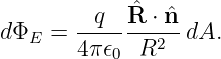
Move the charge off center or replace the sphere by a distorted closed surface. At a small
oriented patch, let R be the displacement from the source to the patch. Coulomb’s law
gives
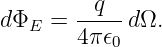
The geometrical ratio on the right is the signed solid angle dΩ subtended by the patch at the
charge. Thus
A ray leaving an interior charge ultimately exits the surface once more than it enters, giving
∮
dΩ = 4π. For an exterior charge the crossings of the closed surface balance and ∮
dΩ = 0.
Therefore the total flux is q∕𝜖0 for an inside charge and zero for an outside charge. ES03E3
develops this argument from the surface Jacobian and signed ray crossings, including a rigorous
independent proof.
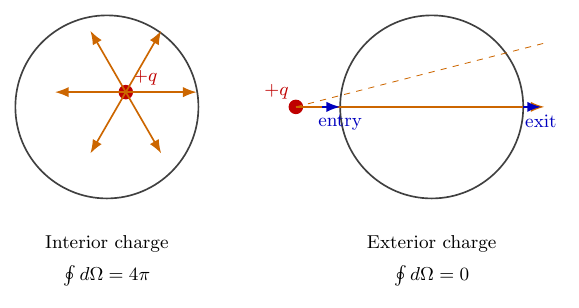
Figure 2. A charge inside the closed surface contributes net outward signed solid angle 4π. For an
external charge, entering and exiting rays contribute opposite signs and the total is zero.
3 3. Gauss’s law for arbitrary charge distributions
superposition allows the flux contributions of many charges to be added. Every point charge inside
the closed surface contributes qi∕𝜖0, while each outside charge contributes zero net flux.
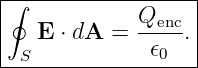
Hence
This is Gauss’s law. The enclosed charge is the algebraic sum of all charges inside the closed
Gaussian surface, including positive and negative charges. A Gaussian surface is an
imagined closed surface chosen for the flux calculation; it need not coincide with a material
object.
For a continuous density the enclosed charge must be computed from the correct measure:
when the relevant source is volume, surface, or line charge. The limits are the portions of the
charged support that lie inside the Gaussian surface. A source outside contributes to the field at a
point but not to Qenc.
3.1 3.1 Zero flux is not a zero field
Consider a dipole comprising +q and −q. A Gaussian surface enclosing both has Qenc = 0, so its
net flux is zero. Yet the field on the surface is not generally zero. Outward and inward flux
contributions cancel. Likewise, an external charge can produce a strong field through a closed
surface even though the net flux of that source is zero.
4 4. From a flux theorem to a calculable field
A closed-surface flux provides only one integrated number. To extract an unknown pointwise field,
ask whether the source distribution remains unchanged under rotations, translations, or reflections.
In the following cases the symmetry constrains both direction and magnitude over appropriate
parts of the Gaussian surface.
4.1 4.1 Spherical symmetry
For a source with charge density ρ(r), spherical symmetry demands a radial field with magnitude
depending only on r. On a sphere of radius r,
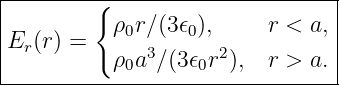
For a uniform solid ball of radius a and constant density ρ0, integrating 4πs2ds yields
so
The interior field grows linearly; the exterior field is equivalent to that of the total charge at the
center.
4.2 4.2 Cylindrical symmetry
An infinitely long, uniform charged wire is unchanged by translation along its axis and by rotation
around that axis. The field must be radial in the transverse plane. Choose a coaxial cylinder of
radius s and length L. The curved side contributes Es(2πsL); both end caps contribute zero
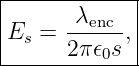
because their normals are axial. Thus
where λenc = Qenc∕L. This formula does not apply to a finite rod merely because a cylinder can be
drawn around it.
4.3 4.3 Planar symmetry
A single infinite sheet with uniform surface charge density σ has a field normal to the sheet with
equal magnitude on opposite sides, and reversed directions. A pillbox straddling the sheet has two
equal-magnitude cap contributions. Therefore
Here the sheet is at z = 0, and the expression gives the field on either open half-space. ES03E2 and
ES03E4 expand these computations to several planar configurations and their potential
functions.
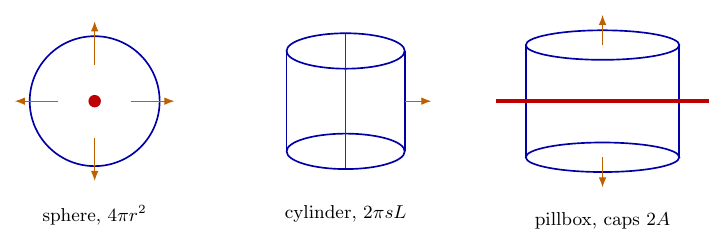
Figure 3. Standard Gaussian surfaces chosen to match spherical, cylindrical, and planar source
symmetries. The surfaces are mathematical tools, not additional physical charge layers.
5 5. Differential form and charge interfaces
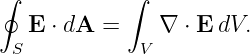
The divergence theorem relates the outward flux of a smooth vector field through a closed surface
to the divergence integrated over its enclosed volume:
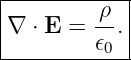
Compare this with Equation (8), where Qenc = ∫
V ρdV , to obtain the differential Gauss
law
The equality holds in the usual pointwise sense for smooth charge distributions and in the
distributional sense when idealized point or surface charges are present. A field whose divergence
vanishes everywhere away from a point charge can still have nonzero net flux through a surface
enclosing that singular point.
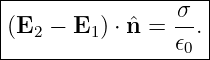
At a surface with surface charge density σ, a thin Gaussian pillbox gives
The same normal n points from region 1 to region 2 in both terms. An abrupt jump in the normal
field signifies an ideal surface charge. A jump in a volume charge density may change the slope of
the field without jumping the field itself.
6 6. When Gauss’s law is not enough
For an off-center point charge inside a sphere, the total flux remains q∕𝜖0. However, the field’s
magnitude on the surface varies and its direction generally is not normal. One cannot use
E = Qenc∕(𝜖0A) to find a local E. The law is true, but symmetry is absent. A finite rod,
rectangular plate, eccentric cavity, or irregular dielectric may require Coulomb integration,
potential differentiation, uniqueness arguments, or numerical methods.
6.1 6.1 Distinguish source symmetry from Gaussian-surface shape
It is not enough to draw a spherical or cylindrical Gaussian surface. The physical sources must
possess the associated symmetry. A spherical Gaussian surface around two separated point charges
does not make their combined field spherically symmetric. One must justify the simplification of
the surface integral from the physical arrangement first.
7 7. Worked example: a displaced cavity in charged matter
The tempting guess that any cavity in a charged sphere has zero field is false. Begin instead with a
uniformly charged full sphere and remove an off-center spherical region. Model the removed
charge as a negative-density sphere superposed on the original positive-density sphere.
Inside the empty cavity, the fields from the two hypothetical uniformly charged spheres
are
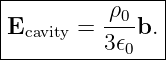
where b locates the cavity center relative to the original sphere center. The points of interest lie
within both hypothetical spheres when the cavity is wholly contained in the original ball. Adding
gives
It is uniform within the cavity, but generally nonzero. This calculation illustrates how Gauss’s law
derives the field for symmetric building blocks, while superposition handles their asymmetric
combination. It does not describe an electrostatic conducting shell with a cavity; Conductor
equilibrium is a distinct problem.
8 8. Exercises
- A uniform field E0z crosses a planar area A whose chosen normal is 120∘ from +z.
Calculate flux and give its sign.
- A cube enclosing +3q, −q, and −2q has a separate external point charge near one face.
Find the total closed flux and state what it tells you about the field on any one face.
- A uniform ball of density ρ0 and radius a has radius r = a∕2. Find the enclosed charge
fraction, the local field magnitude, and the exterior field at r = 2a.
- A line charge has λ = 5.0 nC∕m. Find the field magnitude s = 0.10 m from an infinitely
long line in vacuum.
- A conducting surface at electrostatic equilibrium has free surface charge density σ > 0
and zero field just within the metal. Determine the normal field immediately outside.
- A point charge lies outside an irregular closed surface, but its field penetrates that
surface. What is its net flux contribution? Is the field zero on the surface?
9 9. Solutions
- The dot product gives ΦE = E0A cos 120∘ = −E
0A∕2. The field enters through the
chosen positive normal.
- The net enclosed charge is 3q−q−2q = 0, so ΦE = 0 regardless of the external source.
No individual face field can be inferred from that fact.
- The charge fraction is (r∕a)3 = 1∕8. The interior field is ρ
0a∕(6𝜖0); at r = 2a the
exterior field is ρ0a∕(12𝜖0).
- E = λ∕(2π𝜖0s) ≃ 899 N∕C, directed outward for positive λ.
- The field jump is Eout,n − 0 = σ∕𝜖0, pointing outward for positive σ.
- The external source contributes zero net flux since it lies outside. Its field can be
nonzero over much of the surface, with incoming and outgoing contributions canceling.
10 10. Article sequence and further study
ES03E1 develops flux orientation and curved open surfaces. ES03E2 develops the symmetry
method and textbook starting geometries. ES03E3 derives Gauss’s law using signed
solid angle and analyzes flux through off-center spheres and open disks. ES03E4–E8
build successively harder planar, cylindrical, spherical, and inverse problems. These
are self-contained companions with complete calculations and independent physical
checks.
References
References
[1] D. J. Griffiths, Introduction to Electrodynamics, 4th ed., Cambridge University Press,
2017, Chapter 2.
[2] E. M. Purcell and D. J. Morin, Electricity and Magnetism, 3rd ed., Cambridge
University Press, 2013.
[3] MIT Open Learning Library, 8.02.1x Electricity and Magnetism, Gauss’s-law
materials, https://openlearninglibrary.mit.edu/courses/course-v1:MITx+8.02.1x+1T2019/course/.
[4] J. D. Jackson, Classical Electrodynamics, 3rd ed., Wiley, 1999, Chapter 1.