
|
|
|
|||||||
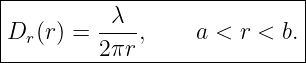
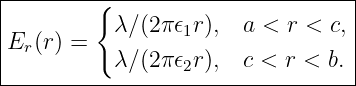
No free surface charge is assumed at r = c, so Dr is continuous there. The electric field differs because 𝜖 changes:
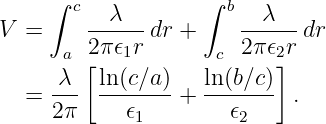
The field is radially outward for λ > 0. The jump in Er at c is not an electrostatic discontinuity error; it is the expected dielectric interface behavior. 3 Potential and capacitance per lengthWorked example 2. Define V = V (a) −V (b) > 0. Integrating the field across the first and second dielectric layers,
Divide λ by this potential difference:
Each cylindrical dielectric layer contributes a term in an effective series denominator. The logarithms, not raw thicknesses, encode cylindrical geometry. 4 Bound charge at the material boundariesWorked example 3. The polarization in dielectric region i is
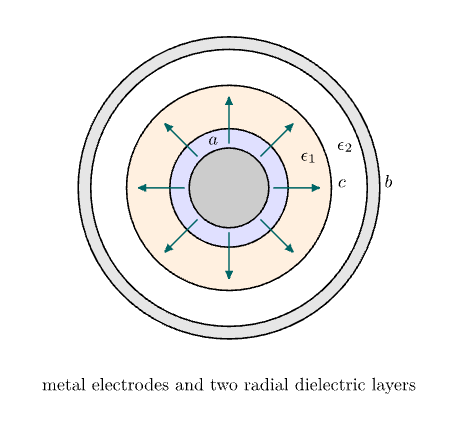
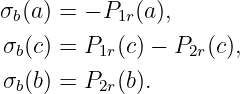
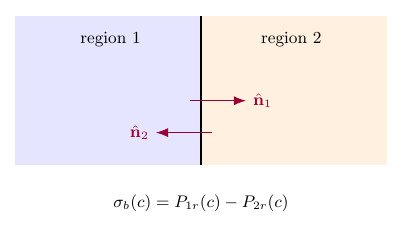
Within each uniform medium, Pr ∝ 1∕r, so ∇⋅P = (1∕r)d(rPr)∕dr = 0. There is no bound volume charge away from the interfaces. But there is bound surface charge. Define Pir(r) as the outward radial magnitude at the indicated radius. The Normals of each dielectric are as follows: at r = a, region 1 points inward; at r = c, region 1 points outward while region 2 points inward; at r = b, region 2 points outward. Hence
These are bound charge densities on the dielectric boundaries. The metal carries the specified free electrode charge; confusing the two would corrupt the interface jump equations.
Figure 2. Outward normals of each dielectric are opposite on the shared interface. The net bound interface density equals the difference in the radial polarization components.
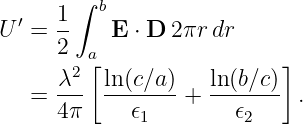
5 Energy and independent checksWorked example 4. The energy per unit length is
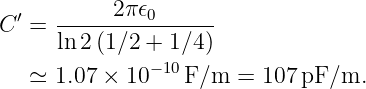
Using Equation (3), this equals λV∕2. Using Equation (4), it also equals λ2∕(2C′). Thus three independent descriptions give the same energy. If 𝜖1 = 𝜖2 = 𝜖, the logarithms add to ln(b∕a) and C′ = 2π𝜖∕ ln(b∕a), the uniform coax result. If c → a or c → b, one dielectric layer disappears and the corresponding single-medium limit follows. 6 Numerical comparisonWorked example 5. Take a = 1 mm, c = 2 mm, b = 4 mm, 𝜖1 = 2𝜖0, and 𝜖2 = 4𝜖0. Since both logarithms equal ln 2,
The result lies between the uniform-permittivity coax values at 2𝜖0 and 4𝜖0, as expected. This is a useful independent order-of-magnitude check. 7 Exercises with worked solutionsExercise 1. Let 𝜖1 = 𝜖2 = 𝜖. Reduce the capacitance formula. Solution. The denominator is [ln(c∕a) + ln(b∕c)]∕𝜖 = ln(b∕a)∕𝜖. Thus C′ = 2π𝜖∕ ln(b∕a). Exercise 2. If 𝜖2 = 2𝜖1 and c = Solution. D is continuous and E = D∕𝜖, hence E1∕E2 = 𝜖2∕𝜖1 = 2. Exercise 3. Find the ratio of capacitance after replacing region 2 with region 1 material, expressed using the formula rather than a number. Solution. The new capacitance is C′new = 2π𝜖1∕ ln(b∕a). Divide it by Equation (4): C′new∕C′ = [ln(c∕a) + (𝜖1∕𝜖2) ln(b∕c)]∕ ln(b∕a). Exercise 4. Why is the bound volume charge zero in each uniform medium even though P(r) varies with radius? Solution. For radial Pr = A∕r, the cylindrical divergence is (1∕r)d(rPr)∕dr = (1∕r)dA∕dr = 0. The polarization varies, but its divergence vanishes away from interfaces. References
"A Coaxial Capacitor with Two Radial Dielectrics" is owned by bloftin.
This object's parent. Cross-references: divergence, bound volume charge, formula, unit, outward normals, boundaries, charge densities, Normals, magnitude, bound surface charge, volume, polarization, potential difference, dielectric interface, electric field, charge, Gauss's Law, flux, displacement, Gaussian surface, line charge density, Conductor, energy, capacitance, voltage, bound charge, dielectric, coaxial capacitor This is version 1 of A Coaxial Capacitor with Two Radial Dielectrics, born on 2026-11-28. Object id is 1644, canonical name is ACoaxialCapacitorWithTwoRadialDielectrics. Accessed 2 times total. Classification:
|
|
|
|
Pending Errata and AddendaNone.
|
DiscussionNo messages.
|
Interact |



 , what is the ratio