|
|
|
|||||||
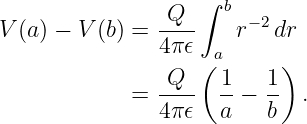
The potential decreases outward:
Therefore
C′ is capacitance per unit length. Every radial integration limit has a physical boundary: the inner electrode at a and outer electrode at b.
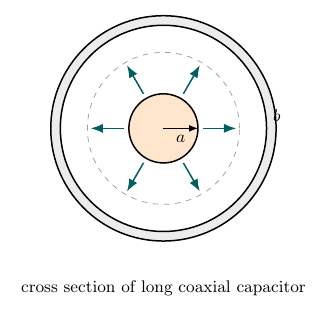
Figure 1. Coaxial geometry with radial electric field and a Gaussian cylindrical surface in the dielectric gap.
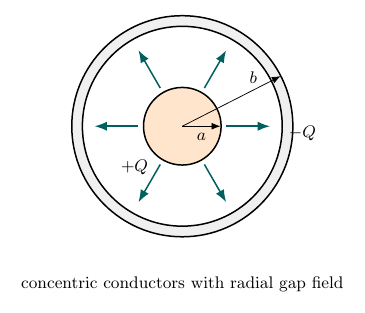
2 Concentric spherical capacitorWorked example 2. Two concentric conducting spherical shells of radii a < b carry ±Q. In the gap the field is Er = Q∕(4π𝜖r2). Integration gives
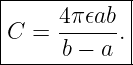
Thus
In the limit b →∞, the outer electrode is effectively at infinity, giving the isolated sphere’s capacitance C = 4π𝜖a. 3 An isolated sphere numerical calculationWorked example 3. A conducting sphere with radius 0.050 m is surrounded by vacuum. Its capacitance relative to infinity is
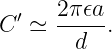
At V = 1.0 kV, Q = CV = 5.56 nC. Its surface Electric Field is E(a+) = V∕a = 2.0 × 10⁴ V∕m. A high voltage alone is not a complete description of the local field: the curvature length also matters. 4 Comparing narrow gapsWorked example 4. For a narrow spherical gap d = b − a ≪ a, the exact formula becomes C = 4π𝜖a(a + d)∕d ≃ 4π𝜖a2∕d. Since the sphere surface area is A = 4πa2, this approaches 𝜖A∕d. In a narrow coaxial gap d = b − a ≪ a, the logarithm is ln(b∕a) = ln(1 + d∕a) ≃ d∕a, so
Multiplying by length L recovers 𝜖A∕d with A = 2πaL. These limits connect curved and planar capacitor models.
Figure 2. Concentric spherical capacitor with charge on opposing metal surfaces and radial field in the dielectric region.
5 Exercises and complete answersExercise 1. Find C′ for a vacuum coax with a = 1 mm, b = 4 mm. Solution. C′ = 2π𝜖0∕ ln 4 ≃ 40.1 pF∕m. Exercise 2. For the coax in Exercise 1, find E(a+) if V (a) − V (b) = 10 V. Solution. From Er = V∕[r ln(b∕a)], E(a+) = 10∕[0.001 ln 4] ≃ 7.21 × 10³ V∕m. Exercise 3. For a vacuum spherical capacitor with a = 2 cm and b = 4 cm, find C. Solution. C = 4π𝜖0(0.02)(0.04)∕(0.02) ≃ 4.45 pF. Exercise 4. Why does an isolated charged sphere have a finite capacitance without a nearby second plate? Solution. The reference electrode is effectively at infinity: the sphere’s charge creates a finite potential V (a) = keQ∕a relative to V (∞) = 0, giving C = Q∕V = 4π𝜖0a. References
"Coaxial and Spherical Capacitors" is owned by bloftin.
This object's parent. Cross-references: charge, voltage, Electric Field, conducting sphere, spherical shells, dielectric, boundary, unit, Gaussian surface, Gauss's Law, formulas, capacitance There are 4 references to this object. This is version 1 of Coaxial and Spherical Capacitors, born on 2026-11-28. Object id is 1638, canonical name is CoaxialAndSphericalCapacitors. Accessed 15 times total. Classification:
|
|
|
|
Pending Errata and AddendaNone.
|
DiscussionNo messages.
|
Interact |