|
|
|
|||||||
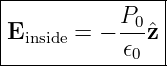
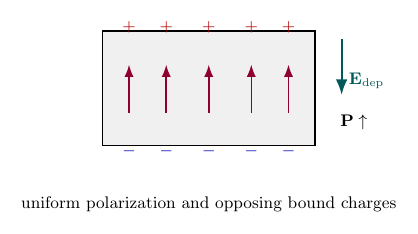
when no other free charges or applied fields exist. This is the depolarizing field produced by bound charge. It opposes P. A finite slab has fringe fields and is not described exactly by this uniform result.
Figure 1. Uniform polarization gives opposite bound surface charges and no bound volume charge. The internal depolarizing field opposes the polarization.
3 Nonuniform radial polarizationWorked example 2. A sphere of radius a has P = βr inside, with constant β in C/m3, and P = 0 outside. In Cartesian components P = β(xx + yy + zz), so
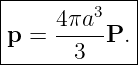
At r = a, n = r and σb = βa. Total volume bound charge is Qb,V = −3β(4πa3∕3) = −4πβa3, whereas total surface bound charge is Qb,S = βa(4πa2) = +4πβa3. They cancel, demonstrating that a globally neutral polarized body can contain both volume and surface bound charge. 4 The uniformly polarized sphereWorked example 3. A solid sphere of radius a has a constant prescribed P = P0z. The bound volume density vanishes. At a surface point whose normal makes angle 𝜃 with +z, σb = P0 cos 𝜃. Because the total dipole moment is volume times polarization,
The exterior electrostatic potential is that of a dipole at the center,
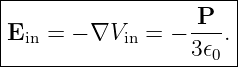
Inside, the solution with the matching dipole angular dependence is linear in r: V in = Ar cos 𝜃. Continuity of potential at r = a gives A = kep∕a3 = P 0∕(3𝜖0). Therefore
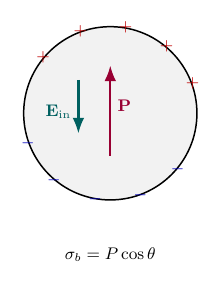
The inside field is uniform and antiparallel to P. The result is for a prescribed uniform polarization, not a universal statement about the self-consistent response of every dielectric sphere in an external field.
Figure 2. A uniformly polarized sphere has bound surface density proportional to cos𝜃 and a uniform depolarizing field in the interior.
5 Recovering bound charge from a one-dimensional polarizationWorked example 4. A dielectric layer spans 0 < z < L with P(z) = (P0 + γz)z. Then ρb = −dPz∕dz = −γ, while the boundary densities are σb(0) = −P0 and σb(L) = P0 + γL. Per unit transverse area the sum is
A nonuniform polarization can produce bound bulk charge even though the complete finite sample remains neutral. 6 Exercises and worked answersExercise 1. A uniformly polarized cube has P = 3.0 μC∕m2 along +x. Find bound charge density on its ±x faces. Solution. σb(+x) = +3.0 μC∕m2 and σ b(−x) = −3.0 μC∕m2. Other faces have zero bound density. Exercise 2. A sphere of radius a has P = βr. Show that total bound charge is zero. Solution. The volume carries −4πβa3 and the surface carries +4πβa3, hence Q b = 0. Exercise 3. A sphere has P0 = 6.0 × 10⁻⁹ C∕m2. Estimate the magnitude of its prescribed-polarization internal field. Solution. |Ein| = P0∕(3𝜖0) ≃ 226 V∕m. Exercise 4. Explain why ρb = 0 does not imply absence of a field created by polarization. Solution. A uniform P may terminate at boundaries with σb = P ⋅n≠0. These surface charges can generate a substantial field. References
"Polarization, Bound Charges, and Polarized Bodies" is owned by bloftin.
This object's parent. Cross-references: solid, magnitude, transverse directions, Normals, divergence, formulas, outward normal, boundary, dielectric, volume density, negative charges, unit, dipole moment, charges, electric dipole, volume, polarization, bound charge There are 2 references to this object. This is version 1 of Polarization, Bound Charges, and Polarized Bodies, born on 2026-11-28. Object id is 1640, canonical name is PolarizationBoundChargesAndPolarizedBodies. Accessed 11 times total. Classification:
|
|
|
|
Pending Errata and AddendaNone.
|
DiscussionNo messages.
|
Interact |