Principal Axes and Principal Moments of Inertia
M05-09 introduced the inertia tensor
through
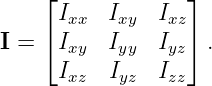
In a general Cartesian basis, the tensor can contain off-diagonal terms:
Because the inertia tensor is real and symmetric, there always exists an orthonormal basis in which
it is diagonal.
The special directions of that basis are the principal axes of inertia.
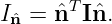
A unit vector
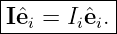
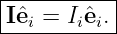
is a principal-axis direction if
Thus principal axes are eigenvectors of the inertia tensor.
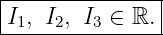
The associated eigenvalues
are the principal moments of inertia.
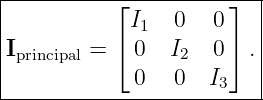
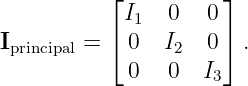
In the principal-axis basis,
This basis reveals the natural rotational geometry of a rigid body.
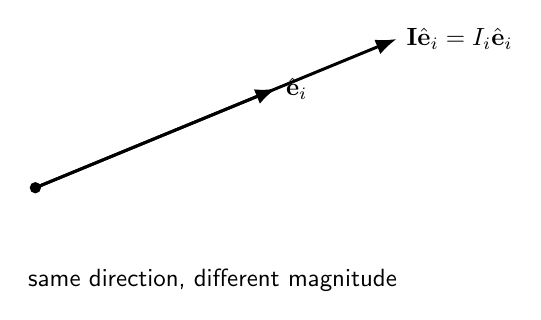
Figure 1. A principal axis is an eigenvector direction of the inertia tensor. Applying the inertia
tensor to a principal-axis unit vector changes only its magnitude, not its direction.
1 Why principal axes matter
For arbitrary angular velocity,
In a nonprincipal basis, an angular-velocity component along one coordinate direction can
contribute to several components of angular momentum.
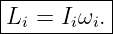
In a principal basis,
| L1 | = I1ω1, | (9)
|
| L2 | = I2ω2, | (10)
|
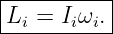
| L3 | = I3ω3. | (11) |
The components decouple algebraically.
This makes principal axes useful for:
2 The eigenvalue problem
Principal directions satisfy
Move all terms to one side:
A nonzero eigenvector exists only when
This is the characteristic equation of the inertia tensor.
For a three-dimensional body it is a cubic equation in
Its three real eigenvalues are the principal moments.
3 Why the eigenvalues are real
The inertia tensor satisfies
A real symmetric matrix has real eigenvalues.
Therefore
This agrees with their physical interpretation as moments of inertia.
Furthermore, because
for every unit vector, the principal moments are nonnegative.
4 Orthogonality of principal axes
Suppose
and
Take the scalar product of the first equation with
Because I is symmetric,
Thus
If
then
Eigenvectors belonging to distinct principal moments are orthogonal.
5 Diagonalization
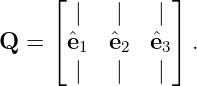
Collect three orthonormal principal-axis unit vectors as columns of
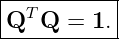
Because the columns are orthonormal,
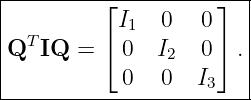
The principal-axis representation is
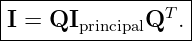
Equivalently,
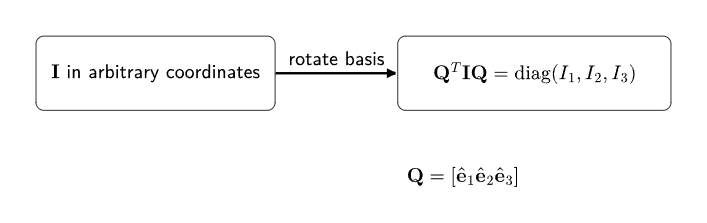
Figure 2. An orthogonal matrix built from principal-axis eigenvectors rotates the coordinate
representation into a basis where the inertia tensor is diagonal.
6 Products of inertia vanish in principal coordinates
In the principal basis,
Therefore all off-diagonal tensor components vanish:
Using the sign convention from M05-09, the corresponding geometric products of inertia also
vanish:
Thus principal axes can be described equivalently as coordinate axes for which the products of
inertia are zero.
The eigenvector definition is more general and more systematic.
7 Principal axes through the center of mass
Principal axes can be defined about any chosen origin.
For rigid body dynamics, the most important set is usually the principal axes through the center of
mass.
Using the center of mass as tensor origin:
- separates translation from rotation cleanly,
- minimizes parallel-axis complications,
- gives the standard form used in Euler’s equations.
Unless otherwise stated, the principal axes in later rigid body dynamics articles will be taken
through the center of mass.
8 Two-dimensional principal-axis problem
For a planar lamina in the xy plane,
The characteristic equation is
Thus
Expanding:
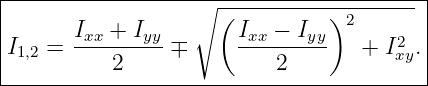
Therefore the two in-plane principal moments are
9 Principal-axis rotation angle in two dimensions
Rotate the coordinate axes through angle 𝜃.
The transformed off-diagonal tensor component is
A principal orientation satisfies
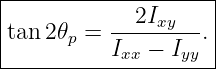
Therefore
Equivalent forms can appear with an overall sign change depending on the active or passive
rotation convention.
The safest procedure is always to check the transformed off-diagonal entry or solve the eigenvector
equation directly.
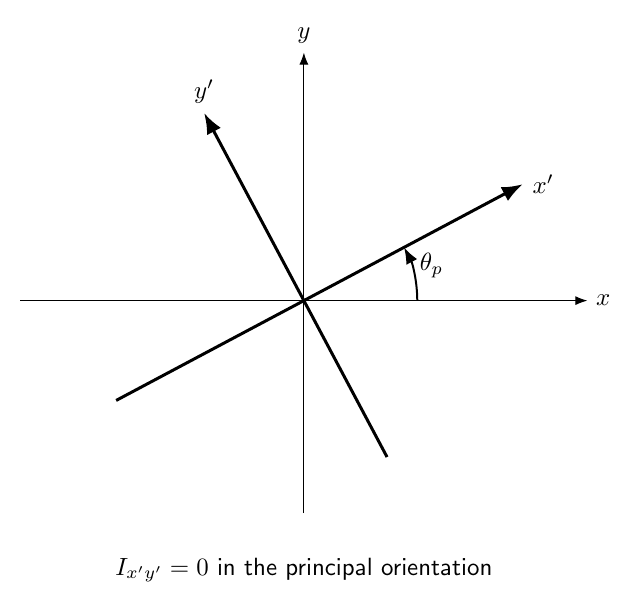
Figure 3. In a planar problem, rotating the coordinate axes to the principal orientation eliminates
the off-diagonal inertia component. The principal directions are orthogonal.
10 Example 1: a two-dimensional inertia tensor
Consider
The characteristic equation is
| 0 | = det ![[5 − I − 2 ]
p
− 2 8 − Ip](https://images.physicslibrary.org/cache/objects/1482/make4ht/PrincipalAxesAndPrincipalMomentsOfInertia39x.png) | (43)
|
| = (5 − Ip)(8 − Ip) − 4 | (44)
|
| = Ip2 − 13I
p + 36. | (45) |
Thus
The principal moments are
11 Example 1 continued: principal directions
For
solve
Thus
A normalized eigenvector is
For
a normalized eigenvector is
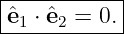
Their dot product is zero:
12 Verification by diagonalization
Construct
Then
This verifies both principal moments and principal directions.
13 Rotational kinetic energy in principal coordinates
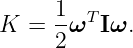
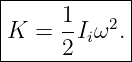
In any coordinates,
In principal coordinates,
There are no cross terms.
This is one major practical advantage of the principal-axis basis.
14 Angular momentum in principal coordinates
Similarly,
Thus
The principal components of angular momentum are obtained by simple scalar multiplication.
15 When are angular momentum and angular velocity parallel?
Suppose
lies exactly along principal axis 1.
Then
Therefore
More generally, L is parallel to ω precisely when ω is an eigenvector of I, apart from degeneracies
where any direction within an equal-eigenvalue eigenspace is also principal.
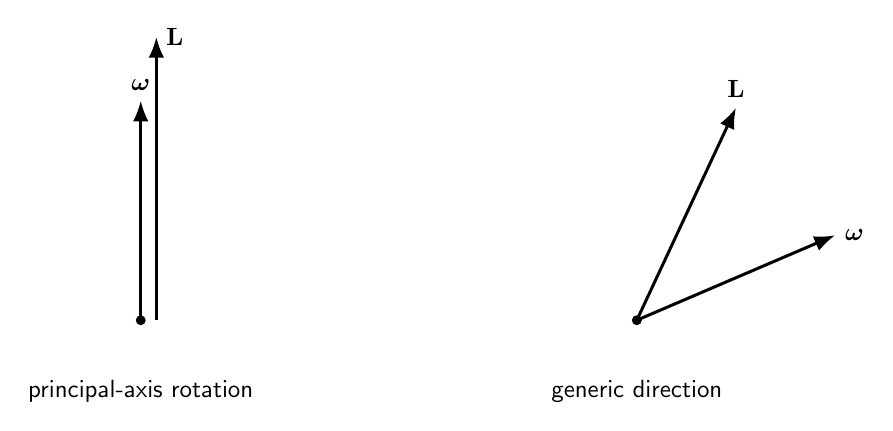
Figure 7. Rotation exactly about a principal axis makes angular momentum parallel to angular
velocity. For a generic nonprincipal direction, the two vectors are generally not parallel.
16 Principal moments as extrema of axis moment
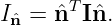
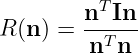
M05-09 showed that the scalar moment about a unit axis is
The unit vector must satisfy
Ask: for which directions is
stationary?
Use a Lagrange multiplier λ:
Differentiate with respect to the vector components:
Therefore
The stationary axis moments occur exactly along eigenvector directions.
Multiplying on the left by
gives
Thus
Principal moments are the stationary values of the scalar moment of inertia over all axis directions
through the chosen origin.
17 Minimum, intermediate, and maximum principal moments
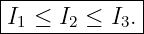
Order the principal moments as
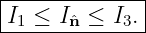
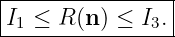
Then for any unit direction,
The minimum scalar moment occurs along the minimum-principal-moment axis.
The maximum scalar moment occurs along the maximum-principal-moment axis.
The intermediate principal direction is also a stationary direction, but it is not the global minimum
or maximum.
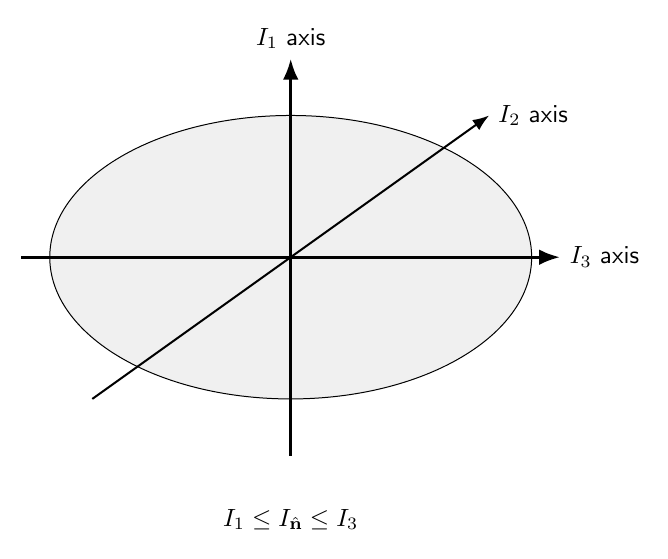
Figure 4. The principal moments are stationary values of the scalar moment of inertia over all axis
directions through the chosen origin. They include the minimum and maximum axis moments.
18 Rayleigh quotient interpretation
The quantity
is the Rayleigh quotient of the inertia tensor.
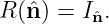
For a unit vector,
For a symmetric tensor,
This linear-algebra result has a direct physical interpretation: no axis through the chosen origin
can have a scalar moment smaller than the minimum principal moment or larger than the
maximum principal moment.
19 Symmetry can reveal principal axes without solving a determinant
Geometry often identifies principal axes immediately.
If a body is symmetric about a plane through the tensor origin, then the Normal to that plane is a
principal direction.
For example, symmetry under
makes
Then
Therefore
is a principal axis.
With three mutually orthogonal symmetry planes through the origin, all three coordinate axes are
principal.
20 Axis of rotational symmetry
Suppose a body is invariant under rotations about the z axis.
Then no direction in the xy plane can be physically distinguished.
Therefore
The symmetry axis
is principal, and every orthonormal pair in the transverse plane can serve as the other two
principal axes.
Such a body has two equal principal moments.
21 Degenerate principal moments
If
the corresponding eigenspace is two-dimensional.
Every unit vector in that eigenspace is an eigenvector with the same eigenvalue.
Thus the individual principal axes within that subspace are not unique.
Only the subspace itself is physically distinguished.
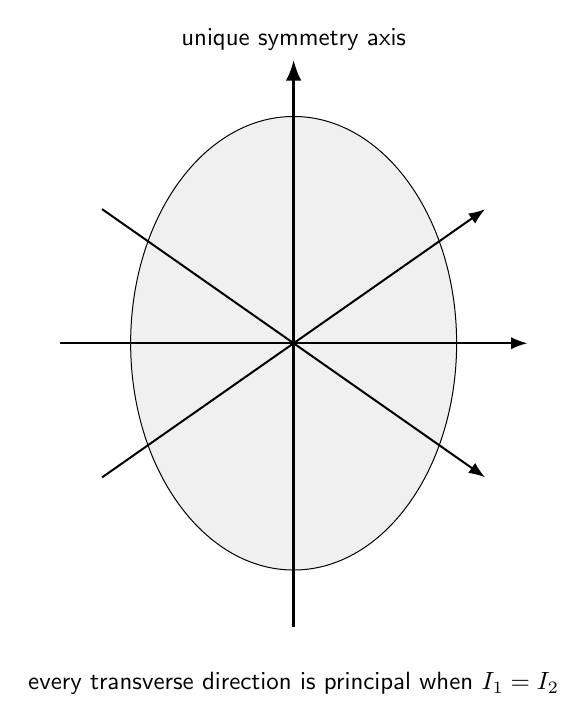
Figure 5. When two principal moments are equal, every direction in the corresponding eigenspace
is principal. An axisymmetric body therefore has a unique symmetry axis but no unique pair of
transverse principal axes.
22 Spherical inertia tensor
If
then
Every direction is a principal axis.
For every angular velocity,
so
for all directions.
A homogeneous sphere about its center is the standard example.
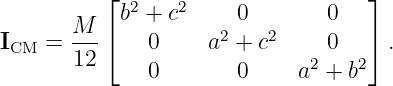
23 Example 2: uniform rectangular box
A uniform rectangular box centered at its center of mass has side lengths:
- a along x,
- b along y,
- c along z.
M05-09 found
The tensor is already diagonal.
Therefore the box edges are principal directions and the principal moments are
I1 =  (b2 + c2), (b2 + c2), | | (90)
|
I2 =  (a2 + c2), (a2 + c2), | | (91)
|
I3 =  (a2 + b2). (a2 + b2). | | (92) |
If two side lengths are equal, two principal moments become degenerate.
24 Example 3: thin disk
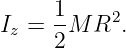
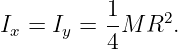
For a uniform thin disk of radius R centered at the origin,
Any diameter has
Thus
The normal to the disk is a unique principal direction.
Any two perpendicular diameters can serve as the other principal axes.
25 Example 4: slender rod
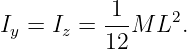
For an ideal slender rod of length L along the x axis,
in the zero-thickness approximation, while
Therefore
The rod direction is the minimum-moment principal axis.
Every direction perpendicular to the rod is a principal direction with the same moment.
26 Inertia ellipsoid
The principal moments can be visualized geometrically.
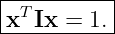
One common inertia-ellipsoid convention is
In principal coordinates,
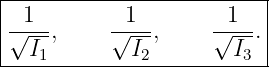
This is an ellipsoid with semiaxes
Its geometric axes are the principal axes of inertia.
The exact scale convention varies among texts, but the orientation information is the
same.
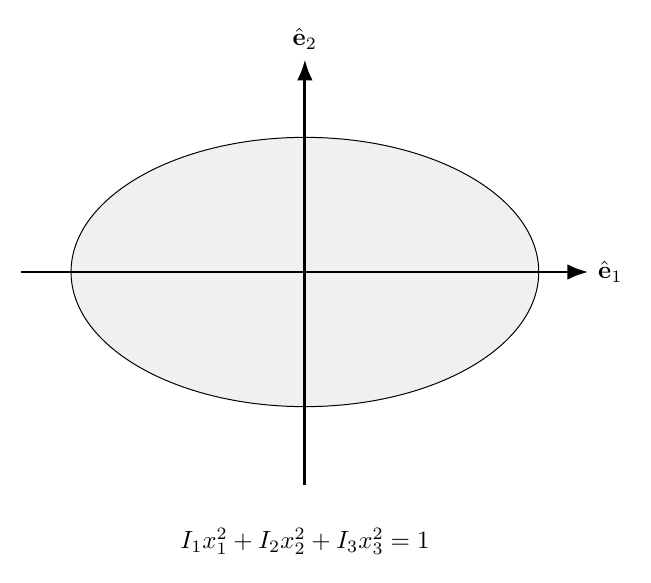
Figure 6. In principal coordinates, the quadratic form of the inertia tensor defines an ellipsoid
whose geometric axes align with the principal axes of inertia.
27 Why the inertia ellipsoid is useful
The inertia ellipsoid provides a geometric picture of anisotropy.
If
the ellipsoid is a sphere.
If two moments are equal, it is a spheroid.
If all three differ, it is triaxial.
Thus:
- spherical inertia corresponds to complete rotational isotropy,
- two equal principal moments correspond to axial symmetry,
- three distinct moments correspond to a triaxial mass distribution.
28 Tensor invariants and principal moments
Coordinate rotation changes the matrix entries but not the eigenvalues.
Therefore several quantities are invariant:
The sum of pairwise products is also invariant:
These invariants provide strong checks on diagonalization calculations.
29 Example 5: invariant checks
For
the principal moments were
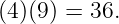
The trace is
and
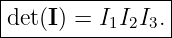
The determinant is
and
Both invariants agree.
30 Rotation about a principal axis
Suppose a rigid body has
Then
The rotational kinetic energy is
Thus rotation about a principal axis behaves instantaneously like the familiar scalar-inertia
case.
This is why the scalar formula is so successful in fixed-axis problems when the rotation axis is a
principal direction.
31 Rotation not aligned with a principal axis
Let
Then
If
the relative weighting of the two components changes.
Therefore
in general.
This mismatch drives much of the interesting behavior of torque-free three-dimensional
rotation.
32 Principal axes and rotor balance
For a rotor intended to spin steadily about a shaft, two geometric conditions are especially
important:
- the shaft should pass through the center of mass,
- the shaft should align with a principal axis.
The first condition removes static mass eccentricity.
The second removes cross-coupling between the shaft direction and transverse angular-momentum
components.
These ideas underlie static and dynamic balancing of rotating machinery.
33 Finding principal axes numerically
For a complicated body, the inertia tensor may be assembled numerically from:
- a finite-element model,
- a CAD mass-property calculation,
- discrete measured masses,
- a numerical volume integral.
Once I is known, compute:
- eigenvalues for principal moments,
- normalized eigenvectors for principal directions.
Because I is symmetric, numerical eigensolvers specialized for real symmetric matrices should be
preferred.
They preserve orthogonality more reliably and are more efficient than a general nonsymmetric
eigenvalue solver.
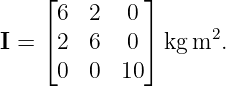
34 Example 6: numerical three-dimensional tensor
Consider
The z direction is already uncoupled, so
The in-plane block is
Its eigenvalues are
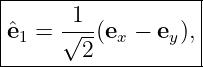
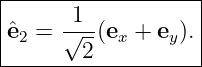
Normalized eigenvectors are
and
Thus the principal moments are
35 A principal-axis workflow
For practical calculations:
- choose the tensor origin, usually the center of mass,
- write or compute the inertia tensor,
- use symmetry to identify any obvious principal axes,
- solve the remaining characteristic equation,
- normalize the eigenvectors,
- check orthogonality,
- check trace and determinant invariants,
- assemble the orthogonal principal-axis matrix,
- verify diagonalization.
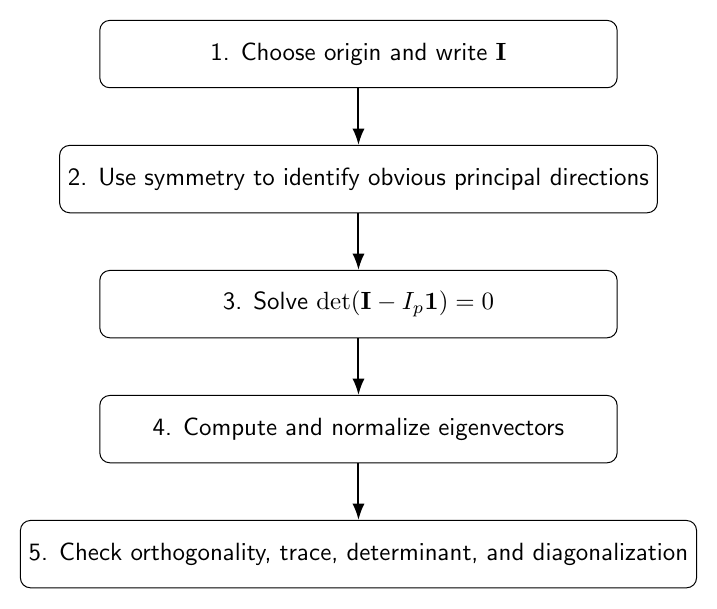
Figure 8. Principal-axis calculations are an eigenvalue problem with strong physical checks:
symmetry, orthogonality, tensor invariants, and final diagonalization.
36 Bridge to Euler’s equations
In a principal-axis body frame,
This greatly simplifies rotational dynamics.
However, the principal axes rotate with the rigid body.
Differentiating angular momentum in a rotating body frame therefore requires the rotating-frame
derivative rule.
Combining that derivative with
leads to Euler’s rigid body equations:
| τ1 | = I1ω1 + (I3 − I2)ω2ω3, | (128)
|
| τ2 | = I2ω2 + (I1 − I3)ω3ω1, | (129)
|
| τ3 | = I3ω3 + (I2 − I1)ω1ω2. | (130) |
These equations are derived carefully in M05-11.
37 Common mistakes
- Confusing a principal axis with any convenient coordinate axis.
- Assuming a diagonal tensor is the same as an isotropic tensor.
- Forgetting that principal axes depend on the chosen tensor origin.
- Solving for eigenvalues but not computing or normalizing eigenvectors.
- Assuming eigenvectors for repeated eigenvalues are unique.
- Forgetting that distinct eigenvalues of a symmetric tensor have orthogonal eigenvectors.
- Using the two-dimensional principal-angle formula without checking the rotation
convention.
- Forgetting that the principal moments are stationary axis moments.
- Assuming every stationary principal moment is either the global minimum or
maximum; the intermediate moment is also stationary.
- Forgetting to use a unit vector in In = nT In.
- Assuming L ∥ ω for arbitrary rotation in a principal basis.
- Forgetting that L ∥ ω when ω itself lies along a principal direction.
- Confusing symmetry axes with center of mass offsets.
- Ignoring trace or determinant checks after diagonalization.
- Treating body-frame principal axes as fixed in inertial space during dynamics.
38 Practice exercises
- Starting from Ie = Ipe, derive the characteristic equation for principal moments.
- Prove that eigenvectors belonging to distinct principal moments are orthogonal.
- Show that QT IQ is diagonal when the columns of Q are orthonormal principal-axis
eigenvectors.
- Derive the two-dimensional principal moments for a symmetric 2 × 2 inertia matrix.
- Derive the equation for the two-dimensional principal-axis angle by requiring the
transformed product of inertia to vanish.
- For I =
![[ ]
5 − 2
− 2 8](https://images.physicslibrary.org/cache/objects/1482/make4ht/PrincipalAxesAndPrincipalMomentsOfInertia122x.png) kg m2, reproduce the eigenvalues and normalized eigenvectors in
this article.
kg m2, reproduce the eigenvalues and normalized eigenvectors in
this article.
- Verify the trace and determinant invariants for the same tensor.
- Use a Lagrange multiplier to prove that principal axes give stationary scalar moments
of inertia.
- Prove that I1 ≤ In ≤ I3 for any unit vector.
- Explain why a plane of reflection symmetry produces a principal axis normal to the
plane.
- Find the principal moments of a thin disk, a homogeneous sphere, and an ideal slender
rod.
- For I =
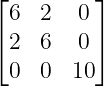 kg m2, determine all principal axes and moments.
- Show that a spherical inertia tensor makes every direction principal.
- Explain physically why aligning a rotor shaft with a principal axis is desirable.
- Starting from diagonal principal coordinates, explain why Euler’s equations still contain
nonlinear coupling terms even though the inertia tensor is diagonal.
39 Summary
Principal axes are eigenvector directions of the inertia tensor:
The eigenvalues
are the principal moments.
For a real symmetric inertia tensor, principal axes can be chosen orthonormal.
With
In principal coordinates,
and
Principal axes are also stationary directions of
Rotation exactly about a principal axis gives
These results prepare the principal-axis body frame used in M05-11 to derive Euler’s equations for
three-dimensional rigid body rotation.
References
References
[1] J. R. Taylor, Classical Mechanics, University Science Books, 2005.
[2] H. Goldstein, C. Poole, and J. Safko, Classical Mechanics, 3rd ed., Addison-Wesley,
2002.
[3] L. D. Landau and E. M. Lifshitz, Mechanics, 3rd ed., Butterworth-Heinemann, 1976.
[4] K. R. Symon, Mechanics, 3rd ed., Addison-Wesley, 1971.





















![[ ]
Ixx Ixy
I2D = Ixy Iyy .](https://images.physicslibrary.org/cache/objects/1482/make4ht/PrincipalAxesAndPrincipalMomentsOfInertia30x.png)
![[ ]
Ixx − Ip Ixy
det Ixy Iyy − Ip = 0.](https://images.physicslibrary.org/cache/objects/1482/make4ht/PrincipalAxesAndPrincipalMomentsOfInertia31x.png)




![[ 5 − 2]
I = kg m2.
− 2 8](https://images.physicslibrary.org/cache/objects/1482/make4ht/PrincipalAxesAndPrincipalMomentsOfInertia38x.png)



![[ 1 − 2][ex ]
= 0.
− 2 4 ey](https://images.physicslibrary.org/cache/objects/1482/make4ht/PrincipalAxesAndPrincipalMomentsOfInertia43x.png)

![|---------[-]--|
|ˆe1 = √1-- 2 .|
| 5 1 |
---------------](https://images.physicslibrary.org/cache/objects/1482/make4ht/PrincipalAxesAndPrincipalMomentsOfInertia45x.png)

![|---------[---]--|
| -1-- − 1 |
|ˆe2 = √5-- 2 .|
-----------------](https://images.physicslibrary.org/cache/objects/1482/make4ht/PrincipalAxesAndPrincipalMomentsOfInertia47x.png)

![[ ]
-1-- 2 − 1
Q = √ -- 1 2 .
5](https://images.physicslibrary.org/cache/objects/1482/make4ht/PrincipalAxesAndPrincipalMomentsOfInertia49x.png)
![|--------[-----]--|
QT IQ = 4 0 . |
| 0 9 |
------------------](https://images.physicslibrary.org/cache/objects/1482/make4ht/PrincipalAxesAndPrincipalMomentsOfInertia50x.png)




























![[ ]
I = 5 − 2 ,
− 2 8](https://images.physicslibrary.org/cache/objects/1482/make4ht/PrincipalAxesAndPrincipalMomentsOfInertia100x.png)











![[ ]
6 2 .
2 6](https://images.physicslibrary.org/cache/objects/1482/make4ht/PrincipalAxesAndPrincipalMomentsOfInertia115x.png)




![Q = [ˆe ˆe ˆe ],
1 2 3](https://images.physicslibrary.org/cache/objects/1482/make4ht/PrincipalAxesAndPrincipalMomentsOfInertia126x.png)