Gravitational Potential Energy and Gravitational Potential
Newtonian gravity is a conservative interaction.
That means gravitational work can be represented by a potential-energy function.
For two point masses
and
separated by distance
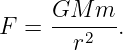
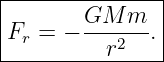
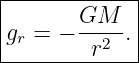
the gravitational force magnitude is
With the source mass
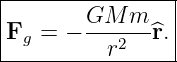
fixed at the origin, the vector force on
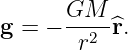
is
We will derive the potential energy from the work done by this force.
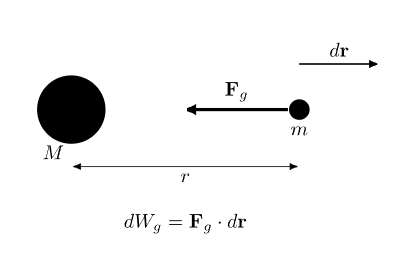
Figure 1. Moving a test mass radially through a point-mass gravitational field. The force points
inward while the radial displacement may point inward or outward.
1 Work done by gravity
For an infinitesimal displacement
the gravitational work is
For radial motion,
Therefore
| dWg | = − r ⋅ dr r | (11)
|
| = − dr. | (12) |
Integrating from
to
| Wg | = −GMm∫
r1r2
 | (15)
|
| = GMm r1r2
. | (16) |
Thus
2 Potential-energy difference
For any conservative force,
Therefore
Rearranging,
Only differences in potential energy are physically required by mechanics.
The absolute zero may be chosen conveniently.
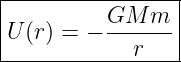
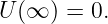
3 Choosing the zero at infinity
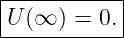
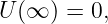
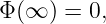
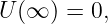
For an isolated gravitational system, the standard convention is
Let
and
Then
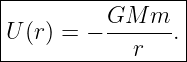
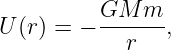
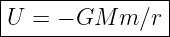
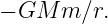
Hence
The negative sign is essential.
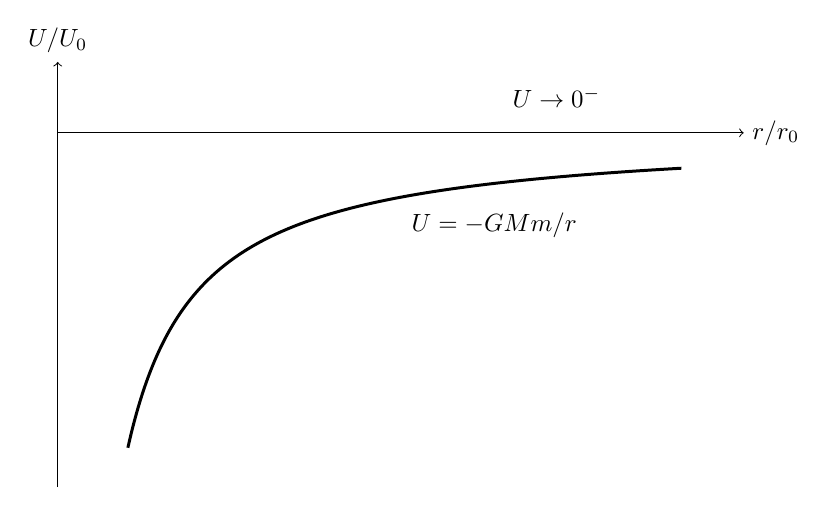
Figure 2. With the zero chosen at infinity, point-mass gravitational potential energy is negative
and approaches zero from below as separation increases.
4 Why gravitational potential energy is negative
With
a finite separation has
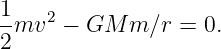
This means energy must be supplied to separate the masses completely to infinity with zero final
speed.
Conversely, allowing masses to fall together releases gravitational potential energy into kinetic
energy or other forms.
Negative potential energy is therefore a statement about the chosen zero and the bound nature of
the attractive interaction.
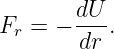
5 Force from potential energy
For a one-dimensional conservative force,
Using
 | =  . | (30) |
Therefore
The negative sign recovers the inward gravitational force.
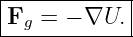
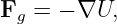
In vector form,
6 Gravitational potential
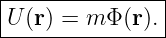
Potential energy depends on the test mass.
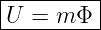
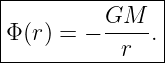
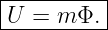
It is useful to divide by that mass and define the gravitational potential:
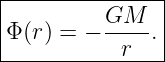
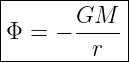
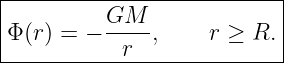
For a point source mass,
The SI units are
Since
potential can also be written in units of
7 Potential versus potential energy
The distinction is parallel to field versus force.
Gravitational potential:
depends only on the source and location.
Potential energy:
also depends on the test mass.
Doubling the test mass doubles
but leaves
unchanged.
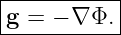
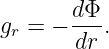
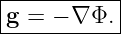
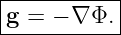
8 Field from potential
Since
and
while
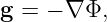
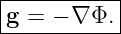
we obtain
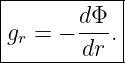
For spherical symmetry,
Using
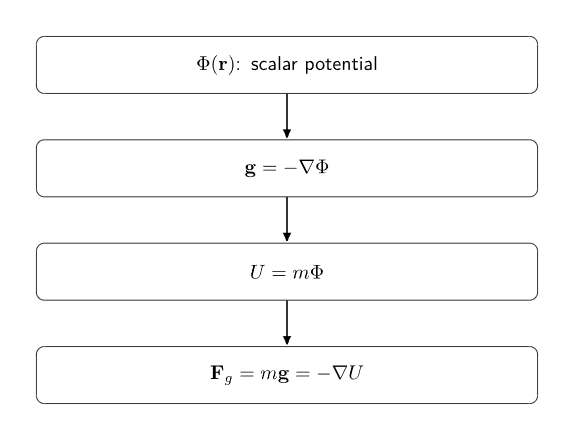
Figure 3. The Gravitational Field points in the direction of decreasing potential. For a point
mass, the negative radial slope of Φ = −GM∕r gives the inward inverse-square field.
9 Potential difference and gravitational work
Between two points,
For a test mass
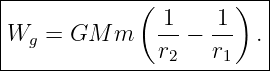
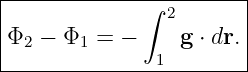
The gravitational work is
10 Path independence
Because Newtonian gravity is conservative, the work between two fixed endpoints does not depend
on the path.
For a point mass source,
Tangential displacement contributes no work because it is perpendicular to the radial
field.
Only the change in radius matters.
Therefore all paths connecting the same
and
produce the same gravitational work.
11 Equipotential surfaces
An equipotential surface has constant
For a point mass,
Thus constant potential means constant
The equipotential surfaces are spheres centered on the mass.
Because
the gravitational field is perpendicular to equipotential surfaces.
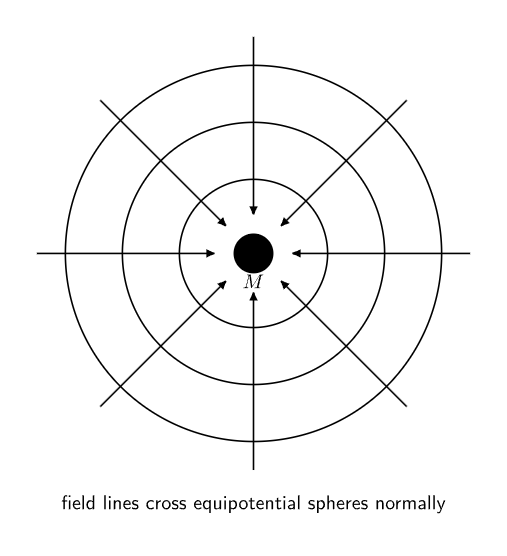
Figure 4. Point-mass equipotential surfaces are concentric spheres. The gravitational field is
perpendicular to each equipotential surface and points toward decreasing potential.
12 Superposition of gravitational potential
Potential is a scalar.
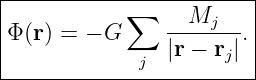
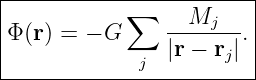
For several point masses,
The corresponding field is
Scalar superposition is often easier than directly summing vector fields.
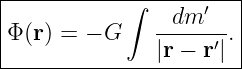
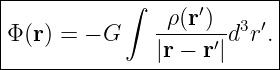
For a continuous mass distribution,
With volume density,
13 Potential of a thin spherical shell
Consider a thin spherical shell of radius
and total mass
Outside the shell, the shell theorem gives the same field as a point mass.
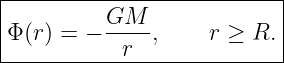
With
the exterior potential is
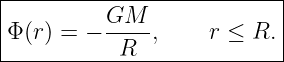
Inside the shell,
Therefore
so the potential is constant throughout the interior.
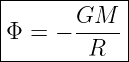
Continuity at the shell gives
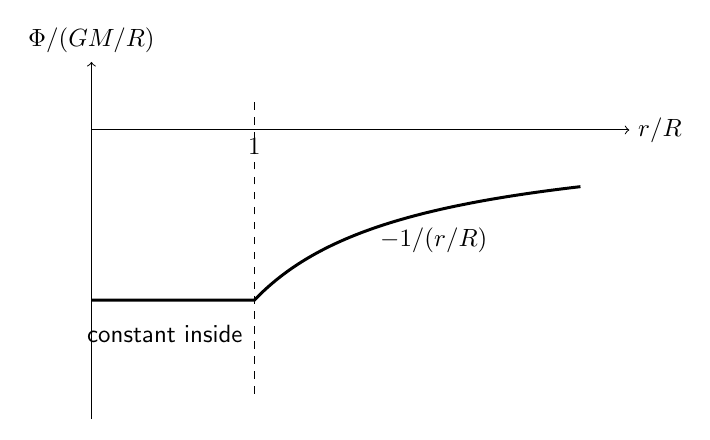
Figure 5. A thin spherical shell has constant gravitational potential throughout its interior even
though the gravitational field there is zero. Outside, the potential follows −GM∕r.
14 Zero field does not mean zero potential
Inside a spherical shell,
But
is generally not zero.
A zero field means the potential has zero spatial gradient.
It does not require the potential itself to vanish.
This distinction is important throughout field theory.
15 Potential of a spherically symmetric body
For a spherically symmetric density
consider a field point at radius
Interior shells with
act like central point masses for the field, while exterior shells produce zero field but still
contribute constant potential.
The total potential can be written
For a finite body of radius
the second integral ends at
16 Uniform solid sphere
For a uniform sphere of:
- radius R,
- total mass M,
- constant density ρ,
the exterior potential is
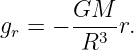
Inside, the gravitational field is
Use
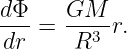
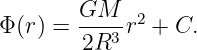
Thus
Integrate:
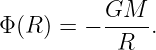
Continuity at
requires
Therefore
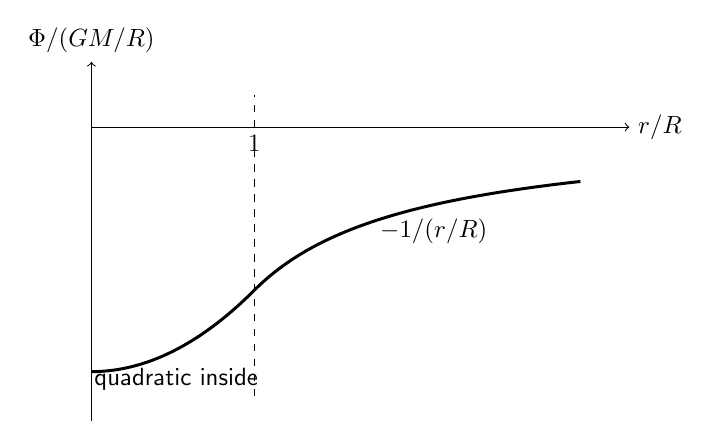
Figure 6. The potential of a uniform solid sphere is quadratic inside and joins continuously to the
exterior −GM∕r curve at the surface.
17 Potential at the center of a uniform sphere
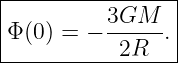
Set
Then
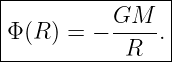
At the surface,
The center therefore lies deeper in the gravitational potential well.
18 Potential energy inside a uniform sphere
A test mass
has potential energy
Thus
The corresponding radial force is
| Fr | = − | (93)
|
| = − r. | (94) |
This agrees with the uniform-sphere interior field derived in M07-03.
19 Near-surface approximation
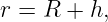
Near the surface of a spherical body, let
where
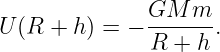
The exact point-mass potential energy outside is
The change from the surface is
| ΔU | = U(R + h) − U(R) | (98)
|
| = GMm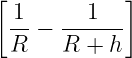 . | (99) |
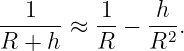
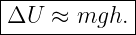
For
Therefore
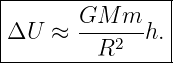
Since
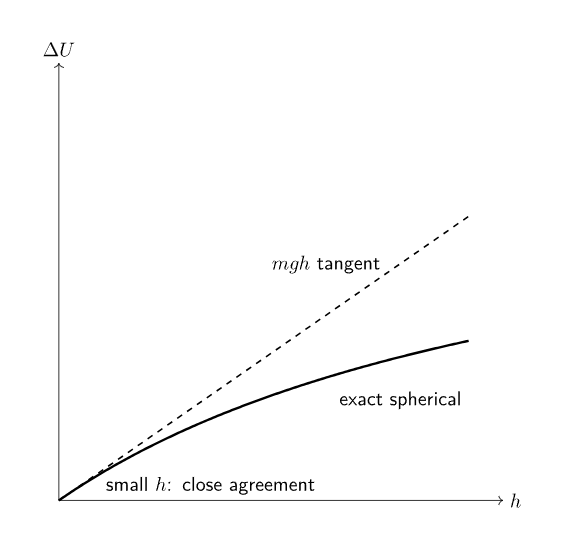
Figure 7. Near the surface, the exact gravitational potential curve is nearly linear over small
height changes. The familiar mgh expression is the local first-order approximation.
20 Why mgh is not the universal gravitational potential energy
The expression
assumes:
- a nearly constant gravitational field,
- a relatively small vertical displacement,
- a chosen reference height.
The inverse-square result
is the appropriate point-mass or exterior-spherical-body expression over large changes in
radius.
Thus
is a local approximation, not a replacement for
21 Example 1: potential at Earth’s surface
Using
and
| Φ(RE) | = − | (111)
|
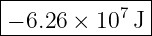
| ≈−6.26 × 10⁷ J∕kg. | (112) |
A
mass therefore has potential energy approximately
relative to the zero at infinity.
22 Example 2: exact versus mgh
Raise a
mass by
near Earth’s surface.
The exact spherical change is
Numerically,
Using
The agreement is excellent because
is very small.
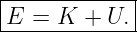
23 Mechanical energy in a gravitational field
For a test mass moving in a fixed gravitational potential,
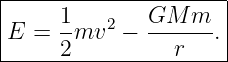
For point-mass gravity,
If no nongravitational work is done,
This form is central to orbital mechanics.
24 Escape speed
Escape means reaching
with nonnegative final speed.
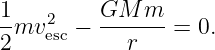
The minimum escape condition has
At infinity,
so the minimum final mechanical energy is zero.
At launch radius
set
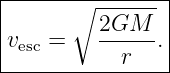
Cancel
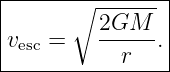
and solve:
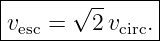
In terms of circular speed,
so
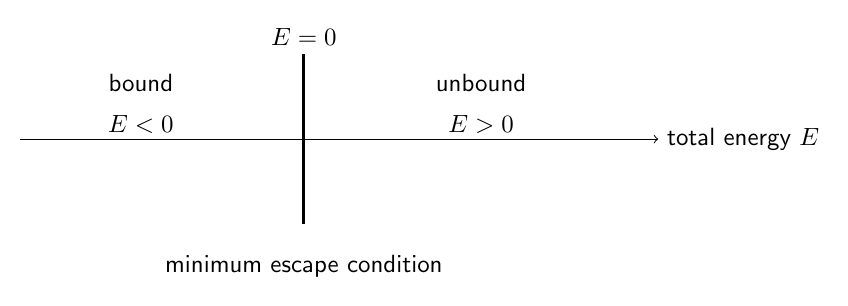
Figure 8. Escape corresponds to total mechanical energy reaching the threshold E = 0. Bound
motion has negative total energy, while positive total energy is unbound.
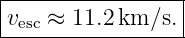
25 Example 3: escape speed from spherical Earth
Using
and
| vesc | =  | (137)
|
| ≈ 1.12 × 10⁴ m∕s. | (138) |
Thus
This ideal value neglects atmosphere, Earth’s rotation, oblateness, and other bodies.
26 Escape speed is independent of test mass
The test mass cancels from
Therefore the ideal Newtonian escape speed depends on:
- source mass,
- launch radius,
but not on the escaping object’s mass.
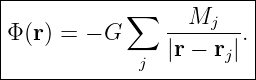
27 Potential of several masses
For point masses
The potential energy of a test mass is
Then
This scalar-first approach can simplify complicated many-source problems.
28 Potential energy of a system of point masses
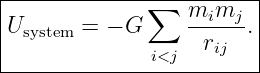
For an isolated system of point masses, the gravitational potential energy is the sum over distinct
pairs:
The restriction
counts each pair once.
If one instead sums over all
a factor of
is required to avoid double counting.
29 Example 4: three point masses
For three masses,
the system potential energy is
There are three distinct interacting pairs.
30 Common mistakes
- Forgetting the negative sign in U = −GMm∕r.
- Confusing gravitational potential Φ with potential energy U.
- Assuming potential must be zero where the field is zero.
- Forgetting that the zero of potential energy is a convention.
- Using mgh over distances where g changes substantially.
- Treating mgh as the exact inverse-square potential energy.
- Forgetting that g = −∇Φ.
- Using g = +∇Φ.
- Assuming equipotential surfaces are field lines.
- Forgetting that field lines are perpendicular to equipotential surfaces.
- Adding gravitational potentials as vectors instead of scalars.
- Forgetting that a spherical shell has constant, nonzero interior potential.
- Assuming the uniform-sphere interior potential is −GM∕r.
- Forgetting to count each interacting pair only once in system potential energy.
- Using escape speed without recognizing the E = 0 threshold.
31 Practice exercises
- Starting from the inverse-square force, derive the gravitational work between radii r1
and r2.
- Derive U = −GMm∕r using U(∞) = 0.
- Show that Fr = −dU∕dr reproduces the gravitational force.
- Define gravitational potential and derive Φ = −GM∕r.
- Show that g = −∇Φ.
- Derive the potential difference between two radii.
- Show that point-mass equipotential surfaces are spheres.
- Derive the scalar superposition formula for several point masses.
- Derive the potential of a thin spherical shell inside and outside the shell.
- Derive the interior potential of a uniform solid sphere.
- Show that the uniform-sphere potential and its first radial derivative are continuous at
the surface.
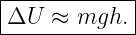
- Derive the near-surface approximation ΔU ≈ mgh.
- Compare exact spherical ΔU with mgh for a chosen small altitude.
- Derive the escape-speed formula from Conservation of Mechanical Energy.
- Write the total gravitational potential energy of four point masses without double
counting any pair.
32 Summary
For two point masses,
when
The gravitational potential is
Potential energy and potential are related by
The field follows from the potential:
For several point masses,
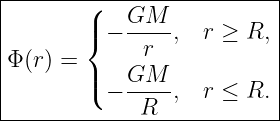
A thin spherical shell has
A uniform solid sphere has
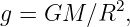
Near a spherical body’s surface,
The ideal escape speed from radius
is
Potential energy turns Newtonian gravitation into an energy problem and prepares the way for
orbital-energy analysis.
References
References
[1] PhysicsLibrary, M07-03, Newton’s Shell Theorem and Spherical Mass Distributions.
[2] PhysicsLibrary, M07-01, Newton’s Law of Universal Gravitation.
[3] PhysicsLibrary, M03-05, Conservative Forces and Potential Energy.
[4] J. R. Taylor, Classical Mechanics, University Science Books, 2005.
[5] D. Kleppner and R. Kolenkow, An Introduction to Mechanics, 2nd ed., Cambridge
University Press, 2014.