|
|
|
|||||||
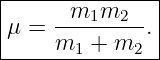
The reduced mass is
For an isolated two-body system,
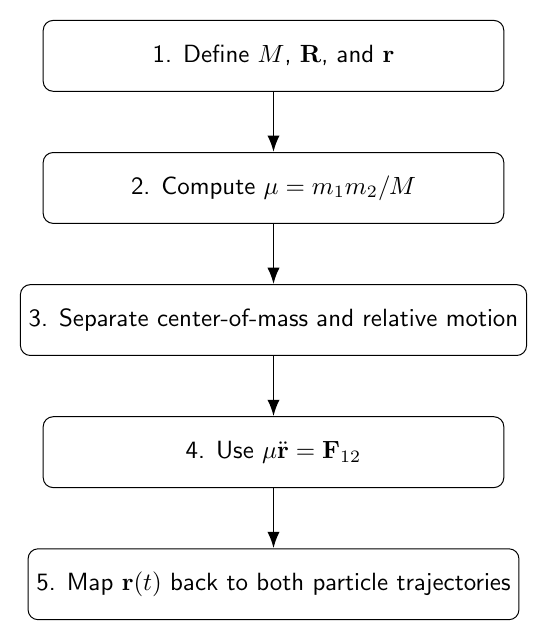
Figure 1. A compact strategy for two-body problems. Separate center-of-mass translation from relative motion, then use the reduced mass in the internal dynamics.
1 High-value GRE facts
Part I: Original GRE-style problems
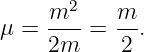
Problem 1: reduced mass of equal particlesTwo particles each have mass m. Their reduced mass is
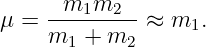
Problem 2: heavy-mass limitIf m2 ≫ m1, then the reduced mass approaches
Problem 3: relative velocityIf r = r1 − r2, then
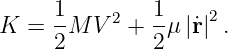
Problem 4: relative kinetic energyThe relative kinetic energy of a two-particle system is
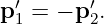
Problem 5: center-of-mass frame momentumIn the center-of-mass frame,
Problem 6: relative equationFor an isolated pair with interaction force F12 on particle 1,
Problem 7: barycentric distanceFor two masses separated by distance r, the distance of m1 from the center of mass is
Problem 8: relative angular momentumFor a central two-body interaction, the relative angular momentum is
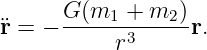
Problem 9: gravitational relative accelerationFor exact Newtonian two-body gravity, the relative acceleration is
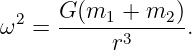
Problem 10: circular relative angular frequencyFor a circular gravitational two-body orbit of separation r,
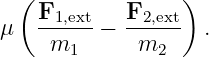
Problem 11: uniform external gravityTwo nearby masses experience exactly the same uniform gravitational acceleration. In the relative equation, this external field
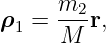
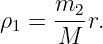
Problem 12: shape of barycentric orbitsIf the relative orbit r(t) is known, the two center-of-mass-frame trajectories are
Part II: Complete worked solutions
Solution 1
Answer: (B).
Solution 2For m2 ≫ m1,
Answer: (B).
Solution 3Differentiate
Thus
Answer: (B).
Solution 4The exact kinetic-energy decomposition is
Answer: (B).
Solution 5The center-of-mass frame has zero total momentum:
Therefore
Answer: (B).
Solution 6The reduced relative equation is
Answer: (B).
Solution 7From
the magnitude is
Answer: (B).
Solution 8For two-body relative motion,
Answer: (B).
Solution 9The exact relative gravitational equation is
Answer: (C).
Solution 10Circular relative motion requires
Answer: (A).
Solution 11The external term in the relative equation is proportional to the difference in external accelerations:
If those accelerations are equal, the term vanishes. Answer: (B).
Solution 12The barycentric coordinates are
Thus both are scaled copies of the relative trajectory on opposite sides of the center of mass. Answer: (B).
2 GRE checklist
References
References
"GRE Physics Companion: Two-Body Reduction and Relative Motion" is owned by bloftin.
This object's parent. Cross-references: formulas, magnitude, internal force, field, central force, center of mass, force, momentum, acceleration, angular momentum, particle, relative kinetic energy, total momentum, relative motion, system, mass This is version 1 of GRE Physics Companion: Two-Body Reduction and Relative Motion, born on 2026-10-04. Object id is 1405, canonical name is GREPhysicsCompanionTwoBodyReductionAndRelativeMotion. Accessed 8 times total. Classification:
|
|
|
|
Pending Errata and AddendaNone.
|
DiscussionNo messages.
|
Interact |
![[parent]](https://images.physicslibrary.org/images/uparrow.png)