Physics Library
 An open source physics library
Encyclopedia | Forums | Docs | Random  

[parent] example of Kinetic Energy and the Work-Energy Theorem

(Example)

GRE Physics Companion: Kinetic Energy and the Work-Energy Theorem

This companion develops fast problem-solving habits for the material in M03-02. The central GRE idea is that work-energy problems often let you bypass time and acceleration completely.

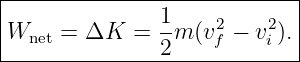
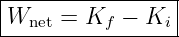
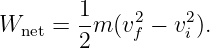
The core relation is

|----------------------------|
|               1-   2    2  |
|Wnet = ΔK   =  2m (vf − vi).|
-----------------------------
(1)

PIC

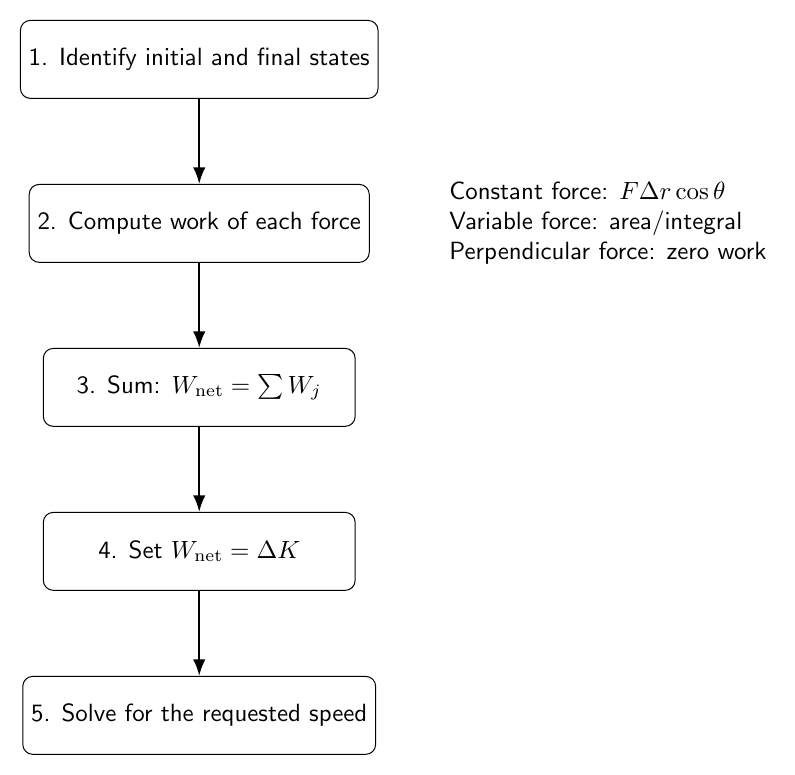
Figure 1. A compact decision path for work-energy problems. Identify the initial and final states, compute the work of each force, sum to obtain net work, and convert the result into a change in kinetic energy.

1 Core formulas to know

------------
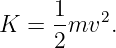
|     1     |
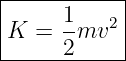
K  =  -mv2  |
------2-----|
(2)

|-------∑------|
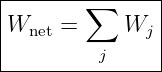
|Wnet =     Wj |
|        j     |
----------------
(3)

|----------------|
-Wnet-=-Kf--−-Ki--
(4)

|----------------|
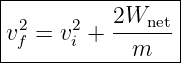
|v2=  v2+  2Wnet-|
--f----i-----m----
(5)

For a constant force over displacement Δr,

|-------------------------|
W--=--F-⋅ Δr-=-F-Δr-cos𝜃.--
(6)

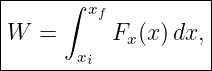
For a one-dimensional variable force,

|-------------------|
|     ∫ xf          |
W  =      Fx (x )dx, |
-------xi------------
(7)

so work is the signed area under an Fx versus x graph.

2 High-value GRE observations

  1. K depends on v2. If speed doubles, kinetic energy quadruples.
  2. Wnet > 0 means the final speed is greater than the initial speed.
  3. Wnet = 0 means the initial and final speeds are equal. It does not mean the force was zero.
  4. A force perpendicular to the instantaneous displacement does no instantaneous work. This is why the centripetal force in uniform circular motion does not change speed.
  5. The theorem requires net work. Individual forces can do positive, negative, or zero work.
  6. The square root in a final-speed calculation gives speed only. It does not determine the sign of a one-dimensional velocity.
  7. Kinetic energy is frame dependent. Always use work and kinetic energy measured in the same inertial frame.
  8. If an Fx versus x graph crosses the axis, areas below the axis count as negative work.

Part I: Original GRE-style problems

Problem 1: speed scaling

A particle of fixed mass has kinetic energy K at speed v. Its speed is increased to 3v. Its new kinetic energy is

  1. 3K
  2. 6K
  3. 9K
  4. 27K
  5. K∕9

Problem 2: net work from a speed change

A 2.0 kg cart speeds up from 3.0 m∕s to 7.0 m∕s. What net work is done on the cart?

  1. 20 J
  2. 32 J
  3. 40 J
  4. 64 J
  5. 80 J

Problem 3: zero net work

Which statement must be true if the net work on a constant-mass particle over an interval is zero?

  1. The particle is at rest throughout the interval.
  2. The net force is zero throughout the interval.
  3. The acceleration is zero throughout the interval.
  4. The initial and final speeds are equal.
  5. The initial and final velocity vectors are equal.

Problem 4: force-displacement graph

A 1.0 kg particle starts from rest. From x = 0 to x = 4.0 m, the net force in the x direction increases linearly from 0 to 8.0 N. What is the particle’s speed at x = 4.0 m?

  1. 2.0 m∕s
  2. 4.0 m∕s
  3. 5.7 m∕s
  4. 8.0 m∕s
  5. 16 m∕s

Problem 5: incline with friction

A 2.0 kg block starts from rest and slides 5.0 m down a straight incline that is 30∘ above the horizontal. The kinetic-friction force has constant magnitude 4.0 N. Take g = 9.8 m∕s2. What is the block’s speed after the 5.0 m slide?

  1. 3.0 m∕s
  2. 5.4 m∕s
  3. 7.0 m∕s
  4. 8.5 m∕s
  5. 9.9 m∕s

Problem 6: circular motion

A satellite moves in a circular orbit at constant speed. During one quarter of an orbit, the net force on the satellite does

  1. positive work because the satellite moves in the force direction
  2. negative work because the force points inward
  3. zero work because the force is perpendicular to the instantaneous velocity
  4. zero work only if the quarter orbit begins on the positive x axis
  5. positive or negative work depending on the reference direction

Problem 7: equal kinetic energy

Particles A and B have masses m and 4m, respectively, and have equal kinetic energies. If A has speed v, the speed of B is

  1. v∕4
  2. v∕2
  3. v
  4. 2v
  5. 4v

Problem 8: stopping distance under a constant force

A 1000 kg CAR moves at 20 m∕s. A constant braking force of magnitude 5000 N acts opposite the motion. Neglect all other horizontal forces. What stopping distance is predicted?

  1. 10 m
  2. 20 m
  3. 40 m
  4. 80 m
  5. 100 m

Problem 9: return to the same height

A projectile is launched from a point and later returns to the same height. Air resistance is negligible. Between launch and return to that height, the work done by gravity is

  1. positive
  2. negative
  3. zero
  4. equal to the maximum kinetic energy
  5. impossible to determine without the launch angle

Problem 10: frame dependence

A particle has kinetic energy K in inertial frame S. Another inertial frame S′ moves at constant velocity relative to S. Which statement is generally correct?

  1. The particle has the same kinetic energy in both frames.
  2. The particle’s kinetic energy can differ between the frames.
  3. Kinetic energy changes only if the particle accelerates.
  4. Kinetic energy is invariant under Galilean transformations.
  5. The work-energy theorem can hold in only one of the two frames.

Part II: Complete worked solutions

Solution 1

Kinetic energy is proportional to the square of speed:

      2
K ∝  v .
(8)

Therefore

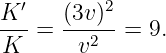
K ′   (3v)2
---=  ----- = 9.
K      v2
(9)

Hence

K ′ = 9K.
(10)

Answer: (C).

Solution 2

Use

        1    2    2
Wnet  = -m (vf − vi).
        2
(11)

Substitute:

Wnet = 1-
2(2.0)(   2     2)
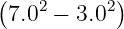
 7.0  − 3.0 (12)
= 1.0(49 − 9) (13)
= 40 J. (14)

Answer: (C).

Solution 3

The work-energy theorem gives

Wnet  = Kf −  Ki.
(15)

If Wnet = 0, then

Kf  = Ki.
(16)

For constant mass,

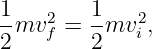
1-   2   1-   2
2 mv f = 2mv i,
(17)

so the speeds are equal:

vf = vi.
(18)

The velocity directions can differ, as in uniform circular motion.

Answer: (D).

Solution 4

The work is the area under the force-displacement graph. The graph is a triangle with base 4.0 m and height 8.0 N:

W    = 1-(4.0 )(8.0) = 16 J.
  net  2
(19)

The particle starts from rest, so

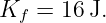
Kf  = 16 J.
(20)

For m = 1.0 kg,

1
--
2mvf2 = 16, (21)
vf2 = 32, (22)
vf = 5.66 m∕s. (23)

Answer: (C).

Solution 5

The component of Weight along the incline is

         ∘
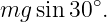
mg  sin 30 .
(24)

The work of gravity is

Wg = mgd sin 30∘ (25)
= (2.0)(9.8)(5.0)(0.5) (26)
= 49 J. (27)

The work of friction is

Wf  =  − (4.0)(5.0) = − 20 J.
(28)

The Normal force does zero work, so

Wnet = 49 − 20 = 29 J.
(29)

Starting from rest,

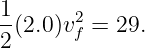
1-     2
2(2.0)vf = 29.
(30)

Thus

v  = √29--= 5.39 m ∕s.
 f
(31)

Answer: (B).

Solution 6

For uniform circular motion, the net force is radial while the instantaneous velocity is tangential:

Fnet ⊥ v.
(32)

Thus

Fnet ⋅ v = 0,
(33)

so the force does no work and the speed remains constant.

Answer: (C).

Solution 7

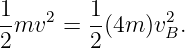
Equal kinetic energies give

1   2   1       2
-mv   = --(4m )vB.
2       2
(34)

Cancel common factors:

v2 = 4v2B.
(35)

Therefore

     v
vB = --.
     2
(36)

Answer: (B).

Solution 8

The initial kinetic energy is

     1           2           5
Ki = --(1000)(20) =  2.0 × 10 J.
     2
(37)

The final kinetic energy is zero. Therefore

Wnet = − 2.0 × 10⁵ J.
(38)

The braking work is

W  =  − F d.
(39)

Hence

− (5000)d = −2.0 × 10⁵, (40)
d = 40 m. (41)

Answer: (C).

Solution 9

Gravity is conservative, but potential energy is not needed to answer the question. The work done by gravity depends only on the vertical displacement:

Wg  = − mg Δy.
(42)

The projectile returns to the same height, so

Δy =  0.
(43)

Therefore

Wg =  0.
(44)

Answer: (C).

Solution 10

Under a Galilean transformation,

 ′
v =  v − U.
(45)

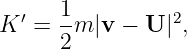
Therefore

  ′  1          2
K  = --m |v −  U |,
     2
(46)

which is generally not equal to

     1
K  = --mv2.
     2
(47)

The work-energy theorem remains valid when all quantities are evaluated consistently in the chosen inertial frame.

Answer: (B).

3 GRE checklist

Before committing to a long force calculation, ask:

  1. Is the question asking for speed rather than time?
  2. Can I calculate the work of each force over the known displacement?
  3. Is a force-displacement graph giving me work as an area?
  4. Are any forces perpendicular to the displacement and therefore doing zero work?
  5. Have I used net work rather than one selected force?
  6. Did I remember that kinetic energy scales as v2?
  7. If the net work is zero, did I conclude only that the initial and final speeds are equal?

References

References

[1]   J. R. Taylor, Classical Mechanics, University Science Books, 2005.

[2]   D. Kleppner and R. Kolenkow, An Introduction to Mechanics, 2nd ed., Cambridge University Press, 2014.

[3]   OpenStax, University Physics, Volume 1, Rice University, 2016.


"example of Kinetic Energy and the Work-Energy Theorem" is owned by bloftin.
(view preamble)
View style:
Other names:  M03-02G
Keywords:  GRE physics, kinetic energy, work-energy theorem, net work, mechanics problems, speed, force-displacement graph, circular motion, reference frames

This object's parent.

Cross-references: energy, Normal, friction, Weight, work-energy theorem, resistance, motion, CAR, magnitude, vectors, mass, particle, velocity, square, theorem, uniform circular motion, centripetal force, speed, graph, displacement, kinetic energy, net work, force, work, relation, acceleration, M03-02

This is version 1 of example of Kinetic Energy and the Work-Energy Theorem, born on 2026-10-03.
Object id is 1372, canonical name is ExampleOfKineticEnergyAndTheWorkEnergyTheorem.
Accessed 5 times total.

Classification:
Physics Classification: 45.50.-j (Dynamics and kinematics of a particle and a system of particles)
 45.05.+x (General theory of classical mechanics of discrete systems)
Pending Errata and Addenda
None.
Discussion
Style: Expand: Order:

No messages.

Interact
rate | post | correct | update request | add example | add (any)