
|
|
|
|||||||
and
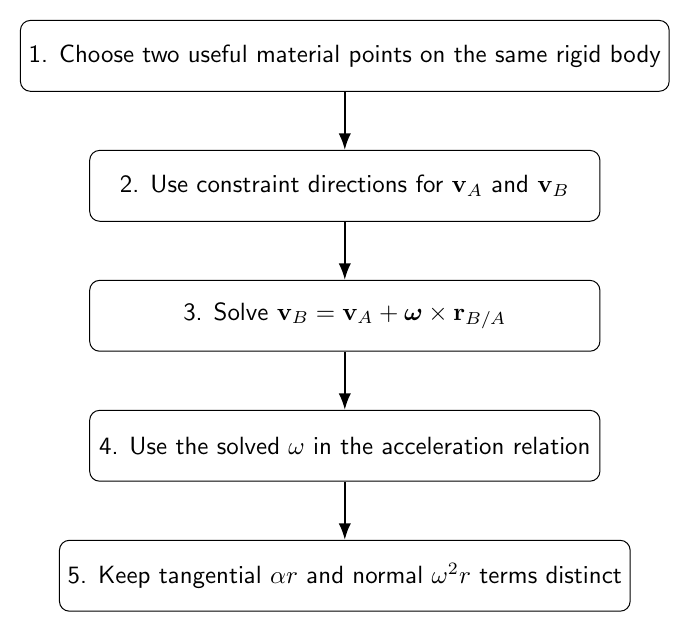
Figure 1. A compact strategy for general plane motion: select two useful points, exploit known constraint directions, solve velocity first for ω, then solve acceleration using both tangential and Normal relative-acceleration terms.
1 High-value GRE facts
Part I: Original GRE-style problems
Problem 1: relative velocity directionFor two points A and B on the same rigid body, the relative velocity vB − vA is
Problem 2: pure translationIf a planar rigid body has ω = 0, then at that instant
Problem 3: fixed pointIf point A is fixed and the rigid body rotates in a plane, then
Problem 4: relative speedPoints A and B are separated by 0.50 m on a rigid link rotating instantaneously at 4 rad/s. The magnitude of their relative velocity is
Problem 5: normal relative accelerationA rigid link has ω = 3 rad/s and points separated by 0.40 m. The magnitude of the normal relative acceleration is
Problem 6: zero angular accelerationIf α = 0 but ω≠0, then for two distinct points on a rigid body
Problem 7: instantaneous centerAt an instantaneous center of zero velocity,
Problem 8: locating instantaneous centerIf velocity directions are known at two points on a rigid body, the instantaneous center is located by
Problem 9: sliding bar geometryA bar has endpoint A moving horizontally and endpoint B moving vertically. The instantaneous center lies
Problem 10: kinetic energyA rigid body has M = 4 kg, vCM = 3 m/s, ICM = 2 kg m2, and ω = 2 rad/s. Its total kinetic energy is
Problem 11: pure translation instantaneous centerFor pure translation, the instantaneous center can be viewed geometrically as
Problem 12: acceleration analysisWhich quantity is needed for the normal relative-acceleration term?
Part II: Complete worked solutions
Solution 1
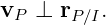
A cross product is perpendicular to rB∕A. Answer: (B).
Solution 2If ω = 0,
Thus all points have the same instantaneous velocity. Answer: (A).
Solution 3For a fixed point A,
Hence
Answer: (B).
Solution 4
Answer: (C).
Solution 5
Answer: (C).
Solution 6When α = 0,
which is nonzero if ω≠0 and A≠B. Answer: (B).
Solution 7The instantaneous-center definition requires
It imposes no requirement that
Answer: (B).
Solution 8For instantaneous rotation about I,
Therefore I lies on the line through each point perpendicular to its velocity. Answer: (C).
Solution 9The horizontal velocity at A implies a vertical radius from I to A. The vertical velocity at B implies a horizontal radius from I to B. Answer: (B).
Solution 10
Answer: (C).
Solution 11In pure translation, all velocities are parallel. The perpendicular lines used to locate an instantaneous center are therefore parallel, corresponding to an instantaneous center at infinity. Answer: (C).
Solution 12The normal term is
Thus it depends on angular speed. Answer: (B).
2 GRE checklist
References
References
"GRE Physics Companion: General Plane Motion of a Rigid Body" is owned by bloftin.
This object's parent. Cross-references: energy, speed, cross product, torque, mass, position, vectors, instantaneous center of zero velocity, magnitude, angular acceleration, angular velocity, center of mass, kinetic energy, fixed-axis rotation, material points, Normal, acceleration, velocity, general plane motion, rigid body This is version 1 of GRE Physics Companion: General Plane Motion of a Rigid Body, born on 2026-10-17. Object id is 1479, canonical name is GREPhysicsCompanionGeneralPlaneMotionOfARigidBody. Accessed 8 times total. Classification:
|
|
|
|
Pending Errata and AddendaNone.
|
DiscussionNo messages.
|
Interact |
![[parent]](https://images.physicslibrary.org/images/uparrow.png)













 (4)(9) +
  (2)(4)