Physics Library
 An open source physics library
Encyclopedia | Forums | Docs | Random  

[parent] GRE Physics Companion: Conservation of Angular Momentum and Central force Motion

(Example)

GRE Physics Companion: Conservation of Angular Momentum and Central Force Motion

The central conservation statement is

|-------------------------------|
τ-ext-=-0---=⇒-----L-=-constant.--
(1)

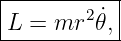
For a central force,

|----------|
-L-=-mr2-˙𝜃,-
(2)

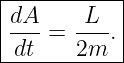
and

|----------|
|dA     L  |
|---=  ---.|
-dt----2m---
(3)

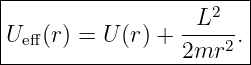
For a conservative central force,

|-----------------------|
|                -L2--- |
Ue ff(r) = U (r) + 2mr2 .|
------------------------
(4)

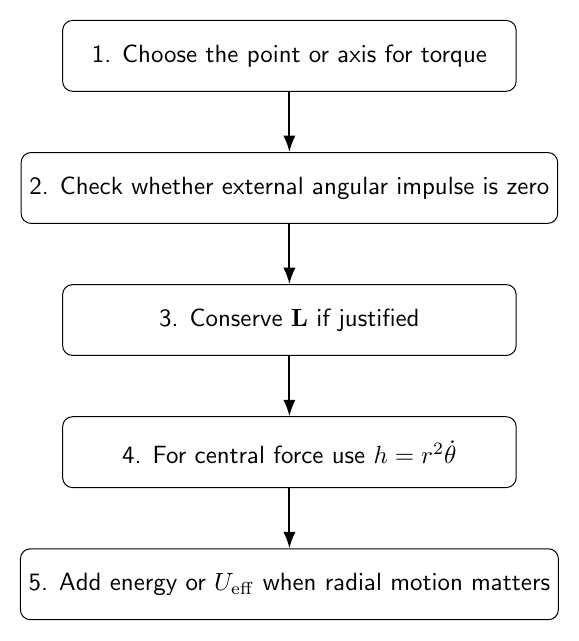
PIC

Figure 1. A compact strategy for angular momentum conservation and central force problems. Choose the torque point first, conserve angular momentum when justified, then use polar or energy relations as needed.

1 High-value GRE facts

  1. Zero external torque about a point implies constant angular momentum about that point.
  2. Angular-momentum conservation does not imply kinetic-energy conservation.
  3. For fixed-axis rotation, Iω is conserved when external torque is negligible.
  4. A central force produces zero torque about its force center.
  5. Central force motion is planar.
  6. specific angular momentum is h = r2𝜃.
  7. Constant angular momentum implies constant areal velocity.
  8. At an apsis, radial velocity is zero and the velocity is transverse.
  9. The effective potential is U + L2∕(2mr2).
  10. For two-body relative motion, replace the single-particle mass with the reduced mass μ.

Part I: Original GRE-style problems

Problem 1: changing moment of inertia

A rotating system has negligible external torque. Its moment of inertia decreases from 4I to I. If its initial angular speed is ω, its final angular speed is

  1. ω∕4
  2. ω∕2
  3. ω
  4. 2ω
  5. 4ω

Problem 2: rotational kinetic energy

In Problem 1, the final rotational kinetic energy is what multiple of the initial rotational kinetic energy?

  1. 1∕4
  2. 1∕2
  3. 1
  4. 2
  5. 4

Problem 3: central force torque

A particle is acted on by a force F = F(r)er. Its torque about the force center is

  1. rF
  2. rF∕2
  3. zero
  4. F∕r
  5. dependent on speed

Problem 4: specific angular momentum

For planar central force motion, specific angular momentum is

  1. rṙ
  2. r𝜃
  3. r2𝜃
  4. ṙ∕r
  5. 𝜃∕r

Problem 5: areal velocity

A particle has specific angular momentum h. Its areal velocity is

  1. h∕4
  2. h∕2
  3. h
  4. 2h
  5. 4h

Problem 6: apsis speed

At two apses of a central-force orbit, rp = ra∕3. If the apoapsis speed is va, the periapsis speed is

  1. va∕3
  2. va
  3. √ --
  3 va
  4. 3va
  5. 9va

Problem 7: effective potential

For a conservative central force, the angular-momentum contribution to the effective potential is

  1. L∕(mr)
  2. L2∕(2mr2)
  3. L2∕(mr)
  4. mr2L∕2
  5. L2r2∕(2m)

Problem 8: radial turning point

At a radial turning point,

  1. ṙ = 0
  2. 𝜃 = 0
  3. L = 0
  4. U = 0
  5. torque is nonzero

Problem 9: circular orbit

A circular orbit in an effective potential occurs at a radius where

  1. Ueff = 0 only
  2. dUeff∕dr = 0
  3. L = 0
  4. F = 0
  5. 𝜃 = 0

Problem 10: gravitational circular speed

For a circular orbit about fixed mass M, the orbital speed is

  1. ∘ -------
  GM  ∕r
  2. GM∕r
  3. √GM---r-
  4. GM∕r2
  5. ∘ ------2-
  GM  ∕r

Problem 11: radial force and work

A radial force has zero torque about the center. Which statement is also necessarily true?

  1. It can never do work.
  2. It can do work if radial displacement occurs.
  3. It must conserve kinetic energy.
  4. It must be gravitational.
  5. It implies zero particle speed.

Problem 12: reduced mass

For two particles of masses m1 and m2, the reduced mass is

  1. m1 + m2
  2. m1 − m2
  3. m1m2
  4. m1m2∕(m1 + m2)
  5. (m1 + m2)∕(m1m2)

Part II: Complete worked solutions

Solution 1

Conservation gives

(4I)ω =  Iωf.
(5)

Thus

ωf =  4ω.
(6)

Answer: (E).

Solution 2

Use

      L2-
K  =  2I.
(7)

Since If = Ii∕4 at fixed L,

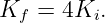
Kf  = 4Ki.
(8)

Answer: (E).

Solution 3

A central force is parallel to r, so

r × F = 0.
(9)

Answer: (C).

Solution 4

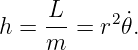
    -L     2 ˙
h = m  =  r 𝜃.
(10)

Answer: (C).

Solution 5

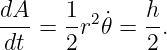
dA-   1-2 ˙   h-
dt =  2r 𝜃 =  2.
(11)

Answer: (B).

Solution 6

At each apsis,

rv = constant.
(12)

Thus

rpvp = rava.
(13)

With rp = ra∕3,

vp = 3va.
(14)

Answer: (D).

Solution 7

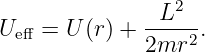
               L2
Ueff = U (r) + ----2.
              2mr
(15)

Answer: (B).

Solution 8

A radial turning point reverses the radial direction, so instantaneously

˙r = 0.
(16)

Answer: (A).

Solution 9

For a circular orbit,

r = constant,
(17)

which requires a stationary point of the effective potential:

dUeff
-----=  0.
 dr
(18)

Answer: (B).

Solution 10

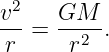
Equate gravitational acceleration to centripetal acceleration:

v2-   GM---
 r =   r2 .
(19)

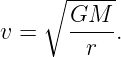
Therefore

    ∘ GM---
v =   -----.
        r
(20)

Answer: (A).

Solution 11

Zero torque means the force has no moment about the center. If radial velocity is nonzero, then

P =  F ⋅ v
(21)

can be nonzero. Answer: (B).

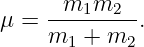
Solution 12

      m m
μ = ----1-2--.
    m1  + m2
(22)

Answer: (D).

2 GRE checklist

  1. State the torque point before conserving angular momentum.
  2. For fixed-axis redistribution, use Iiωi = Ifωf only when external torque is negligible.
  3. Do not assume kinetic energy is conserved just because angular momentum is conserved.
  4. Recognize a central force as a zero-torque force about its center.
  5. Use h = r2𝜃 and dA∕dt = h∕2 for central force motion.
  6. At an apsis, use L = mrv because the velocity is transverse there.
  7. For conservative central forces, use Ueff = U + L2∕(2mr2).
  8. Use reduced mass for genuine two-body relative-coordinate dynamics.

References

References

[1]   J. R. Taylor, Classical Mechanics, University Science Books, 2005.

[2]   D. Kleppner and R. Kolenkow, An Introduction to Mechanics, 2nd ed., Cambridge University Press, 2014.

[3]   OpenStax, University Physics, Volume 1, Rice University, 2016.


"GRE Physics Companion: Conservation of Angular Momentum and Central force Motion" is owned by bloftin.
(view preamble)
View style:
Other names:  M04-08G
Keywords:  GRE physics, conservation of angular momentum, central force, torque, specific angular momentum, areal velocity, effective potential, circular orbit, apsis, reduced mass

This object's parent.

Cross-references: centripetal acceleration, acceleration, kinetic energy, displacement, work, turning point, particle, rotational kinetic energy, speed, moment of inertia, system, mass, relative motion, effective potential, velocity, apsis, areal velocity, specific angular momentum, motion, force, angular momentum, central force

This is version 1 of GRE Physics Companion: Conservation of Angular Momentum and Central force Motion, born on 2026-10-04.
Object id is 1403, canonical name is GREPhysicsCompanionConservationOfAngularMomentumAndCentralForceMotion.
Accessed 12 times total.

Classification:
Physics Classification: 45.50.-j (Dynamics and kinematics of a particle and a system of particles)
 45.20.Dd (Newtonian mechanics)

Pending Errata and Addenda

None.

Discussion

No messages.

Interact