Physics Library
 An open source physics library
Encyclopedia | Forums | Docs | Random  

[parent] GRE Physics Companion: Collisions in Two Dimensions

(Example)

GRE Physics Companion: Collisions in Two Dimensions

The basic conservation equation is

|------------------------------|
-m1u1-+--m2u2--=-m1v1--+-m2v2.--
(1)

Resolve it into components:

m1u1x + m2u2x = m1v1x + m2v2x, (2)
m1u1y + m2u2y = m1v1y + m2v2y. (3)

For smooth oblique impact, use Normal and tangential components:

v1t = u1t, (4)
v2t = u2t, (5)
v2n − v1n = e(u1n − u2n). (6)

PIC

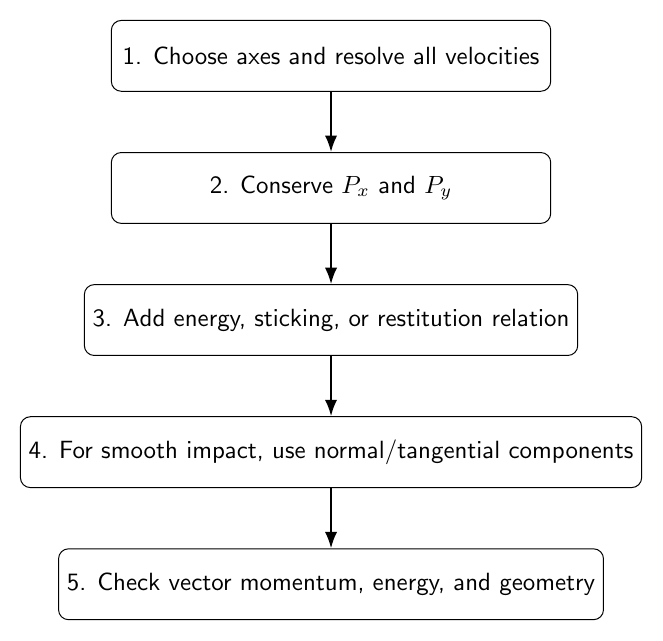
Figure 1. A compact strategy for two-dimensional collision problems. Conserve vector momentum, then add the appropriate energy, restitution, or contact-geometry relation.

1 High-value GRE facts

  1. Momentum conservation in two dimensions means separate x and y equations.
  2. Choose axes to simplify the collision geometry.
  3. perfectly inelastic collisions end with one common velocity vector.
  4. elastic collisions also conserve kinetic energy.
  5. Equal masses with one initially at rest leave at right angles in a two-dimensional elastic collision.
  6. For smooth oblique impact, tangential velocity components are unchanged.
  7. Restitution applies to normal relative velocity.
  8. Center-of-mass-frame momenta are equal and opposite.
  9. Conservation laws may require an additional geometric relation for a unique solution.
  10. Rough impact can involve tangential impulse and rotation.

Part I: Original GRE-style problems

Problem 1: vector momentum

A 2m particle moves at velocity vex and an m particle moves at velocity vey. The total momentum is

  1. mv(ex + ey)
  2. mv(2ex + ey)
  3. mv(ex + 2ey)
  4. 3mvex
  5. 3mvey

Problem 2: perfectly inelastic direction

Two equal masses approach a collision point, one moving east at speed v and the other north at speed v. They stick. Their final direction is

  1. east
  2. north
  3. 45∘ north of east
  4. 30∘ north of east
  5. zero velocity

Problem 3: perfectly inelastic speed

For the collision in Problem 2, the final speed is

  1. v∕2
  2. v∕√ --
  2
  3. v
  4. √2--v
  5. 2v

Problem 4: equal-mass elastic geometry

An elastic collision occurs between equal masses, with the target initially at rest. The two outgoing velocity vectors are

  1. parallel
  2. antiparallel
  3. perpendicular
  4. necessarily equal in magnitude
  5. necessarily vertical

Problem 5: missing equation

For a general two-dimensional elastic collision of two particles, momentum conservation and kinetic-energy conservation may fail to determine a unique final state because

  1. momentum is not conserved in two dimensions
  2. energy is never conserved
  3. there can be more unknown velocity components than independent conservation equations
  4. mass changes during impact
  5. Newton’s third law fails

Problem 6: smooth tangential component

In a smooth frictionless oblique collision, the tangential component of a particle’s velocity

  1. reverses
  2. doubles
  3. becomes zero
  4. is unchanged
  5. is multiplied by e

Problem 7: restitution direction

For smooth oblique impact, the coefficient of restitution relates the

  1. total speed magnitudes
  2. tangential relative velocities
  3. normal relative velocities
  4. angular velocities
  5. center-of-mass speeds

Problem 8: equal-mass smooth impact

Two equal masses collide smoothly along the x direction. Initially u1x = 4 m∕s, u2x = 0, and e = 0.50. The final normal velocity of particle 1 is

  1. 0
  2. 1 m∕s
  3. 2 m∕s
  4. 3 m∕s
  5. 4 m∕s

Problem 9: center-of-mass frame

In the center-of-mass frame for a two-particle system,

  1. both particles are at rest
  2. the two momenta sum to zero
  3. both momenta point in the same direction
  4. kinetic energy is always zero
  5. external force must vanish

Problem 10: impulse direction

For a smooth collision of frictionless spheres, the collision impulse lies

  1. tangent to the surfaces
  2. along the line of impact
  3. perpendicular to the line joining centers
  4. along the initial velocity
  5. in an arbitrary direction

Problem 11: energy retention

If the normal coefficient of restitution is e = 0.60, the fraction of normal relative kinetic energy retained after impact is

  1. 0.16
  2. 0.36
  3. 0.40
  4. 0.60
  5. 0.80

Problem 12: rough contact

If a collision involves a significant tangential impulse, one should generally expect

  1. tangential velocity components to be guaranteed unchanged
  2. possible changes in translation and rotation
  3. restitution to equal one
  4. zero angular momentum
  5. no energy transfer

Part II: Complete worked solutions

Solution 1

The two momenta are

p1 = 2mvex, (7)
p2 = mvey. (8)

Therefore

P  = mv (2ex + ey).
(9)

Answer: (B).

Solution 2

The initial momentum components are equal:

Px = mv, (10)
Py = mv. (11)

Thus the total momentum points at 45∘.

Answer: (C).

Solution 3

The combined mass is 2m.

The final components are

vx = v-
2, (12)
vy = v
--
2. (13)

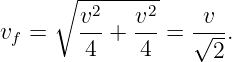
Therefore

      ∘ --------
        v2   v2     v
vf =    -4-+ -4-=  √--.
                     2
(14)

Answer: (B).

Solution 4

For equal masses with one initially at rest,

u = v1 + v2
(15)

and

u2 = v21 + v22.
(16)

Squaring the vector equation shows

v1 ⋅ v2 = 0.
(17)

Answer: (C).

Solution 5

There are four final velocity components. Momentum gives two equations and kinetic energy gives one more. A geometric or contact constraint may still be required.

Answer: (C).

Solution 6

Smooth contact means zero tangential impulse:

Jt = 0.
(18)

Thus tangential momentum and tangential velocity of each particle are unchanged.

Answer: (D).

Solution 7

For oblique impact,

v2n − v1n = e(u1n − u2n).
(19)

Answer: (C).

Solution 8

For equal masses,

       1 − e      1 + e
v1n =  -----u1n + -----u2n.
         2          2
(20)

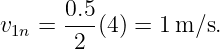
Thus

      0.5
v1n = ---(4) = 1 m ∕s.
       2
(21)

Answer: (B).

Solution 9

By definition of the center-of-mass frame,

P ′ = 0.
(22)

Thus the two momenta sum to zero.

Answer: (B).

Solution 10

For smooth frictionless spheres, the contact impulse acts along the common normal through the centers at contact.

Answer: (B).

Solution 11

Relative normal speed is multiplied by e, so relative normal kinetic energy is multiplied by

e2 = (0.60)2 = 0.36.
(23)

Answer: (B).

Solution 12

A tangential impulse can change tangential translation and can also generate or modify spin.

Answer: (B).

2 GRE checklist

  1. Write separate momentum equations in x and y.
  2. Choose axes that fit the contact geometry.
  3. Use kinetic-energy conservation only for elastic collisions.
  4. For equal masses with one target initially at rest, test for perpendicular outgoing velocities.
  5. In smooth impact, conserve tangential velocity components for each particle.
  6. Apply restitution only along the normal direction.
  7. Use the center-of-mass frame when scattering geometry is easier there.
  8. Count equations and unknowns before solving.

References

References

[1]   J. R. Taylor, Classical Mechanics, University Science Books, 2005.

[2]   D. Kleppner and R. Kolenkow, An Introduction to Mechanics, 2nd ed., Cambridge University Press, 2014.

[3]   OpenStax, University Physics, Volume 1, Rice University, 2016.


"GRE Physics Companion: Collisions in Two Dimensions" is owned by bloftin.
(view preamble)
View style:
Other names:  M04-04G
Keywords:  GRE physics, two-dimensional collisions, oblique collision, momentum conservation, elastic collision, line of impact, coefficient of restitution, normal and tangential components

This object's parent.

Cross-references: spin, angular momentum, relative kinetic energy, line of impact, external force, system, coefficient of restitution, oblique collision, magnitude, vectors, speed, total momentum, particle, impulse, tangential velocity components, two-dimensional, masses, kinetic energy, elastic collisions, velocity, perfectly inelastic collisions, collision, dimensions, relation, energy, momentum, vector, two-dimensional collision, Normal

This is version 1 of GRE Physics Companion: Collisions in Two Dimensions, born on 2026-10-04.
Object id is 1396, canonical name is GREPhysicsCompanionCollisionsInTwoDimensions.
Accessed 3 times total.

Classification:
Physics Classification: 45.50.-j (Dynamics and kinematics of a particle and a system of particles)
 45.20.Dd (Newtonian mechanics)

Pending Errata and Addenda

None.

Discussion

No messages.

Interact