|
|
|
|||||||
The answer links mechanics, differential equations, geometry, and wave analysis. A linear restoring force produces a second-order differential equation whose real solutions are sine and cosine. The same equation also admits complex exponential solutions. Euler’s formula then shows that these are not different physical models. They are different mathematical representations of the same harmonic motion [1, 2, 3, 4]. This connection is central to later wave mechanics, circuits, RF engineering, antennas, communications, and GNSS because differentiation, phase shifts, propagation, and superposition become much easier to manipulate in complex-exponential form.
1 Learning objectivesAfter working through this entry, the reader should be able to:
2 From restoring force to the harmonic differential equationThe simplest physical route to sinusoidal motion is a mass attached to an ideal spring. Let u(t) denote displacement from equilibrium. For sufficiently small deformation, Hooke’s law gives
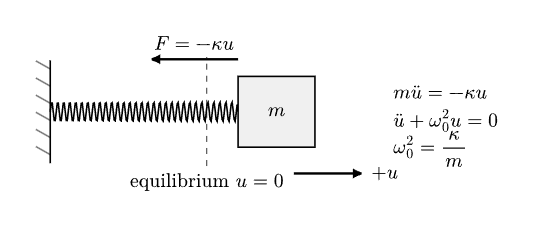
where κ > 0 is the spring stiffness. The minus sign is the essential physical feature: when u > 0 the force points in the negative direction, and when u < 0 the force points in the positive direction. The force therefore tends to restore the mass toward u = 0. Newton’s second law gives
Using Equation (2),
or
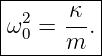
Define the natural angular frequency by
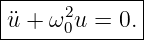
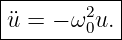
Then
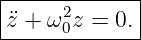
This is the ideal simple harmonic oscillator equation.
Figure 1. A linear restoring force produces the simple harmonic oscillator equation. The force always points opposite the displacement. Equation (7) contains the key mathematical requirement:
The second derivative must reproduce the original function with a negative scale factor.
3 Why sine and cosine solve the equationDifferentiate a cosine twice:
Therefore
Likewise,
Thus sine also satisfies Equation (7). Because the differential equation is linear, any linear combination of two solutions is also a solution. Hence
The two constants are not accidental. Equation (7) is second order, so two independent initial data are needed. Usually they are
From Equation (14),
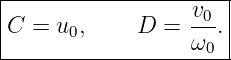
and
so
Therefore
This is already a complete real solution of the harmonic oscillator.
4 From two coefficients to amplitude and phaseThe same motion can be written as a single shifted cosine:
Use the angle-difference identity
Then
Compare this with Equation (14). The coefficients must satisfy
Squaring and adding gives
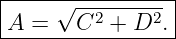
Hence
The phase must retain quadrant information, so the robust expression is
Thus
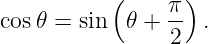
The sine form is equally valid because
There is no physical preference for sine or cosine. Choosing one rather than the other only changes the phase convention.
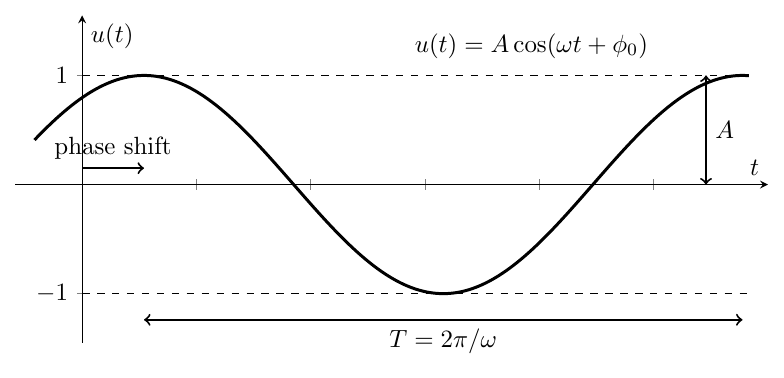
5 Reading the general sinusoidWrite a general one-point harmonic signal as
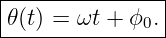
Its instantaneous phase is
The important quantities are
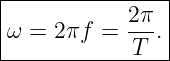
The period and frequency satisfy
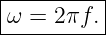
while one complete cycle is 2π radians, so
Figure 2. Amplitude, period, and phase shift in a harmonic time history. Phase describes position within the repeating cycle. The equation is easiest to interpret as uniform phase accumulation. Since
we have
Angular frequency is therefore the rate at which phase advances.
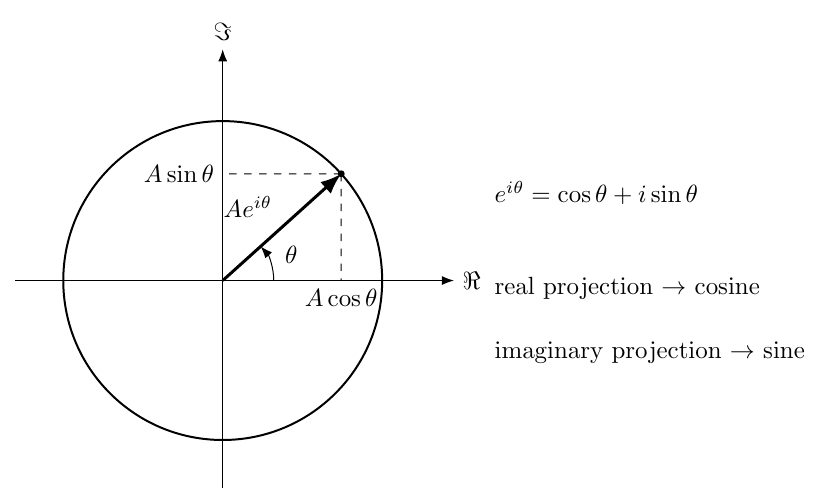
6 The unit circle: the geometry behind sine and cosineConsider a point moving around a circle of radius A. Let its angle be 𝜃. Its Cartesian coordinates are
If the angle increases uniformly,
then the horizontal projection is a cosine in time and the vertical projection is a sine in time.
Figure 3. Cosine and sine are the orthogonal projections of uniform circular motion. Euler’s formula packages both projections into one rotating complex number. This geometric picture explains why sine and cosine occur as a natural pair. They are not unrelated functions that happen to solve the same equation. They are the two orthogonal coordinates of rotation.
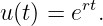
7 A second route: the exponential trial solutionFor constant-coefficient linear differential equations, exponentials are especially useful because differentiating an exponential reproduces the same exponential. Try
Then
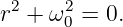
Substitute into Equation (7):
Since ert is never zero,
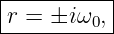
Thus
where
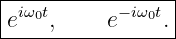
The two exponential solutions are therefore
In electrical engineering the symbol j is often used instead of i so that i remains available for electric current. The mathematics is identical. At first these complex solutions may seem to have introduced something unphysical. The next section shows that they are simply a compact representation of sine and cosine.
8 Deriving Euler’s formula from power seriesThe exponential function has the Maclaurin expansion
Set
Then
The powers of i repeat in a four-step cycle:
Therefore
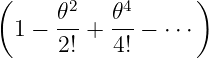
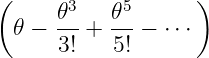
Group the real terms and the imaginary terms:
But the Maclaurin series of cosine and sine are
Hence
This is Euler’s formula. The result is algebraic, but its geometry is equally important. Equation (54) places the point ei𝜃 at coordinates
on the unit circle. Its magnitude is
Changing 𝜃 rotates the complex number without changing its magnitude.
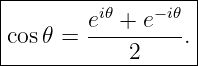
9 Recovering cosine and sine from exponentialsEuler’s formula gives
Add the two equations:
Therefore
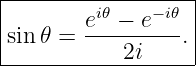
Subtract the equations:
so
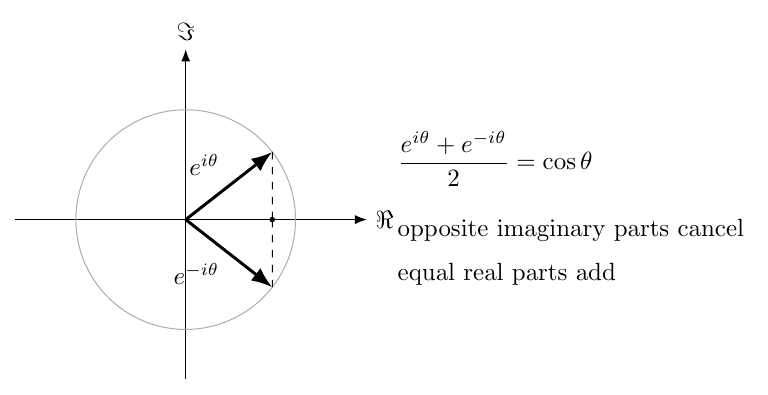
Figure 4. A real cosine can be viewed as the sum of two equal counter-rotating complex exponentials. Their imaginary parts cancel while their real parts add. This is an important conceptual result. A real sinusoid contains a conjugate pair of complex exponentials. Later, Fourier analysis will interpret those exponentials as positive- and negative-frequency components.
10 Why the complex exponential solves the oscillator equationConsider
Differentiate once:
Differentiate again:
Therefore
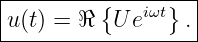
Taking the real part gives
and taking the imaginary part gives
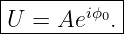
Thus the physical real-valued sinusoid is contained inside the complex solution. The complex number is a mathematical bookkeeping device. It simultaneously stores amplitude and phase:
has magnitude A and argument ϕ0.
11 The general real solution as a conjugate pairThe two characteristic roots in Equation (44) give the general complex solution
For the result to be real for every t, choose conjugate coefficients:
Let
Then
The sine/cosine basis and the complex-exponential basis therefore span the same two-dimensional solution space.
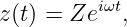
12 Why complex exponentials simplify differentiationThis is one of the most important practical reasons for using the complex representation. For
where Z is independent of time,
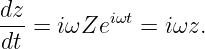
Thus
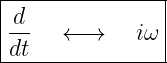
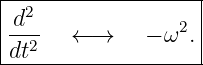
for a single-frequency complex sinusoid. Similarly,
A differential operation has become algebraic multiplication. This is why complex exponentials are so effective in oscillation theory, AC circuits, linear systems, Electromagnetism, and signal processing [5, 4].
12.1 Multiplication by i is a quarter-cycle rotationFrom Euler’s formula,
If
then
Therefore multiplying by i rotates a complex phasor by 90∘ counterclockwise without changing its magnitude. Differentiation of eiωt both scales the magnitude by ω and advances the phase by π∕2.
13 Phasor notationFor a single fixed angular frequency ω, write
Define the complex amplitude, or phasor,
Then
The common time factor eiωt can often be suppressed while performing algebra. The constant complex number U carries the amplitude and phase. This notation is powerful only when all quantities under comparison share the same angular frequency. A phasor is not a replacement for an arbitrary time-dependent signal.
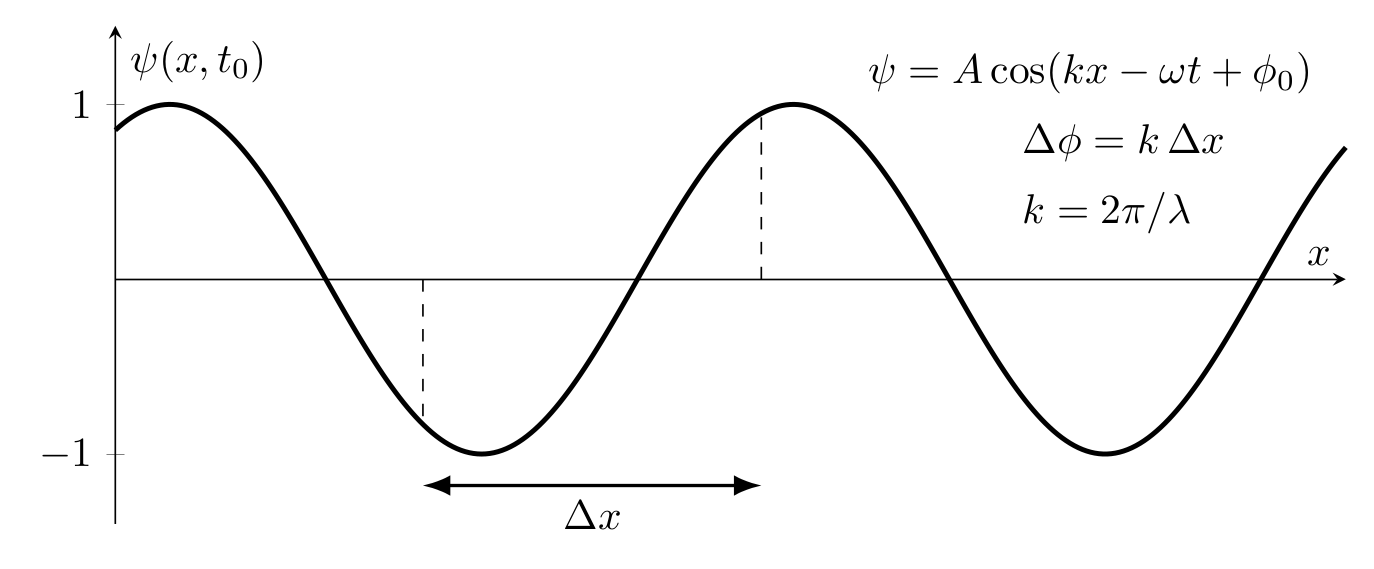
14 From one-point oscillation to a traveling waveThe next conceptual step is to allow phase to depend on position as well as time. A one-dimensional traveling sinusoid can be written
The total phase is
The spatial phase rate is the Wavenumber
and the temporal phase rate is the angular frequency
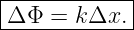
At fixed time, moving by Δx changes the phase by
At fixed position, waiting for a time Δt changes the phase by
for the sign convention in Equation (85).
Figure 5. In a traveling wave, phase advances in space as well as time. A spatial separation Δx corresponds to phase separation Δϕ = kΔx. The complex representation is
This is the direct bridge from elementary harmonic motion to wave mechanics and RF signal representation.
15 Phase velocity from constant phaseA recognizable crest or trough corresponds to a fixed value of phase. Set
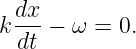
Differentiate with respect to time:
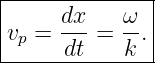
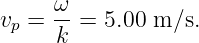
Hence the phase velocity is
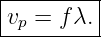
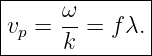
Using ω = 2πf and k = 2π∕λ,
The familiar wave-speed relation is therefore also a statement about the ratio of temporal phase accumulation to spatial phase accumulation.
16 Sign conventionsTwo common complex traveling-wave conventions are
and
They are complex conjugates. Either convention is valid if used consistently. The observable real cosine is unchanged by a consistent switch of convention, but signs in derivatives, propagation factors, Fourier transforms, and phasor formulas may change. Before comparing formulas from two sources, identify the assumed time convention.
17 Worked example: initial displacement and velocityConsider
with
The natural angular frequency is
Write
From u(0) = 3,
Differentiate:
At t = 0,
so
Thus
The amplitude is
and
Therefore
The two expressions are exactly the same motion.
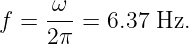
18 Worked example: from a traveling wave to its parametersSuppose
Comparison with Equation (85) gives
Then
and
The phase velocity is
A displacement of
corresponds to
This example links the one-point harmonic language of WM02 directly to the spatial phase language used in later wave and RF articles.
19 Common conceptual errors
19.1 The imaginary part is not an imaginary physical displacementComplex notation is a mathematical representation. If the physical quantity is real, the measurable signal is usually obtained by taking the real part after the complex algebra has been completed.
19.2 Amplitude and phase are different pieces of informationThe complex number
contains both. Its magnitude is A; its angle is ϕ.
19.3 Sine and cosine are not physically different kinds of motionThey differ by a phase shift of π∕2. Choosing sine or cosine as the reference form is a convention.
19.4 Angular frequency is not ordinary frequencyThe two are related by
The factor 2π converts cycles to radians.
19.5 A phasor is not an arbitrary time signalThe compact replacement d∕dt ↔ iω assumes a single harmonic time dependence. General non-sinusoidal signals require superposition or Fourier methods.
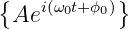
20 Why this matters for RF and GNSSAn RF carrier is commonly represented physically as
Its complex representation is
The real waveform is recovered through
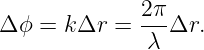
If propagation changes the path length by Δr, the carrier phase changes by
This is why Euler’s representation, phase, wavenumber, path length, I/Q processing, antenna arrays, and GNSS carrier tracking all become tightly connected. The complex exponential is not an RF-specific trick. It is the natural algebraic language of harmonic waves.
21 SummaryThe central chain is
Euler’s formula provides the bridge:
For a traveling wave, the phase acquires spatial dependence:
The temporal phase rate is ω, the spatial phase rate is k, and their ratio gives the phase velocity:
WM03 can now treat phase difference as a physical comparison between two oscillations or two points on a wave, rather than as an isolated trigonometric parameter.
References
References
[1] A. P. French, Vibrations and Waves, W. W. Norton, 1971. [2] Frank S. Crawford, Waves, Berkeley Physics Course, Vol. 3, McGraw-Hill, 1968. [3] Mary L. Boas, Mathematical Methods in the Physical Sciences, 3rd ed., Wiley, 2006. [4] Erwin Kreyszig, Advanced Engineering Mathematics, 10th ed., Wiley, 2011. [5] Alan V. Oppenheim, Alan S. Willsky, and S. Hamid Nawab, Signals and Systems, 2nd ed., Prentice Hall, 1997. "Wave Mechanics: Harmonic Motion, Euler's Formula, and Complex Exponentials" is owned by bloftin.
This object's parent. Cross-references: parameter, WM03, physical quantity, Fourier transforms, observable, relation, velocity, Wavenumber, Electromagnetism, systems, operation, two-dimensional, magnitude, algebraic, Maclaurin series, powers, section, uniform circular motion, Cartesian coordinates, position, unit, identity, function, Hooke's law, deformation, equilibrium, displacement, mass, power series, simple harmonic oscillator, representations, formula, second-order differential equation, force, differential equations, mechanics, WM02, oscillation, WM01 This is version 1 of Wave Mechanics: Harmonic Motion, Euler's Formula, and Complex Exponentials, born on 2026-10-09. Object id is 1440, canonical name is WaveMechanicsHarmonicMotionEulersFormulaAndComplexExponentials. Accessed 20 times total. Classification:
|
|
|
|
Pending Errata and AddendaNone.
|
DiscussionNo messages.
|
Interact |
![[parent]](https://images.physicslibrary.org/images/uparrow.png)





 cos(
cos( cos(
cos(
 sin(
sin( sin(
sin(




















 +
+  +
+  +
+ 


 +
+  +
+ 

 +
+ 

 +
+ 
















![[ ]
ei(ω0t+ϕ0) + e−i(ω0t+ϕ0)](https://images.physicslibrary.org/cache/objects/1440/make4ht/WaveMechanicsHarmonicMotionEulersFormulaAndComplexExponentials79x.png)