Vector Differentiation in Physics: Vector-Valued Functions, Moving Bases, and Kinematics
Vector differentiation is the study of how a vector changes with respect to a scalar parameter such
as time, arc length, or an angle. It is one of the basic mathematical operations of mechanics
because position, velocity, acceleration, momentum, angular momentum, force, and many other
physical quantities are vectors whose magnitudes and directions may both change. A
mathematically careful treatment also explains why differentiating vectors in polar, cylindrical,
spherical, or rotating coordinates requires more than differentiating their scalar components
[1, 2, 3].
This article focuses on derivatives of vector-valued functionshttps://physicslibrary.org/encyclopedia/Bijective.html
and on their use in mechanics. Gradient, divergence, curl, and related differential operators acting
on scalar and vector fields belong more naturally to vector calculus, although the final sections
show how the two subjects connect.
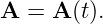
1 A vector-valued function
Let a vector depend on a scalar parameter t:
For motion in three-dimensional Euclidean space one may write
where ex,ey,ez are fixed Cartesian basis vectors.
The derivative is defined by the same limit used for scalar functions, except that the difference
quotient is now a vector:
provided this vector limit exists.
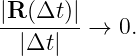
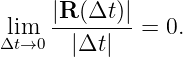
Equivalently, A is differentiable at t if there exists a vector B such that
with
Then
This form makes the local-linear meaning of the derivative explicit: over a sufficiently short
interval, the change in the vector is the derivative multiplied by the parameter increment, plus a
remainder that becomes negligible faster than Δt.
2 Componentwise differentiation in a fixed basis
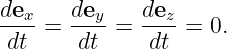
If the basis vectors are constant in time,
Therefore
Thus a vector-valued function in a fixed Cartesian basis is differentiable exactly when its
component functions are differentiable, and its derivative is obtained component by
component.
This simple rule is often the first rule learned for vector differentiation. It is correct only because
the Cartesian basis is fixed. Later we will see that a moving basis contributes its own
derivatives.
3 Geometric meaning: the derivative is tangent to a curve
A vector-valued function
may represent a curve in physical space. For two nearby parameter values, the difference
is a chord joining two nearby points of the curve. The difference quotient
points along that chord. As Δt → 0, the chord direction approaches the tangent direction to the
curve.
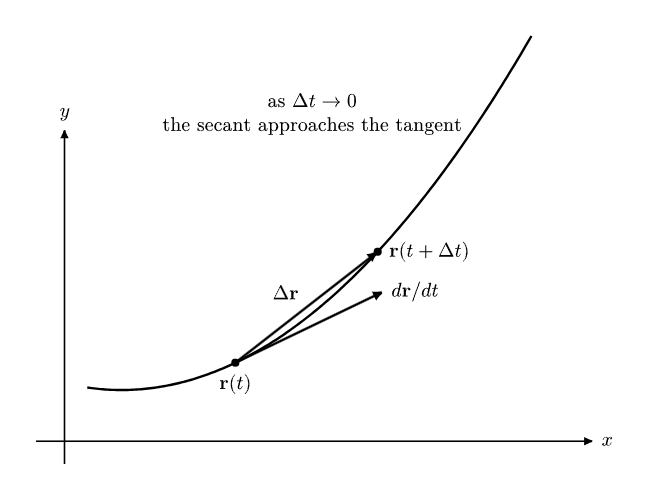
Figure 1. The derivative of a vector-valued position function is the limit of secant vectors and is
tangent to the trajectory. In mechanics this derivative is velocity.
For a particle position r(t),
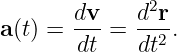
is therefore tangent to the path. The acceleration is the derivative of the velocity,
Acceleration need not point along the path because it measures the change of the entire velocity
vector, including both its magnitude and its direction.
4 Differentiation with respect to another parameter
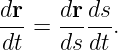
A curve can be parameterized by a quantity other than time. Suppose
and s = s(t). The chain rule gives
If s is arc length, then
so the vector
is the unit tangent to the path. Since
where v = |v| is speed,
This decomposition will be useful when differentiating the velocity.
5 Product rules for vectors
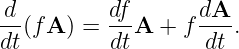
The familiar scalar product rule extends naturally to vector products. Let f(t) be a scalar and let
A(t) and B(t) be differentiable vectors.
For scalar multiplication,
For the dot product,
For the cross product,
The order in the cross-product rule matters because
These identities can be proved directly from the limit definition using bilinearity of the dot and
cross products.
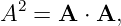
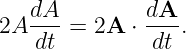
6 Derivative of a vector magnitude
Let
with A≠0. Since
differentiation gives
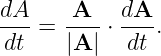
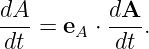
Therefore
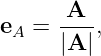
If
then
Only the part of dA∕dt parallel to A changes the magnitude. A perpendicular derivative changes
the direction without changing the magnitude to first order.
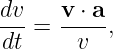
A useful mechanics example is
provided v≠0.
7 Derivative of a unit vector
Let
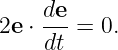
be a unit vector. Differentiating
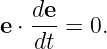
gives
Hence
The derivative of a unit vector is therefore perpendicular to the unit vector itself.
A more explicit formula follows from e = A∕A:
The bracket removes the component of dA∕dt parallel to A. What remains is the perpendicular
part responsible for turning the vector.
This result is fundamental in orbital mechanics, rigid-body kinematics, moving coordinate systems,
and Differential Geometry.
8 Velocity and acceleration along a curved path
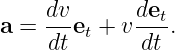
Write the velocity as
where et is the unit tangent. Differentiation gives
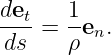
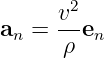
The derivative of et must be perpendicular to et. For a smooth plane curve, define the radius of
curvature ρ and principal normal en by
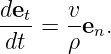
Using ds∕dt = v,
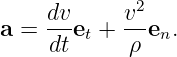
Therefore
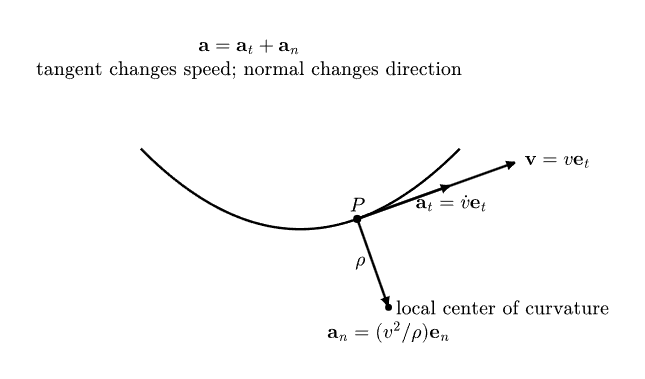
Figure 2. Acceleration separates into a tangential part that changes speed and a normal part that
changes the direction of the velocity. The normal acceleration points toward the local center of
curvature.
Thus
changes the speed, while
changes the direction of motion. Uniform circular motion has dv∕dt = 0 but still has nonzero
acceleration because et continuously changes direction.
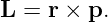
9 A physics example: differentiating angular momentum
For a particle with position r and momentum p,
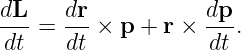
Using the cross-product differentiation rule,
For constant mass,
so
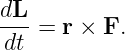
Newton’s second law gives
Therefore
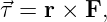
Since torque is defined by
we obtain
This derivation shows how a basic vector product rule becomes one of the central dynamical
relations of mechanics.
10 The crucial complication: a moving basis
Suppose a vector is written in a basis whose directions themselves depend on time:
Now the product rule gives
The last three terms vanish only when the basis vectors are fixed.
This is the source of many additional terms in polar, cylindrical, spherical, and rotating-coordinate
equations of motion. They are not artificial corrections; they arise because the coordinate
directions themselves change.
11 Polar-coordinate basis derivatives
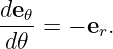
In the plane, define
and
Differentiating with respect to 𝜃 gives
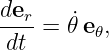
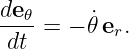
The chain rule then gives
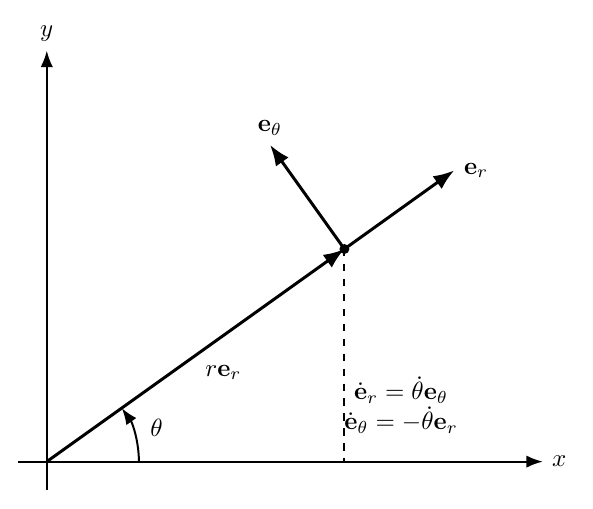
Figure 3. The polar basis moves with the particle’s angular coordinate. Even when the scalar
components of a vector are constant, the vector can change because er and e𝜃 rotate.
The position vector is
Differentiating,
Differentiating again,
The term
is the inward centripetal contribution, while
is produced by simultaneous radial motion and rotation of the basis.
These terms follow entirely from differentiating the basis vectors correctly.
12 Rotating frames and the transport theorem
The polar-coordinate result is a special case of a more general rule. Let a rotating basis e′1,e′2,e′3
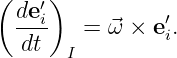
have angular velocity ω relative to an inertial frame. Each basis vector satisfies
For
differentiation gives
This is the vector transport theorem.
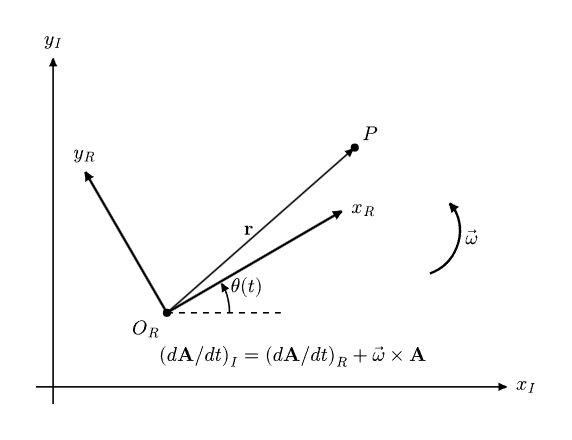
Figure 4. A vector expressed in a rotating basis changes in an inertial frame for two reasons: its
components can change relative to the rotating frame, and the basis itself rotates with angular
velocity ω.
Applying the transport theorem to a particle position relative to a moving origin gives the inertial
velocity
Differentiating once more gives the inertial acceleration
The additional terms are, respectively, the Coriolis, Euler, and centrifugal contributions. Their
origin is vector differentiation in a rotating basis.
13 Vector fields and the derivative following a particle
The previous sections considered a vector that depends directly on one scalar parameter. Physics
also uses vector fields such as velocity, electric field, or magnetic field:
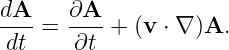
A particle following a trajectory r(t) samples different points of the field. The ordinary chain rule
applied componentwise gives
In vector notation this is
In continuum mechanics and fluid mechanics this is called the material or substantial derivative.
The first term measures explicit change of the field at a fixed point, while the second measures
change caused by motion through a spatially nonuniform field.
This formula is also a useful bridge to vector calculus. The derivative of a vector-valued trajectory
and the spatial differentiation of a vector field are related but distinct ideas.
14 Differentials and infinitesimal changes
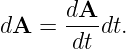
If A(t) is differentiable, its differential is
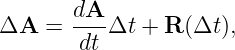
This equation is best interpreted as the linear part of the change in A associated with a small
change dt. More precisely,
where
This interpretation prevents a common confusion: dA is not an arbitrary tiny vector inserted by
notation; it is the linear map generated by the derivative acting on the small scalar increment
dt.
15 Common errors
Several mistakes recur in mechanics problems involving vector differentiation.
- Differentiating only components in a moving basis. In polar, spherical, or
rotating coordinates the basis vectors also have derivatives.
- Assuming zero speed derivative means zero acceleration. Constant speed does
not imply constant velocity. Uniform circular motion is the standard counterexample.
- Treating the derivative of a unit vector as parallel to the vector. Since the
magnitude is fixed, the derivative of a unit vector is perpendicular to it.
- Reversing factors in a differentiated cross product. The correct order is
preserved:
- Confusing vector differentiation with vector differential operators. dA∕dt
differentiates a vector-valued function with respect to a scalar. Quantities such as ∇⋅ A and
∇× A describe spatial derivatives of a vector field.
16 Worked example: a planar spiral
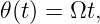
Consider
where u and Ω are constants. Then
The polar-coordinate velocity is
The acceleration is
Even though both scalar rates u and Ω are constant, the acceleration is not zero because the polar
basis rotates and because the tangential speed rΩ changes as the radius changes.
This is a compact demonstration of why vector differentiation is more than differentiating scalar
coefficients.
17 Relation to classical mechanics
Vector differentiation underlies many of the standard equations of classical mechanics:
It also supplies the kinematic machinery behind curvilinear coordinates, orbital frames, rotating
rigid bodies, Coriolis effects, and non-inertial reference frames. For this reason physics texts often
introduce vector differentiation early in mechanics, before moving on to full equations of motion
[1, 2].
Summary
The derivative of a vector-valued function is defined by the vector limit
In a fixed Cartesian basis it is obtained by differentiating components. In a moving basis, the basis
vectors must also be differentiated. Product rules apply to scalar multiplication, dot products, and
cross products. The derivative of a unit vector is perpendicular to that unit vector, which leads
naturally to tangential-normal acceleration and to the extra terms appearing in polar and rotating
coordinates.
The central lesson for mechanics is simple:
A vector can change because its components change, because its direction
changes, or because the basis used to describe it changes.
A correct derivative must account for all three possibilities.
References
References
[1] J. R. Taylor, Classical Mechanics, University Science Books, 2005.
[2] J. B. Marion and S. T. Thornton, Classical Dynamics of Particles and Systems, 5th
ed., Brooks/Cole, 2004.
[3] H. Goldstein, C. Poole, and J. Safko, Classical Mechanics, 3rd ed., Addison-Wesley,
2002.
[4] G. B. Arfken, H. J. Weber, and F. E. Harris, Mathematical Methods for Physicists,
7th ed., Academic Press, 2013.
[5] M. L. Boas, Mathematical Methods in the Physical Sciences, 3rd ed., Wiley, 2006.



















![[ ( ) ]
de-= 1- dA--− e e ⋅ dA- .
dt A dt dt](https://images.physicslibrary.org/cache/objects/1279/make4ht/VectorDifferentiation34x.png)