Supersonic Motion, Mach Cones, and Shock Waves
M06-14 showed that the ordinary moving-source Doppler formula becomes singular as a source
speed approaches the wave speed from below.
That divergence is not an infinite physical frequency. It signals a change in wavefront
geometry.
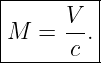
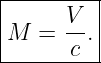
The key dimensionless ratio is the Mach number,
Here V is the source or flow speed relative to the medium and c is the local small-disturbance
sound speed.
The basic regimes are
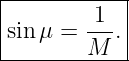
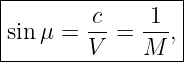
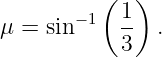
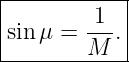
For steady uniform supersonic motion, the small-disturbance Mach angle μ satisfies
This article derives that geometry and then develops the finite-amplitude physics of shock
waves.
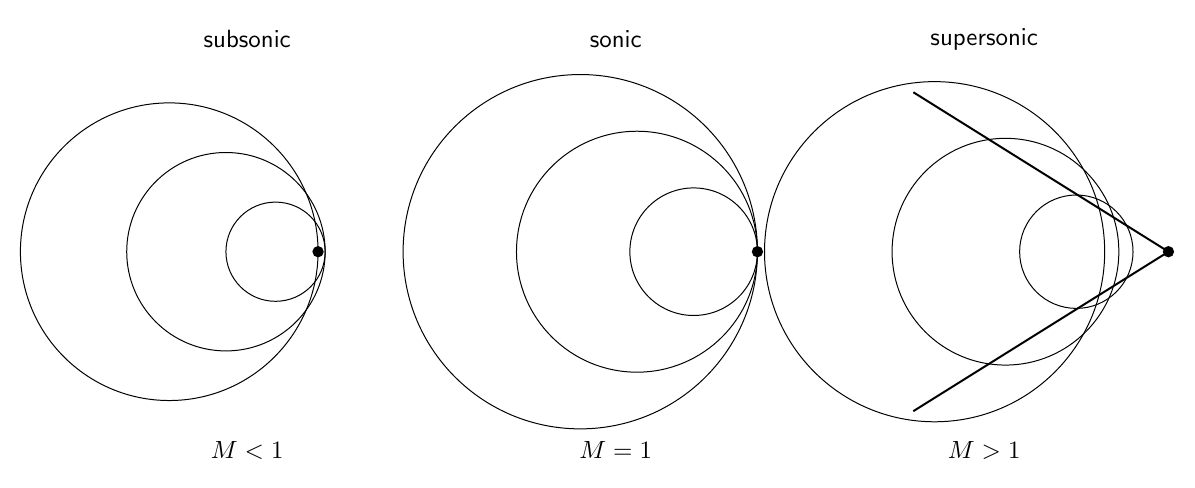
Figure 1. Equal-time wavefront constructions for subsonic, sonic, and supersonic motion. A
subsonic source remains inside its disturbance field, a sonic source reaches the forward wavefronts,
and a supersonic source lies outside earlier wavefronts.
1 Mach number as a comparison of time scales
Suppose a body of characteristic length L moves at speed V .
The flow transit time is
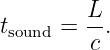
A sound disturbance crosses the same distance in
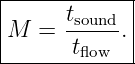
Therefore
For M < 1, acoustic information can cross the characteristic distance before the body
does.
For M > 1, the source can cross that distance faster than a small disturbance can propagate
through the medium.
2 Wavefront construction for a moving source
Let a point source move at constant speed V through a stationary uniform medium.
Every small disturbance expands at speed c relative to the medium.
A disturbance emitted at time zero has radius
at later time t, while the source has moved
The ratio of those distances is the Mach number.
3 Subsonic motion
For
we have
The source remains inside each earlier disturbance sphere.
Signals can therefore propagate ahead of the source.
This is the geometric basis for upstream communication in subsonic flow.
4 Sonic motion
For
the source lies on the forward edge of each earlier disturbance sphere.
Forward wavefront spacing collapses.
This is the geometric limit behind the singular behavior of the moving-source Doppler
formula.
5 Supersonic motion
For
the source lies outside each earlier disturbance sphere.
The envelope tangent to the family of spheres forms a cone in three dimensions.
That envelope is the Mach cone.
6 Derivation of the Mach angle
Suppose the source travels from point O to point S in time t.
Then
The disturbance emitted at O has radius
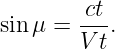
The tangent from S to that sphere produces a right triangle. Therefore
Hence
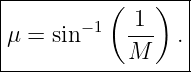
or
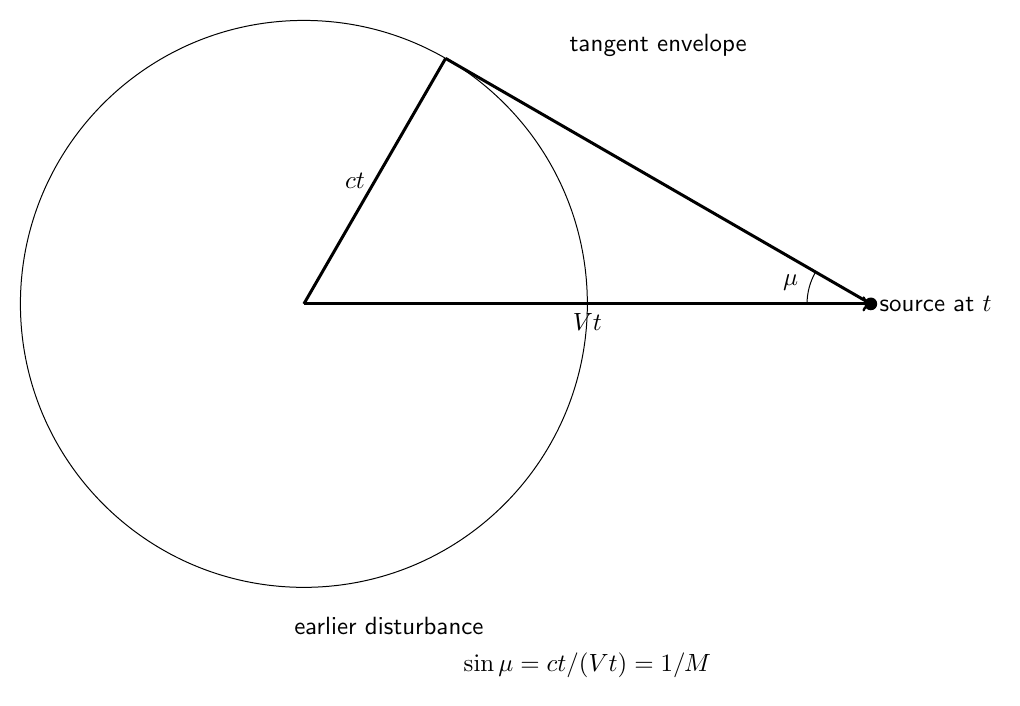
Figure 2. Mach-angle geometry. In time t, the source travels V t while an earlier disturbance
expands a distance ct. The tangent envelope gives sinμ = c∕V = 1∕M.
7 Example 1: Mach angle at Mach 2
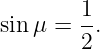
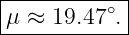
For
Therefore
8 Example 2: Mach angle at Mach 3
For
Thus
9 High-Mach-number limit
At the sonic limit,
the Mach angle approaches
At large Mach number, the angle is small.
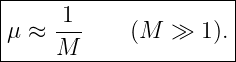
Using
for small μ in radians,
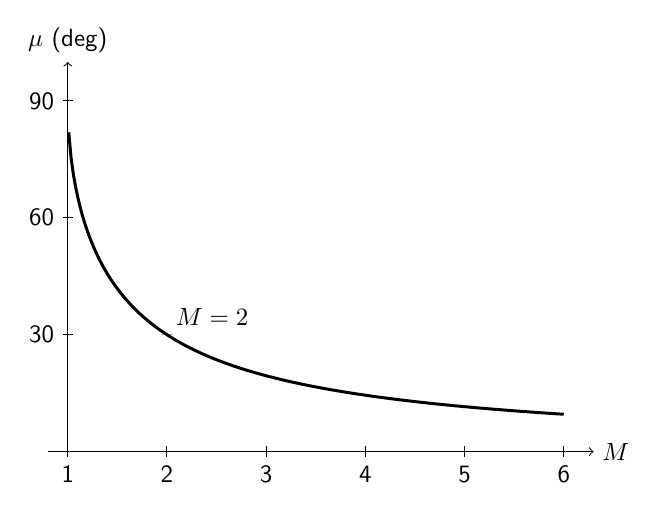
Figure 3. The Mach angle decreases as Mach number increases. It approaches 90∘ as M
approaches one from above and behaves approximately as 1∕M radians at high Mach number.
10 Mach wave versus shock wave
A Mach cone is first a statement about the geometry of infinitesimal disturbances.
For an infinitesimally weak disturbance, the cone is made of Mach waves.
A finite disturbance can instead produce a shock wave.
The distinction is:
- a Mach wave is the small-disturbance limit,
- a shock contains finite jumps in pressure, density, temperature, and velocity,
- a physical shock produces entropy.
For a weak shock, the shock angle approaches the Mach angle.
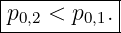
For stronger compression, the shock angle is generally larger than μ.
Thus the finite shock angle is not, in general, identical to the Mach angle.
11 Why finite-amplitude compression waves steepen
Linear acoustics assumes every part of a waveform propagates with the same speed
c.
Finite-amplitude compression waves are nonlinear.
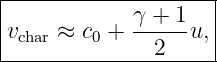
For a weak right-moving simple wave in an ideal gas, the local characteristic speed is
approximately
where c0 is the undisturbed sound speed, u is local particle velocity, and γ is the ratio of specific
heats.
A stronger compression therefore propagates faster than a weaker compression ahead of
it.
The rear of the wave catches the front.
The profile steepens.
When the gradient becomes sufficiently large, viscosity and thermal conduction become important
in a thin layer.
That layer is a shock.
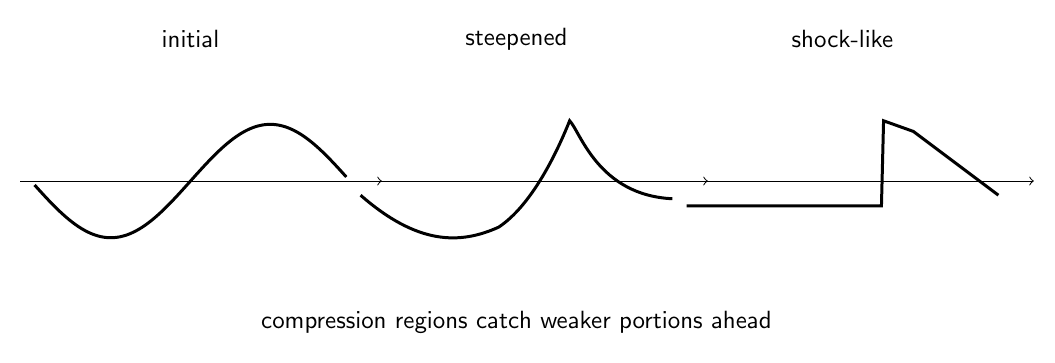
Figure 4. Finite-amplitude compression portions propagate faster than weaker portions. The
waveform steepens until dissipative physics produces a thin shock layer.
12 Shock-fixed reference frame
A shock is easiest to analyze in a frame where the shock surface is stationary.
Let region 1 be upstream and region 2 downstream.
Use:
- ρ1, p1, u1, h1 upstream,
- ρ2, p2, u2, h2 downstream.
The velocities are Normal to the shock in the shock-fixed frame.
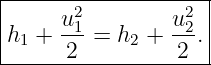
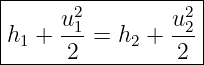
For a steady adiabatic shock with no shaft work, conservation of mass, momentum, and total
energy connects the two states.
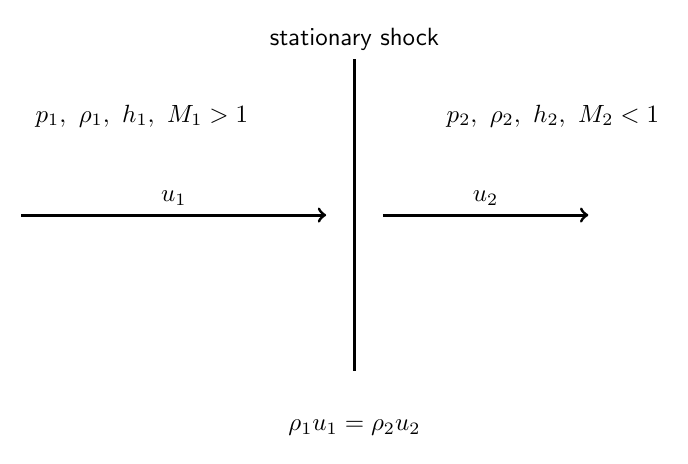
Figure 5. A normal shock viewed in the shock-fixed frame. Mass, momentum, and total energy
fluxes are conserved across the thin shock layer, while entropy increases.
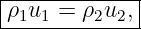
13 Mass conservation
For unit area,
The common mass flux is
A compressive shock has
Therefore
14 Momentum conservation
Normal momentum flux is
Thus
Since the flow slows through a compressive shock, static pressure rises:
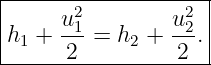
15 Energy conservation
For steady adiabatic flow with no shaft work,
Bulk kinetic energy per unit mass decreases while thermal enthalpy increases.
16 Rankine-Hugoniot conditions
The three jump relations
and
are the one-dimensional Rankine-Hugoniot conditions.
They express conservation.
A separate entropy condition selects the physically admissible compressive shock.
17 Entropy condition
A physical adiabatic shock is irreversible.
Therefore
Across a normal compressive shock:
- static pressure increases,
- density increases,
- temperature increases,
- normal flow speed decreases,
- entropy increases.
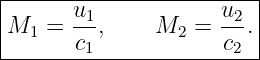
18 Upstream and downstream Mach numbers
Define
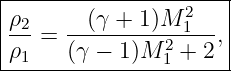
For an ideal-gas normal shock,
A normal shock converts supersonic normal flow into subsonic normal flow.
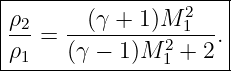
19 Ideal-gas density ratio
For a calorically perfect ideal gas,
As
the ratio approaches one.
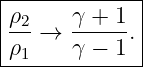
For a strong shock,
For air with
the strong-shock density ratio approaches
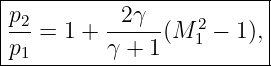
20 Ideal-gas pressure ratio
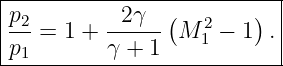
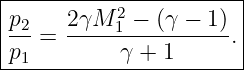
The normal-shock pressure ratio is
Equivalently,
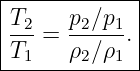
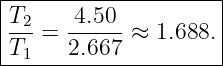
21 Temperature ratio
Using the ideal-gas law,
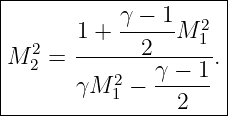
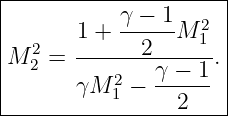
22 Downstream Mach number
For a normal shock,
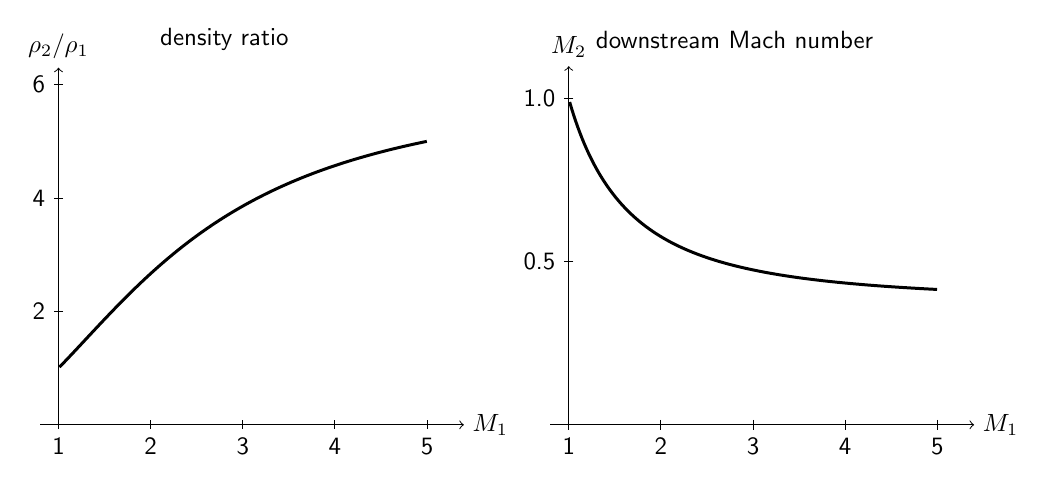
Figure 6. Representative ideal-gas normal-shock trends for air. Density increases with upstream
Mach number, while the downstream Mach number remains below one for a supersonic upstream
state.
23 Example 3: normal shock at Mach 2
Take
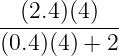
The density ratio is
 | =  | (55)
|
| = 2.667. | (56) |
The pressure ratio is
 | = 1 +  (4 − 1) | (57)
|
| = 4.50. | (58) |
Therefore
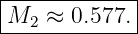
For the downstream Mach number,
| M22 | = 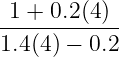 | (60)
|
| =  . | (61) |
Hence
24 Shock thickness
The jump equations model the shock as a discontinuity.
A real shock has small but finite thickness.
Within the layer:
- viscous stresses matter,
- heat conduction matters,
- strong gradients generate entropy.
These transport processes regularize the nonlinear steepening.
At macroscopic scales, the layer is often thin enough that the discontinuity approximation is
excellent.
25 Stagnation quantities
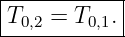
Across an adiabatic shock with no shaft work, total enthalpy is conserved.
For a calorically perfect ideal gas,
But the shock is irreversible, so stagnation pressure decreases:
The stagnation-pressure loss measures mechanical irreversibility.
26 Sonic-boom geometry
A supersonic aircraft continuously carries a shock system.
Consider ideal horizontal flight at altitude h.
Let the Mach angle be μ.
For an observer directly below the flight path, the shock cone reaches the observer when the
aircraft is horizontally ahead by distance x.
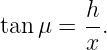
The right triangle gives
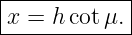
Therefore
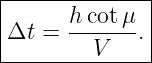
The ideal delay after overhead passage is
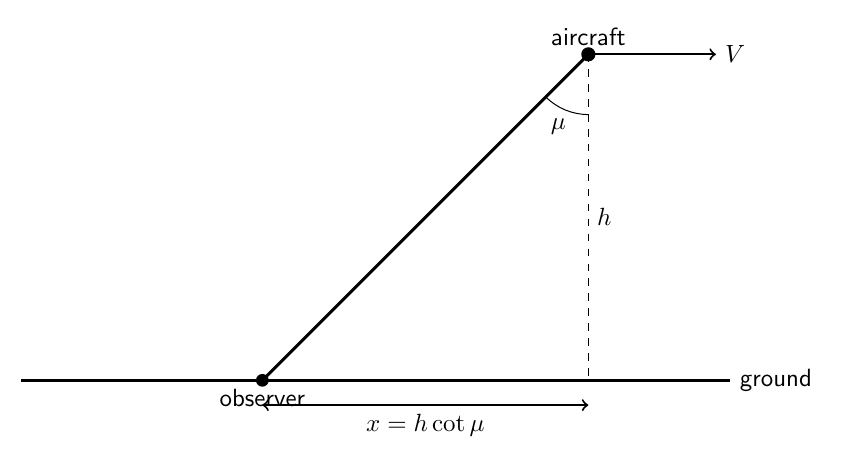
Figure 7. Ideal sonic-boom geometry for level flight. A ground observer encounters the trailing
shock cone after the aircraft has moved ahead by x = hcotμ.
27 Example 4: Mach 2 sonic-boom delay
Take
and
Then
and
The aircraft is ahead by
| x | = h cot 30∘ | (73)
|
| ≈ 17.32 km. | (74) |
The ideal delay is
| Δt | = 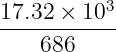 | (75)
|
| ≈ 25.25 s. | (76) |
28 A sonic boom is not only a Mach-one crossing event
A common misconception is that a sonic boom occurs only at the instant an aircraft first crosses
Mach one.
A continuously supersonic aircraft continuously carries a shock system.
Different observers hear the boom when that shock system passes them.
The relevant event is shock passage, not merely the earlier acceleration through the sonic
threshold.
29 N-wave signature
Far from a slender supersonic aircraft, the pressure history often resembles an N-shaped
waveform.
The observer can experience:
- a rapid positive pressure jump,
- a slower pressure evolution,
- a later rapid pressure change from the rear shock system.
The exact signature depends on aircraft geometry, atmospheric structure, propagation distance,
and nonlinear evolution.
30 Oblique shocks
A normal shock is perpendicular to the incoming flow.
Many supersonic flows contain oblique shocks.
If β is the shock angle measured from the upstream flow direction, the upstream normal Mach
number is
Normal-shock relations apply to the normal velocity component.
In the ideal inviscid model, the tangential velocity component is unchanged across the
shock.
For a weak oblique shock, the shock angle approaches the Mach angle.
31 Flow deflection and shock angle
For a calorically perfect ideal gas, the flow deflection angle 𝜃 and shock angle β satisfy
For a given supersonic Mach number and modest compression angle, weak- and strong-shock
branches can exist.
If the required turning is too large, an attached shock is impossible and the shock detaches.
32 Bow shocks
A blunt body generally produces a detached bow shock.
Near the stagnation line the shock is nearly normal.
Farther away it becomes increasingly oblique.
Examples include:
- blunt supersonic vehicles,
- atmospheric entry capsules,
- supersonic flow around spheres,
- astrophysical bow shocks.
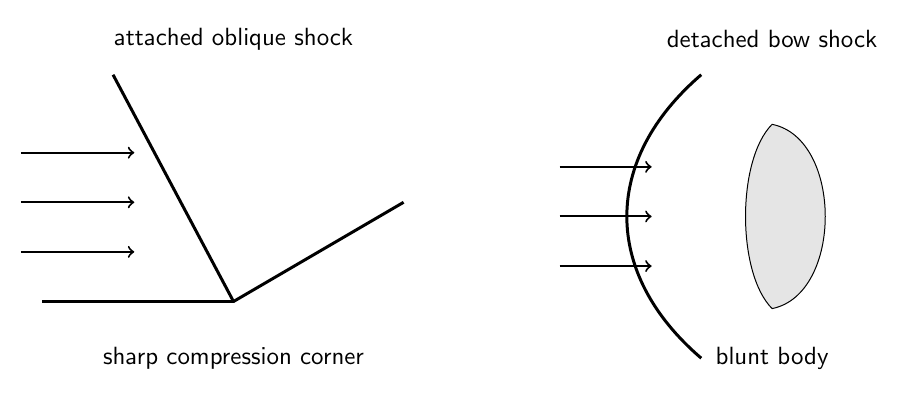
Figure 8. Supersonic flow can form an attached oblique shock at a sharp compression corner or a
detached bow shock ahead of a blunt body. In the weak-disturbance limit, the shock angle
approaches the Mach angle.
33 Information propagation in supersonic flow
The Mach-cone picture has a causal interpretation.
In a uniform supersonic stream, ordinary small disturbances are swept downstream.
They cannot propagate directly upstream against the flow.
This gives supersonic flow a different information structure from subsonic flow.
The geometry of characteristics determines which regions can influence one another.
34 Common mistakes
- Treating Mach number as a speed rather than the ratio V∕c.
- Using the Mach-angle relation for M < 1.
- Writing cos μ = 1∕M instead of sin μ = 1∕M.
- Assuming a larger Mach number gives a wider Mach cone.
- Calling every Mach wave a finite shock.
- Assuming finite shock angle always equals Mach angle.
- Extending linear acoustics through a finite shock without jump conditions.
- Forgetting that density increases and normal velocity decreases through a compressive
normal shock.
- Forgetting that entropy increases through a physical shock.
- Assuming stagnation pressure is conserved across an irreversible shock.
- Confusing stagnation temperature with static temperature.
- Applying normal-shock formulas to the total velocity of an oblique shock instead of its
normal component.
- Thinking a sonic boom occurs only once when the aircraft first crosses Mach one.
- Ignoring altitude and Mach angle in sonic-boom timing.
- Treating a detached bow shock as an attached Mach line.
35 Practice exercises
- Derive the Mach-angle relation from the wavefront-envelope construction.
- Calculate Mach angles for M = 1.2, 2, 3, and 5.
- Show that μ ≈ 1∕M radians for M ≫ 1.
- Explain geometrically why upstream acoustic influence is possible in subsonic flow but
not in a uniform supersonic stream.
- Explain the distinction between a Mach wave and a finite shock wave.
- Use the nonlinear characteristic-speed relation to explain waveform steepening.
- Derive the mass and momentum jump conditions from a shock-fixed control volume.
- State the energy jump condition and explain its physical meaning.
- Reproduce the Mach-2 normal-shock density, pressure, temperature, and downstream
Mach-number ratios.
- Evaluate the strong-shock density-ratio limit for air.
- Derive x = h cot μ for the ideal sonic-boom geometry.
- Reproduce the Mach-2, 10 km altitude sonic-boom delay example.
- Explain why a steadily supersonic aircraft produces a continuing shock system.
- For an oblique shock, identify the normal Mach number and explain which velocity
component remains unchanged.
- Explain why a sufficiently blunt body produces a detached bow shock.
36 Summary
The Mach number is
For supersonic small-disturbance motion,
A finite shock obeys mass conservation,
momentum conservation,
and total-enthalpy conservation,
For a physical adiabatic shock,
For an ideal gas,
and
Mach cones describe characteristic wave geometry.
Shock waves describe finite irreversible jumps.
Their connection is where linear waves meet nonlinear compressible flow.
References
References
[1] PhysicsLibrary, M06-14, Doppler Effect and Moving Sources and Observers.
[2] PhysicsLibrary, M06-11, Acoustic Waves, Sound Intensity, and Acoustic Impedance.
[3] A. P. French, Vibrations and Waves, W. W. Norton, 1971.
[4] J. D. Anderson, Modern Compressible Flow: With Historical Perspective, 3rd ed.,
McGraw-Hill, 2003.
[5] H. W. Liepmann and A. Roshko, Elements of Gasdynamics, Wiley, 1957.