1 Categorical Quantum Logics
This is a topic entry on Categorical quantum logics focusing on Quantum ŁM-algebraic Logic and
applications in quantum physics, QED, QFT, relativity theories, AQFT and quantum
gravity.
1.1 Fundamental Concepts of Space, Time and Space-Times in Quantum Theory vs. General
Relativity
A notable feature of current 21-st century physical thought involves a close examination of the
validity of the classical model of space-time as a 4–dimensional manifold equipped with a Lorentz
metric. The expectation of the earlier approaches to quantum gravity (QG) was to cope with
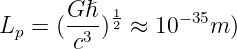
microscopic length scales where a traditional manifold structure (in the conventional sense) needs
to be forsaken (for instance, at the Planck length,
.
Whereas Newton, Riemann, Einstein, Weyl, Hawking, Penrose, Weinberg and many other
exceptionally creative theoreticians regarded physical space as represented by a continuum, there is
an increasing number of proponents for a discrete, or‘quantized’ structure of space–time, since
space itself is considered as discrete on the Planck scale. Like most radical theories, the latter
view carries its own set of problems. The biggest problem arises from the fact that any
discrete, ‘point-set’ (or discrete topology), view of physical space–time is not only in
immediate conflict with Einstein’s General Relativity representation of space–time as a
continuous Riemann space, but it also conflicts with the fundamental impossibility
of carrying out quantum measurements that would localize precisely either quantum
events or masses at ‘singular points’ (in the sense of disconnected, or isolated , sharply
defined, geometric points) in space–time. Since GR seems to break down at the Planck
scale, space–time may no longer be describable by a smooth manifold structure such as a
Riemann metric tensor. While not neglecting the large scale classical model, one needs
to propose a structure of ‘ideal observations’ as manifest in a limit, in some sense, of
‘discrete’, or at least separable, measurements, where in such a limit it also encompasses the
classical event. Further details are given in our recent, related paper (Baianu et al,
2007b).
1.2 Quantum Logics (QL) and Logic Lattice Algebras (LA): Operational Quantum Logic (OQL)
and Łukasiewicz quantum logic (LQL).
Quantum Fields, General Relativity and Symmetries. As the experimental findings in high-energy
physics–coupled with theoretical studies– have revealed the presence of new fields and symmetries,
there appeared the need in modern physics to develop systematic procedures for generalizing
space–time and quantum state space (QSS) representations in order to reflect these new
concepts. In the General Relativity (GR) formulation, the local structure of space–time,
characterized by its various tensors (of energy–momentum, torsion, curvature, etc.),
incorporates The Gravitational Fields surrounding various masses. In Einstein’s own
representation, the physical space–time of GR has the structure of a Riemannian R4 space
over large distances, although the detailed local structure of space–time – as Einstein
perceived it – is likely to be significantly different. On the other hand, there is a growing
consensus in theoretical physics that a valid theory of Quantum Gravity requires a
much deeper understanding of the small(est)–scale structure of Quantum Space–Time
(QST) than currently developed. In Einstein’s GR theory and his subsequent attempts at
developing a unified field theory (as in the space concept advocated by Leibnitz), space-time
does not have an independent existence from objects, matter or fields, but is instead an
entity generated by the continuous transformations of fields. Hence, the continuous
nature of space–time was adopted in GR and Einstein’s subsequent field theoretical
developments. Furthermore, the quantum, or ‘quantized’, versions of space-time, QST, are
operationally defined through local quantum measurements in general reference frames that
are prescribed by GR theory. Such a definition is therefore subject to the postulates
of both GR theory and the axioms of Local Quantum Physics. We must emphasize,
however, that this is not the usual definition of position and time observables in ‘standard’
QM. The general reference frame positioning in QST is itself subject to the Heisenberg
uncertainty principle, and therefore it acquires through quantum measurements, a certain
‘fuzziness’ at the Planck scale which is intrinsic to all microphysical quantum systems. Such
systems with fuzziness include spin networks that change in time thus giving birth to spin
foam.
Operational Quantum Logic (OQL) and Łukasiewicz Quantum Logic (LQL) As pointed out by von
Neumann and Birkhoff (1930), a logical foundation of quantum mechanics consistent with
quantum algebra is essential for both the completeness and mathematical validity of the
theory. The development of Quantum Mechanics from its very beginnings both inspired
and required the consideration of specialized logics compatible with a new theory of
measurements for microphysical systems. Such a specialized logic was initially formulated by von
Neumann and Birkhoff (1932) and called ‘Quantum Logic’. Subsequent research on
Quantum Logics (Chang, 1958; Genoutti, 1968; Dalla Chiara, 1968, 2004) resulted in
several approaches that involve several types of non-distributive lattice (algebra) for
n–valued quantum logics. Thus, modifications of the Łukasiewicz Logic Algebras that
were introduced in the context of algebraic categories by Georgescu and Vraciu (1973),
also recently reviewed and expanded by Georgescu (2006), can provide an appropriate
framework for representing quantum systems, or– in their unmodified form- for describing the
activities of complex networks in categories of Łukasiewicz Logic Algebras (Baianu,
1977).
Lattices and Von Neumann-Birkhoff (VNB) Quantum Logic: Definition and Some Logical
Properties. We commence here by giving the set-based definition of a Lattice. An s–lattice L, or a
‘set-based’ lattice, is defined as a partially ordered set that has all binary products (defined by the
s–lattice operation “ ∧
”) and coproducts (defined by the s–lattice operation “∨
”), with
the ”partial ordering” between two elements X and Y belonging to the s–lattice being
written as “X ≼ Y ”. The partial order defined by ≼ holds in Las X ≼ Y if and only if
X = X ∧
Y (or equivalently, Y = X ∨
Y Eq.(3.1)(p. 49 of Mac Lane and Moerdijk,
1992).
Łukasiewicz-Moisil (LM) Quantum Logic (LQL) and Algebras. With all truth ’nuances’ or
assertions of the type << system A is excitable to the i-th level and system B is excitable to the
j-th level >> one can define a special type of lattice which is subject to the axioms introduced by
Georgescu and Vraciu ( 1970) and that becomes a n-valued Łukasiewicz-Moisil, or LM, algebra.
Further algebraic and logic details are provided in Georgescu (2006) and Baianu et al (2007b). In
order to have the n-valued Łukasiewicz Logic Algebra represent correctly the basic behaviour of
quantum systems (i.e., as observed through measurements that involve a quantum system
interactions with a measuring instrument –which is a macroscopic object), several of these axioms
have to be significantly changed so that the resulting lattice becomes non-distributive and also
(possibly) non–associative (Dalla Chiara, 2004), in addition to being non-commutative. With an
appropriately defined quantum logic of events one can proceed to define Hilbert, or
‘nuclear’/Frechet, spaces in order to be able to utilize the ‘standard’ procedures of quantum
theories.
Deterministic Time–reversible– vs. Probabilistic Time–Irreversibility and its Laws- Unitary vs.
General Transformations A significant part of the scientific–philosophical work of Ilya Prigogine
(see e.g. Prigogine, 1980) has been devoted to the dynamical meaning of irreversibility expressed in
terms of the second law of Thermodynamics. For systems with strong enough instability of
motion, the concept of phase space trajectories is no longer meaningful and the dynamical
description has to be replaced by the notion of distribution functions on the phase space. The
viewpoint is that quantum theory produces a more coherent type of motion than in the
classical setting, and the quantum effects induce correlations between neighbouring
classical trajectories in phase space (which can be compared with the Bohr–Sommerfeld
postulate of the image of phase cells having area ℏ). Prigogine’s idea (1980) is to associate a
macroscopic entropy (or Lyapounov function) with a microscopic entropy operator M .
One also notes the possibility of ‘contingent Universes’ with this ‘probabilistic time’
paradigm. We must mention here that the time operator T represents the ‘internal time’,
whereas the usual, ‘secondary’ time in quantum dynamics is regarded as an average over T
(AN-2.6). Given the internal time’s ability to distinguish between between future and
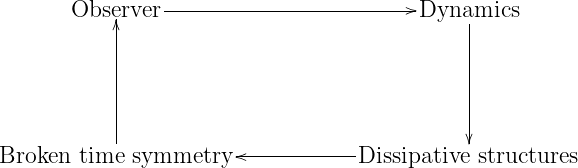
past, a self-consistent scheme may be summarized in the following diagram (Prigogine,
1980):
for which ‘irreversibility’ occurs as the intermediary in the following sequence:
Note however that certain quantum theorists, including Einstein, regarded the irreversibility of
time as an ‘illusion’. Others– operating with minimal representations in quantum logic for finite
quantum systems– go further still by denying that there is any need for real time to appear in the
formulation of quantum theory.
Fundamental Concepts of algebraic topology with Potential Application to Ontology Levels Theory
and Space-Time Structures. We shall consider briefly the potential impact of novel Algebraic
Topology concepts, methods and results on the problems of defining and classifying rigorously
quantum space-times. With the advent of Quantum Groupoids–generalizing Quantum Groups,
Quantum Algebra and Quantum Algebraic Topology, several fundamental concepts and new
theorems of Algebraic Topology may also acquire an enhanced importance through their potential
applications to current problems in theoretical and mathematical physics, such as those described
in an available preprint (Baianu, Brown and Glazebrook, 2006), and also in several recent
publications (Baianu et al 2007a,b; Brown et al 2007).
Now, if quantum mechanics is to reject the notion of a continuum, then it must also reject
the notion of the real line and the notion of a path. How then is one to construct a
homotopy theory? One possibility is to take the route signalled by Čech, and which
later developed in the hands of Borsuk into ‘Shape Theory’ (see, Cordier and Porter,
1989). Thus a quite general space is studied by means of its approximation by open
covers.
A few fundamental concepts of Algebraic Topology and category theory are summarized here that
have an extremely wide range of applicability to the higher complexity levels of reality as well as to
the fundamental, quantum level(s). Technical details are omitted in this section in order to focus
only on the ontologically-relevant aspects; full mathematical details are however also available
in a recent paper by Brown et al (2007) that focuses on a mathematical/conceptual
framework for a completely formal approach to categorical ontology and the theory of
levels.
1.2.1 Local–to–Global (LG) Construction Principles consistent with Quantum ‘Axiomatics’.
A novel approach to QST construction in Algebraic/Axiomatic QFT involves the use of generalized
fundamental theorems of algebraic topology from specialized, ‘globally well-behaved’ topological
spaces, to arbitrary ones (Baianu et al, 2007c). In this category, are the generalized,
higher homotopy van Kampen Theorems (HHvKT) of Algebraic Topology with novel and
unique non-Abelian applications. Such theorems greatly aid the calculation of higher
homotopy of topological spaces. R. Brown and coworkers (1999, 2004a,b,c) generalized
the van Kampen theorem, at first to fundamental groupoids on a set of base points
(Brown,1967), and then, to higher dimensional algebras involving, for example, homotopy double
groupoids and 2-categories (Brown, 2004a). The more sensitive algebraic invariant of
topological spaces seems to be, however, captured only by cohomology theory through
an algebraic ring structure that is not accessible either in homology theory, or in the
existing homotopy theory. Thus, two arbitrary topological spaces that have isomorphic
homology groups may not have isomorphic cohomological ring structures, and may also not
be homeomorphic, even if they are of the same homotopy type. Furthermore, several
non-Abelian results in algebraic topology could only be derived from the generalized Van
Kampen theorem (viz. Brown, 2004a), so that one may find links of such results to the
expected ‘non-commutative geometrical’ structure of quantized space–time (Connes,
1994). In this context, the important algebraic–topological concept of a Fundamental
Homotopy Groupoid (FHG) is applied to a Quantum Topological Space (QTS) as a
“partial classifier” of the invariant topological properties of quantum spaces of any
dimension; quantum topological spaces are then linked together in a crossed complex
over a quantum groupoid (Baianu, Brown and Glazebrook, 2006), thus suggesting the
construction of global topological structures from local ones with well-defined quantum
homotopy groupoids. The latter theme is then further pursued through defining locally
topological groupoids that can be globally characterized by applying the Globalization
Theorem, which involves the unique construction of the Holonomy Groupoid. We are
considering in a separate publication(Baianu et al 2007c) how such concepts might be applied
in the context of Algebraic or Axiomatic quantum field theory (AQFT) to provide a
local-to-global construction of Quantum space-times which would still be valid in the presence of
intense gravitational fields without generating singularities as in GR. The result of such
a construction is a Quantum Holonomy Groupoid, (QHG) which is unique up to an
isomorphism.
1.3 Theories: Axioms, Principles, Postulates and Laws.
The Greeks devised the axiomatic method, but thought of it in a different manner to that we do
today. One can imagine that the way Euclid’s Geometry evolved was simply through the delivering
of a course covering the established facts of the time. In delivering such a course, it is natural to
formalize the starting points, and so arranging a sensible structure. These starting points came to
be called postulates, definitions and axioms, and they were thought to deal with real, or even ideal,
objects, named points, lines, distance and so on. The modern view, initiated by the discovery of
non Euclidean geometry, is that the words points, lines, etc. should be taken as undefined terms,
and that axioms give the relations between these. This allows the axioms to apply to many other
instances, and has led to the Power of modern geometry and algebra. Clarifying the
meaning to be ascribed to ‘concept’, ‘percept’, ‘thought’, ‘emotion’, etc., and above
all the relations between these words, is clearly a fundamental but time–consuming
step. Although relations–in their turn–can be, and were, defined in terms of sets, their
axiomatic/categorical introduction greatly expands their range of applicability well beyond that of
set-relations. Ultimately, one deals with relations among relations and relations of higher
order.
The more rigorous scientific theories, including those founded in Logics and Mathematics, proceed
at a fundamental level from axioms and principles, followed in the case of ‘natural sciences’ by laws
of nature that are valid in specific contexts or well-defined situations. Whereas the hierarchical
theory of levels provides a powerful, systemic approach through categorical ontology, the
foundation of science involves universal models and theories pertaining to different levels of reality.
Such theories are based on axioms, principles, postulates and laws operating on distinct levels of
reality with a specific degree of complexity.
Because of such distinctions, inter-level principles or laws are rare and over-simplified principles
abound. As relevant examples, consider the Chemical/ Biochemical Thermodynamics, Physical
Biochemistry and Molecular Biology fields which have developed a rich structure of
specific-level laws and principles, however, without ‘breaking through’ to the higher,
emergent/integrative level of organismic biology. This does not detract of course from their
usefulness, it simply renders them incomplete as theories of biological reality. With the
possible exceptions of Evolution and Genetic Principles or Laws, Biology has until recently
lacked other universal principles for highly complex dynamics in organisms, populations
and species, as it will be shown in the following sections. One can therefore consider
Biology to be at an almost ‘pre–Newtonian’ stage by comparison with either Physics or
Chemistry.
Whereas axioms are rarely invoked in the natural sciences perhaps because of their
abstract and exacting attributes, (as well as their coming into existence through elaborate
processes of repeated abstraction and refinement), postulates are ‘obvious assumptions’
of extreme generality that do not require proof but just like axioms are accepted on
the basis of their very numerous, valid consequences. Principles and laws, even though
quite strict, may not apply under certain exceptional, or ‘singular’ situations. Natural
laws are applicable to well-defined zones or levels of reality, and are thus less general,
or universal, than principles. Unlike physical laws that are often expressed through
mathematical equations, principles are instead often explained in words, and tend to have the
most general form attainable/acceptable in an established theory. It is interesting to
note that in Greek, and later Roman antiquity, both philosophers and orators did link
philosophy and logic; moreover, in medieval time, first Francis Bacon, then Newton
opted for quite precise formulations of “natural philosophy” and a logical approach to
‘objective’ reality. In Newton’s approach, the logical and precise formulation of such “natural
principles” demanded the development of mathematical concepts suitable for the exact
determination and quantification of the rate of a change in the “state of motion” of any
mechanical body, or system. Later philosophical developments have strayed from such precise
formulations and, indeed, mathematical developments seem to have lost their appeal in ‘natural
philosophy’.
It is also in this context that the ‘local-to-global’ model approach becomes relevant, as in the case
of generalized van Kampen theorems (see the Brown, Glazebrook and Baianu (2007) paper for a
concise presentation of the van Kampen generalized theorems).
Interestingly, the founder of relational biology, Nicolas Rashevsky (1968) proposed that physical
laws and principles can be expressed in terms of mathematical functions, or mappings, and are thus
being predominantly expressed in a numerical form, whereas the laws and principles of biological
organisms and societies need take a more general form in terms of quite general, or
abstract–mathematical and logical relations which cannot always be expressed numerically; the
latter are often qualitative, whereas the former are predominantly quantitative. According to his
suggested criterion, string theories may not be characteristic of the physical domain as they
involve many qualitative relations and features. In this respect, one may also suggest
that modern, Abstract Art, in its various forms– if considered as a distinct class of
representations–has moved ahead of modern philosophy to attempt universal representations of
reality in a precise but flexible manner, thus appealing to both reason and emotions
combined.
Symmetry, commutativity and Abelian Structures.
The hierarchy constructed above, up to level 3, can be further extended to higher, n-levels, always
in a consistent, natural manner, that is using commutative diagrams. Let us see therefore a few
simple examples or specific instances of commutative properties. The type of global, natural
hierarchy of items inspired by the mathematical TC-FNT has a kind of internal symmetry because
at all levels, the link compositions are natural, that is, if f : x→y and g : y→z h : x→z, then the
composition of morphism g with f is given by another unique morphism h = g ∘ f. This
general property involving the equality of such link composition chains or diagrams
comprising any number of sequential links between the same beginning and ending
objects is called commutativity (see for example Samuel and Zarisky, 1957), and is often
expressed as a naturality condition for diagrams. This key mathematical property also
includes the mirror-like symmetry x ⋆ y = y ⋆ x; when x and y are operators and the
symbol ’⋆’ represents the operator multiplication. Then, the equality of x ⋆ y with y ⋆ x
defines the statement that ”the x and y operators commute”; in physical terms, this
translates into a sharing of the same set of eigenvalues by the two commuting operators,
thus leading to ‘equivalent’ numerical results (i.e., up to a multiplication constant);
furthermore, the observations X and Y corresponding, respectively, to these two operators
would yield the same result if X is performed before Y in time, or if Y is performed first
followed by X. This property, when present, is very convenient for both mathematical
and physical applications (such as those encountered in quantum mechanics). When
commutativity is global in a structure, as in an Abelian (or commutative) group, commutative
groupoid, commutative ring, etc., such a structure that is commutative throughout is
usually called Abelian. However, in the case of category theory, this concept of Abelian
structure has been extended to a special class of categories that have meta-properties
formally similar to those of the category of commutative groups, Ab-G; the necessary and
sufficient conditions for such ‘Abelianness’ of categories other than that of Abelian groups
were expressed as three axioms Ab1 to Ab3 and their duals (Freyd, 1964; see also the
details in Baianu et al 2007b and Brown et al 2007). A first step towards re-gaining
something like the ‘global commutativity’ of an Abelian group is to require that all classes of
morphisms [A,B] or Hom(A,B) have the structure of commutative groups; subject to
a few other general conditions such categories are called additive. Then, some kind
of global commutativity is assured for all morphisms of additive categories. However,
further conditions are needed to make additive categories ‘Abelian’, and additional
properties were also posited for Abelian categories in order to extend the applications of
Abelian category theory to other fields of modern mathematics (Grothendieck, 1957;
Grothendieck and Dieudoné 1960; Oberst 1969; Popescu 1973.) A Homotopy theory
was also formulated in Abelian categories (Kleisli, 1962). The equivalence of Abelian
categories was reported by Roux, and important imbedding theorems were proved by
Mitchell (1964) and by Lubkin (1960); a characterization of Abelian categories with
generators and exact limits was presented by Gabriel and Popescu (1964). As one can
see from both earlier and recent literature, Abelian categories have been studied in
great detail, even though one cannot say that all their properties have been already
found.
h : x→z, then the
composition of morphism g with f is given by another unique morphism h = g ∘ f. This
general property involving the equality of such link composition chains or diagrams
comprising any number of sequential links between the same beginning and ending
objects is called commutativity (see for example Samuel and Zarisky, 1957), and is often
expressed as a naturality condition for diagrams. This key mathematical property also
includes the mirror-like symmetry x ⋆ y = y ⋆ x; when x and y are operators and the
symbol ’⋆’ represents the operator multiplication. Then, the equality of x ⋆ y with y ⋆ x
defines the statement that ”the x and y operators commute”; in physical terms, this
translates into a sharing of the same set of eigenvalues by the two commuting operators,
thus leading to ‘equivalent’ numerical results (i.e., up to a multiplication constant);
furthermore, the observations X and Y corresponding, respectively, to these two operators
would yield the same result if X is performed before Y in time, or if Y is performed first
followed by X. This property, when present, is very convenient for both mathematical
and physical applications (such as those encountered in quantum mechanics). When
commutativity is global in a structure, as in an Abelian (or commutative) group, commutative
groupoid, commutative ring, etc., such a structure that is commutative throughout is
usually called Abelian. However, in the case of category theory, this concept of Abelian
structure has been extended to a special class of categories that have meta-properties
formally similar to those of the category of commutative groups, Ab-G; the necessary and
sufficient conditions for such ‘Abelianness’ of categories other than that of Abelian groups
were expressed as three axioms Ab1 to Ab3 and their duals (Freyd, 1964; see also the
details in Baianu et al 2007b and Brown et al 2007). A first step towards re-gaining
something like the ‘global commutativity’ of an Abelian group is to require that all classes of
morphisms [A,B] or Hom(A,B) have the structure of commutative groups; subject to
a few other general conditions such categories are called additive. Then, some kind
of global commutativity is assured for all morphisms of additive categories. However,
further conditions are needed to make additive categories ‘Abelian’, and additional
properties were also posited for Abelian categories in order to extend the applications of
Abelian category theory to other fields of modern mathematics (Grothendieck, 1957;
Grothendieck and Dieudoné 1960; Oberst 1969; Popescu 1973.) A Homotopy theory
was also formulated in Abelian categories (Kleisli, 1962). The equivalence of Abelian
categories was reported by Roux, and important imbedding theorems were proved by
Mitchell (1964) and by Lubkin (1960); a characterization of Abelian categories with
generators and exact limits was presented by Gabriel and Popescu (1964). As one can
see from both earlier and recent literature, Abelian categories have been studied in
great detail, even though one cannot say that all their properties have been already
found.
However, not all quantum operators ‘commute’, and not all categorical diagrams or
mathematical structures are, or need be, commutative. Non-commutativity may therefore
appear as a result of ‘breaking’ the ‘internal symmetry’ represented by commutativity. As
a physical analogy, this might be considered a kind of ‘symmetry breaking’ which is
thought to be responsible for our expanding universe and CPT violation, as well as many
other physical phenomena such as phase transitions and superconductivity (Weinberg,
2003).
References
[1] Baianu, I.C. and R. Poli. (2008), From Simple to Complex and Ultra-Complex
Systems: A Paradigm Shift Towards Non-Abelian Systems Dynamics., In: Theory and
Applications of Ontology, vol. 1, R. Poli, Ed., Springer: Berlin.
[2] Brown, R., Glazebrook, J. F. and I.C. Baianu.(2007), A Conceptual, Categorical and
Higher Dimensional Algebra Framework of Universal Ontology and the Theory of Levels
for Highly Complex Structures and Dynamics., Axiomathes (17): 321–379.
[3]
Baianu I. C., Brown R., Georgescu G. and J. F. Glazebrook.(2006), Complex Nonlinear
Biodynamics in Categories, Higher Dimensional Algebra and Łukasiewicz–Moisil Topos:
Transformations of Neuronal, Genetic and Neoplastic Networks, Axiomathes, 16 Nos.
1–2: 65–122.
[4] Baianu, I.C., R. Brown and J. F. Glazebrook.(2007), A Non-Abelian, Categorical
Ontology of Spacetimes and Quantum Gravity, Axiomathes, 17: 169-225.
[5] Poli, R. (1998), Levels,Axiomathes, 9, 1-2, pp. 197-211.
[6] Poli, R. (2001a), The Basic Problem of the Theory of Levels of Reality, Axiomathes,
12, 3-4, pp. 261-283.
[7] Poli, R. (2001b), Alwis. Ontology for Knowledge Engineers. PhD Thesis, Univ. of
Utrecht.