0.1 Homotopy double groupoid of a Hausdorff space
Let X be a Hausdorff space. Also consider the HDA concept of a double groupoid, and how it can
be completely specified for a Hausdorff space, X. Thus, in ref. [2] Brown et al. associated
to X a double groupoid, ρ2□(X) , called the homotopy double groupoid of X which is
completely defined by the data specified in Definitions 0.1 to 0.3 in this entry and related
objects.
Generally, the geometry of squares and their compositions leads to a common representation of a
double groupoid in the following form:
where M is a set of ‘points’, H,V are ‘horizontal’ and ‘vertical’ groupoids, and S is a set of
‘squares’ with two compositions.
The laws for a double groupoid are also defined, more generally, for any topological space 𝕋, and
make it also describable as a groupoid internal to the category of groupoids. Further details of this
general definition are provided next.
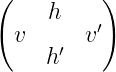
Given two groupoids H,V over a set M, there is a double groupoid □(H,V ) with H,V as
horizontal and vertical edge groupoids, and squares given by quadruples
for which we assume always that h,h′∈ H, v,v′∈ V and that the initial and final points of these
edges match in M as suggested by the notation, that is for example sh = sv,th = sv′,…, etc. The
compositions are to be inherited from those of H,V , that is:
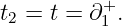
Alternatively, the data for the above double groupoid D can be specified as a triple of groupoid
structures:
where:
and
Then, as a first step, consider this data for the homotopy double groupoid specified in the following
definition; in order to specify completely such data one also needs to define the related concepts of
thin equivalence and the relation of cubically thin homotopy, as provided in the two definitions
following the homotopy double groupoid data specified above and in the (main) Definition
0.1.
Definition 0.1. The data for the homotopy double groupoid, ρ□(X), will be denoted by :

Here ρ1(X) denotes the path groupoid of X from ref. [1] where it was defined as follows. The
objects of ρ1(X) are the points of X. The morphisms of ρ1□(X) are the equivalence classes of
paths in X with respect to the following (thin) equivalence relation ∼T , defined as follows.
The data for ρ2□(X) is defined last; furthermore, the symbols specified after the thin square
symbol specify both the sides (or the groupoid ‘dimensions’) of the square which are involved
(i.e., 1 and 2, respectively), and also the order in which the shown operations (∂1−, 𝜀
2... ,
etc) are to be performed relative to the thin square specified for each groupoid, ρ1 or ρ2;
moreover, all such symbols are explicitly and precisely defined in the related entries of the
concepts involved in this definition. These two groupoids can also be pictorially represented
as the (H,V ) pair depicted in the large diagram (0.1), or D, shown at the top of this page.
Definition 0.2. Thin Equivalence
Let a,a′ : x ≃ y be paths in X. Then a is thinly equivalent to a′, denoted a ∼T a′, if there
is a thin relative homotopy between a and a′.
We note that ∼ T is an equivalence relation, see [2]. We use ⟨a⟩ : x ≃ y to denote the
∼ T class of a path a : x ≃ y and call ⟨a⟩ the semitrack of a. The groupoid structure of
ρ1□(X) is induced by concatenation, +, of paths. Here one makes use of the fact that if
a : x ≃ x′, a′ : x′ ≃ x′′, a′′ : x′′ ≃ x′′′ are paths then there are canonical thin relative
homotopies
The source and target maps of ρ1□(X) are given by
if ⟨a⟩ : x ≃ y is a semitrack. Identities and inverses are given by
At the next step, in order to construct the groupoid ρ2□(X) data in Definition 0.1, R.
Brown et al. defined as follows a relation of cubically thin homotopy on the set R2□(X) of
squares.
Definition 0.3. Cubically Thin Homotopy
Let u,u′ be squares in X with common vertices.
-
1.
- A cubically thin homotopy U : u ≡T □u′ between u and u′ is a cube U ∈ R
3□(X) such
that
(i) U is a homotopy between u and u′,
i.e. ∂1−(U) = u, ∂
1+(U) = u′,
(ii) U is rel. vertices of I2,
i.e. ∂2−∂
2−(U), ∂
2−∂
2+(U), ∂
2+∂
2−(U), ∂
2+∂
2+(U) are constant,
(iii) the faces ∂iα(U) are thin for α = ±1, i = 1, 2.
-
2.
- The square u is cubically T-equivalent to u′, denoted u ≡T □u′ if there is a cubically thin
homotopy between u and u′.
Remark 0.1. By removing from the above double groupoid construction the condition that
all morphisms must be invertible one obtains the prototype of a double category.
References
[1] K.A. Hardie, K.H. Kamps and R.W. Kieboom., A homotopy 2-groupoid of a Hausdorff
Applied Categorical Structures, 8 (2000): 209-234.
[2] R. Brown, K.A. Hardie, K.H. Kamps and T. Porter., A homotopy double groupoid
of a Hausdorff space , Theory and Applications of Categories 10,(2002): 71-93.