0.1 Higher dimensional, generalized van Kampen theorems (HD-GVKT)
There are several generalizations of the original van Kampen theorem, such as its extension to
crossed complexes, its extension in categorical form in terms of colimits, and its generalization to
higher dimensions, i.e., its extension to 2-groupoids, 2-categories and double groupoids
[3].
With this HDA-GVKT approach one obtains comparatively quickly not only classical results such
as the Brouwer degree and the relative Hurewicz theorem, but also non–commutative results on
second relative homotopy groups, as well as higher dimensional results involving the action of, and
also presentations of, the fundamental group. For example, the fundamental crossed complex ΠX∗
of the skeletal filtration of a CW–complex X is a useful generalization of the usual cellular chains
of the universal cover of X. It also gives a replacement for singular chains by taking X to be the
geometric realization of a singular complex of a space. Non-Abelian higher homotopy (and
homology) results in higher dimensional algebra (HDA) were proven by Ronald Brown that
generalize the original van Kampen’s theorem for fundamental groups (ordinary homotopy, [10]) to
fundamental groupoids ([1]) double groupoids, and higher homotopy ([7]); please see also
Ronald Brown’s presentation of the original van Kampen’s theorem at PlanetMath.org
[8].
Related research areas are: algebraic topology, higher dimensional algebra (HDA) , higher
dimensional homotopy, non-Abelian homology theory, supercategories, axiomatic theory of
supercategories, n-categories, lextensive categories, topoi/toposes, double groupoids,
omega-groupoids, crossed complexes of groupoids, double categories, double algebroids, categorical
ontology, axiomatic foundations of Mathematics, and so on.
Its potential for applications in quantum algebraic topology (QAT), and especially in non-Abelian
quantum algebraic topology (NAQAT) related to QFT, HQFT, TQFT, quantum gravity and
supergravity (quantum field) theories has also been recently pointed out and explored
([9, 11, 13]).
0.2 Generalized van Kampen theorem (GvKT)
Consideration of a set of base points leads next to the following theorem for the fundamental
groupoid.
0.2.1 The van Kampen theorem for the fundamental groupoid, π1(X,X0), [1]
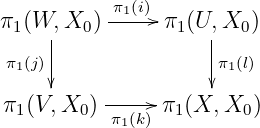
Let the space X be the union of open sets U,V with intersection W, and let X0 be a subset of X
meeting each path component of U,V,W. Then:
- (C) (connectivity) X0 meets each path component of X, and
- (I) (isomorphism) the diagram of groupoid morphisms induced by inclusions:
is a pushout of groupoids
0.2.2 Remarks
When extended to the context of double groupoids this theorem leads to a higher dimensional
generalization of the Van Kampen theorem, the HD-GVKT, [3].
Note that this theorem is a generalization of an analogous Van Kampen theorem for the
fundamental group, [1, 10]. From this theorem, one can compute a particular fundamental group
π1(X,x0) using combinatorial information on the graph of intersections of path components of
U,V,W, but for this it is useful to develop the algebra of groupoids. Notice two special features of
this result:
- (i) The computation of the invariant one wants to obtain, the fundamental group, is
obtained from the computation of a larger structure, and so part of the work is to give
methods for computing the smaller structure from the larger one. This usually involves
non canonical choices, such as that of a maximal tree in a connected graph. The work
on applying groupoids to groups gives many examples of such methods [6, 7].
- (ii) The fact that the computation can be done at all is surprising in two ways: (a) The
fundamental group is computed precisely, even though the information for it uses input
in two dimensions, namely 0 and 1. This is contrary to the experience in homological
algebra and algebraic topology, where the interaction of several dimensions involves
exact sequences or spectral sequences, which give information only up to extension,
and (b) the result is a non commutative invariant, which is usually even more difficult
to compute precisely.
0.2.3 Essential data from ref. [3]
The reason for this success seems to be that the fundamental groupoid π1(X,X0) contains
information in dimensions 0 and 1, and therefore it can adequately reflect the geometry of the
intersections of the path components of U,V,W and the morphisms induced by the inclusions of W
in U and V . This fact also suggested the question of whether such methods could be extended
successfully to higher dimensions.
References
[1] R. Brown, Groupoids and Van Kampen’s theorem., Proc. London Math. Soc. (3) 17
(1967) 385-401.
[2] R. Brown, Topology and Groupoids., Booksurge PLC (2006).
[3] R. Brown, K.A. Hardie, K.H. Kamps and T. Porter, A homotopy double groupoid of
a Hausdorff space, Theory and Applications of Categories. 10 (2002) 71-93.
[4] R. Brown and A. Razak, A Van Kampen theorem for unions of non-connected spaces,
Archiv. Math. 42 (1984) 85-88.
[5] R. Brown and G. Janelidze.:1997, Van Kampen theorems for categories of covering
morphisms in lextensive categories, J. Pure Appl. Algebra, 119: 255–263, ISSN 0022-4049.
[6] P.J. Higgins, Categories and Groupoids, van Nostrand: New York, 1971; also Reprints
of Theory and Applications of Categories, No. 7 (2005) pp 1-195.
[7] Brown R., Higgins P.J., Sivera, R. (2008), Non-Abelian algebraic topology, (in
preparation)., available here as a PDF; PDFs of other relevant HDA papers .
[8] R. Brown: VanKampen-sTheorem
[9] Brown, R., Glazebrook, J. F. and I.C. Baianu.(2007), A Conceptual, Categorical and
Higher Dimensional Algebra Framework of Universal Ontology and the Theory of Levels
for Highly Complex Structures and Dynamics., Axiomathes (17): 321–379.
[10] van Kampen, E. H. (1933), On the Connection Between the Fundamental Groups
of some Related Spaces, Amer. J. Math. 55: 261–267.
[11] Baianu I. C., Brown R., Georgescu G. and J. F. Glazebrook.(2006),
Complex Nonlinear Biodynamics in Categories, Higher Dimensional Algebra and
Łukasiewicz–Moisil Topos: Transformations of Neuronal, Genetic and Neoplastic
Networks., Axiomathes, 16 Nos. 1–2: 65–122.
[12] Baianu, I.C., R. Brown and J. F. Glazebrook.(2007), A Non-Abelian, Categorical
Ontology of Spacetimes and Quantum Gravity, Axiomathes, 17: 169-225.
[13] Baianu, I. C., Brown, R. and J. F. Glazebrook.(2008), Quantum Algebraic Topology
and Field Theories., pp.145, the Monograph’s PDF is here available(Preprint).