Van Kampen’s theorem for fundamental groups is stated as follows:
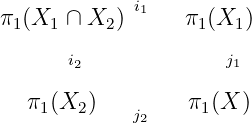
Theorem 1. Let X be a topological space which is the union of the interiors of two path
connected subspaces X1,X2. Suppose X0 := X1 ∩ X2 is path connected. Let further ∗∈ X0
and ik: π1(X0,∗) → π1(Xk,∗), jk: π1(Xk,∗) → π1(X,∗) be induced by the inclusions for
k = 1, 2. Then X is path connected and the inclusion morphisms draw a commutative pushout
diagram:
The natural morphism
is an isomorphism, that is, the fundamental group of X is the free product of the fundamental
groups of X1 and X2 with amalgamation of π1(X0,∗).
Usually the morphisms induced by inclusion in this theorem are not themselves injective, and the
more precise version of the statement is in terms of pushouts of groups.
The notion of pushout in the category of groupoids allows for a version of the theorem for the non
path connected case, using the fundamental groupoid π1(X,A) on a set A of base points, [1]. This
groupoid consists of homotopy classes rel end points of paths in X joining points of A ∩ X.
In particular, if X is a contractible space, and A consists of two distinct points of X,
then π1(X,A) is easily seen to be isomorphic to the groupoid often written ℐ with two
vertices and exactly one morphism between any two vertices. This groupoid plays a role
in the theory of groupoids analogous to that of the group of integers in the theory of
groups.
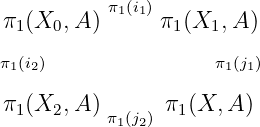
Theorem 2. Let the topological space X be covered by the interiors of two subspaces X1,X2
and let A be a set which meets each path component of X1,X2 and X0 := X1 ∩ X2. Then
A meets each path component of X and the following diagram of morphisms induced by
inclusion
is a pushout diagram in the category of groupoids.
The interpretation of this theorem as a calculational tool for fundamental groups needs some
development of ‘combinatorial groupoid theory’, [2, 4]. This theorem implies the calculation of the
fundamental group of the circle as the group of integers, since the group of integers
is obtained from the groupoid ℐ by identifying, in the category of groupoids, its two
vertices.
There is a version of the last theorem when X is covered by the union of the interiors of a family
{Uλ : λ ∈ Λ} of subsets, [3]. The conclusion is that if A meets each path component of all
1,2,3-fold intersections of the sets Uλ, then A meets all path components of X and the
diagram
of morphisms induced by inclusions is a coequaliser in the category of groupoids.
References
[1] R. Brown, “Groupoids and Van Kampen’s theorem”, Proc. London Math. Soc. (3) 17
(1967) 385-401.
[2] R. Brown, Topology and Groupoids, Booksurge PLC (2006).
[3] R. Brown and A. Razak, “A van Kampen theorem for unions of non-connected
spaces”, Archiv. Math. 42 (1984) 85-88.
[4] P.J. Higgins, Categories and Groupoids, van Nostrand, 1971, Reprints of Theory and
Applications of Categories, No. 7 (2005) pp 1-195.