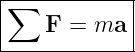
Newton’s Laws of Motion
Newton’s laws connect kinematics to dynamics. Kinematics describes how position, velocity, and
acceleration change; dynamics asks what physical interactions produce those changes. In
Newtonian mechanics those interactions are represented by forces.
The three laws provide the organizing framework:
- An inertial frame is one in which a body with zero net force moves with constant
velocity.
- The net force determines the rate of change of momentum.
- Forces between two interacting bodies occur in equal-and-opposite pairs acting on
different bodies.
These statements are vector laws. The direction of a force matters just as much as its
magnitude.
1 Newton’s first law and inertial frames
Newton’s first law may be stated as follows:
In an inertial reference frame, a body remains at rest or moves with constant
velocity unless acted upon by a nonzero net force.
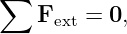
In modern vector notation,
Constant velocity includes the special case of rest,
The first law therefore does not say that an object naturally comes to rest. It says that no change
in velocity is required when the net force is zero.
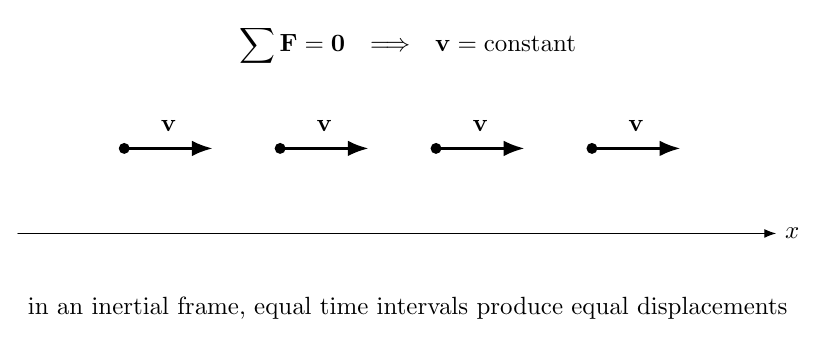
Figure 1. In an inertial frame, zero net force corresponds to constant velocity. Equal time intervals
therefore produce equal displacement vectors.
The first law is also important because it identifies the class of frames in which Newton’s laws take
their simplest form. If one frame is inertial, then any other frame moving with constant velocity
relative to it is also inertial in Newtonian mechanics.
If a frame accelerates or rotates relative to an inertial frame, additional inertial or fictitious-force
terms are required. Those effects are treated later in non-inertial-frame mechanics.
2 Force as a vector interaction
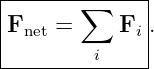
A force represents an interaction capable of changing a body’s momentum. Forces add vectorially.
If several interactions act on the same particle, the net force is
In Cartesian coordinates,
The phrase net force is essential. Newton’s second law relates acceleration to the vector
sum of all forces acting on the chosen body, not automatically to any one individual
force.
3 Newton’s second law in momentum form
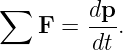
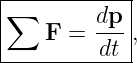
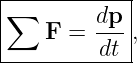
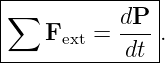
Newton’s second law is most generally introduced in particle mechanics as
where the linear momentum is
Thus force measures how rapidly the momentum vector changes.
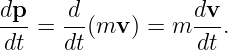
For a particle of constant mass,
Because
we obtain the familiar constant-mass form
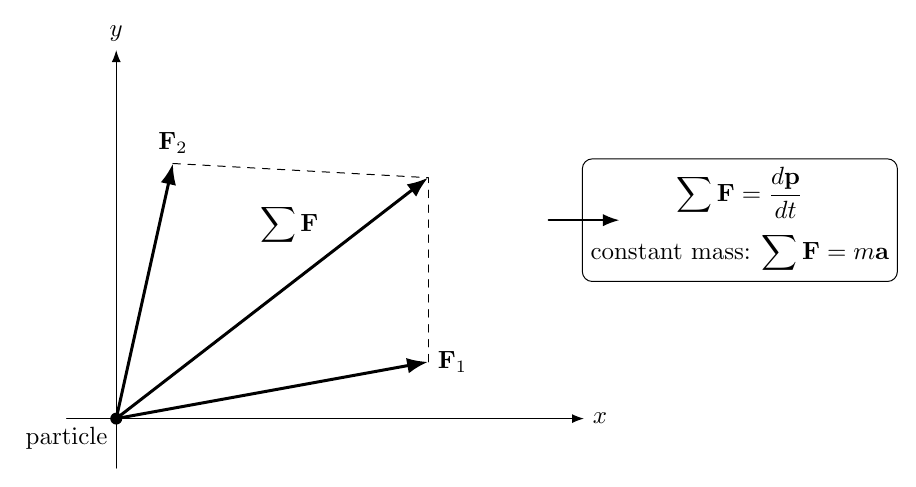
Figure 2. Forces add vectorially. Newton’s second law relates their vector sum to the momentum
derivative, or to ma when the particle mass is constant.
4 Component form of Newton’s second law
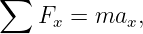
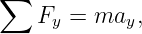
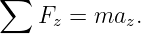
For constant mass, the vector equation
is equivalent to the component equations
and
This component form is the basis for most introductory dynamics calculations. M02-02 develops
the systematic free-body-diagram procedure used to identify the forces before these equations are
written.
5 Mass and inertia
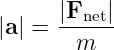
In Newtonian mechanics, inertial mass measures resistance to acceleration. For the same net force,
a larger mass produces a smaller acceleration:
when the acceleration and net force are collinear.
If two bodies experience the same net-force vector and
then
This inverse dependence is one reason Newton’s third law does not imply equal accelerations for
two interacting bodies.
6 Equilibrium and constant-velocity motion
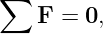
If
then for constant mass
The velocity is therefore constant. Two distinct situations are possible:
Thus equilibrium means zero acceleration, not necessarily zero velocity.
7 Newton’s third law
Newton’s third law describes the forces generated by a mutual interaction. If body A
exerts a force on body B, then body B exerts an equal-and-opposite force on body
A.
Using the notation FA←B for the force on A due to B,
The two forces have equal magnitude and opposite direction, but they act on different
bodies.
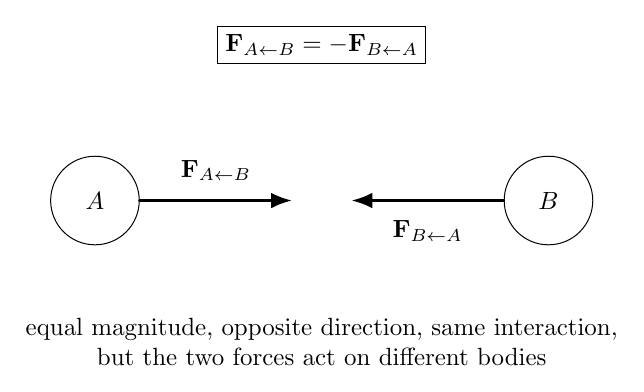
Figure 3. A Newton-third-law pair belongs to one interaction but acts on two different bodies.
The forces are equal in magnitude and opposite in direction.
This distinction prevents a common mistake. A third-law pair does not normally cancel in the
equation of motion for one body because only one member of the pair acts on that
body.
8 Third-law pairs versus balanced forces
Suppose a book rests motionless on a horizontal support. The forces acting on the book
may balance so that its net force is zero. Those balanced forces are not automatically a
Newton-third-law pair because they can arise from different interactions.
A true third-law partner of a force on the book acts on the other body participating in that same
interaction.
The test is therefore:
- identify the interaction;
- identify the two bodies participating in it;
- place one force on each body;
- verify equal magnitude and opposite direction.
The systematic identification of forces and their bodies is developed further in M02-02.
9 Systems of particles and external force
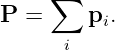
Newton’s laws may be extended from a single particle to a system. Let the total momentum of a
system be
Summing the particle equations gives
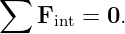
For internal forces that occur in equal-and-opposite Newton-third-law pairs, the internal sum
cancels:
Therefore
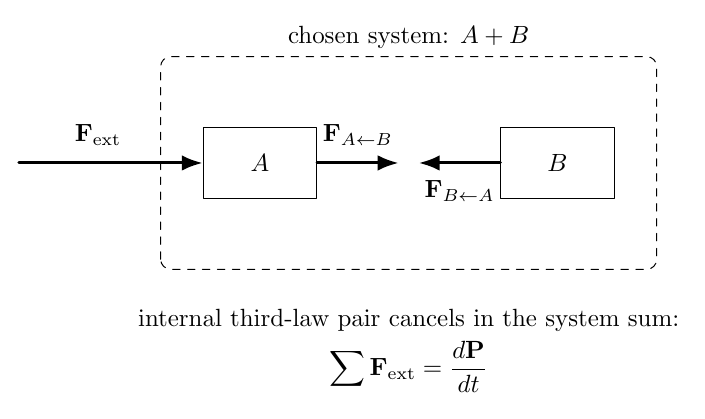
Figure 4. For a system containing both interacting bodies, the internal third-law pair cancels in
the system force sum. The total system momentum changes according to the net external force.
For an isolated system,
so
Thus total linear momentum is conserved. The full treatment belongs to the later momentum
sequence, but the connection follows directly from Newton’s laws.
10 Newton’s laws and Galilean transformations
Suppose frame G′ moves at constant velocity V relative to inertial frame G. Newtonian
relative-motion kinematics gives
Because V is constant,
For the same physical forces and constant mass,
has the same form in both frames. This Galilean invariance is a defining feature of Newtonian
inertial mechanics.
If the relative frame acceleration is nonzero, then a′≠a and the simple form of Newton’s second law
requires additional inertial-force terms.
11 Units and dimensions
The SI unit of force is the newton,
From
the dimensions are
The momentum form gives the same result:
12 What Newton’s laws do not specify
Newton’s laws determine motion only after the actual physical forces are known. They do not by
themselves specify formulas for gravity, normal forces, Tension, springs, friction, drag, or
electromagnetic interactions.
Those force models are developed in the following dynamics articles. The general workflow
is
The first step will be formalized in M02-02 using Free-body diagrams.
13 Worked example 1: one-dimensional net force
A 5.0 kg particle is acted on by an 18 N force to the right and an 8.0 N force to the left. Find its
acceleration.
Choose right as positive. The net force is
Newton’s second law gives
Therefore
14 Worked example 2: two-dimensional force sum
A 4.0 kg particle experiences
and
The net force is
Thus
The acceleration magnitude is
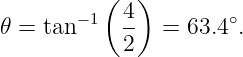
Its direction above the positive x axis is
15 Worked example 3: using the momentum form
A particle has momentum
Find the net force at t = 2.0 s.
Using Newton’s second law,
Therefore
At t = 2.0 s,
This example shows why the momentum form is conceptually more general than starting from
ma.
16 Worked example 4: third-law forces and unequal accelerations
Two skaters of masses
push on one another. During a 0.50 s interval, suppose the force magnitude between them is
approximately constant at 120 N and external horizontal forces are negligible.
Newton’s third law gives equal-and-opposite interaction forces:
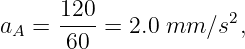
The acceleration magnitudes are
and
The forces are equal, but the accelerations are not because the masses differ.
If both begin at rest, their speed changes over 0.50 s are
and
Their momentum changes have equal magnitude,
and opposite directions.
17 Practice problems
- A puck moves at 6.0 m/s east in an inertial frame. The net force on it is zero for 8.0
s. Find its velocity after the interval and its displacement.
- A 3.0 kg particle experiences 14 N east and 8.0 N west. Find the acceleration.
- A 2.0 kg particle experiences the net force F = (6ex − 8ey) N. Find the acceleration
vector and its magnitude.
- What net force is required to give a 1200 kg vehicle an acceleration 2.5ex m/s2?
- A particle has momentum p(t) = (5tex+2t2e
y) kg m/s. Find the net force as a function
of time.
- Three forces act on a particle: 8 N east, 3 N west, and 5 N west. What is the acceleration
if the mass is 4 kg? What does the result imply about the velocity?
- During a collision, a small CAR exerts a 9000 N force on a truck. According to
Newton’s third law, what force does the truck exert on the car? Must their acceleration
magnitudes be equal? Explain.
- Two skaters of masses 50 kg and 80 kg push apart with a mutual force magnitude 160
N. Find the acceleration magnitude of each during the push.
- Two particles are treated as one system. Their internal forces are equal and opposite,
while the only external force on the system is 10ex N. Find dP∕dt for the system.
- Frame B moves at constant velocity relative to inertial frame G. A particle has
acceleration 3ex − 2ey m/s2 in G. What acceleration is measured in B? Would the
answer necessarily remain true if B accelerated relative to G?
- A 2.0 kg particle starts from rest and experiences the net force F(t) = 4tex N. Find
its velocity at t = 3.0 s.
- Explain why the statement “the forces always cancel because Newton’s third law makes
every force equal and opposite” is incorrect when writing the equation of motion for
one body.
18 Answer check
- Velocity remains 6.0 m/s east; displacement is 48 m east.
- 2.0 m/s2 east.
- a = (3ex − 4ey) m/s2; magnitude 5.0 m/s2.
- Fnet = 3000ex N.
- F = 5ex + 4tey N.
- Net force and acceleration are zero; the velocity is constant but need not be zero.
- The truck exerts 9000 N on the car in the opposite direction. The acceleration
magnitudes need not be equal because the masses can differ.
- 3.2 m/s2 for the 50 kg skater and 2.0 m/s2 for the 80 kg skater, in opposite directions.
- dP∕dt = 10ex N.
- The same acceleration is measured in B because the relative frame velocity is constant.
Not necessarily if B accelerates.
- Since ax = Fx∕m = 2t, vx = ∫
032tdt = 9.0 m/s.
- Third-law partners act on different bodies. Only forces acting on the chosen body
belong in that body’s force sum.
19 Summary
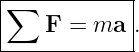
Newton’s laws provide the bridge from kinematics to dynamics. In an inertial frame,
The second law is
which becomes
for constant mass. The third law states
The next step is to identify the forces correctly and consistently. M02-02 develops that skill
through free-body diagrams.
References
[1] J. R. Taylor, Classical Mechanics, University Science Books, 2005.
[2] S. J. Ling, J. Sanny, and W. Moebs, University Physics, Volume 1, archived 2016
revision, OpenStax/BCcampus, CC BY 4.0.
[3] University of California, Davis, Physics 9A: Classical Mechanics, Physics LibreTexts,
CC BY-SA 4.0.
[4] J. Moore et al., Mechanics Map, Engineering LibreTexts, CC BY-SA 4.0.
[5] PhysicsLibrary, M00-06, Reference Frames in Newtonian Mechanics.

![[parent]](https://images.physicslibrary.org/images/uparrow.png)

















![−2
[F ] = M LT .](https://images.physicslibrary.org/cache/objects/1333/make4ht/GRENewtonsLawsOfMotion30x.png)
![[dp ] M LT −1
--- = -------- = M LT −2.
dt T](https://images.physicslibrary.org/cache/objects/1333/make4ht/GRENewtonsLawsOfMotion31x.png)