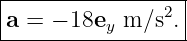
Uniform Circular Motion
Uniform circular motion is motion along a circular path at constant speed. The word uniform
refers to the constancy of the speed, not to the velocity vector. Because the direction of the
velocity changes continuously, the object is accelerated even though its speed does not
change.
For a circle of radius R, the velocity is tangent to the path while the acceleration points toward the
center. This inward acceleration is called the centripetal acceleration.
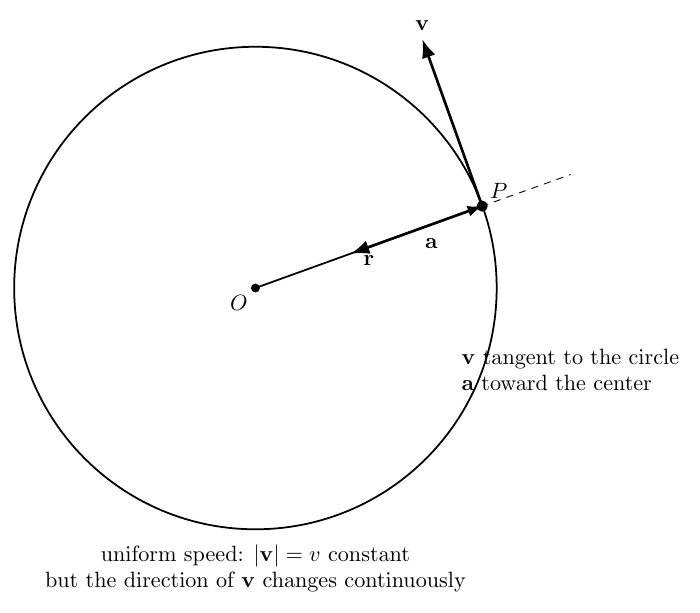
Figure 1. In uniform circular motion the velocity is tangent to the circular path while the
acceleration points toward the center. Constant speed does not imply zero acceleration because
velocity also contains direction.
1 Circular position and angular position
Let a particle move on a circle of radius R centered at the origin. Its position can be described by
the angular coordinate 𝜃 measured from the positive x axis:
The magnitude of the position vector is constant,
but its direction changes as the particle moves.
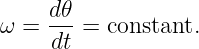
For uniform circular motion, the angular speed is constant:
Therefore
Angles used in the relations below are measured in radians. One full revolution corresponds
to
2 Period, frequency, and angular speed
The period T is the time required for one revolution. The frequency f is the number of revolutions
per unit time:
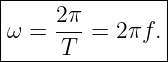
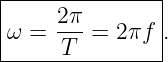
During one period the angular displacement is 2π, so
Thus
The SI unit of ω is radians per second. Since the radian is dimensionless, ω has dimensions of
inverse time.
3 Arc length and tangential speed
For a circular arc, the distance traveled along the path is
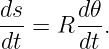
Differentiating with respect to time gives
Because ds∕dt is the speed v,
The speed is constant when both R and ω are constant. The velocity vector itself is not constant
because its direction rotates with the particle.
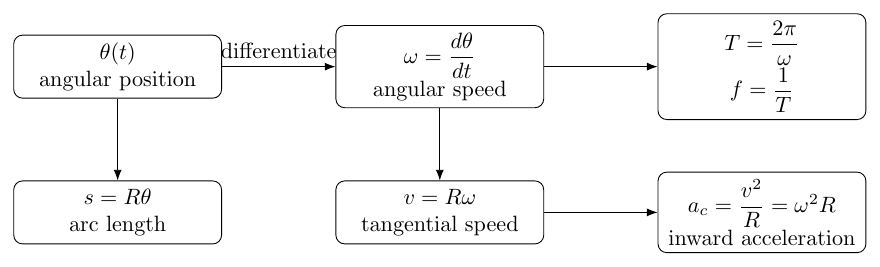
Figure 2. Angular and linear quantities in uniform circular motion are connected by the radius.
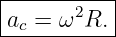
The relations s = R𝜃, v = Rω, and ac = ω2R form a useful kinematic chain.
4 Geometric derivation of centripetal acceleration
Consider two nearby points on the circular path separated by a small angular displacement
Δ𝜃. The velocity vectors at the two points have the same magnitude v but different
directions.
For a sufficiently small angle, the velocity triangle is geometrically similar to the position triangle.
Therefore
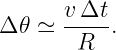
The arc traveled during the same interval is
Since the speed is v,
Hence
Substitution into the velocity change relation gives
Dividing by Δt and taking the limit as Δt → 0 gives
The change in velocity points inward in the small angle limit, so the acceleration vector is directed
toward the center of the circle.
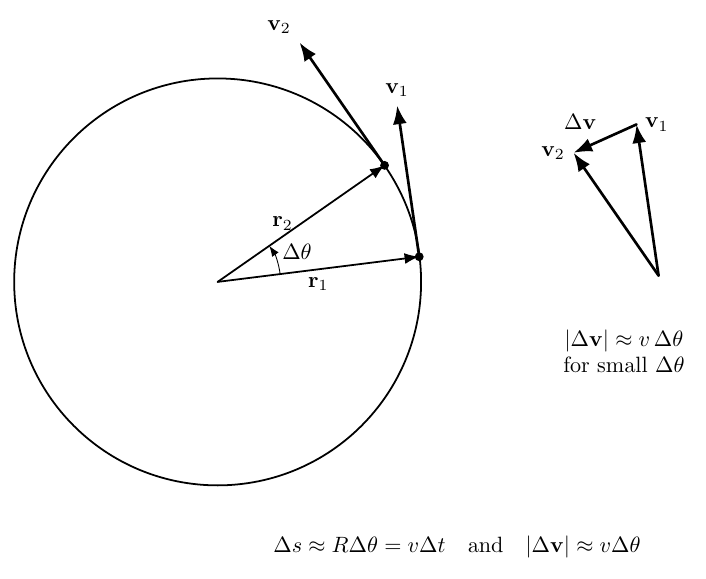
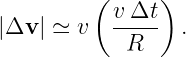
Figure 3. The velocity vectors have equal magnitude but different directions. For a small angular
displacement, the velocity triangle gives |Δv|≃ vΔ𝜃 while the arc gives vΔt ≃ RΔ𝜃.
5 Equivalent forms of centripetal acceleration
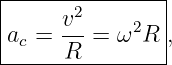
Using
in
we obtain
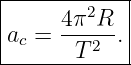
Since
we may also write
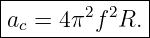
In terms of frequency,
These forms describe the same acceleration and differ only in which quantities are most convenient
to use.
6 Vector derivation
A second derivation follows directly from differentiating the position vector. For constant angular
speed,
Thus
Differentiating gives
Its magnitude is
Differentiating again gives
Therefore
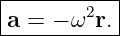
The minus sign shows directly that the acceleration points opposite the outward position vector
and therefore toward the center.
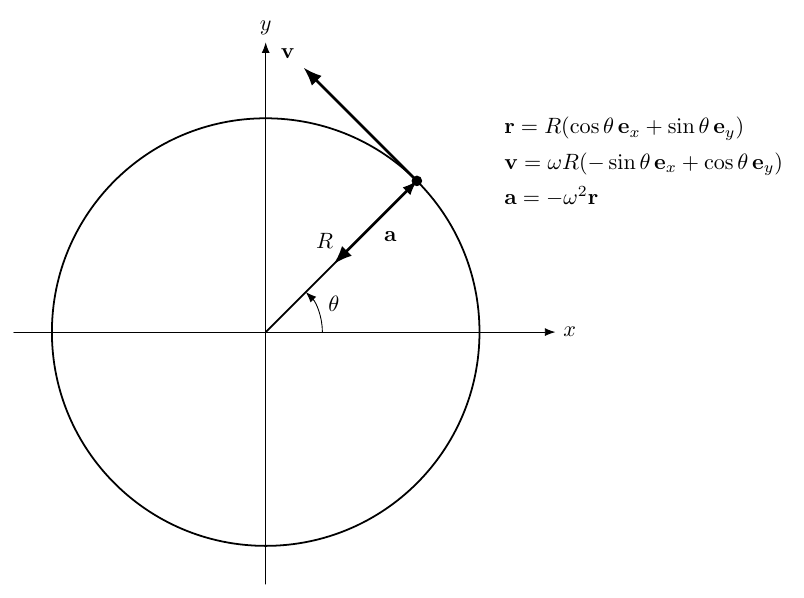
Figure 4. Cartesian vector representation of uniform circular motion. Differentiating the position
vector once gives the tangent velocity; differentiating again gives the inward acceleration
a = −ω2r.
7 Velocity and acceleration are perpendicular
For uniform circular motion,
The acceleration is therefore perpendicular to the velocity at every instant. A perpendicular
acceleration changes the direction of the velocity without changing its magnitude. This is why the
speed remains constant.
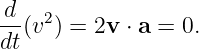
Equivalently, the rate of change of v2 is
Hence v2, and therefore the speed v, remains constant.
8 Centripetal does not name a new force
Uniform circular motion is a kinematic description. The inward acceleration must be produced by
the net force in the dynamics problem, but centripetal force is not a separate additional force to
place on a Free-body diagram.
Newton’s second law later gives the required inward net force magnitude as
Depending on the physical situation, this inward net force may be supplied by Tension, gravity,
friction, a normal force, an electromagnetic force, or a combination of forces. The present article
focuses on the kinematics of the acceleration itself.
9 Worked example 1: speed, period, and centripetal acceleration
A particle moves in a circle of radius
with constant speed
The angular speed is
The period is
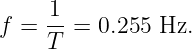
The frequency is
The centripetal acceleration is
Thus
10 Worked example 2: wheel speed from revolutions per minute
A point on the rim of a wheel of radius
rotates at 120 revolutions per minute.
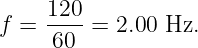
First convert to revolutions per second:
Therefore
The tangential speed is
The centripetal acceleration is
11 Worked example 3: position, velocity, and acceleration vectors
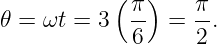
A particle moves counterclockwise in a circle of radius R = 2.0 mm with angular speed
ω = 3.0 mrad∕s. Let 𝜃0 = 0 at t = 0. Find r, v, and a at
The angular position is
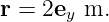
Therefore
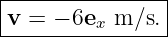
Using the vector velocity formula,
we obtain
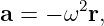
Similarly,
so
The velocity is tangent to the circle and the acceleration points inward, exactly as required.
12 Worked example 4: two points on the same rigidly rotating disk
Two marked points lie at radii
on a rigid disk rotating uniformly with angular speed
Because the disk is rigid, both points have the same angular speed. Their linear speeds
are
and
Thus
Their centripetal accelerations are
and
Hence
At fixed angular speed, both v and ac are proportional to radius. The familiar quadratic
dependence ac ∝ v2 applies when the radius is held fixed instead.
13 Beyond uniform circular motion
If the speed changes while the object remains on a circular path, the acceleration generally has two
components. The inward normal component is still
while the tangential component is
Uniform circular motion is the special case
The full treatment of moving polar coordinate basis vectors appears later in the mechanics
sequence.
14 Practice problems
- A wheel rotates uniformly at 30 revolutions per minute. Find its frequency, period,
and angular speed.
- A particle moves in a circle of radius 2.5 m with period 4.0 s. Find its speed.
- A CAR follows a circular path of radius 50 m at constant speed 15 m/s. Find the
centripetal acceleration.
- A particle has centripetal acceleration 20 mm∕s2 at radius 0.80 m. Find its angular
speed.
- Two points on the same rigid disk are at radii R and 3R. Compare their angular speeds,
linear speeds, and centripetal accelerations.
- A particle moves counterclockwise with R = 1.5 m and ω = 2.0 rad/s. At 𝜃 = 0, write
the directions and magnitudes of v and a.
- A point travels through three complete revolutions on a circle of radius 0.40 m. What
distance does it travel?
- A rotor spins uniformly at 5.0 Hz for 12 s. How many revolutions occur, and what
angular displacement is swept out in radians?
- A satellite is idealized as moving uniformly on a circular path of radius 7.0 × 10⁶ m
with period 6000 s. Find its speed and centripetal acceleration.
- A particle moves at constant speed around a circle. Explain why its acceleration can
be nonzero even though dv∕dt = 0 for the scalar speed.
15 Answer check
- f = 0.500 mHz, T = 2.00 ms, ω = π mrad∕s ≃ 3.14 mrad∕s.
- v = 2πR∕T = 3.93 mm∕s.
- ac = v2∕R = 4.50 mm∕s2.
- ω =
 = 5.00 mrad∕s.
- Same ω; outer point has 3 times the speed and 3 times the centripetal acceleration.
- v = 3.0 mm∕s in +y; ac = 6.0 mm∕s2 in −x.
- s = 3(2πR) = 2.4π mm ≃ 7.54 mm.
- 60 revolutions; Δ𝜃 = 120π mrad.
- v = 2πR∕T ≃ 7.33 × 103 mm∕s; a
c ≃ 7.67 mm∕s2.
- The velocity vector changes direction even when its magnitude is constant; acceleration
is dv∕dt, not merely dv∕dt.
16 Summary
Uniform circular motion has constant speed but continuously changing velocity direction. Its
central kinematic relations are
and
The velocity is tangent to the circle, the acceleration is inward, and the two vectors are
perpendicular. The inward acceleration arises because the velocity direction changes, not because
the speed changes.
References
[1] J. R. Taylor, Classical Mechanics, University Science Books, 2005.
[2] J. B. Marion and S. T. Thornton, Classical Dynamics of Particles and Systems, 5th
ed., Brooks/Cole, 2004.
[3] S. J. Ling, J. Sanny, and W. Moebs, University Physics, Volume 1, OpenStax, 2016.
[4] PhysicsLibrary, M01-03, Acceleration in Mechanics.

![[parent]](https://images.physicslibrary.org/images/uparrow.png)