Particle in Physics: Examples and Complete Worked Solutions
This companion entry develops the modeling ideas from Particle in Physics: Definition, Models,
and Uses. The exercises deliberately mix calculations with model-selection questions because the
central issue is not merely how to move a particle mathematically, but when a particle description
is physically appropriate [1, 2, 4, 5].
All exercises are stated first. Complete worked solutions follow afterward.

Figure 1. Progression of the problem set from classical point-particle kinematics through systems
of particles, relativity, quantum scales, and model selection.
Part I: Exercises
Exercise 1: state, trajectory, momentum, and force
A particle of constant mass
moves in the plane according to
Find r, v, a, p, F, and the speed at t = 2 s.
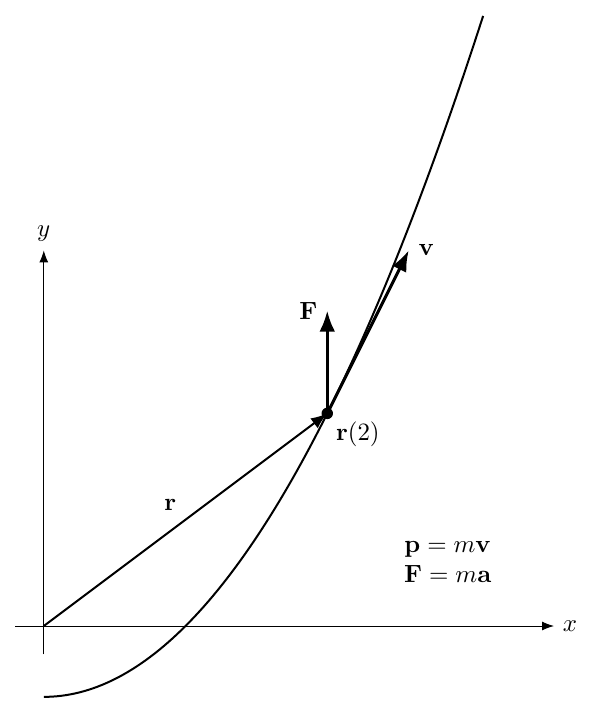
Figure 2. Classical particle state for Exercise 1. Position locates the particle on its trajectory;
velocity, momentum, and force describe its instantaneous dynamics.
Exercise 2: when is Earth a point particle?
Take Earth’s mean radius to be
and the characteristic orbital length scale to be one astronomical unit,
Compute a∕L. If a rough orbital model only needs geometric finite-size effects below 10−3, is a
point-particle approximation reasonable? Name two problems for which the same model would be
inadequate.
Exercise 3: a baseball as a particle or rigid body
A baseball has radius approximately 3.66 cm and travels about 50 m during a fly ball. Estimate
a∕L. Discuss whether a point-particle model is suitable for
- a rough estimate of the center-of-mass trajectory with no spin effects;
- a calculation in which spin, Magnus force, and rotational energy matter.
Exercise 4: a particle in phase space
A one-dimensional harmonic oscillator has
with
At t = π∕8 s, find x, v, p, the spring constant k, and the total mechanical energy. State the
corresponding one-dimensional phase-space point (x,p).
Exercise 5: particle mechanics from a Lagrangian
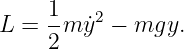
A particle of mass m moves vertically near Earth’s surface. Let y be positive upward and
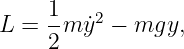
use
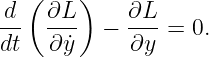
Apply the Euler–Lagrange equation to derive the equation of motion.
Exercise 6: central force and angular momentum
A particle of mass m moves under a central force
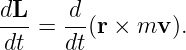
Using
show that the angular momentum about the force center is conserved. Explain why the trajectory
must remain in a plane.
Exercise 7: center of mass of two particles
Two particles have
with positions
Their velocities are
Find the center-of-mass position, total momentum, and center-of-mass velocity.
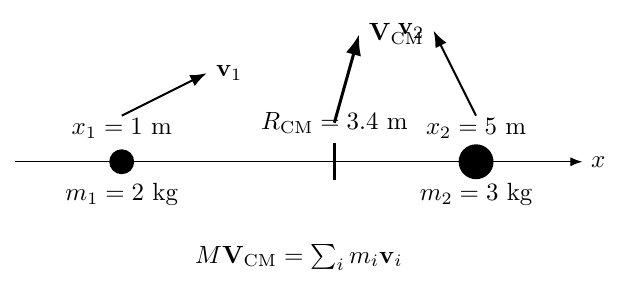
Figure 3. Two-particle geometry for Exercises 7–9. The center of mass provides a single-particle
description of the translational motion of the system.
Exercise 8: external force and center-of-mass motion
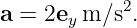
For the system in Exercise 7, suppose the net external force is constant:
Find the center-of-mass acceleration. Using the initial total momentum from Exercise 7, find the
total momentum after 2 s.
Exercise 9: translational and internal kinetic energy
Using the masses and velocities from Exercise 7, calculate
- the total kinetic energy;
- the kinetic energy associated with center-of-mass translation;
- the kinetic energy remaining in motion relative to the center of mass.
Interpret the result physically.
Exercise 10: test-particle approximation
A 1000 kg spacecraft orbits Earth, whose mass is approximately
Compute the mass ratio m∕ME. Explain why the spacecraft is naturally treated as a test particle
in a first orbital model, and state one circumstance in which that approximation would not capture
all relevant physics.
Exercise 11: classify the particle model
For each description, identify the most appropriate term among point particle, test particle, tracer
particle, and material point.
- A tiny neutrally buoyant bead used to visualize a fluid flow while its effect on the flow
is neglected.
- An ideal positive charge used to define the direction of an Electric Field while its own
field is ignored.
- A labeled infinitesimal parcel followed as an elastic solid deforms.
- A planet represented only by its mass and center-of-mass position in a two-body orbit
calculation.
Exercise 12: when the point-particle model fails
A solid disk rolls without slipping down an incline. Compare two models:
- the disk is replaced by a point mass at its center;
- the disk is treated as a rigid body with moment of inertia.
Which model is adequate if only the translational motion of a frictionless sliding object is wanted?
Which is required for rolling motion, and why?
Exercise 13: relativistic particle momentum and energy
A massive particle moves at
Calculate the Lorentz factor γ. Compare the relativistic momentum
with the Newtonian momentum pN = mv. Compare the relativistic kinetic energy
with the Newtonian value KN = mv2∕2, expressing both in units of mc2.
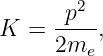
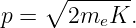
Exercise 14: de Broglie wavelength and the classical-particle limit
Use
Find the de Broglie wavelength of
- a 0.145 kg baseball moving at 40 m/s;
- a nonrelativistic electron with kinetic energy 100 eV.
Use
Explain why the wave nature of one object is ordinarily negligible while that of the other is
experimentally important.
Exercise 15: photon energy and momentum
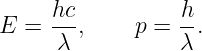
A photon has wavelength
Find its energy and momentum using
Give the energy in joules and electron-volts. Explain why this is a useful example of a “particle”
that is not a Newtonian point mass.
Exercise 16: choose the simplest adequate model
For each spacecraft problem, identify the simplest adequate physical model and explain what
extra degree of freedom or spatial information is required as the problem becomes more
detailed.
- A first two-body estimate of orbital period around a spherical Earth.
- Precision orbit propagation including Earth’s J2 gravity term.
- Spacecraft attitude dynamics and gravity-gradient torque.
- Flexible solar-array vibration during attitude maneuvers.
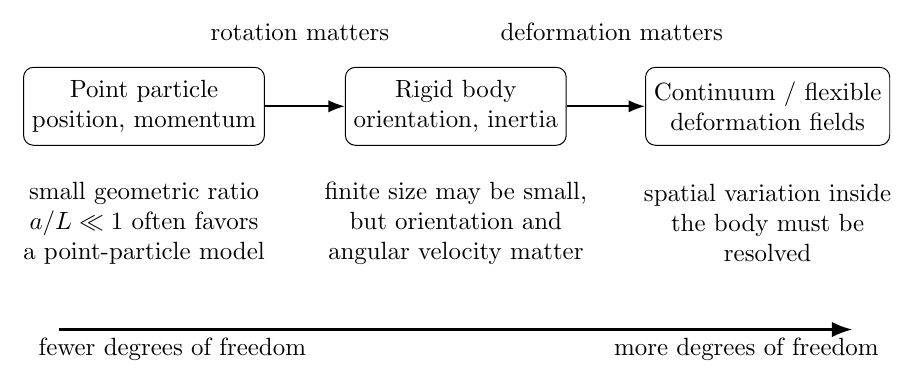
Figure 4. Particle models are selected by physical scale and by which degrees of freedom affect the
quantity being calculated. More detail is added only when the simpler model omits relevant
physics.
Part II: Complete Worked Solutions
Solution 1: state, trajectory, momentum, and force
Differentiate the position:
Differentiate again:
At t = 2 s,
The momentum is
and the net force is
The speed is
This is the basic classical point-particle state: position specifies where the particle is, while
momentum or velocity completes the instantaneous dynamical state.
Solution 2: when is Earth a point particle?
The size ratio is
This is much smaller than 10−3, so geometric finite-size effects are small for a rough heliocentric
orbit model.
The same approximation is inadequate when finite size or internal structure matters. Examples
include tidal deformation, rotational attitude, precession, and modeling Earth’s nonspherical
gravity field such as the J2 term.
Solution 3: a baseball as a particle or rigid body
The scale ratio is
For a rough center-of-mass trajectory with no spin-dependent effects, this is a natural
point-particle approximation.
If spin, Magnus force, torque, or rotational kinetic energy matters, the particle model
no longer contains enough degrees of freedom. At minimum, orientation and angular
velocity must be added, leading toward a rigid-body model. One can still use a point-like
translational state for the center of mass, but the complete model is no longer only a point
particle.
Solution 4: a particle in phase space
At
we have
Therefore
The velocity is
Hence
For a harmonic oscillator,
so
At this instant the potential energy is zero, so
The phase-space point is
Solution 5: particle mechanics from a Lagrangian
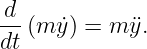
The Euler–Lagrange equation is
For
we obtain
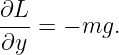
and
Also,
Thus
or
The same particle dynamics that Newtonian mechanics writes as Fy = may emerges from the
stationary-action formulation.
Solution 6: central force and angular momentum
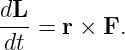
Differentiate angular momentum:
Using the cross-product rule,
The first term vanishes because a vector crossed with itself is zero. Newton’s second law
gives
For a central force, F is parallel to r, so
Therefore
so L is constant.
Because r is always perpendicular to the fixed vector L, the trajectory remains in the plane
perpendicular to L.
Solution 7: center of mass of two particles
The total mass is
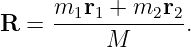
The center of mass is
Therefore
The total momentum is
Thus
so
The center-of-mass velocity is
Solution 8: external force and center-of-mass motion
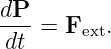
The center-of-mass equation is
Hence
The total momentum obeys
For constant force over 2 s,
Using the initial momentum from Exercise 7,
internal forces do not appear in this center-of-mass balance when they cancel pairwise.
Solution 9: translational and internal kinetic energy
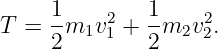
The total kinetic energy is
Both particles have speed squared equal to 5, so
The center-of-mass speed squared is
Therefore
The remainder is
Thus the system’s kinetic energy separates into motion of the center of mass plus motion of the
particles relative to that center of mass.
Solution 10: test-particle approximation
The mass ratio is
The spacecraft’s gravitational effect on Earth is negligible for a first orbital calculation, while
Earth’s field strongly determines the spacecraft motion. This is exactly the logic of a test particle:
it responds to the field without appreciably changing the field source.
The approximation does not describe everything. Spacecraft attitude, finite area, atmospheric
drag, solar-radiation pressure, flexible structures, or mutual gravitational interactions with
comparable masses require additional physics.
Solution 11: classify the particle model
The classifications are:
- Tracer particle: the bead is used to follow the fluid motion while its feedback is
neglected.
- Test particle: the ideal charge responds to an electric field without altering the
prescribed field appreciably.
- Material point: the labeled element follows a piece of a continuum through deformation.
- Point particle: the planet’s finite size and orientation are omitted and only its mass
and center-of-mass position are retained.
The terms overlap conceptually, but each emphasizes a different modeling role.
Solution 12: when the point-particle model fails
For frictionless sliding in which only translation matters, a point mass at the center of mass can be
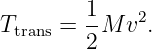
sufficient. Its translational kinetic energy is
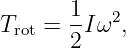
For rolling, the body also has rotational kinetic energy,
and the no-slip constraint couples translation and rotation:
A point particle has no orientation and no moment of inertia, so it cannot represent this rotational
degree of freedom. A rigid-body model is required.
Solution 13: relativistic particle momentum and energy
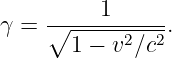
The Lorentz factor is
For v = 0.80c,
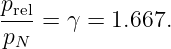
Therefore
The relativistic kinetic energy is
The Newtonian value is
Thus the Newtonian kinetic energy is less than half the relativistic value in this case. The particle
concept survives, but Newtonian particle dynamics no longer does.
Solution 14: de Broglie wavelength and the classical-particle limit
For the baseball,
Therefore
This wavelength is fantastically smaller than any ordinary baseball-scale geometry, so wave
interference is unobservable in ordinary motion.
For a nonrelativistic electron,
so
With
we obtain
Thus
That scale is comparable with atomic spacings, so diffraction and interference become physically
important.
Solution 15: photon energy and momentum
For
we have
Using
this is
The momentum is
A photon carries definite energy and momentum and can produce localized detection events, so
particle language is useful. It is nevertheless not a Newtonian point mass: it is a quantum
excitation of the electromagnetic field and has zero rest mass.
Solution 16: choose the simplest adequate model
For a first two-body orbital-period calculation, Earth and spacecraft can both be treated as
point masses. The essential degrees of freedom are their center-of-mass positions and
velocities.
For precision orbit propagation including J2, the spacecraft may still be a point particle, but
Earth’s gravitational field must include information about Earth’s extended, nonspherical mass
distribution. Thus the field model becomes more detailed even though the spacecraft model need
not.
For attitude dynamics and gravity-gradient torque, the spacecraft must have orientation, angular
velocity, and inertia. A rigid-body model is therefore required.
For flexible solar-array vibration, rigid-body motion is not enough. Structural deformation
introduces distributed or modal degrees of freedom, so a flexible multibody or continuum model is
required.
This sequence illustrates the central rule of the particle article: use the simplest model that retains
the degrees of freedom that affect the phenomenon being calculated.
Summary
The exercises show that “particle” is not one fixed physical category. It is a modeling level. A
classical point particle may be characterized by position and momentum; a many-particle system
can often be reduced to center-of-mass motion; a test particle probes an externally prescribed field;
a relativistic particle requires new momentum and energy relations; and quantum particles demand
a state description whose characteristic wavelength may make the classical trajectory picture
inadequate.
The practical question is always the same:
What is the simplest particle or extended-body model that retains the degrees
of freedom needed for the required accuracy?
References
[1] J. R. Taylor, Classical Mechanics, University Science Books, 2005.
[2] H. Goldstein, C. Poole, and J. Safko, Classical Mechanics, 3rd ed., Addison-Wesley,
2002.
[3] L. D. Landau and E. M. Lifshitz, Mechanics, 3rd ed., Butterworth-Heinemann, 1976.
[4] D. J. Griffiths and D. F. Schroeter, Introduction to Quantum Mechanics, 3rd ed.,
Cambridge University Press, 2018.
[5] M. E. Peskin and D. V. Schroeder, An Introduction to Quantum Field Theory,
Westview Press, 1995.

![[parent]](https://images.physicslibrary.org/images/uparrow.png)