Further Constrained-Motion Examples
The constraint may not be so simple as that imposed by compelling the moving particle to remain
on a given surface or on a given curve.
(a) The Tractrix Problem
Take, for example, the tractrix problem, when the particle moves on a smooth horizontal
plane.
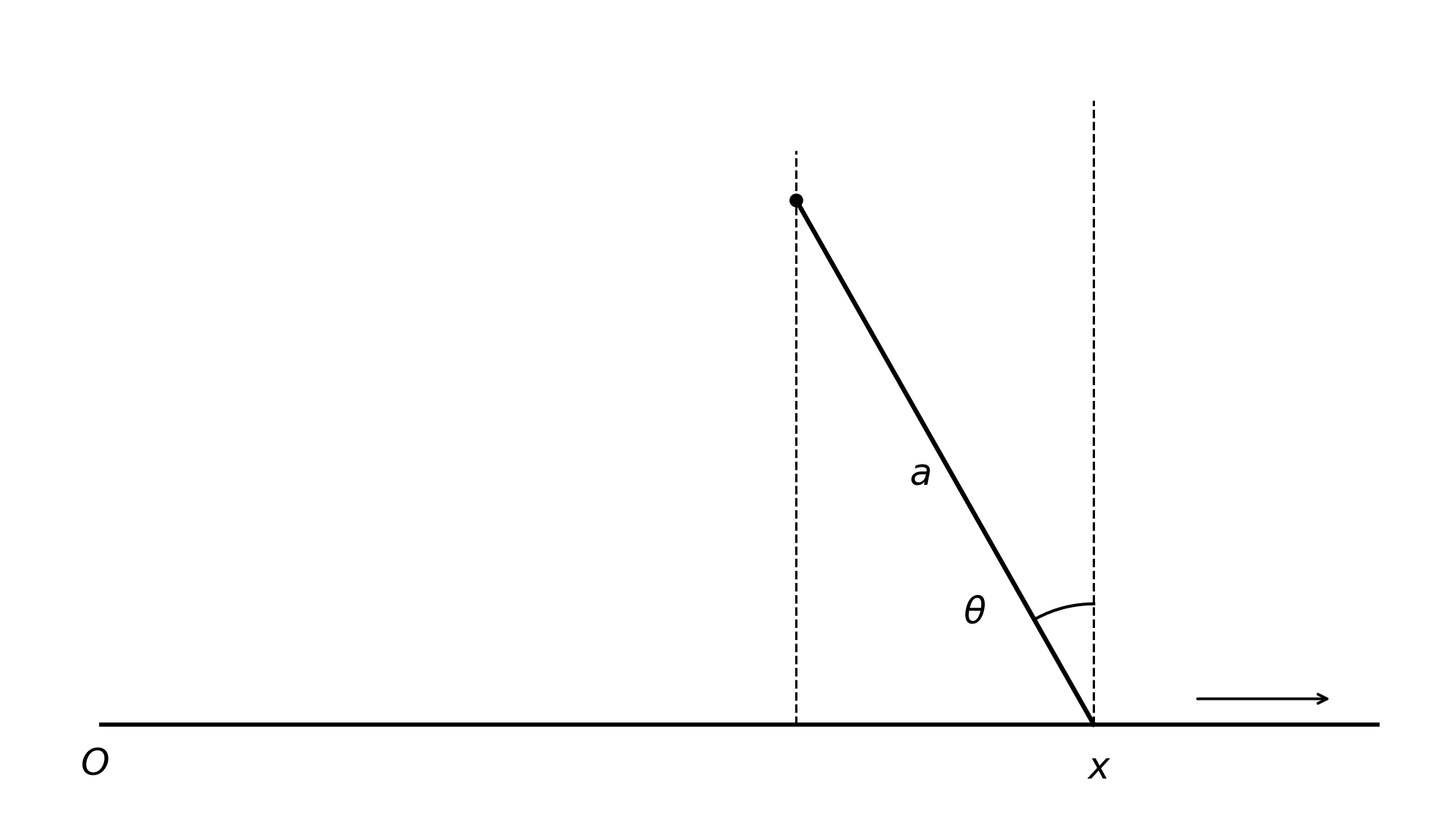
Let a particle of mass m, attached to a string of length a, rest on a smooth horizontal plane. The
string lies straight on the plane at the start, and then the end not attached to the particle is drawn
with uniform velocity along a straight line perpendicular to the initial position of the string and
lying in the plane.
Let us take as our coordinates x, the distance traveled by that end of the string which is not
attached to the particle, and 𝜃, the angle made by the string with its initial position. Let R be the
Tension of the string and n the velocity with which the end of the string is drawn along. Let X,Y
be the rectangular coordinates of the particle, referred to the fixed line and to the initial position
of the string as axes.
Regenerated diagram for Byerly, Chapter I, Art. 6(a): tractrix setup.
Hence
The equations are
and
Adding the condition
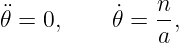
and reducing,
Therefore
Integrating,
The particle revolves with uniform angular velocity about the moving center, and the pull on the
string is constant.
(b) A Particle in a Rotating Horizontal Tube
A particle is at rest in a smooth horizontal tube. The tube is then made to revolve in a horizontal
plane with uniform angular velocity ω. Find the motion of the particle.
Suggestion. Take the polar coordinates r,ϕ of the particle as our coordinates, and let R be the
pressure of the particle on the tube.
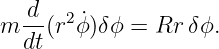
Thus
Adding the condition
and reducing,
Solving,
Since
at the start,
and
If we are interested only in the motions and not in the reactions, problems (a) and (b) can be
solved more simply. If in each we were to use one less coordinate—𝜃 only in (a), and r
only in (b)—rectangular coordinates X,Y for the particle could be obtained whenever
the time was given, and therefore could be expressed explicitly in terms of 𝜃 or r and
t. A careful examination of Art. 2 will show that the reasoning is extended easily to
such a case, and that the work done by the effective forces when q1 only is changed is
still
It is to be noted, however, that when the rectangular coordinates are functions of t
as well as of q1,q2, etc., the energy T is no longer a homogeneous quadratic in q1,q2,
etc.
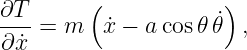
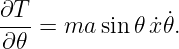
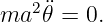
For (a),
and
Then
and
Therefore
as before.
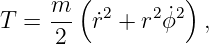
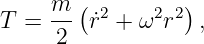
For (b),
Thus
and
as before.
Examples
1. A Particle on a Horizontal Whirling Table
A particle rests on a smooth horizontal whirling table and is attached by a string of length a to a
point fixed in the table at a distance b from the center. The particle, the point, and the center are
initially in the same straight line. The table is then made to rotate with uniform angular velocity
ω. Find the motion of the particle.
Suggestion. Take as the single coordinate 𝜃 the angle made by the string with the radius of
the point. Let X,Y be the rectangular coordinates of the particle, referred to the line
initially joining it with the center and to a perpendicular thereto through the center as
axes.
Then
and
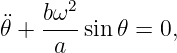
The equation of motion is
and the relative motion on the table is simple pendulum motion, the length of the equivalent
pendulum being
2. A Particle Attracted toward a Point on a Rotating Table
A particle is attracted toward a fixed point in a horizontal whirling table with a force
proportional to the distance. It is initially at rest at the center. The table is then made
to rotate with uniform angular velocity ω. Find the path traced on the table by the
particle.
Suggestion. Take as coordinates x,y, rectangular coordinates referred to the moving radius of the
fixed point as axis of abscissas and to the center of the table as origin. Let X,Y be the rectangular
coordinates referred to fixed axes coinciding with the initial positions of the moving
axes.
Whence come
If
the solution is easy and interesting:
Integrating (2),
Substituting in (1),
Multiplying (3) by 2ẋ, and integrating,
Hence
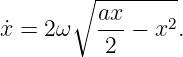
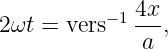
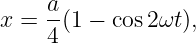
Whence
Replacing 2ωt by 𝜃,
and the curve traced on the table is the cycloid generated by a circle of radius a∕4 rolling backward
along the moving axis of Y .
Source
William Elwood Byerly, An Introduction to the Use of Generalized Coördinates in mechanics and
Physics, Ginn and Company, 1916. Chapter I, “Introduction.”
The 1916 source work is in the public domain in the United States.

![[parent]](https://images.physicslibrary.org/images/uparrow.png)


![m-( ˙2 ˙2) m-[ 2 2 ˙2 ˙]
T = 2 X + Y = 2 x˙ + a 𝜃 − 2a cos𝜃 ˙x𝜃 .](https://images.physicslibrary.org/cache/objects/1065/make4ht/Example2OfDynamicsOfAParticleConstrainedMotion2x.png)


![[ ( ) ]
m d- a2𝜃˙− a cos𝜃x˙ − asin 𝜃 ˙x𝜃˙ δ𝜃 = 0.
dt](https://images.physicslibrary.org/cache/objects/1065/make4ht/Example2OfDynamicsOfAParticleConstrainedMotion7x.png)












![[ d ∂T ∂T ]
------− ---- δq1.
dt∂q˙1 ∂q1](https://images.physicslibrary.org/cache/objects/1065/make4ht/Example2OfDynamicsOfAParticleConstrainedMotion23x.png)


![[ ]
T = m- ( ˙X2 + Y˙2) = m n2 + a2 ˙𝜃2 − 2an cos𝜃𝜃˙ .
2 2](https://images.physicslibrary.org/cache/objects/1065/make4ht/Example2OfDynamicsOfAParticleConstrainedMotion26x.png)

![[ ]
m d-(a2 ˙𝜃 − an cos𝜃) − an sin 𝜃𝜃˙ δ𝜃 = 0.
dt](https://images.physicslibrary.org/cache/objects/1065/make4ht/Example2OfDynamicsOfAParticleConstrainedMotion28x.png)





![[ ]
T = m- b2ω2 + a2(ω + ˙𝜃)2 + 2ab ω(ω + 𝜃˙) cos𝜃 .
2](https://images.physicslibrary.org/cache/objects/1065/make4ht/Example2OfDynamicsOfAParticleConstrainedMotion36x.png)


![m [ ]
T = -- x˙2 + ω2x2 + y˙2 + ω2y2 − 2ωyx˙+ 2ωx y˙ .
2](https://images.physicslibrary.org/cache/objects/1065/make4ht/Example2OfDynamicsOfAParticleConstrainedMotion40x.png)