|
|
|
|||||||
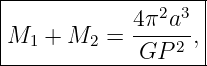
where
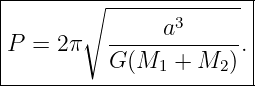
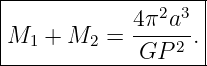
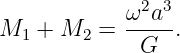
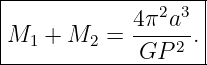
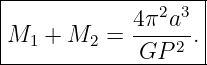
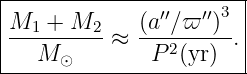
Equation (1) is the Newtonian two-body form of Kepler’s third law. It is the basis of the dynamical-mass discussion in BIN01. The most important geometric point is
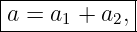
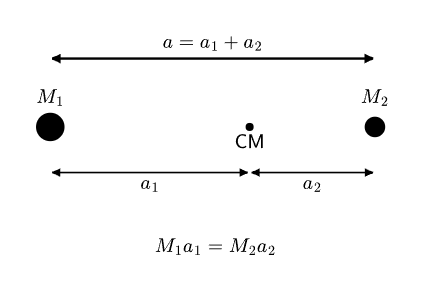
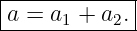
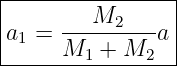
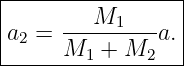
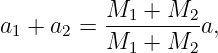
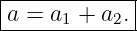
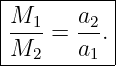
where a1 and a2 are the semimajor axes of the two stars about the center of mass. The a appearing in Equation (1) is not the orbit size of either star individually.
Figure 1. Both stars orbit their common center of mass. The relative separation is the sum of the two barycentric orbital radii in the circular case and the sum of their semimajor axes in the general Keplerian case.
1 Why this relation measures massFor an isolated Newtonian binary, orbital motion is produced by the gravitational attraction of the two stars. The orbital size and orbital period therefore encode the strength of The Gravitational Field. A larger total mass produces stronger gravitational acceleration. For a fixed orbital size, a larger total mass implies a shorter orbital period. For a fixed period, a larger orbital size requires a larger total mass. Equation (1) converts this statement into a quantitative measurement. The mass is called dynamical because it is obtained from the motion caused by gravity rather than inferred only from luminosity, temperature, or a stellar-evolution model.
2 First derivation: circular orbit intuitionThe clearest introductory derivation begins with circular orbits. Let the two stars have masses
and
Let their distances from the center of mass be
and
Their separation is
Because both stars complete one revolution in the same orbital period P, they have the same angular speed
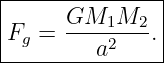
3 Force balance for star 1The gravitational force magnitude is
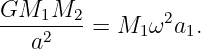
For circular motion, star 1 requires centripetal force
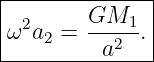
Gravity supplies that force:
Cancel M1:
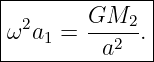
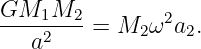
4 Force balance for star 2The same gravitational force acts on star 2. Its circular-motion equation is
Cancel M2:
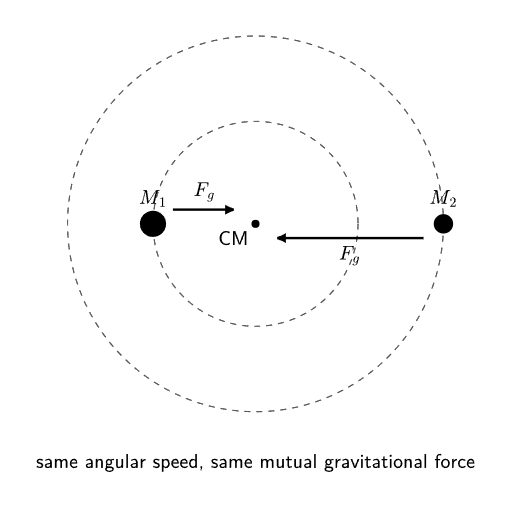
Figure 2. In the circular-orbit derivation, the same mutual gravitational force supplies the centripetal acceleration of each star about the common center of mass.
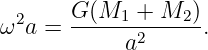
5 Add the two equationsAdd Equations (6) and (7):
Factor the left side:
Using
we obtain
Multiply by a2:
Solve for total mass:
Now insert
Then
Thus
This is the desired relation.
6 What the circular derivation teachesThe circular derivation is especially useful because every step has a simple physical meaning. It shows that:
However, Equation (9) is not restricted to circular orbits. The same result holds for elliptical Keplerian binaries.
7 Second derivation: the general two-body problemLet the inertial-frame positions be
and
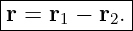
Define the relative vector
Newton’s equations are
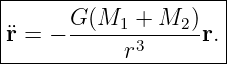
Divide the first by M1 and the second by M2, then subtract:
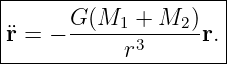
Therefore
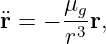
The two-star problem has become one effective Kepler problem for the relative coordinate.
Figure 3. Subtracting the two Newton equations reduces the binary to one relative orbit governed by the total mass.
8 The gravitational parameter of the relative orbitEquation (11) has the same form as the standard Kepler equation
with
The total stellar mass therefore plays the role that a central mass would play in a test-particle Kepler problem. This is why the period of a binary depends on
9 Angular momentum and areal velocityBecause the force in Equation (11) is a central force,
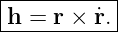
Define specific angular momentum
Then
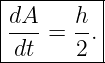
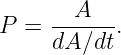
The motion is therefore planar. The areal velocity is
This is Kepler’s second law.
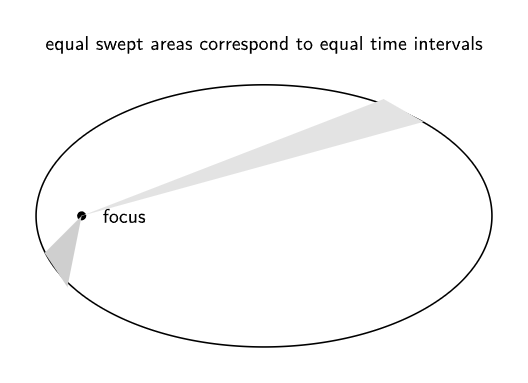
Figure 4. Conservation of orbital angular momentum gives constant areal velocity, which allows the orbital period to be related to the total area of the ellipse.
10 Specific angular momentum of an ellipseFor a Kepler ellipse with semimajor axis a and eccentricity e,
Thus
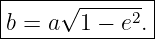
The semiminor axis of the ellipse is
The area of the ellipse is therefore
11 Use the time required to sweep the whole ellipseThe orbital period is the time required for the radius vector to sweep the entire orbital area. Since
we have
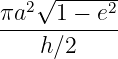
Substitute Equations (15) and (19):
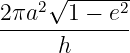
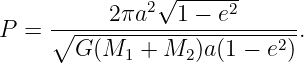
Now insert Equation (17):
The eccentricity factors cancel:
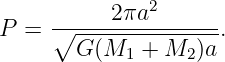
Simplify the powers of a:
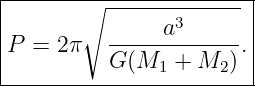
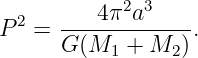
Rearrange:
This is the same result obtained from the circular derivation.
12 Why eccentricity disappearsA striking feature of Equation (21) is that it contains no eccentricity. At first this can seem surprising. An eccentric binary moves much faster near periastron than near apastron. However, the ellipse area contains the factor
and the angular momentum contains the same factor. They cancel when the full orbital period is calculated. Therefore
This does not mean that the instantaneous speed or separation is independent of eccentricity. Only the period for a given a and total mass has this property.
13 Relative orbit versus barycentric orbitsThe individual stellar semimajor axes satisfy
and
Adding them gives
so
This is the orbital length scale required in Equation (21). Using only a1 or a2 in the total-mass formula would give the wrong result.
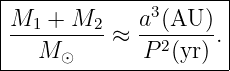
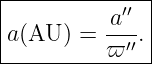
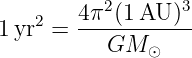
14 Astronomical-unit formEquation (21) becomes especially simple in standard astronomical units. For Earth’s orbit around the Sun,
to the usual Newtonian approximation. Therefore, when
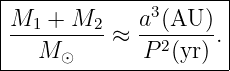
Equation (21) becomes
This is the form most often used for visual binaries.
15 Visual binaries and parallaxA visual-binary orbit usually yields an angular semimajor axis
Kepler’s law requires a physical semimajor axis. If the annual parallax is
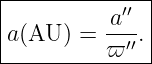
then
Substitute this into Equation (25):
This is the direct observational route from an angular visual orbit to total dynamical mass.
Figure 5. A visual-binary dynamical mass combines angular orbit scale, parallax, and period.
16 Numerical exampleSuppose a visual binary has
Convert parallax to arcseconds:
The physical semimajor axis is
Then
Therefore
This example also illustrates the strong cubic dependence on orbital size.
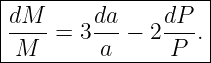
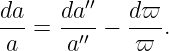
17 Sensitivity to measurement errorsFrom
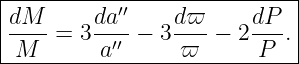
take a logarithmic differential:
Thus
For a visual binary,
so
Therefore
For independent random uncertainties, the approximate variance relation is
If the physical semimajor axis is obtained from angular semimajor axis and parallax,
when correlations can be neglected. This is why accurate parallaxes are so valuable for visual-binary mass measurements.
18 Total mass versus individual massesEquation (21) gives
It does not by itself separate the two component masses. A second observable is required. For example, if the barycentric orbit sizes are known,
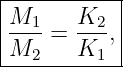
For a double-lined spectroscopic binary,
where K1 and K2 are the radial-velocity semiamplitudes. Combining total mass with a mass ratio gives the individual masses.
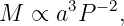
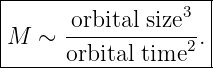
19 Physical interpretationEquation (21) can be written schematically as
The dimensional structure reflects Newtonian gravity. Since
we have
with dimensions of mass. The combination is therefore not arbitrary. It is the natural mass scale formed from the orbital length, orbital time, and gravitational constant.
20 Common mistakes
21 Practice exercises
22 SummaryFor a binary star, the Newtonian two-body problem gives
The relative orbit therefore behaves as a Kepler orbit controlled by the total mass. For an ellipse,
Thus
The same formula is obtained from the simpler circular force-balance derivation. In astronomical units,
For a visual binary,
The combination of orbit size, distance, and period therefore provides a direct dynamical measurement of stellar mass.
References
References
[1] B. W. Carroll and D. A. Ostlie, An Introduction to Modern Astrophysics, 2nd ed., Cambridge University Press, 2017. [2] R. W. Hilditch, An Introduction to Close Binary Stars, Cambridge University Press, 2001. [3] C. D. Murray and S. F. Dermott, Solar System Dynamics, Cambridge University Press, 1999. [4] J. R. Taylor, Classical Mechanics, University Science Books, 2005. "Dynamical Masses from Kepler's Third Law: A Derivation" is owned by bloftin.
This object's parent. Cross-references: MAS, dimensions, spectroscopic binary, observable, parallax, visual binaries, units, formula, angular momentum, square, powers, radius vector, areal velocity, specific angular momentum, central force, vector, positions, centripetal acceleration, centripetal force, magnitude, force, speed, temperature, acceleration, The Gravitational Field, motion, center of mass, BIN01, Kepler's third law, relation, masses There is 1 reference to this object. This is version 2 of Dynamical Masses from Kepler's Third Law: A Derivation, born on 2026-10-04, modified 2026-10-04. Object id is 1413, canonical name is DynamicalMassesFromKeplersThirdLawADerivation. Accessed 12 times total. Classification:
|
|
|
|
Pending Errata and AddendaNone.
|
DiscussionNo messages.
|
Interact |
![[parent]](https://images.physicslibrary.org/images/uparrow.png)





































![3
-L---
[G ] = M T 2,](https://images.physicslibrary.org/cache/objects/1413/make4ht/DynamicalMassesFromKeplersThirdLawADerivation83x.png)

 cancels in the elliptical derivation.