Parallax: Definition, Geometry, and the Small-Angle Approximation
Parallax is the apparent change in the direction to an object caused by a change in the observer’s
position.
In astronomy, the most important introductory example is annual stellar parallax: the apparent
displacement of a nearby star against much more distant background objects as Earth moves
around the Sun.
The geometric starting point is a right triangle.
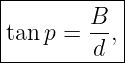
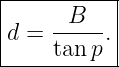
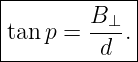
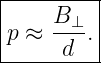
If a baseline of length B is perpendicular to the line of sight and the object is at distance d, then
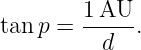
the exact relation is
where p is the parallax angle.
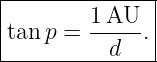
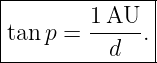
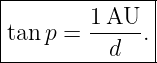
For annual stellar parallax, the conventional maximum one-sided baseline is
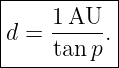
Therefore
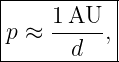
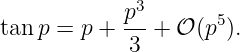
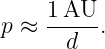
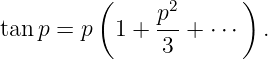
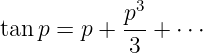
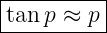
For stars, p is extremely small. The Taylor series of the tangent function then explains why
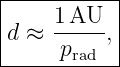
astronomers use the much simpler relation
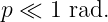
provided p is expressed in radians.
The familiar inverse-parallax formula is therefore a direct consequence of right-triangle geometry
plus the small-angle approximation.
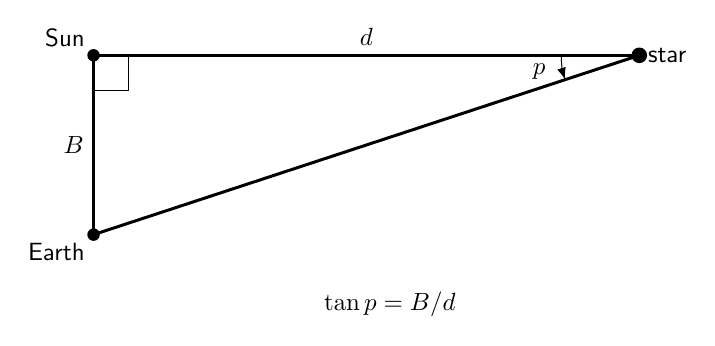
Figure 1. Stellar parallax begins with a right triangle whose short side is the observing baseline
and whose long side is the distance to the star.
1 General geometric definition
Consider an observer who moves between two locations while viewing a distant object.
The observed direction changes because the line of sight is different at the two observer
positions.
The effect is the same geometric phenomenon seen when a nearby object appears to shift relative
to a distant background as one alternately closes the left and right eye.
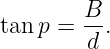
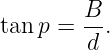
In the simplest right-triangle geometry,
This relation is exact.
No small-angle approximation has yet been made.
The parallax angle becomes smaller as the object becomes more distant:
Thus parallax is fundamentally a geometric distance measurement.
2 Annual stellar parallax
For a nearby star, Earth’s orbital motion supplies a known baseline.
A convenient idealized geometry compares the direction to the star from the Sun and from Earth
when the Sun-Earth line is perpendicular to the star’s mean line of sight.
The baseline is then one astronomical unit:
The stellar parallax p is conventionally the angular semiamplitude corresponding to this one-AU
baseline.
Hence
Observations taken roughly six months apart can use Earth positions separated by approximately
two astronomical units.
The total apparent angular excursion between the two extreme directions is then approximately
The cataloged annual parallax remains the semiamplitude p, not the full peak-to-peak
displacement.
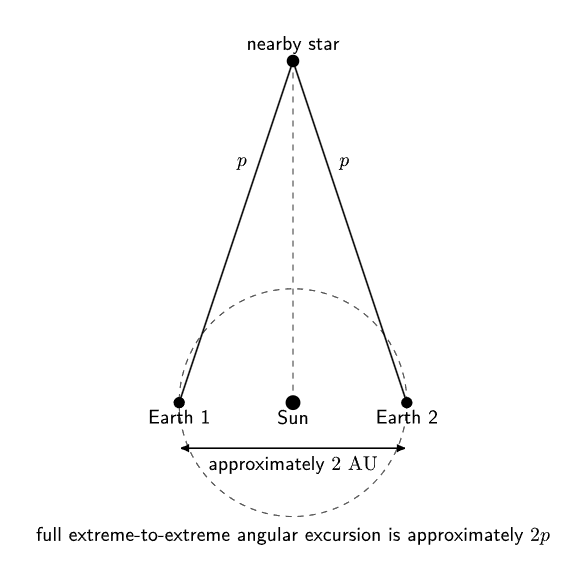
Figure 2. Earth positions on opposite sides of the Sun provide an approximately two-AU
observing separation. The cataloged annual parallax is the one-sided angular semiamplitude.
3 The tangent relation
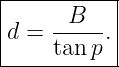
Return to the exact geometry:
Solving for distance gives
For annual parallax,
This is the exact elementary-trigonometric relation for the idealized right-triangle geometry.
The common inverse relation involving 1∕p appears only after approximating the tangent.
4 Taylor series of the tangent function
The Taylor series of tan p about
is
when p is measured in radians.
Factor out p:
If
then
and all higher-order terms are much smaller than the leading term.
Therefore
This is the small-angle approximation.
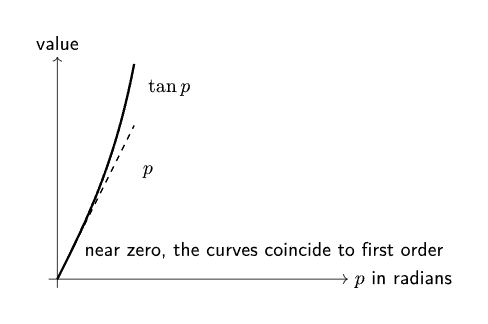
Figure 3. Near zero radians the tangent function is nearly indistinguishable from the straight line
represented by its first Taylor-series term.
5 Deriving the parallax distance relation
Begin with the exact annual-parallax geometry:
For a stellar parallax,
Using
we obtain
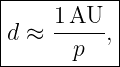
Therefore
with p in radians.
This is the basic parallax distance formula.
The inverse dependence
is not a separate empirical law.
It follows from trigonometry and the Taylor expansion of the tangent function.
6 Why radians are required
The approximation
is valid only when p is expressed in radians.
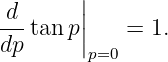
An angle in radians is defined by
which makes it dimensionless and gives the derivative
If degrees or arcseconds are inserted directly into
the numerical relation is incorrect.
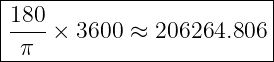
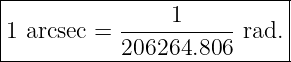
One radian contains
arcseconds.
Therefore
7 From radians to parsecs
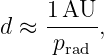
Starting from
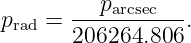
write the parallax in arcseconds:
Then
| d | ≈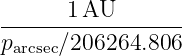 | (33)
|
| = 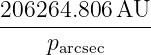 . . | (34) |
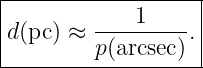
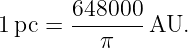
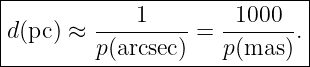
The parsec is chosen so that
Therefore
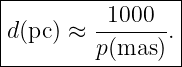
Equivalently, if parallax is measured in milliarcseconds,
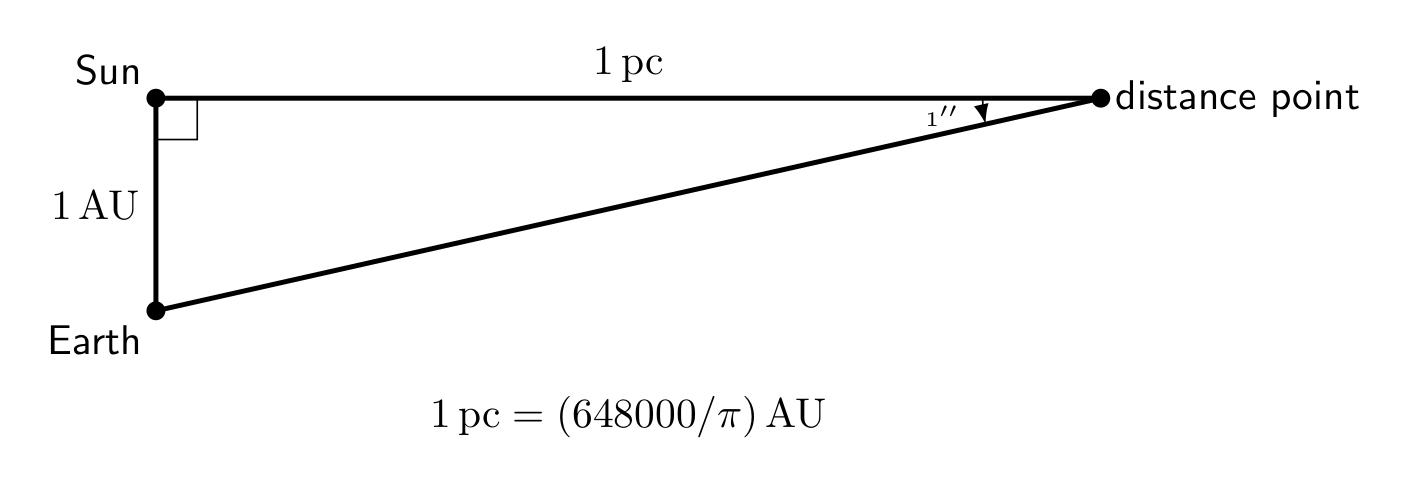
Figure 4. The parsec is the astronomical distance unit naturally associated with a one-arcsecond
parallax on a one-AU baseline.
8 A modern note on the parsec
Historically, the parsec was introduced through stellar-parallax geometry.
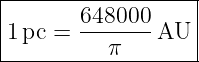
Modern astronomical standards take
as an exact relation.
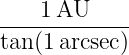
This corresponds to the small-angle angular conversion.
The difference between this modern exact parsec and the value obtained from
appears only at an extremely small fractional level.
For introductory and ordinary stellar-astrometry work, the distinction is negligible.
9 How accurate is the small-angle approximation?
From the Taylor series,
Thus the fractional correction to replacing tan p with p begins at approximately
For
Therefore
 | ≈ 7.8 × 10⁻¹². | (44) |
That is far smaller than ordinary stellar-parallax measurement uncertainties.
The small-angle approximation is therefore extraordinarily accurate for stellar parallaxes.
10 Example 1: fifty milliarcseconds
Suppose
Convert to arcseconds:
Then
| d(pc) | ≈ | (47)
|
| = 20 pc. | (48) |
11 Example 2: ten milliarcseconds
For
| d(pc) | ≈ | (50)
|
| = 100 pc. | (51) |
A star with half the parallax lies approximately twice as far away.
12 Parallax uncertainty
For the simple inverse relation
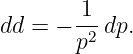
differentiation gives
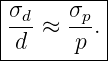
For small uncertainties,
Thus a one-percent parallax uncertainty gives approximately a one-percent distance uncertainty
when the parallax signal-to-noise ratio is high.
The nonlinear inverse transformation becomes important when
is not small compared with
In that regime, simply computing
can produce biased or misleading distance estimates.
Modern astrometry often uses probabilistic distance inference for low-signal-to-noise
parallaxes.
13 Parallax is an apparent angular effect
Parallax does not mean the star physically oscillates across space each year.
The star’s apparent direction changes because the observer’s location changes.
In a complete astrometric model, observed sky position can contain contributions from
- constant reference position,
- proper motion,
- annual parallax,
- orbital motion,
- instrumental and reference-frame effects.
For a binary star, annual parallax and orbital astrometric motion can both appear in the same
data.
They must be separated by their different geometric and temporal signatures.
14 The parallax ellipse
Earth’s motion is approximately in the ecliptic plane.
The projection of Earth’s orbital baseline onto the tangent plane of a star depends on the star’s
direction on the sky.
As a result, the annual parallactic displacement generally traces an ellipse.
Special cases include:
- near the ecliptic, the parallactic ellipse collapses toward a line,
- near an ecliptic pole, it approaches a circle.
The cataloged parallax p is the scale factor of this known annual geometric signature.
15 General baseline form
The one-AU annual-parallax geometry is one example of a more general relation.
If only the baseline component perpendicular to the line of sight contributes, then
For small angles,
Thus increasing the observing baseline increases the measurable parallax angle.
This is why a large baseline is valuable in astrometry.
16 Definition summary
A concise definition is:
Parallax is the apparent angular displacement of an object produced by a change
in the observer’s position. For annual stellar parallax, the parallax angle is the
angular semiamplitude corresponding to a one-AU baseline between the Sun and
Earth.
The exact right-triangle relation is
The Taylor series
gives
for stellar parallaxes.
Therefore
and in astronomical units,
The familiar parsec relation is therefore a compact small-angle form of the exact tangent
geometry.
17 Common mistakes
- Treating the full six-month peak-to-peak angular displacement as the cataloged
parallax instead of twice the parallax semiamplitude.
- Writing d = 1∕p without specifying the units.
- Applying tan p ≈ p while using degrees or arcseconds numerically instead of radians.
- Forgetting that the exact geometric relation contains tan p.
- Confusing annual parallax with proper motion.
- Interpreting the parallactic shift as physical yearly motion of the star.
- Inverting a very noisy parallax without considering the nonlinear statistics of the
transformation.
- Forgetting that orbital astrometric motion in a binary star can coexist with annual
parallax.
18 Practice exercises
- Starting from a right triangle, derive d = B∕ tan p.
- Write the Taylor series of tan p through the cubic term and show why tan p ≈ p for
small p.
- Show that the leading fractional correction to the small-angle approximation is
approximately p2∕3.
- Convert one arcsecond to radians.
- Starting from d = 1 AU∕prad, derive d(pc) = 1∕p(arcsec).
- A star has parallax 25 MAS. Estimate its distance in parsecs.
- A star has parallax 4 mas. Estimate its distance in parsecs.
- If the full apparent shift between opposite Earth positions is 80 mas, what is the annual
parallax p?
- If p = 20 ± 0.2 mas, estimate the fractional distance uncertainty in the small-error
limit.
- Explain why a binary star astrometric model may need both annual parallax and
orbital terms.
References
References
[1] B. W. Carroll and D. A. Ostlie, An Introduction to Modern Astrophysics, 2nd ed.,
Cambridge University Press, 2017.
[2] W. M. Smart, Textbook on Spherical Astronomy, 6th ed., Cambridge University
Press, 1977.
[3] International Astronomical Union, Resolution B2 on Recommended Zero Points for
the Absolute and Apparent Bolometric Magnitude Scales, 2015.
[4] Gaia Collaboration, Gaia Data Release 3: Summary of the Content and Survey
Properties, Astronomy and Astrophysics, 674, A1, 2023.