Acceleration in Mechanics
Acceleration describes how velocity changes with time. Because velocity is a vector, acceleration
measures changes in either the magnitude of velocity, its direction, or both.
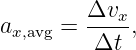
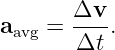
For a finite time interval, average acceleration is
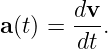
At an instant, acceleration is the time derivative of velocity,
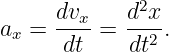
Since velocity is the derivative of position,
Acceleration is therefore a second time derivative of position. These definitions are kinematic: they
describe motion without yet asking what forces produce it. Dynamics enters later through
Newton’s laws.
1 Average acceleration
Suppose a particle has velocity  at time
  and velocity
  at time
  . Define
and
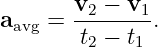
The average acceleration is
The direction of average acceleration is the direction of the velocity change  , not necessarily
the direction of motion.
, not necessarily
the direction of motion.
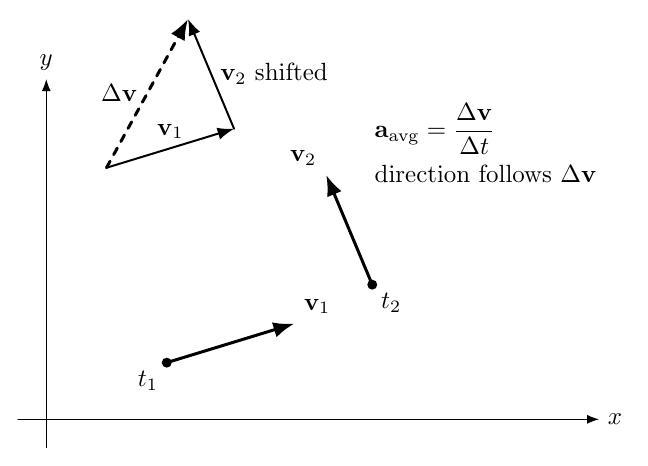
Figure 1. Acceleration is associated with the change in the velocity vector. The vector
 can be nonzero because the speed changes, the direction changes, or both.
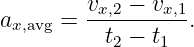
In one dimension,
The SI unit is
The dimensions of acceleration are
2 Instantaneous acceleration as a limit
Average acceleration describes a finite interval. To obtain the acceleration at one instant, shrink
the interval around that instant.
Let the velocity at time  be
be  . A short time
  later, the velocity is
  . The
velocity change is
. The
velocity change is
The instantaneous acceleration is
Thus
Using
we also have
In one-dimensional motion,
3 Acceleration components in Cartesian coordinates
For motion described by
with a fixed Cartesian basis,
Differentiating once more gives
Therefore
The magnitude is
4 Acceleration from a velocity-time graph
For one-dimensional motion, acceleration is the slope of a velocity-time graph.
Over a finite interval,
which is the secant slope of the  -versus-
 graph.
At an instant,
which is the tangent slope.
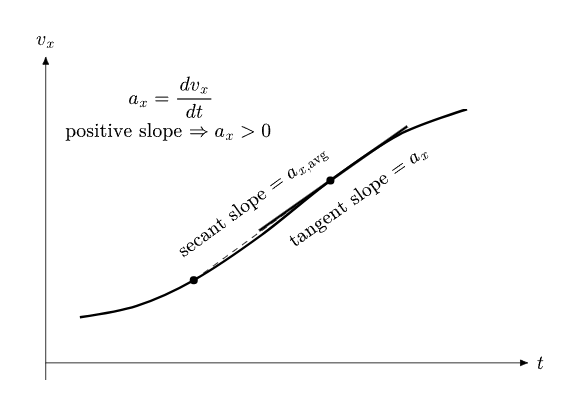
Figure 2. On a velocity-time graph, average acceleration is a secant slope and instantaneous
acceleration is the tangent slope. The area under an acceleration-time graph will later give the
change in velocity.
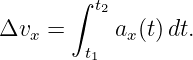
The inverse relation follows from integration:
This relationship becomes central in M01-04 on motion graphs and M01-05 on constant-acceleration
motion.
5 The sign of acceleration in one dimension
A common misconception is that positive acceleration means “speeding up” and negative
acceleration means “slowing down.” The sign of acceleration instead tells how the velocity
component changes.
In one dimension, compare the signs of  and
and  :
:
- if
 and
and  have the same sign, the speed increases;
- if
 and
and  have opposite signs, the speed decreases;
- if
 , the sign of
  determines which way the velocity begins to change.
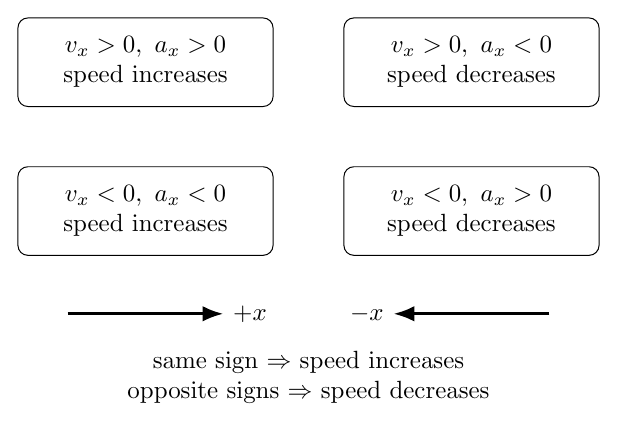
Figure 3. In one-dimensional motion, speeding up or slowing down depends on the relative signs
of velocity and acceleration, not on the sign of acceleration alone.
For example, an object moving left has  . If it also has
  , its velocity becomes more
negative and its speed increases.
, its velocity becomes more
negative and its speed increases.
6 Zero velocity does not imply zero acceleration
A particle can be instantaneously at rest while still having nonzero acceleration.
A vertically thrown ball provides the standard example. At its highest point,
but, neglecting air resistance, its acceleration is still approximately
The zero value of velocity is only an instantaneous statement about motion. Acceleration describes
how that velocity is changing.
Conversely, zero acceleration does not imply zero velocity. A particle moving with constant nonzero
velocity has
7 Acceleration can change direction without changing speed
Because velocity is a vector, acceleration need not change speed. It can change only the direction of
motion.
Uniform circular motion is the simplest example. A particle moves with constant speed  , but its
tangent velocity vector continually changes direction. The acceleration points inward toward the
center of the circle.
, but its
tangent velocity vector continually changes direction. The acceleration points inward toward the
center of the circle.
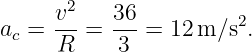
For a circle of radius  , the magnitude is
The detailed derivation belongs to M01-08, but the kinematic lesson is already important:
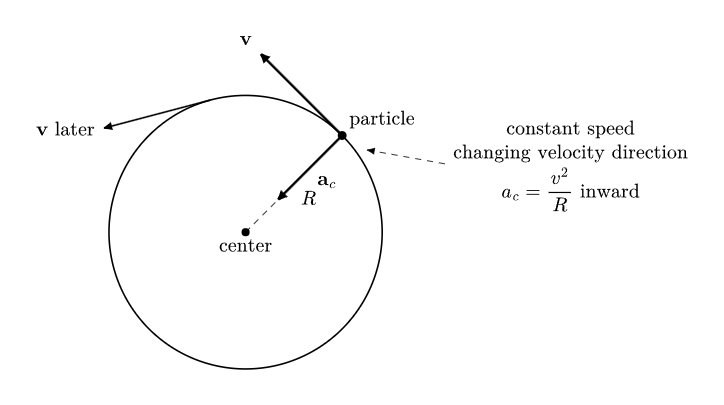
Figure 4. In uniform circular motion the speed can remain constant while the tangent velocity
changes direction. The resulting acceleration is directed toward the center.
More generally, acceleration can be decomposed into a part that changes speed and a part that
changes direction. That decomposition is developed later in curvilinear kinematics.
8 Acceleration and reference frames
Acceleration is not frame-independent in every possible reference frame. The precise Newtonian
statement is narrower.
For two Cartesian frames whose origins move with constant relative velocity  ,
,
Differentiating gives
because 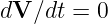 .
.
Thus acceleration is invariant under a Galilean transformation between inertial frames related by
constant translational velocity.
If the second frame has translational acceleration  , then instead
Rotating frames introduce additional terms. Those effects are treated later in the mechanics
sequence.
9 Acceleration and Newtonian dynamics
Kinematics defines acceleration without reference to force. Dynamics explains how forces determine
acceleration.
For a constant-mass particle in an inertial frame, Newton’s second law is
This does not define acceleration; it relates the kinematically defined acceleration to the net force
and mass.
The distinction is useful:
is a kinematic statement, while
is a dynamical law.
10 Constant acceleration as an important special case
If acceleration is constant,
then integrating
gives
The full constant-acceleration equations, including position as a function of time and velocity as a
function of displacement, are derived systematically in M01-05.
11 Gravitational acceleration near Earth’s surface
Near Earth’s surface, freely falling objects experience an approximately downward gravitational
acceleration when air resistance is neglected. A commonly used reference value is the standard
gravity
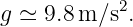
Actual local gravitational acceleration varies with location and altitude. In introductory mechanics,
it is often approximated as
The sign assigned to gravitational acceleration depends on the chosen coordinate direction. If
upward is positive,
12 Worked example 1: acceleration from a position function
A particle moves along the  axis according to
with  in metres and
  in seconds. Find
  ,
,  , and the acceleration at
 .
.
Differentiate the position once:
Differentiate again:
At  ,
,
Thus
13 Worked example 2: vector average acceleration
A particle’s velocity changes from
to
over  . Find the average acceleration.
The velocity change is
Therefore
Its magnitude is
14 Worked example 3: constant speed with nonzero acceleration
A particle moves around a circle of radius
at constant speed
Although the speed is constant, the velocity changes direction. The centripetal acceleration
magnitude is
The acceleration points radially inward.
This example demonstrates that acceleration measures change of velocity, not merely change of
speed.
15 Common mistakes
- Treating negative acceleration as automatically meaning that an object slows down.
- Assuming
 at one instant implies
  .
.
- Assuming constant speed implies zero acceleration.
- Confusing acceleration with velocity or displacement because all can carry a sign in
one dimension.
- Reading acceleration as the height of a velocity-time graph rather than its slope.
- Forgetting that acceleration is Galilean-invariant only between inertial frames with
constant relative translational velocity.
- Using
 without stating a sign convention for the vertical axis.
16 Practice problems
M01-03-P01
A CAR’s velocity changes from  east to
  east in
  . Find its average
acceleration.
. Find its average
acceleration.
M01-03-P02
A particle moves along the  axis with
Find  , and determine whether the particle is speeding up or slowing down at
  and
and
 .
.
M01-03-P03
A particle has
Find  ,
,  , and
, and  .
.
M01-03-P04
Velocity changes from  to
to  in
in  . Find
  and
its magnitude.
and
its magnitude.
M01-03-P05
A ball is thrown vertically upward. At its highest point, state the velocity and acceleration when
upward is positive and air resistance is neglected.
M01-03-P06
A particle moves left with  and has
  . Is it speeding up or slowing
down? Explain using signs.
. Is it speeding up or slowing
down? Explain using signs.
M01-03-P07
A particle moves right with 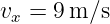 and has
  . Is it speeding up or slowing
down?
. Is it speeding up or slowing
down?
M01-03-P08
A car travels around a circular curve of radius  at constant speed
  . Find the
acceleration magnitude and state its direction.
. Find the
acceleration magnitude and state its direction.
M01-03-P09
Frame  moves at constant velocity relative to inertial frame
  . A particle has acceleration
 in
in  . What acceleration is measured in
  ?
?
M01-03-P10
A frame has translational acceleration  relative to an inertial frame. A particle has
inertial-frame acceleration
relative to an inertial frame. A particle has
inertial-frame acceleration  . Find its acceleration in the translating
frame.
. Find its acceleration in the translating
frame.
17 Compact answer check
- P01:
 east.
east.
- P02:
 ; at
; at  ,
,  , so slowing down; at
  ,
,  ,
so speeding up.
,
so speeding up.
- P03:
 ;
;  ;
;  .
.
- P04:
 ; magnitude
  .
.
- P05:
 ;
;  .
.
- P06: Speeding up because
 and
and  have the same sign.
- P07: Slowing down because
 and
and  have opposite signs.
- P08:
 , inward.
- P09: The same acceleration:
 .
.
- P10:
 .
.
18 Connection to the next articles
M01-03 completes the basic position-velocity-acceleration chain:
M01-04 uses motion graphs to connect slopes and areas among  ,
,  , and
, and  .
M01-05 then develops the special but extremely important case of constant acceleration in
full.
.
M01-05 then develops the special but extremely important case of constant acceleration in
full.
References
[1] PhysicsLibrary, Acceleration, object id 73.
[2] PhysicsLibrary, M01-02: Velocity in Mechanics.
[3] OpenStax / cnxuniphysics, University Physics Volume 1, archived 2016 BCcampus
clone, CC BY 4.0.
[4] University of California, Davis, Physics 9A: Classical Mechanics, Physics LibreTexts,
CC BY-SA 4.0.
[5] J. R. Taylor, Classical Mechanics, University Science Books, 2005. Used as a scope
and notation reference.





![[a] = m ∕s2.](https://images.physicslibrary.org/cache/objects/1312/make4ht/AccelerationInMechanics13x.png)
![[a] = LT −2.](https://images.physicslibrary.org/cache/objects/1312/make4ht/AccelerationInMechanics14x.png)