Variable Mass Systems and the Rocket Equation
The particle-system equations developed earlier assumed a fixed set of particles.
A rocket does not satisfy that assumption.
As propellant is expelled, mass crosses the boundary of the object we call “the rocket.” The rocket
mass decreases, and the escaping material carries momentum with it.
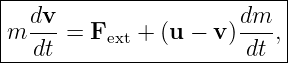
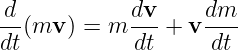
The central lesson is
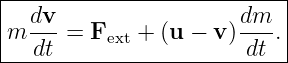
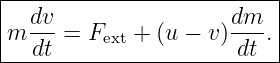
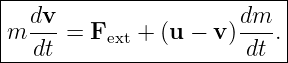
For one stream of transferred mass, a useful Newtonian equation is
where
- m(t) is the instantaneous mass of the chosen body,
- v is the body’s velocity in an inertial frame,
- u is the inertial-frame velocity of the material crossing the boundary,
- dm∕dt is the signed rate of change of the body’s mass.
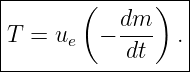
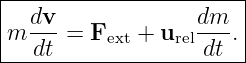
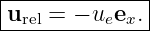
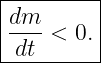
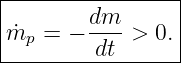
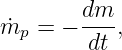
For a rocket,
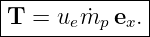
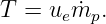
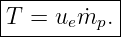
If exhaust leaves backward with speed ue relative to the rocket, the thrust magnitude
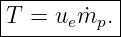
is
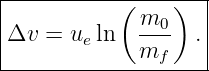
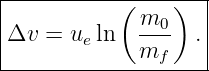
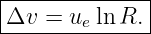
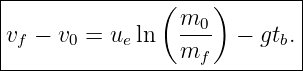
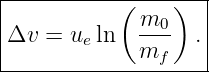
With no external force, integration gives the ideal rocket equation
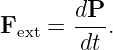
1 Why the fixed-mass equation needs modification
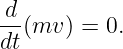
For a fixed set of particles,
If the selected system is the rocket body alone, however, particles continually leave the
system.
Writing
and then expanding
does not by itself produce the correct rocket equation.
The missing physics is the momentum carried across the system boundary by the exhaust.
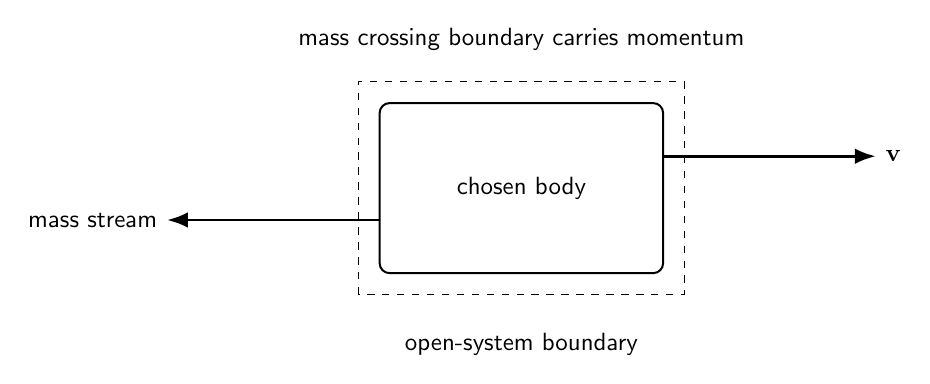
Figure 1. A variable mass body is an open system. Material crossing the boundary transports
momentum, so mass flow must appear explicitly in the momentum balance.
2 Closed material system versus open rocket system
There are two useful ways to analyze rocket motion.
2.1 Closed material system
Choose a system containing the rocket and all propellant that will later be expelled.
No mass crosses this enlarged system boundary.
Ordinary total momentum conservation applies directly when external impulse is negligible.
2.2 Open rocket system
Choose only the instantaneous rocket and its remaining propellant.
Mass crosses the boundary through the exhaust.
The momentum carried by that mass must be included as a flux term.
Both viewpoints produce the same physics when used consistently.
3 One-stream variable mass momentum balance
Consider a body with instantaneous mass m and velocity v.
During a short time dt, its mass changes by dm.
The material transferred across the boundary has inertial velocity u.
First-order momentum bookkeeping gives
Divide by dt:
Define the stream velocity relative to the body:
Then
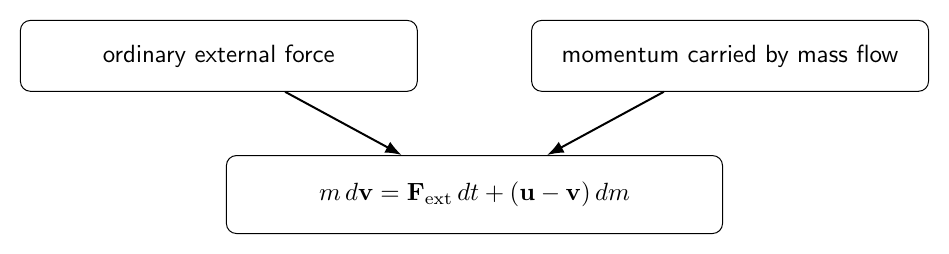
Figure 3. The variable mass equation separates ordinary external force from momentum transfer
associated with material crossing the system boundary.
4 Sign convention for a rocket
Let ex point in the desired forward direction.
Suppose exhaust leaves backward relative to the rocket at speed ue > 0:
The rocket is losing mass:
Therefore
points forward.
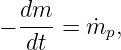
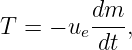
Define the positive propellant mass-flow rate
Then the thrust vector is
Its magnitude is
5 Differential derivation of rocket thrust
Consider a one-dimensional rocket.
At time t, the rocket has mass m and velocity v.
During dt, the rocket ejects positive mass
The remaining rocket mass is
and its new velocity is
If exhaust leaves backward at speed ue relative to the rocket, its inertial velocity to first order
is
Ignoring external impulse for the moment,
Final momentum is
Expand and discard the second-order product dμdv:
| pf | = mv + mdv − v dμ + v dμ − ue dμ | (25)
|
| = mv + mdv − ue dμ. | (26) |
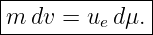
Momentum conservation gives
Therefore
Since
we obtain
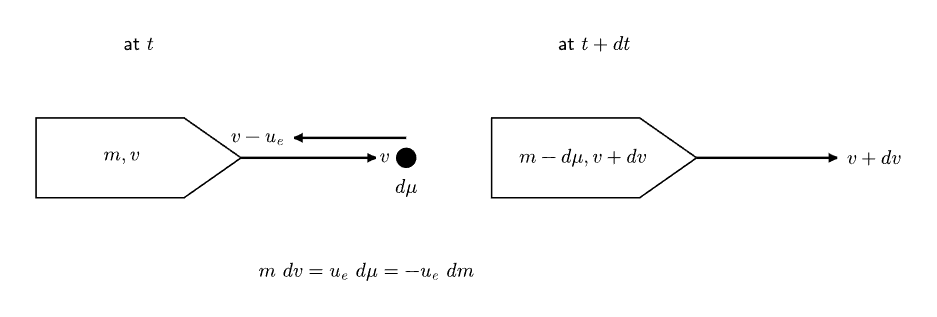
Figure 2. Differential rocket derivation. The expelled propellant carries backward momentum,
producing a forward change in rocket momentum.
6 Rocket equation with external force
Include an external force Fext along the line of motion.
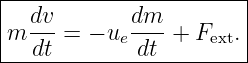
The differential equation becomes
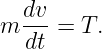
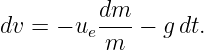
Dividing by dt,
Because
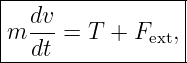
this is
with
The mass is time dependent even when thrust is constant.
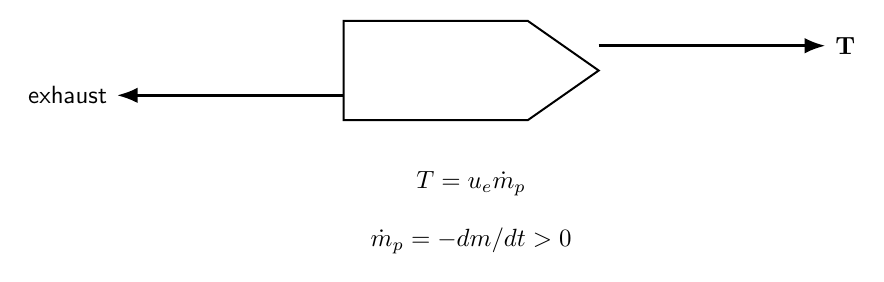
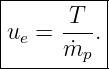
Figure 4. Thrust equals effective exhaust speed times positive propellant mass-flow rate:
T = ueṁp.
7 Ideal Tsiolkovsky rocket equation
Assume:
- one-dimensional motion,
- no external force during the idealized burn,
- constant effective exhaust speed ue,
- Newtonian mechanics.
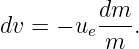
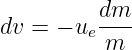
Then
Separate variables:
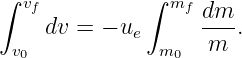
Integrate from initial mass m0 and velocity v0 to final mass mf and velocity vf:
Therefore
| vf − v0 | = −ue![[ln m ]](https://images.physicslibrary.org/cache/objects/1398/make4ht/VariableMassSystemsAndTheRocketEquation36x.png) m0mf m0mf
| (39)
|
| = −ue ln  . . | (40) |
Thus
8 Mass ratio
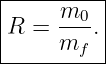
Define the mass ratio
Then
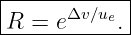
Solving for mass ratio,
The exponential dependence is one of the central design constraints of rocketry.
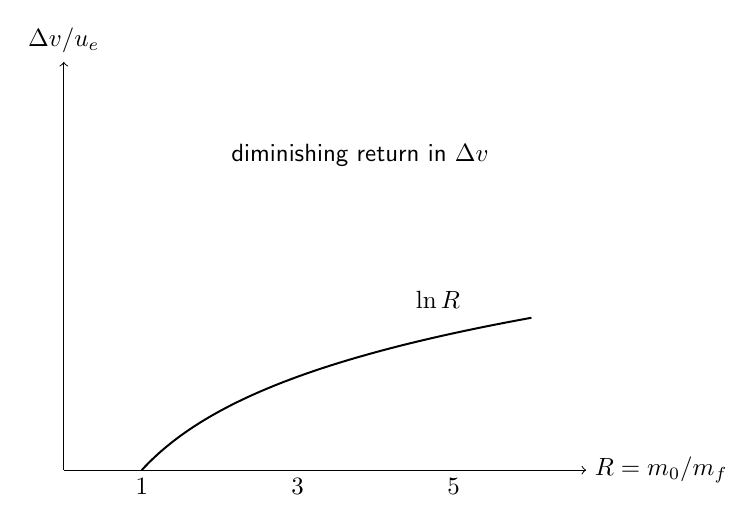
Figure 5. Ideal rocket delta-v grows logarithmically with mass ratio. Equivalently, required mass
ratio grows exponentially with required delta-v.
9 Example 1: ideal delta-v
A rocket has
| m0 | = 12000 kg, | (45)
|
| mf | = 4000 kg, | (46) |
and effective exhaust speed
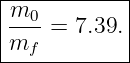
The mass ratio is
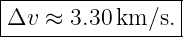
Therefore
| Δv | = 3000 ln 3 | (49)
|
| = 3296 m∕s. | (50) |
Thus
10 Example 2: required mass ratio
Suppose
and required ideal delta-v is
Then
Therefore
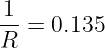
Only
of the initial mass remains after the modeled propellant expenditure.
11 Propellant fraction
Define
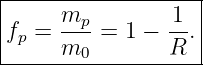
The propellant fraction relative to initial mass is
For
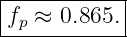
we obtain
Thus about 86.5% of the initial mass is expelled in this idealized single-stage example.
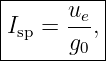
12 Specific impulse
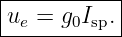
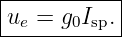
Rocket performance is often expressed using specific impulse:
where
is standard gravity.
Therefore
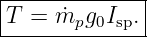
The thrust equation becomes
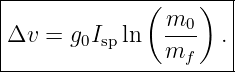
The ideal rocket equation can be written
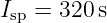
13 Example 3: thrust from specific impulse
An engine has
and propellant flow rate
The effective exhaust speed is
| ue | = g0Isp | (68)
|
| = (9.80665)(320) | (69)
|
| = 3138 m∕s. | (70) |
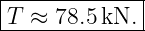
The thrust is
| T | = ṁpue | (71)
|
| = (25)(3138) | (72)
|
| = 7.85 × 10⁴ N. | (73) |
Thus
14 Constant propellant mass-flow rate
If
then
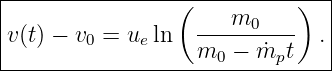
The ideal velocity change from time 0 to t is
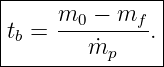
The burn time to reach final mass mf is
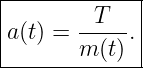
15 Acceleration during a constant-thrust burn
For no external force and constant thrust,
Therefore
As propellant is consumed, m(t) decreases.
Thus acceleration increases even if thrust remains constant.
16 Vertical flight with constant gravity
Take upward as positive.
Neglect drag and assume constant gravitational acceleration g.
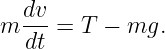
Then
Using
we obtain
Integrating over the burn,
The quantity
is the gravity loss in this simplified vertical constant-g model.
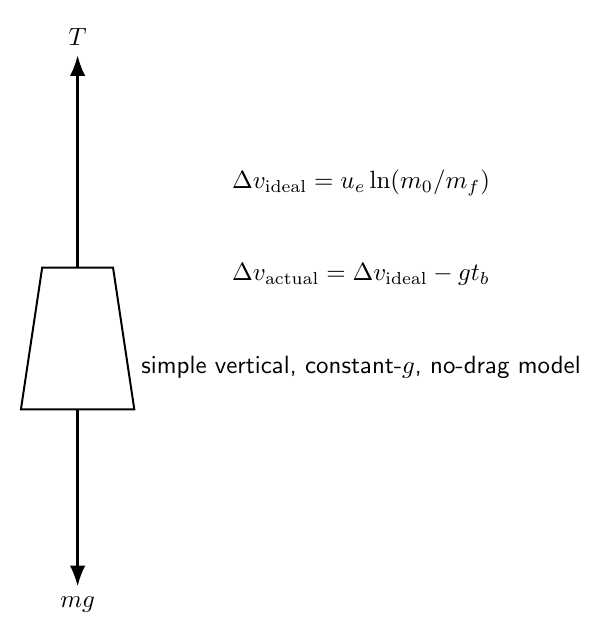
Figure 6. In simplified vertical flight, ideal rocket delta-v is reduced by gravity acting throughout
the burn.
17 Example 4: vertical burn with gravity
Suppose an ideal rocket would produce
The burn lasts
Neglect drag and use
The gravity loss is
Therefore
This is a deliberately simplified vertical model.
18 Drag and other external forces
In general,
If
for vertical upward flight with drag magnitude D, then
Thus, schematically,
The ideal rocket equation provides propulsive delta-v. External forces determine how much of that
capability appears as actual vehicle velocity change.
19 Staging
A single-stage vehicle must carry payload, structure, tanks, engine, and all remaining
propellant.
Discarding empty structure allows a later stage to begin with a smaller inert mass burden.
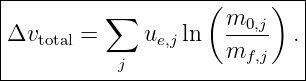
For ideal sequential stages,
Each stage has its own effective exhaust speed and mass ratio.
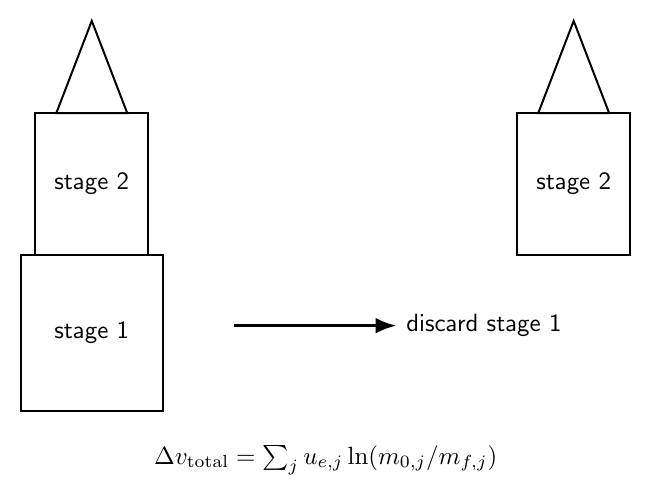
Figure 7. Staging discards inert structure so later propulsion does not have to accelerate hardware
that is no longer useful. Ideal stage delta-v values add.
20 Example 5: two ideal stages
Stage 1 provides
| ue,1 | = 3000 m∕s, | (96)
|
| R1 | = 3.0. | (97) |
Stage 2 provides
| ue,2 | = 3400 m∕s, | (98)
|
| R2 | = 2.5. | (99) |
Then
| Δv1 | = 3000 ln 3 = 3296 m∕s, | (100)
|
| Δv2 | = 3400 ln 2.5 = 3115 m∕s. | (101) |
Therefore
21 Mass accretion: a different variable mass problem
Variable mass is not unique to rockets.
Suppose a cart of mass m and velocity v collects incoming material moving at inertial velocity
u.
Now
The one-stream equation is
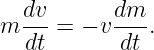
If the incoming material is initially at rest in the laboratory,
and no external horizontal force acts:
Thus
The cart slows as it gains stationary mass.
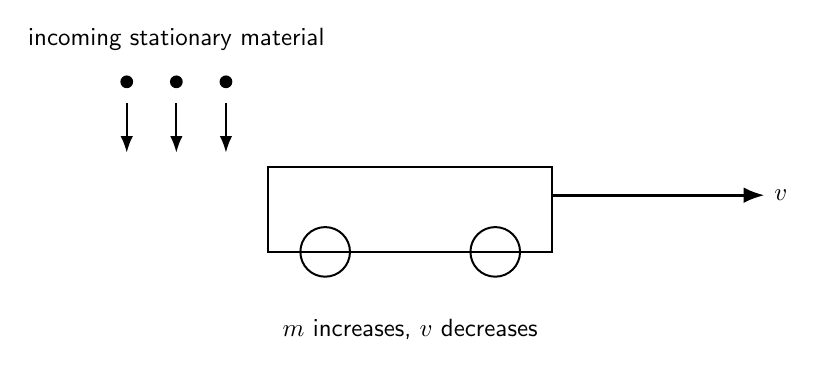
Figure 8. A cart that captures stationary material gains mass and slows. The incoming material
brings its own momentum into the open-system balance.
22 Example 6: cart collecting stationary mass
A cart has initial mass
and speed
It collects stationary material until its mass becomes
With no external horizontal force,
Therefore
Kinetic energy decreases because capture is inelastic.
23 Multiple mass streams
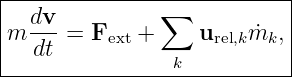
If several independent streams cross the boundary, the momentum-flux contributions
add.
Schematically,
provided each signed mass-flow rate and relative stream velocity are defined consistently.
The sign convention must be stated explicitly before using the equation.
24 Effective exhaust velocity
The simple derivation treats exhaust as a stream with relative speed ue.
Real rocket thrust can also include a pressure contribution at the nozzle exit.
A more detailed propulsion model uses
where ve is nozzle-exit exhaust speed relative to the vehicle, pe is exit pressure, pa is ambient
pressure, and Ae is exit area.
An effective exhaust velocity can then be defined by
25 What the ideal rocket equation does not include
The ideal equation
does not by itself include:
- gravitational loss,
- aerodynamic drag,
- steering loss,
- pressure variation unless absorbed into effective ue,
- changing exhaust performance,
- structural mass constraints,
- relativistic effects.
It is an integrated momentum relation for idealized propulsion, not a complete trajectory
model.
26 Why the logarithm appears
The differential relation
contains the factor
Integrating 1∕m produces
The logarithm is therefore a direct consequence of thrust acting on a continuously decreasing
mass.
27 Energy is not the easiest route
A rocket carries internal energy in its propellant.
That energy becomes rocket kinetic energy, exhaust kinetic energy, thermal energy, pressure work,
and other losses.
Because the exhaust retains substantial kinetic energy, simply equating propellant energy to rocket
kinetic energy does not yield the rocket equation.
Momentum balance is the natural starting point.
28 Center of mass of rocket plus exhaust
If the full rocket-plus-exhaust material system experiences no external force,
Therefore the center-of-mass velocity of the complete material system remains constant.
The rocket accelerates forward because the exhaust acquires backward momentum.
29 Common mistakes
- Applying F = d(mv)∕dt to the rocket body alone without a momentum-flux term.
- Forgetting that the rocket has dm∕dt < 0.
- Using exhaust speed in the laboratory frame when the rocket equation requires exhaust
velocity relative to the rocket.
- Losing the minus sign in mdv = −ue dm.
- Using Δv = ue(m0∕mf) instead of the logarithmic relation.
- Confusing thrust with impulse.
- Confusing specific impulse in seconds with exhaust velocity in m∕s.
- Forgetting the factor g0 in ue = g0Isp.
- Adding gravity loss to ideal delta-v instead of subtracting it in the simple vertical
model.
- Assuming constant thrust means constant acceleration.
- Treating a variable mass open system as if it were a fixed set of particles.
- Mixing signed mass-flow rate dm∕dt with positive propellant flow rate ṁp without
stating the convention.
- Assuming the ideal rocket equation is a complete launch trajectory model.
- Forgetting that staging mass ratios must be defined for each stage using the mass
actually carried by that stage.
30 Practice exercises
- Derive
- Starting from differential momentum conservation, derive
for a one-dimensional rocket with no external force.
- Integrate the differential rocket equation to obtain
- A rocket has ue = 2800 m∕s and R = 4. Find its ideal delta-v.
- What mass ratio is required for Δv = 6000 m∕s with ue = 3200 m∕s?
- Find the propellant fraction corresponding to R = 5.
- An engine has Isp = 300 s and propellant flow rate 40 kg∕s. Find effective exhaust speed and
thrust.
- A rocket burns 5000 kg of propellant at constant rate 50 kg∕s. Find the burn time.
- A constant-thrust rocket has initial mass 10000 kg and final mass 5000 kg. By what factor
does its acceleration change if external forces are neglected?
- Derive the simplified vertical result
- A vertical burn has ideal delta-v 2500 m∕s and lasts 60 s. Estimate the gravity loss at
constant g.
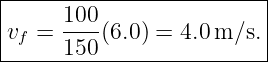
- A cart of mass 80 kg moving at 5 m∕s collects 20 kg of stationary material. Find its final
speed.
- Explain physically why a rocket can accelerate in empty space.
- Show that the center-of-mass velocity of rocket plus exhaust remains constant when external
force is zero.
- For two ideal rocket stages, derive
31 Summary
For one stream crossing an open system boundary,
For a rocket with effective exhaust speed ue and positive propellant flow rate
the thrust magnitude is
With no external force,
Integration gives
Using specific impulse,
For simplified vertical flight with constant gravity and no drag,
The next article returns to fixed-mass particle systems and develops angular momentum.
References
References
[1] K. E. Tsiolkovsky, Exploration of Cosmic Space by Means of Reaction Devices, 1903.
[2] G. P. Sutton and O. Biblarz, Rocket Propulsion Elements, 9th ed., Wiley, 2017.
[3] J. R. Taylor, Classical Mechanics, University Science Books, 2005.
[4] D. Kleppner and R. Kolenkow, An Introduction to Mechanics, 2nd ed., Cambridge
University Press, 2014.
[5] OpenStax, University Physics, Volume 1, Rice University, 2016.