Rotational Work, Power, and Energy Transfer
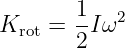
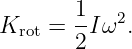
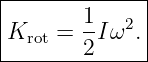
M03-09 established the rotational kinetic energy
for a rigid body rotating about a fixed axis.
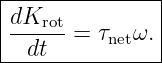
The next question is how rotational kinetic energy changes.
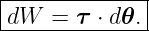
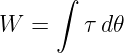
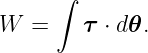
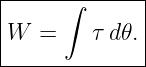
A force transfers energy when its point of application moves. In rotational motion, the same
physical idea can be expressed through torque and angular displacement:
For fixed-axis rotation,
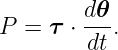
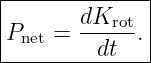
The corresponding instantaneous power is
For a fixed axis,
These relations describe energy transfer in shafts, motors, flywheels, Pulleys, brakes, turbines,
gears, and rotating machinery.
1 From force work to torque work
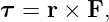
Consider a force F applied to a rigid body at position r measured from a fixed rotation
axis.
The differential work is
For a small rigid rotation,
Substitute:
Using the scalar triple-product identity,
Since
we obtain
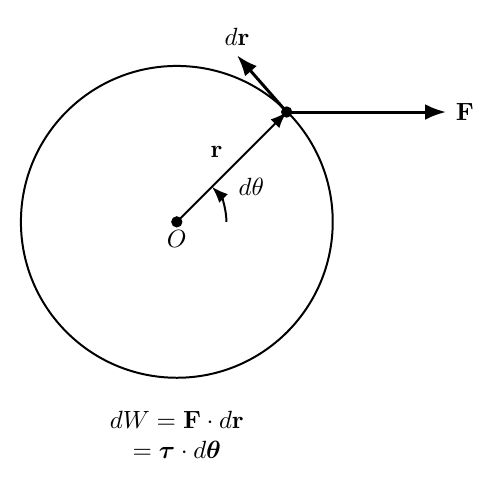
Figure 1. The ordinary work F ⋅ dr produced by a force on a rotating body can be written as
torque times angular displacement.
2 Sign of rotational work
For fixed-axis rotation,
Therefore:
- dW > 0 when torque and angular displacement have the same sign,
- dW = 0 when the torque has no component along the rotation axis,
- dW < 0 when torque opposes the angular displacement.
A motor driving a shaft usually does positive rotational work.
A brake opposing rotation usually does negative rotational work.
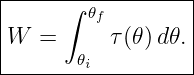
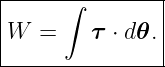
3 Finite rotational work
For a torque that may vary with angular position,
If torque is constant,
Angular displacement must be expressed in radians because the differential relation
assumes radian measure.
4 Torque angle graphs
The integral
has a geometric interpretation.
On a graph of torque versus angular displacement:
- area above the angular axis contributes positive work,
- area below the angular axis contributes negative work,
- total signed area equals rotational work.
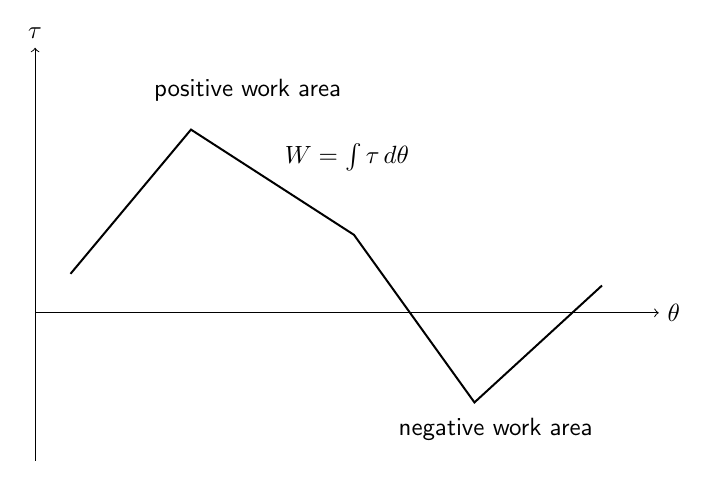
Figure 2. The signed area under a torque-versus-angle curve equals rotational work.
The units are
Radians are dimensionless in SI, so the result has units
5 Torque is not energy
Torque and energy can both be expressed using the dimensional combination N m, but they are
different physical quantities.
Torque is a rotational moment:
Work and energy are scalars:
A torque of
is not the same physical quantity as
The numerical dimensions coincide, but the physical meanings and transformation properties do
not.
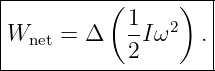
6 Rotational work-energy theorem
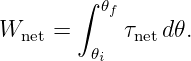
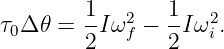
For a rigid body rotating about a fixed axis,
The net rotational work is
Use
and
Then
| Wnet | = ∫
Iω d𝜃 d𝜃 | (27)
|
| = ∫
ωiωf
Iω dω. | (28) |
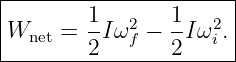
For constant moment of inertia,
Therefore
7 Rotational power
Power is the time rate of work:
Using
we obtain
Therefore
For a fixed axis,

Figure 3. Torque acting through angular velocity transfers energy at the rate P = τω. For a fixed
moment of inertia, this is also dKrot∕dt.
8 Power and rotational kinetic energy
For fixed I,
Differentiate:
 | = Iω | (37)
|
| = Iωα. | (38) |
Since
we obtain
Thus
9 Constant torque
If a constant net torque τ0 acts through angular displacement Δ𝜃,
Then
Therefore
10 Example 1: flywheel accelerated by constant torque
A flywheel has
A constant net torque
acts while the wheel turns through
It starts from rest.
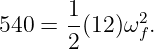
The work is
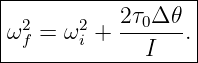
Set this equal to final rotational kinetic energy:
Thus
and
11 Variable torque example
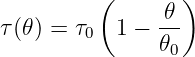
Suppose
for
The work is
| W | = ∫
0𝜃0
τ0 d𝜃 d𝜃 | (54)
|
| = τ0![[ ]
𝜃2
𝜃 − ----
2𝜃0](https://images.physicslibrary.org/cache/objects/1387/make4ht/RotationalWorkPowerAndEnergyTransfer52x.png) 0𝜃0 0𝜃0
| (55)
|
| =  τ0𝜃0. τ0𝜃0. | (56) |
Geometrically, this is the area of a triangle under the torque angle graph.
12 Torsional springs
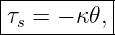
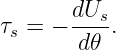
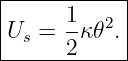
A torsional spring produces a restoring torque proportional to angular displacement:
where κ is the torsional spring constant.
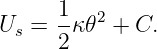
The potential energy satisfies
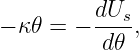
Thus
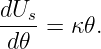
so
Integrating,
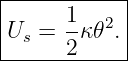
Choosing
gives
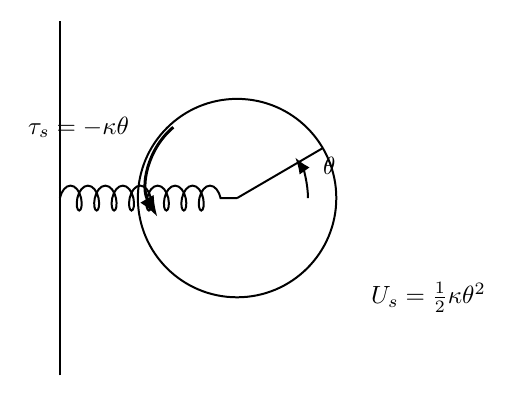
Figure 4. A torsional spring stores rotational potential energy Us =  κ𝜃2 and exerts the restoring
torque τs = −κ𝜃.
κ𝜃2 and exerts the restoring
torque τs = −κ𝜃.
13 Example 2: torsional spring release
A rotor with moment of inertia I is attached to a torsional spring of constant κ.
The rotor is released from rest at angular displacement 𝜃0.
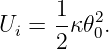
Initially,
and
At
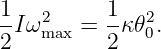
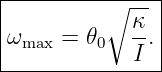
the spring potential energy is zero and the rotational kinetic energy is maximum:
Therefore
14 Flywheel energy storage
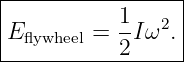
A flywheel stores energy as rotational kinetic energy:
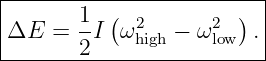
The usable energy between two angular speeds is
Because the energy depends on ω2, doubling angular speed multiplies stored kinetic energy by four
for the same I.
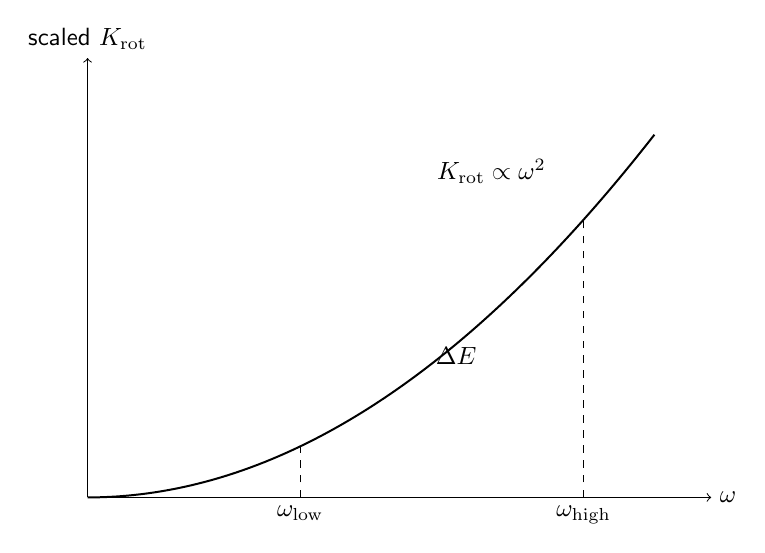
Figure 5. Flywheel energy grows quadratically with angular speed. Energy extracted as the wheel
slows is the difference between two values of  Iω2.
Iω2.
15 Example 3: usable flywheel energy
A flywheel has
It operates between
| ωhigh | = 300 rad∕s, | (72)
|
| ωlow | = 100 rad∕s. | (73) |
The usable energy is
| ΔE | =  (20) (20)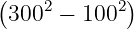 | (74)
|
| = 10(90000 − 10000) | (75)
|
| = 800000 J. | (76) |
Thus
16 Motor torque and power
For a motor shaft,
If torque is approximately constant,
If the motor is operating in an approximately constant-power regime,
Therefore available torque decreases as angular speed increases.
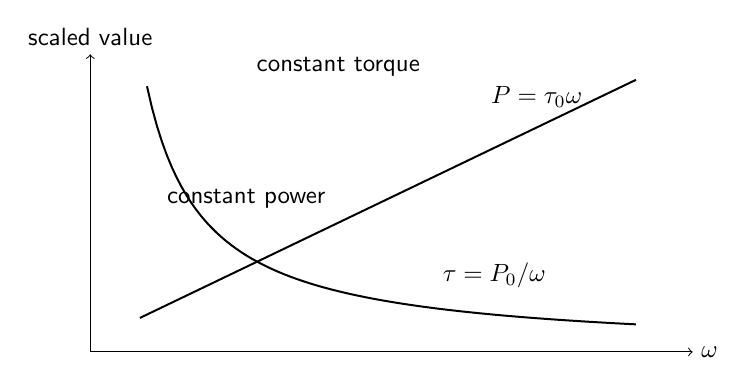
Figure 6. At constant torque, power increases linearly with angular speed. At constant power,
torque decreases as 1∕ω.
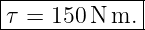
17 Example 4: shaft torque from power
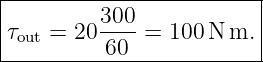
A motor delivers
at
Then
| τ | =  | (83)
|
| =  | (84)
|
| = 150 N m. | (85) |
Therefore
18 Rotational braking
A brake applies a torque opposite the angular velocity.
Thus
The braking power is negative:
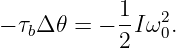
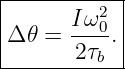
If a constant braking torque of magnitude τb acts through stopping angle Δ𝜃,
Therefore
The stopping angle grows as ω02.
19 Regenerative rotational braking
Negative rotational work does not have to become thermal energy.
In regenerative braking, a rotating system can drive an electrical machine as a generator.
Then rotational kinetic energy is transferred into electrical energy:
The torque on the rotor still opposes the motion, so
The destination of the removed mechanical energy depends on the physical mechanism.
20 Rotational damping
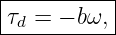
A common damping model is a torque proportional to angular velocity:
where b > 0 is a rotational damping coefficient.
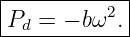
The damping power is
| Pd | = τdω | (94)
|
| = −bω2. | (95) |
Therefore
The damping torque always removes rotational mechanical energy when ω≠0.
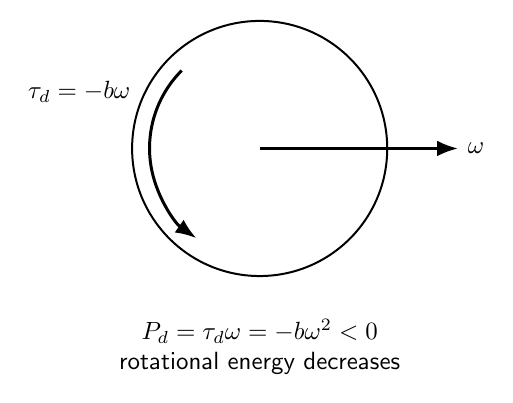
Figure 7. Viscous rotational damping produces negative power Pd = −bω2, continuously removing
rotational mechanical energy.
21 Free decay under viscous rotational damping
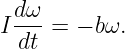
Consider a rotor with no applied torque except
The equation of motion is
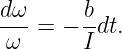
Separate variables:
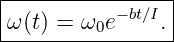
Integrating,
The rotational kinetic energy is
Energy decays twice as fast in the exponent as angular speed because kinetic energy depends on
ω2.
22 Belts, pulleys, and tangential power transfer
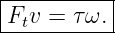
A belt applies tangential force Ft at pulley radius R.
The torque is
If the pulley edge moves at tangential speed
then the linear power transmitted by the belt is
Substitute
Therefore
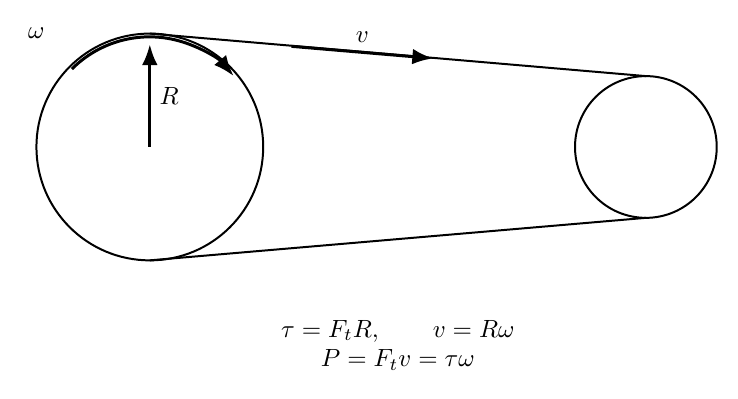
Figure 8. A tangential belt force transfers the same power whether described linearly as Ftv or
rotationally as τω.
23 Ideal mechanical transmission
In an ideal lossless rotational transmission,
Thus
A decrease in angular speed can therefore accompany an increase in torque.
For a real transmission with efficiency η,
Hence
24 Example 5: ideal speed reduction
An ideal transmission reduces angular speed from
to
If
power conservation gives
Thus
25 Combined translational and rotational power
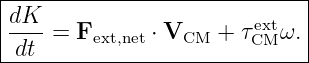
For a rigid body in planar motion,
Differentiate:
Using the translational and rotational equations of motion,
Thus rigid-body power naturally separates into translational and rotational parts.
26 Contact forces and energy transfer
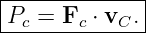
The work of a contact force depends on the velocity of the point where the force acts.
For a force Fc applied at contact point C,
For ideal rolling on a fixed surface,
so static friction can produce zero power.
For a moving belt or moving surface,
so frictional contact can transfer mechanical power.
This point-of-application view is the safest way to reason about work by contact forces.
27 Common mistakes
- Treating torque itself as energy because both can use N m.
- Using degrees rather than radians in W = ∫
τ d𝜃.
- Using W = τΔ𝜃 when torque varies with angle.
- Forgetting the sign of braking or damping torque.
- Using P = τω without considering the angle between torque and angular velocity in
three dimensions.
- Forgetting that flywheel energy scales as ω2.
- Assuming constant torque means constant power.
- Assuming constant power means constant torque.
- Forgetting that viscous damping gives Pd = −bω2.
- Assuming all negative rotational work becomes heat.
- Using a force displacement different from the displacement of the actual force
application point.
- Forgetting transmission efficiency in real power-transfer systems.
28 Practice exercises
- A constant torque of 15 N m acts through 8 rad. Find the work.
- A torque varies as τ(𝜃) = 4𝜃 in SI units. Find the work from 𝜃 = 0 to 𝜃 = 3 rad.
- Derive the rotational work-energy theorem from τ = Iα.
- A shaft rotates at 200 rad∕s while transmitting torque 75 N m. Find the power.
- A flywheel with I = 10 kg m2 increases speed from 50 to 150 rad∕s. Find the increase
in stored rotational kinetic energy.
- A constant braking torque of magnitude 40 N m stops a flywheel with I = 5 kg m2
from 20 rad∕s. Find the stopping angle.
- A torsional spring has κ = 12 N m∕rad and is twisted by 0.50 rad. Find the stored
energy.
- A rotor with I = 3 kg m2 is released from 𝜃
0 = 0.40 rad on a torsional spring with
κ = 75 N m∕rad. Find the maximum angular speed.
- Show that a belt force satisfies Ftv = τω for a pulley of radius R.
- An ideal transmission has ωin∕ωout = 4. If the input torque is 25 N m, find the output
torque.
- Repeat the preceding problem for a transmission efficiency of 0.85.
- A viscous rotational damper has τd = −bω. Derive the damping power.
- Solve Iω = −bω and obtain the exponential decay of angular speed.
- Explain why the energy of a viscously damped rotor decays with e−2bt∕I.
- Give an example where a contact force does zero work and another where a contact
force transfers nonzero power.
29 Summary
Rotational work is
For fixed-axis rotation,
The rotational work-energy theorem is
Rotational power is
A torsional spring stores
A flywheel stores
Viscous rotational damping has
For ideal power transmission,
This completes the main work-energy sequence and provides the bridge into momentum
methods.
References
References
[1] J. R. Taylor, Classical Mechanics, University Science Books, 2005.
[2] D. Kleppner and R. Kolenkow, An Introduction to Mechanics, 2nd ed., Cambridge
University Press, 2014.
[3] K. R. Symon, Mechanics, 3rd ed., Addison-Wesley, 1971.
[4] H. D. Young and R. A. Freedman, University Physics with Modern Physics, 15th ed.,
Pearson, 2020.
[5] OpenStax, University Physics, Volume 1, Rice University, 2016.