Power
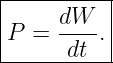
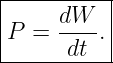
Work measures energy transfer through a force acting over a displacement. Power measures how
rapidly that work is done.
Two machines can perform the same amount of work while operating at very different power levels.
A motor that lifts a load in two seconds transfers the same gravitational energy as a slower motor
that lifts the same load through the same height in twenty seconds, but the first motor transfers
that energy ten times faster.
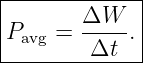
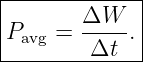
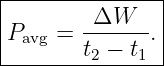
The average power delivered during a time interval is
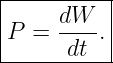
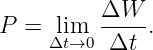
The instantaneous power is the limiting rate
For a force acting on a moving particle,
This dot-product form is one of the most useful relations in mechanics. It connects force, motion,
work, and energy at a single instant.
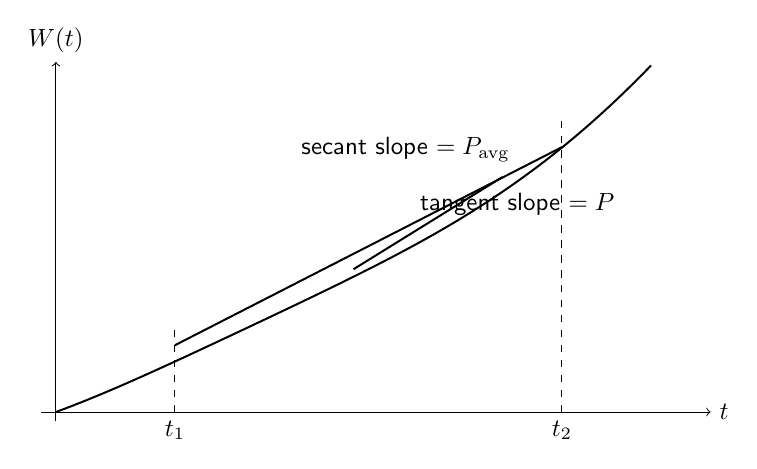
Figure 1. Average power measures work per finite time interval. Instantaneous power is the local
slope of the work-versus-time curve.
1 Average power
Suppose a force does work ΔW during the interval from t1 to t2. The elapsed time
is
The average power is
Average power says nothing about how uniformly the work was performed during the interval. A
machine can deliver a large power for part of the interval and a smaller power during another part
while having the same average.
If the work done over the interval is known,
This relation is exact for the average value over the stated interval.
2 Instantaneous power
To describe the rate of work at a particular instant, shrink the time interval:
Thus
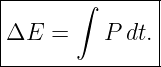
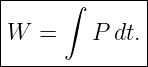
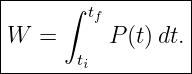
If the power varies with time, the work done from ti to tf is
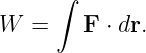
This relation is analogous to the variable-force work integral
On a graph of P versus t, the signed area under the curve equals work.
3 Derivation of P = F ⋅ v
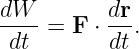
Differential work is
Divide by dt:
Since
we obtain
If 𝜃 is the instantaneous angle between the force and velocity,
This is the instantaneous mechanical power delivered by the force to the particle.
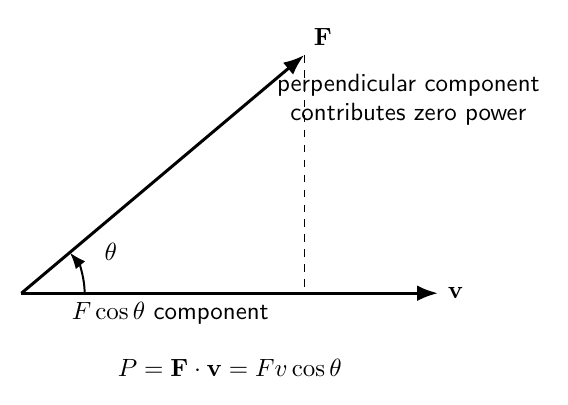
Figure 2. Only the component of force parallel to the instantaneous velocity contributes to
mechanical power. The perpendicular component changes the direction of motion but contributes
no instantaneous work.
4 The sign of power
The sign of P = F ⋅ v has a direct mechanical interpretation.
| P > 0 |  the force is transferring energy to the particle, the force is transferring energy to the particle, | (16)
|
| P = 0 |  the force is doing no instantaneous work, the force is doing no instantaneous work, | (17)
|
| P < 0 |  the force is removing kinetic energy from the particle. the force is removing kinetic energy from the particle. | (18) |
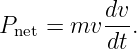
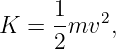
For a constant-mass particle,
Thus positive net power means kinetic energy is increasing, negative net power means kinetic
energy is decreasing, and zero net power means the kinetic energy is instantaneously
unchanged.
5 Power and kinetic energy
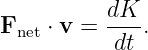
M03-02 established the differential work-energy relation
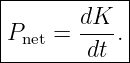
Therefore
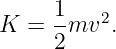
For constant mass,
Differentiating,
for one-dimensional motion in which v denotes the signed speed along the coordinate
direction.
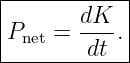
Hence
In vector form, the more general identity is
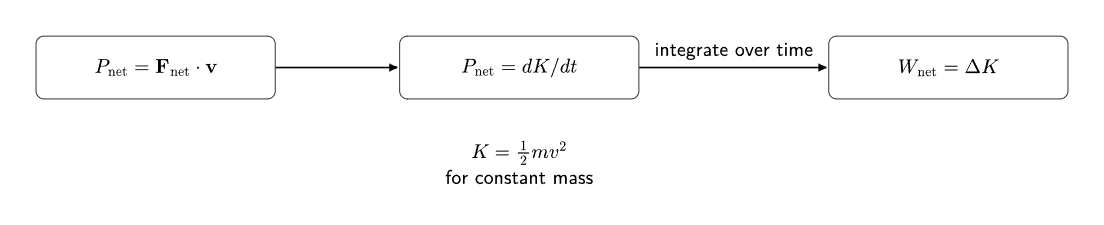
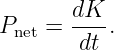
Figure 3. Net power is the time rate of change of kinetic energy. The work-energy theorem is
recovered by integrating power over time.
6 Units of power
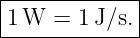
The SI unit of power is the watt:
Since
we also have
Using base SI units,
Common multiples include
| 1 kW | = 103 W, | (31)
|
| 1 MW | = 106 W. | (32) |
Mechanical horsepower is approximately
7 Power is not energy
A watt is a unit of power, not energy.
A kilowatt-hour is a unit of energy because it is power multiplied by time:
| 1 kWh | = (1000 W)(3600 s) | (34)
|
| = 3.6 × 10⁶ J. | (35) |
Thus
The distinction is fundamental:
when the power is constant, and more generally
8 Example 1: lifting a load
A motor lifts a 50 kg crate vertically upward through 8.0 m in 5.0 s at constant speed.
At constant speed, the upward motor force equals the Weight:
The work done by the motor is
| W | = mgh | (40)
|
| = (50)(9.81)(8.0) | (41)
|
| = 3924 J. | (42) |
The average power is
| Pavg | =  | (43)
|
| =  | (44)
|
| = 785 W. | (45) |
Thus
Because the lifting speed is constant, the instantaneous mechanical power is also constant.
9 Example 2: pulling at an angle
A force of magnitude 120 N pulls a cart moving at 4.0 m∕s. The force makes an angle of 30∘ above
the direction of motion.
The instantaneous power delivered by the force is
| P | = Fv cos 𝜃 | (47)
|
| = (120)(4.0) cos 30∘ | (48)
|
| = 416 W. | (49) |
Only the component of force parallel to the velocity transfers mechanical energy to the cart at that
instant.
10 Example 3: braking power
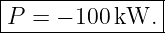
A braking force of magnitude 5000 N acts opposite the velocity of a CAR moving at
20 m∕s.
The angle between force and velocity is 180∘, so
| P | = Fv cos 180∘ | (50)
|
| = −(5000)(20) | (51)
|
| = −1.0 × 10⁵ W. | (52) |
Therefore
The negative sign means the braking force is removing mechanical energy from the car at a rate of
100 kJ∕s at that instant.
11 Constant power and changing speed
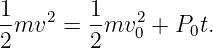
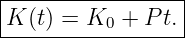
Suppose a constant net power P0 is delivered to a particle of constant mass m moving in one
dimension.
Since
integration gives
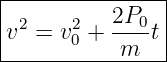
Using
we obtain
Therefore
and
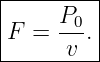
For motion in the same direction as the force,
so
Thus a system delivering constant mechanical power produces less force as speed increases.
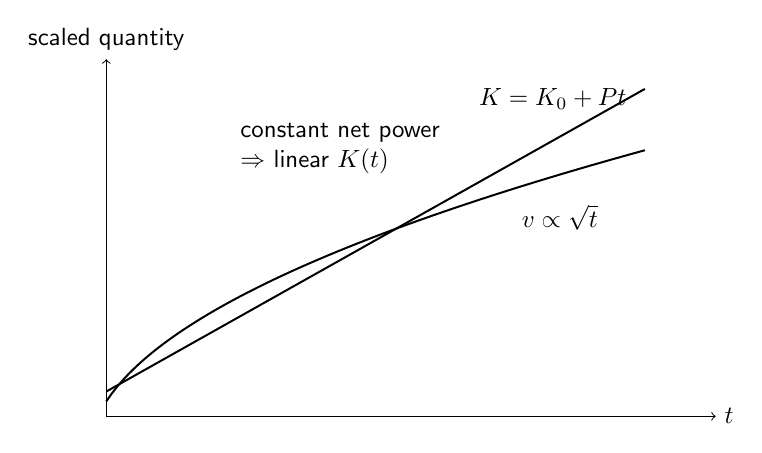
Figure 4. Under constant net power, kinetic energy increases linearly with time, while speed grows
as the square root of time for a constant-mass particle starting from rest.
12 Power required to overcome resistance
Suppose a vehicle moves at steady speed v while a resistive force FR(v) acts opposite the
motion.
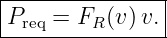
Steady speed requires the driving force to balance the resistance:
The mechanical power required at the point of application is
This produces important speed scaling.
If resistance is approximately constant,
then
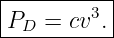
If drag is approximately proportional to v2,
then
Therefore doubling speed under quadratic drag multiplies the required drag power by
eight.
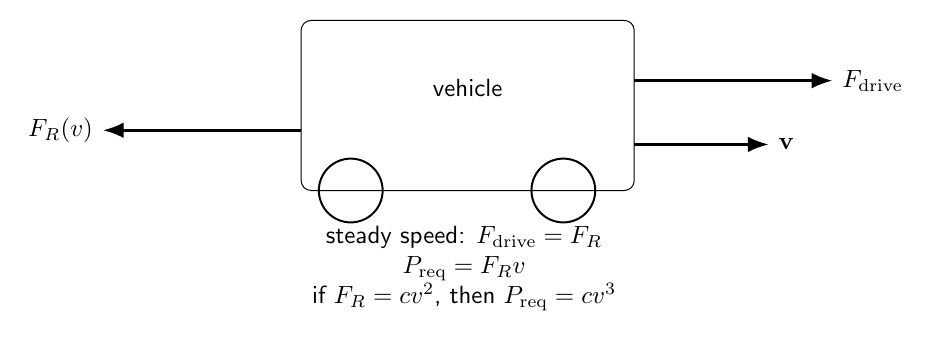
Figure 5. At steady speed, drive force balances resistance. The required mechanical power is
resistance multiplied by speed. Quadratic drag therefore produces a cubic power demand.
13 Efficiency and input power
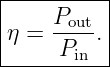
Real machines are not perfectly efficient. If a machine receives input power Pin and delivers useful
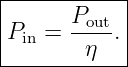
output power Pout, define the efficiency
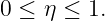
For an efficiency between zero and one,
Hence
and
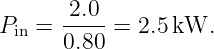
For example, if a motor must deliver
with
then the required input power is
The missing 0.5 kW is transferred into other forms such as thermal energy, sound, or internal
mechanical losses.
14 Power delivered by several forces
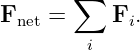
If several forces act on a particle,
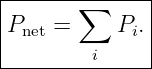
The net power is
| Pnet | = Fnet ⋅ v | (76)
|
| =  ⋅ v ⋅ v | (77)
|
| = ∑
iFi ⋅ v. | (78) |
Therefore
Individual forces may deliver positive, negative, or zero power at the same instant.
For example, a vehicle moving uphill at steady speed may receive positive power from its engine
while gravity and drag each contribute negative power. The net power is zero because the kinetic
energy remains constant.
15 Power in uniform circular motion
In uniform circular motion, the centripetal force is perpendicular to the velocity:
Thus
The force is nonzero and the acceleration is nonzero, but the force does not change the kinetic
energy because it changes only the direction of velocity.
This is another example of why power must be interpreted through a dot product rather than
merely as force multiplied by speed.
16 Power versus force
Large force does not necessarily mean large power.
From
power depends on force, speed, and direction.
A large force acting on an object that is nearly stationary can correspond to small mechanical
power.
A smaller force acting on an object moving rapidly in the force direction can correspond to much
greater power.
This distinction is important in engines, motors, actuators, pumps, and biological systems.
17 Common mistakes
- Confusing power with energy.
- Treating the kilowatt-hour as a unit of power.
- Using P = Fv when the force is not parallel to the velocity.
- Forgetting the sign of F ⋅ v.
- Assuming that zero power means zero force.
- Using average power when the problem asks for instantaneous power.
- Assuming constant power implies constant force.
- Forgetting that at constant power the available force decreases as 1∕v for collinear
motion.
- Ignoring efficiency when converting required output power into input power.
- Forgetting that area under a power-versus-time graph represents work or energy
transfer.
18 Practice exercises
- A machine does 12 kJ of work in 3.0 s. Find its average power.
- A 200 N horizontal force pushes an object moving at 5.0 m∕s in the force direction.
Find the instantaneous power.
- A 150 N force acts at 60∘ to a velocity of 8.0 m∕s. Find the power delivered by the
force.
- A braking force of 3000 N acts opposite a car moving at 25 m∕s. Find the instantaneous
power of the braking force.
- A 75 kg person climbs vertically through 12 m in 18 s. Estimate the average mechanical
power against gravity.
- Show that 1 kWh = 3.6 × 10⁶ J.
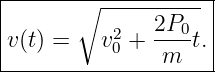
- A motor delivers constant net power P0 to a mass m initially at rest. Derive
v(t) =
 .
.
- A vehicle experiences drag FD = cv2. Show that the power required to balance the
drag is proportional to v3.
- An engine delivers 40 kW of mechanical power while the vehicle moves at 20 m∕s. If
the driving force is parallel to the velocity, find the force.
- A motor must provide 5.0 kW of useful mechanical output at 75% efficiency. Find the
input power.
- A particle moves in uniform circular motion under a central force. Explain why the
force can be large while its mechanical power is zero.
- A power history is P(t) = P0t∕T for 0 ≤ t ≤ T. Integrate the power to find the work
done during the interval.
19 Summary
Average power is
Instantaneous power is
For a force acting on a moving particle,
For the net force,
Work is recovered from power by integration:
Under constant net power,
For collinear force and velocity,
The next article, M03-05, develops conservative forces and potential energy.
References
References
[1] J. R. Taylor, Classical Mechanics, University Science Books, 2005.
[2] D. Kleppner and R. Kolenkow, An Introduction to Mechanics, 2nd ed., Cambridge
University Press, 2014.
[3] H. D. Young and R. A. Freedman, University Physics with Modern Physics, 15th ed.,
Pearson, 2020.
[4] OpenStax, University Physics, Volume 1, Rice University, 2016.










 (
(