
|
|
|
|||||||
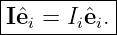
In the principal-axis basis,
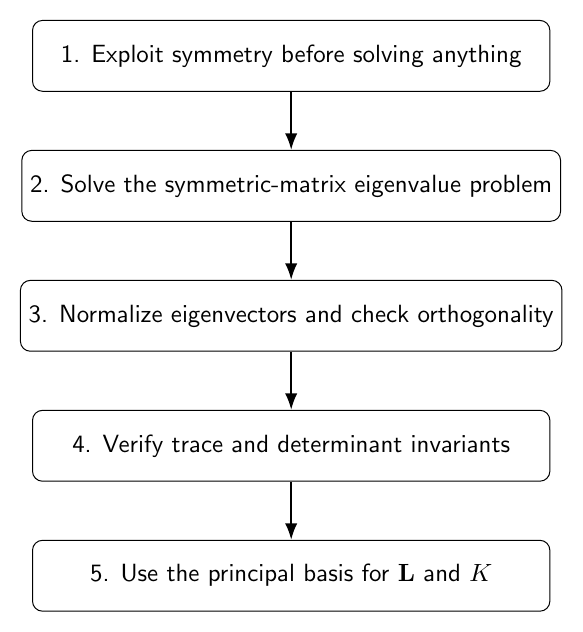
Figure 1. A compact strategy for principal-axis problems: exploit symmetry first, solve the eigenvalue equation, normalize eigenvectors, verify orthogonality, and check the diagonalization with tensor invariants.
1 High-value GRE facts
Part I: Original GRE-style problems
Problem 1: eigenvector meaningA unit vector e is a principal axis of inertia if
Problem 2: diagonal principal basisIn a principal-axis basis, the inertia tensor
Problem 3: orthogonalityTwo principal moments are distinct. Their principal-axis eigenvectors are
Problem 4: two-dimensional eigenvaluesFor
the principal moments are
Problem 5: invariant checkFor the tensor in Problem 4, the determinant equals
Problem 6: angular momentumIf a body rotates exactly about principal axis 2 with angular speed ω, then
Problem 7: kinetic energyIn principal coordinates, the rotational kinetic energy is
Problem 8: axisymmetric bodyAn axisymmetric body has
Which statement is correct?
Problem 9: spherical inertiaIf
then
Problem 10: extremum propertyThe stationary values of
subject to
occur when
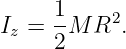
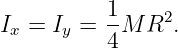
Problem 11: thin diskFor a thin uniform disk about its center,
Each diameter has principal moment
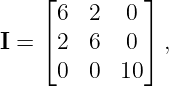
Problem 12: numerical 3D tensorFor
the three principal moments are
Part II: Complete worked solutions
Solution 1A principal axis is an eigenvector direction:
Answer: (C).
Solution 2Principal-axis coordinates diagonalize the symmetric inertia tensor. Answer: (B).
Solution 3Distinct eigenvalues of a real symmetric matrix have orthogonal eigenvectors. Answer: (B).
Solution 4The characteristic equation is
Thus the principal moments are
Answer: (B).
Solution 5
Answer: (D).
Solution 6If
then
Answer: (A).
Solution 7In principal coordinates the tensor is diagonal, so no cross terms appear:
Answer: (B).
Solution 8A repeated eigenvalue has a multidimensional eigenspace. Every direction in that eigenspace is an eigenvector with the same principal moment. Answer: (C).
Solution 9If
then
for every direction. Answer: (C).
Solution 10Using a Lagrange multiplier gives
Thus stationary directions are eigenvector directions. Answer: (A).
Solution 11For a planar disk,
Rotational symmetry gives
Hence
Answer: (B).
Solution 12The z direction gives eigenvalue 10. For the in-plane block,
the eigenvalues are
Thus the principal moments are
Answer: (B).
2 GRE checklist
References
References
"GRE Physics Companion: Principal Axes and Principal Moments of Inertia" is owned by bloftin.
This object's parent. Cross-references: formulas, energy, symmetric matrix, kinetic energy, angular momentum, speed, matrix, identity, tensor, unit vector, rotational kinetic energy, determinant, trace, moment of inertia, scalar, products of inertia, inertia tensor There are 3 references to this object. This is version 1 of GRE Physics Companion: Principal Axes and Principal Moments of Inertia, born on 2026-10-17. Object id is 1483, canonical name is GREPhysicsCompanionPrincipalAxesAndPrincipalMomentsOfInertia. Accessed 10 times total. Classification:
|
|
|
|
Pending Errata and AddendaNone.
|
DiscussionNo messages.
|
Interact |
![[parent]](https://images.physicslibrary.org/images/uparrow.png)

![[ 5 − 2]
I = ,
− 2 8](https://images.physicslibrary.org/cache/objects/1483/make4ht/GREPhysicsCompanionPrincipalAxesAndPrincipalMomentsOfInertia2x.png)
 (
( (
(
















![[6 2]
,
2 6](https://images.physicslibrary.org/cache/objects/1483/make4ht/GREPhysicsCompanionPrincipalAxesAndPrincipalMomentsOfInertia27x.png)

