Physics Library
 An open source physics library
Encyclopedia | Forums | Docs | Random  

[parent] GRE Physics Companion: Forced Wave Equations, Resonant Response, and Modal Green Functions

(Example)

GRE Physics Companion: Forced Wave Equations, Resonant Response, and Modal Green Functions

A forced wave field expanded in spatial eigenfunctions obeys

|------------------|
-¨qn +-ω2nqn-=-Fn(t),
(1)

with

|------------------|
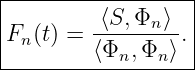
|        -⟨S,Φn-⟩- |
|Fn(t) = ⟨Φn, Φn ⟩.|
-------------------
(2)

PIC

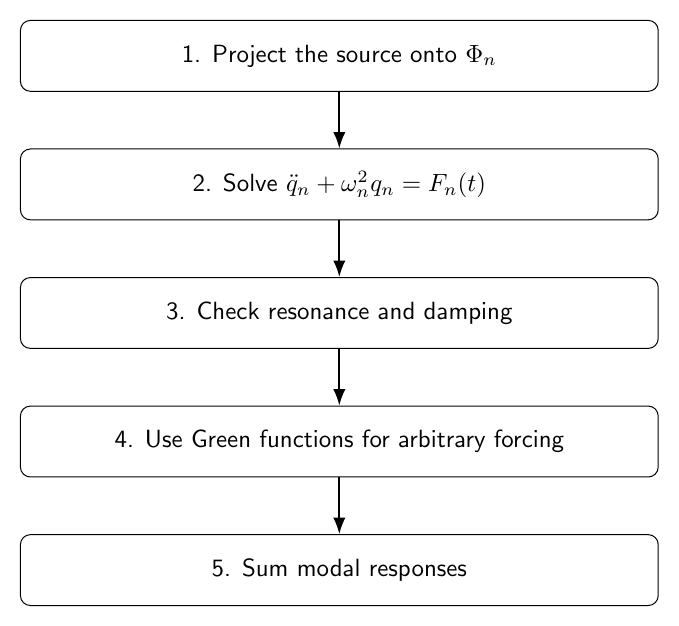
Figure 1. A compact forced-wave strategy: project the source onto modes, solve the corresponding driven oscillators, check for resonance and damping, then sum the modal responses.

1 High-value GRE facts

  1. Modal coupling is a spatial overlap integral.
  2. A point source at a modal node does not excite that ideal mode.
  3. Undamped harmonic response contains the denominator ωn2 − Ω2.
  4. Exact undamped resonance produces amplitude proportional to time.
  5. Damping gives a finite resonance peak.
  6. For the convention used here, Q = ωn∕(2γn).
  7. The retarded oscillator Green function contains H(t − t′).
  8. The impulse response contains sin[ωn(t − t′)]∕ωn.
  9. Frequency-domain resonances appear as poles of the modal response.
  10. Source location and observation location both enter the full modal Green function.

Part I: Original GRE-style problems

Problem 1: modal projection

For orthogonal modes with norm Nn, the modal force is

  1. Fn = Nn ∫ SΦn dV
  2. Fn = ∫ S dV
  3. Fn = (1∕Nn) ∫ SΦn dV
  4. Fn = ωnS
  5. Fn = ∇2S

Problem 2: point force at a node

A point source is placed exactly at a node of mode n. In the ideal linear model, the coupling to that mode is

  1. maximal
  2. zero
  3. infinite
  4. independent of source location
  5. proportional only to ωn

Problem 3: centered fixed-string drive

A point force at the center of a fixed string excites

  1. only even modes
  2. only odd modes
  3. only mode 2
  4. all modes equally
  5. no modes

Problem 4: nonresonant harmonic response

For

     2
¨q + ω0q = F0 cosΩt,
(3)

the steady particular amplitude away from resonance is proportional to

  1. 1∕(ω0 + Ω)
  2. 1∕(ω02 − Ω2)
  3. ω02 − Ω2
  4. Ω2
  5. t

Problem 5: exact undamped resonance

At exact resonance, the ideal particular solution contains

  1. constant amplitude
  2. amplitude proportional to t
  3. amplitude proportional to 1∕t
  4. no oscillation
  5. exponential decay

Problem 6: quality factor

For

            2
¨q + 2γ ˙q + ω 0q = F,
(4)

the weak-damping quality factor is

  1. γ∕ω0
  2. 2γ∕ω0
  3. ω0∕(2γ)
  4. ω0∕γ2
  5. 1∕ω0

Problem 7: resonance bandwidth

If ω0 = 1000 rad∕s and Q = 50, the weak-damping full width at half Power is approximately

  1. 5 rad/s
  2. 10 rad/s
  3. 20 rad/s
  4. 50 rad/s
  5. 100 rad/s

Problem 8: impulse response

The retarded Green function of

      2
¨q + ω 0q = F(t)
(5)

is

  1. H(t − t′) cos[ω0(t − t′)]
  2. H(t − t′) sin[ω0(t − t′)]∕ω0
  3. sin(ω0t′)
  4. 1∕ω02
  5. exp(+ω0t)

Problem 9: causality

A retarded Green function must vanish when

  1. t > t′
  2. t = t′
  3. t < t′
  4. ω = 0
  5. the source and receiver differ

Problem 10: frequency-domain pole

The undamped modal frequency response has poles at

  1. Ω = 0 only
  2. Ω = ±ωn
  3. Ω = ±iωn
  4. Ω = ωn∕2
  5. no finite frequency

Problem 11: source and receiver factors

In the full modal Green function, one mode contributes a spatial factor proportional to

  1. Φn(r) + Φn(r′)
  2. Φn(r)Φn(r′)
  3. ∇Φn only
  4. λn2
  5. 1∕Nn only

Problem 12: zero mode

For ω0 = 0,

sin(ω0-τ)-
  ω0
(6)

is interpreted by the limit

  1. 0
  2. 1
  3. τ
  4. 1∕τ
  5. τ2

Part II: Complete worked solutions

Solution 1

Projection and orthogonality give

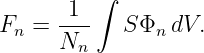
         ∫
      1--
Fn =  Nn    SΦn dV.
(7)

Answer: (C).

Solution 2

For a point source,

Fn ∝  Φn (r0).
(8)

At a node this vanishes. Answer: (B).

Solution 3

At the string center,

Φn (L∕2) = sin(nπ ∕2),
(9)

which vanishes for even n. Answer: (B).

Solution 4

Substitution of

qp = A cos Ωt
(10)

gives

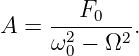
     --F0----
A =  ω2 − Ω2 .
      0
(11)

Answer: (B).

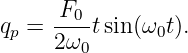
Solution 5

At resonance,

qp = F0-tsin(ω0t).
     2ω0
(12)

Answer: (B).

Solution 6

For the damping convention 2γq,

      ω0
Q  = ---.
     2 γ
(13)

Answer: (C).

Solution 7

Δ Ω ≈  ω0-=  1000-= 20 rad∕s.
       Q      50
(14)

Answer: (C).

Solution 8

The causal impulse response is

                  sin[ω (t − t′)]
g(t,t′) = H (t − t′)---0--------.
                       ω0
(15)

Answer: (B).

Solution 9

Causality requires no response before the source acts:

              ′
g = 0     t < t .
(16)

Answer: (C).

Solution 10

The denominator is

ω2n − Ω2,
(17)

which vanishes at

Ω = ± ωn.
(18)

Answer: (B).

Solution 11

The source coupling contributes Φn(r′) and the observation point contributes Φn(r). Answer: (B).

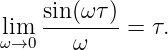
Solution 12

Using sin x ≈ x for small x,

     sin(ω-τ)-
ωlim→0   ω     = τ.
(19)

Answer: (C).

2 GRE checklist

  1. Project both source and field onto the homogeneous eigenmodes.
  2. Check source-mode overlap before declaring a resonance.
  3. At exact undamped resonance, replace the divergent algebraic amplitude by the linearly growing solution.
  4. Keep the damping convention consistent when using Q or bandwidth.
  5. Include the Heaviside factor in a retarded Green function.
  6. Check the derivative jump of the impulse response.
  7. Treat zero modes by a limit rather than division by zero.

References

References

[1]   PhysicsLibrary, M06-19, Helmholtz Equation, Boundary-Value Problems, and Eigenfunction Expansions.

[2]   PhysicsLibrary, M06-03, Driven Harmonic Motion and Resonance.

[3]   G. B. Arfken, H. J. Weber, and F. E. Harris, Mathematical Methods for Physicists, 7th ed., Academic Press, 2013.


"GRE Physics Companion: Forced Wave Equations, Resonant Response, and Modal Green Functions" is owned by bloftin.
(view preamble)
View style:
Other names:  M06-20G
Keywords:  GRE physics, forced wave equation, modal forcing, resonance, damping, quality factor, Green function, mode selection

This object's parent.

Cross-references: zero modes, algebraic, frequency, frequency response, retarded Green function, Power, quality factor, force, norm, modal Green function, impulse, function, amplitude, harmonic, node, spatial overlap, resonance, oscillators

This is version 1 of GRE Physics Companion: Forced Wave Equations, Resonant Response, and Modal Green Functions, born on 2026-10-31.
Object id is 1548, canonical name is GREPhysicsCompanionForcedWaveEquationsResonantResponseAndModalGreenFunctions.
Accessed 11 times total.

Classification:
Physics Classification: 45.50.-j (Dynamics and kinematics of a particle and a system of particles)
 45.05.+x (General theory of classical mechanics of discrete systems)

Pending Errata and Addenda

None.

Discussion

No messages.

Interact