Physics Library
 An open source physics library
Encyclopedia | Forums | Docs | Random  

[parent] GRE Physics Companion: Energy Methods for Particle Systems

(Example)

GRE Physics Companion: Energy Methods for Particle Systems

The two formulas to recognize immediately are

|----------------|
K--=--KCM--+-Krel-
(1)

and

|-------------------|
ΔK---=-Wext-+-Wint.--
(2)

For two particles,

|--------------------------------|
|       1- 2           --m1m2--- |
|Krel = 2μvrel,     μ = m   + m  .|
-------------------------1-----2--
(3)

PIC

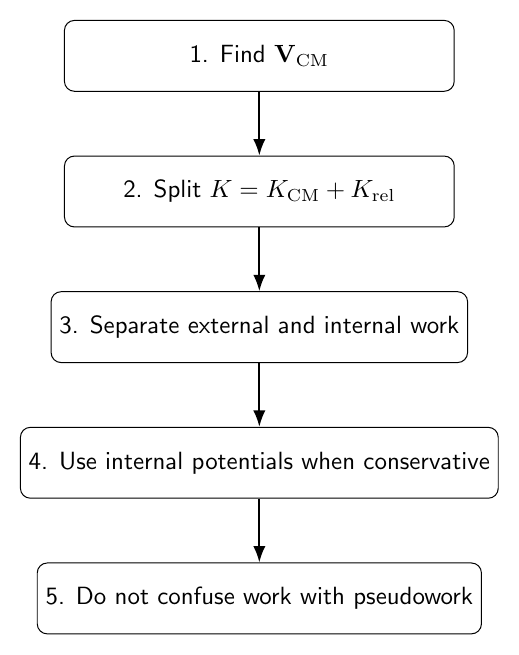
Figure 1. A compact strategy for particle-system energy problems. Separate center-of-mass motion from relative motion, then identify external work, internal work, and internal potential energy.

1 High-value GRE facts

  1. Total kinetic energy is the sum of the kinetic energies of all particles.
  2. K = KCM + Krel.
  3. internal forces cancel from the net force but not generally from work.
  4. Actual external work uses the displacement of each force application point.
  5. Fext,net ⋅ dRCM is pseudowork and tracks KCM.
  6. Zero total momentum does not imply zero total kinetic energy.
  7. If no net external force acts, V CM is constant.
  8. An explosion can increase Krel while leaving KCM unchanged.
  9. For two particles, use reduced mass for relative kinetic energy.
  10. In uniform gravity, the system potential is MgY CM.

Part I: Original GRE-style problems

Problem 1: center-of-mass velocity

Two particles move along a line. Particle 1 has mass 2m and velocity +v, while particle 2 has mass m and velocity −v. The center-of-mass velocity is

  1. −v
  2. −v∕3
  3. 0
  4. +v∕3
  5. +v

Problem 2: zero momentum

A system has total momentum zero. Which statement must be true?

  1. Its total kinetic energy is zero.
  2. Its center-of-mass kinetic energy is zero.
  3. Every particle is at rest.
  4. Its relative kinetic energy is zero.
  5. No internal forces act.

Problem 3: kinetic-energy decomposition

A system has total kinetic energy 50 J and center-of-mass kinetic energy 18 J. Its relative kinetic energy is

  1. 18 J
  2. 32 J
  3. 50 J
  4. 68 J
  5. 900 J

Problem 4: reduced mass

Two particles have masses m and 3m. Their reduced mass is

  1. m∕4
  2. 3m∕4
  3. m
  4. 3m
  5. 4m

Problem 5: internal force work

Which statement is correct for equal-and-opposite internal forces?

  1. Their net internal work is always zero.
  2. They cancel from the net force, but their total work need not vanish.
  3. They can never change relative kinetic energy.
  4. They are always nonconservative.
  5. They cannot store potential energy.

Problem 6: explosion at rest

A system initially at rest explodes into two fragments in the absence of external impulse. Which quantity must remain zero?

  1. total kinetic energy
  2. relative kinetic energy
  3. center-of-mass velocity
  4. speed of each fragment
  5. internal energy change

Problem 7: actual work versus pseudowork

A constant external force F moves one particle of a two-equal-particle system through distance d, while the second particle remains fixed. The actual external work is Fd. The center of mass moves

  1. 0
  2. d∕4
  3. d∕2
  4. d
  5. 2d

Problem 8: pseudowork

For the system in Problem 7, the center-of-mass pseudowork is

  1. 0
  2. Fd∕4
  3. Fd∕2
  4. Fd
  5. 2Fd

Problem 9: uniform gravity

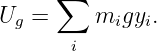
For particles in a uniform gravitational field,

     ∑
Ug =     migyi.
       i
(4)

This equals

  1. Mg∕Y CM
  2. MgY CM
  3. M2gY CM
  4. gY CM∕M
  5. zero

Problem 10: two-fragment momentum

A 2 kg fragment moves at +6 m∕s after an explosion from rest. The second fragment has mass 3 kg. Its velocity is

  1. −9 m∕s
  2. −6 m∕s
  3. −4 m∕s
  4. +4 m∕s
  5. +9 m∕s

Problem 11: explosion kinetic energy

For the fragments in Problem 10, the total kinetic energy is

  1. 12 J
  2. 24 J
  3. 36 J
  4. 60 J
  5. 72 J

Problem 12: isolated spring pair

Two particles connected by an ideal spring form an isolated system. Which quantity is necessarily constant?

  1. each particle’s kinetic energy
  2. the spring potential energy
  3. Krel
  4. KCM
  5. each particle’s speed

Part II: Complete worked solutions

Solution 1

The total mass is

M  = 3m.
(5)

The total momentum is

P  = (2m )(v) + (m)(− v) = mv.
(6)

Thus

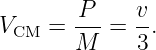
        P    v
VCM  = --- = --.
       M     3
(7)

Answer: (D).

Solution 2

If total momentum is zero,

P  = M V     = 0.
         CM
(8)

Thus

VCM =  0
(9)

and

K    =  0.
  CM
(10)

The particles can still move relative to one another.

Answer: (B).

Solution 3

Use

K  = KCM  +  Krel.
(11)

Thus

Krel = 50 − 18 = 32 J.
(12)

Answer: (B).

Solution 4

The reduced mass is

μ = m (3m )
--------
m + 3m (13)
= 3m2-
4m (14)
= 3
--
4m. (15)

Answer: (B).

Solution 5

Newton’s third law makes the pair forces equal and opposite, so they cancel from the net system force.

Their work is

dW  inijt = Fij ⋅ (dri − drj),
(16)

which need not vanish.

Answer: (B).

Solution 6

With no external impulse, total momentum is constant.

The initial system is at rest, so

P = 0
(17)

and therefore

VCM   = 0
(18)

after the explosion.

Answer: (C).

Solution 7

For equal masses,

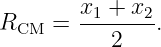
       x1 + x2
RCM  = ---2----.
(19)

If particle 1 moves by d and particle 2 remains fixed,

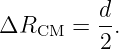
ΔR     = d-.
   CM    2
(20)

Answer: (C).

Solution 8

Pseudowork is

Wpseudo = F ΔRCM.
(21)

Using

ΔRCM   = d∕2,
(22)

we obtain

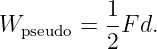
Wpseudo = 1-Fd.
          2
(23)

Answer: (C).

Solution 9

By definition,

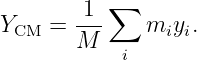
       -1-∑
YCM  = M      miyi.
            i
(24)

Therefore

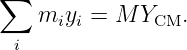
∑
   miyi =  M YCM.
 i
(25)

Multiplying by g,

Ug = M  gYCM.
(26)

Answer: (B).

Solution 10

Momentum conservation gives

(2 )(6) + (3)v  = 0.
            2
(27)

Thus

v2 = − 4 m∕s.
(28)

Answer: (C).

Solution 11

The kinetic energy is

K = 1
--
2(2)(62) + 1
--
2(3)(42) (29)
= 36 + 24 (30)
= 60 J. (31)

Answer: (D).

Solution 12

An isolated system has no net external force, so

VCM
(32)

is constant.

Therefore

        1
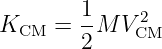
KCM  =  -M V 2CM
        2
(33)

is constant.

The spring can exchange energy with relative motion, so Krel and Us need not be individually constant.

Answer: (D).

2 GRE checklist

For particle-system energy problems:

  1. Compute the center-of-mass velocity when momentum information is available.
  2. Use K = KCM + Krel.
  3. For two particles, consider the reduced mass.
  4. Do not assume internal work vanishes.
  5. Distinguish actual external work from pseudowork.
  6. Use momentum conservation for explosions and internal releases.
  7. In uniform gravity, replace ∑ migyi with MgY CM when useful.
  8. State the system boundary before assigning internal and external interactions.

References

References

[1]   J. R. Taylor, Classical Mechanics, University Science Books, 2005.

[2]   D. Kleppner and R. Kolenkow, An Introduction to Mechanics, 2nd ed., Cambridge University Press, 2014.

[3]   OpenStax, University Physics, Volume 1, Rice University, 2016.


"GRE Physics Companion: Energy Methods for Particle Systems" is owned by bloftin.
(view preamble)
View style:
Other names:  M03-08G
Keywords:  GRE physics, particle systems, center of mass, relative kinetic energy, internal work, external work, pseudowork, reduced mass, explosions, energy accounting

This object's parent.

Cross-references: system boundary, field, center of mass, internal energy, speed, velocity, system, relative kinetic energy, mass, external force, momentum, pseudowork, displacement, work, force, internal forces, kinetic energy, potential energy, internal work, external work, relative motion, motion, energy, particles, formulas

This is version 1 of GRE Physics Companion: Energy Methods for Particle Systems, born on 2026-10-03.
Object id is 1384, canonical name is GREPhysicsCompanionEnergyMethodsForParticleSystems.
Accessed 7 times total.

Classification:
Physics Classification: 45.20.Dd (Newtonian mechanics)
 45.50.-j (Dynamics and kinematics of a particle and a system of particles)
Pending Errata and Addenda
None.
Discussion
Style: Expand: Order:

No messages.

Interact
rate | post | correct | update request | add example | add (any)