|
|
|
|||||||
Normal modes satisfy
and
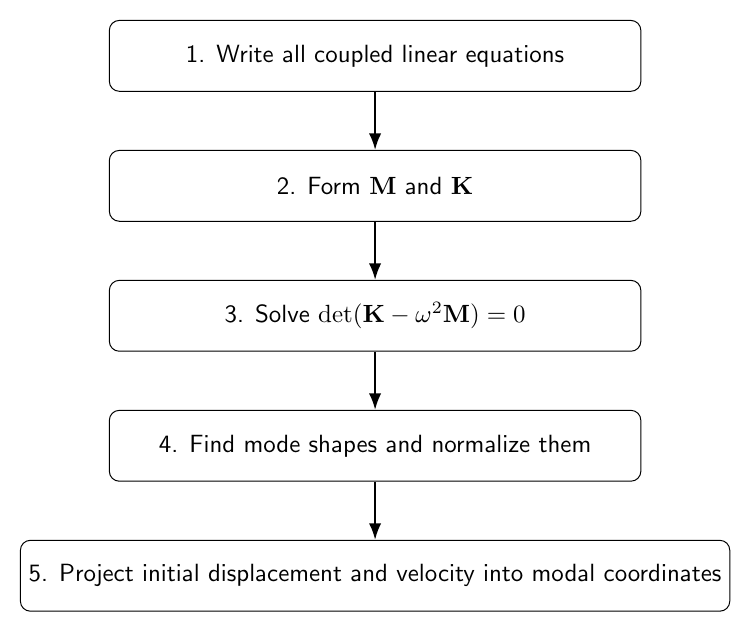
Figure 1. A compact normal-mode strategy: write the coupled equations, form M and K, solve the generalized eigenvalue problem, identify mode shapes, and project initial conditions into modal coordinates.
1 High-value GRE facts
Part I: Original GRE-style problems
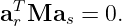
Problem 1: normal-mode conditionA normal mode of
satisfies
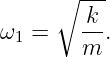
Problem 2: equal-mass symmetric modeFor two equal masses with wall springs k and coupling spring kc, the in-phase normal frequency is
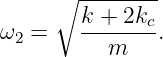
Problem 3: antisymmetric modeFor the same system, the out-of-phase normal frequency is
Problem 4: symmetric mode shapeA mode shape for the lower-frequency equal-mass mode is proportional to
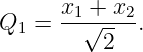
Problem 5: normal coordinatesFor equal masses, a convenient symmetric normal coordinate is
Problem 6: mode superpositionAn arbitrary small motion of a conservative linear coupled system can generally be written as
Problem 7: zero modeTwo equal masses are connected only by one spring and otherwise free. The in-phase translation mode has
Problem 8: mass orthogonalityFor distinct normal modes of a symmetric conservative system,
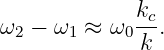
Problem 9: weak couplingIf
the mode splitting is approximately
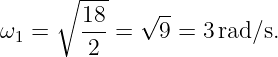
Problem 10: numerical frequenciesFor
the lower normal frequency is
Problem 11: same numerical systemFor the system in Problem 10, the upper normal frequency is
Problem 12: continuum bridgeA long chain of coupled oscillators is important because
Part II: Complete worked solutions
Solution 1Using
gives
Answer: (B).
Solution 2In the in-phase mode,
so the coupling spring is not stretched. Only the wall springs provide restoring force:
Answer: (A).
Solution 3In the out-of-phase mode, the coupling spring contributes additional restoring stiffness:
Answer: (C).
Solution 4The lower-frequency mode is the in-phase motion:
Answer: (C).
Solution 5The symmetric normal coordinate is
Answer: (A).
Solution 6The normal modes form a basis for the linear small-oscillation motion. Therefore a general motion is a superposition of modes. Answer: (B).
Solution 7Equal translation does not stretch the only spring, so there is no restoring force:
Answer: (A).
Solution 8For distinct eigenfrequencies of a symmetric conservative system,
Answer: (A).
Solution 9For weak coupling,
Answer: (B).
Solution 10
Answer: (B).
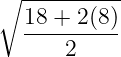
Solution 11
Answer: (C).
Solution 12As the number of coupled oscillators becomes large, the discrete mode family approaches the normal modes of a continuous medium and hence wave mechanics. Answer: (B).
2 GRE checklist
References
References
[1] PhysicsLibrary, M06-03, Driven Harmonic Motion and Resonance. [2] PhysicsLibrary, M06-02, Damped Harmonic Motion. [3] PhysicsLibrary, M06-01, Simple Harmonic Motion. [4] A. P. French, Vibrations and Waves, W. W. Norton, 1971. [5] J. R. Taylor, Classical Mechanics, University Science Books, 2005. "GRE Physics Companion: Coupled Oscillators and Normal Modes" is owned by bloftin.
This object's parent. Cross-references: velocity, mechanics, coupled oscillators, displacement, normal coordinate, force, zero modes, matrix, masses, frequencies, Normal, amplitude, angular frequency, mode shapes, generalized eigenvalue problem, normal modes, system This is version 1 of GRE Physics Companion: Coupled Oscillators and Normal Modes, born on 2026-10-18. Object id is 1495, canonical name is GREPhysicsCompanionCoupledOscillatorsAndNormalModes. Accessed 14 times total. Classification:
|
|
|
|
Pending Errata and AddendaNone.
|
DiscussionNo messages.
|
Interact |
![[parent]](https://images.physicslibrary.org/images/uparrow.png)












![[ ]
1
0](https://images.physicslibrary.org/cache/objects/1495/make4ht/GREPhysicsCompanionCoupledOscillatorsAndNormalModes12x.png)
![[ ]
0
1](https://images.physicslibrary.org/cache/objects/1495/make4ht/GREPhysicsCompanionCoupledOscillatorsAndNormalModes13x.png)
![[ ]
1
1](https://images.physicslibrary.org/cache/objects/1495/make4ht/GREPhysicsCompanionCoupledOscillatorsAndNormalModes14x.png)
![[ ]
1
− 1](https://images.physicslibrary.org/cache/objects/1495/make4ht/GREPhysicsCompanionCoupledOscillatorsAndNormalModes15x.png)
![[ ]
2
1](https://images.physicslibrary.org/cache/objects/1495/make4ht/GREPhysicsCompanionCoupledOscillatorsAndNormalModes16x.png)



 rad/s
rad/s
 rad/s
rad/s
 rad/s
rad/s



![[ ]
a ∝ 1 .
1 1](https://images.physicslibrary.org/cache/objects/1495/make4ht/GREPhysicsCompanionCoupledOscillatorsAndNormalModes32x.png)