Physics Library
 An open source physics library
Encyclopedia | Forums | Docs | Random  

[parent] GRE Physics Companion: Conservation of Mechanical Energy

(Example)

GRE Physics Companion: Conservation of Mechanical Energy

Mechanical-energy problems are often among the fastest problems on an exam because time and acceleration can disappear from the calculation.

The central relation is

|-------------------|
Ki +  Ui = Kf + Uf  |
---------------------
(1)

when only conservative forces do work.

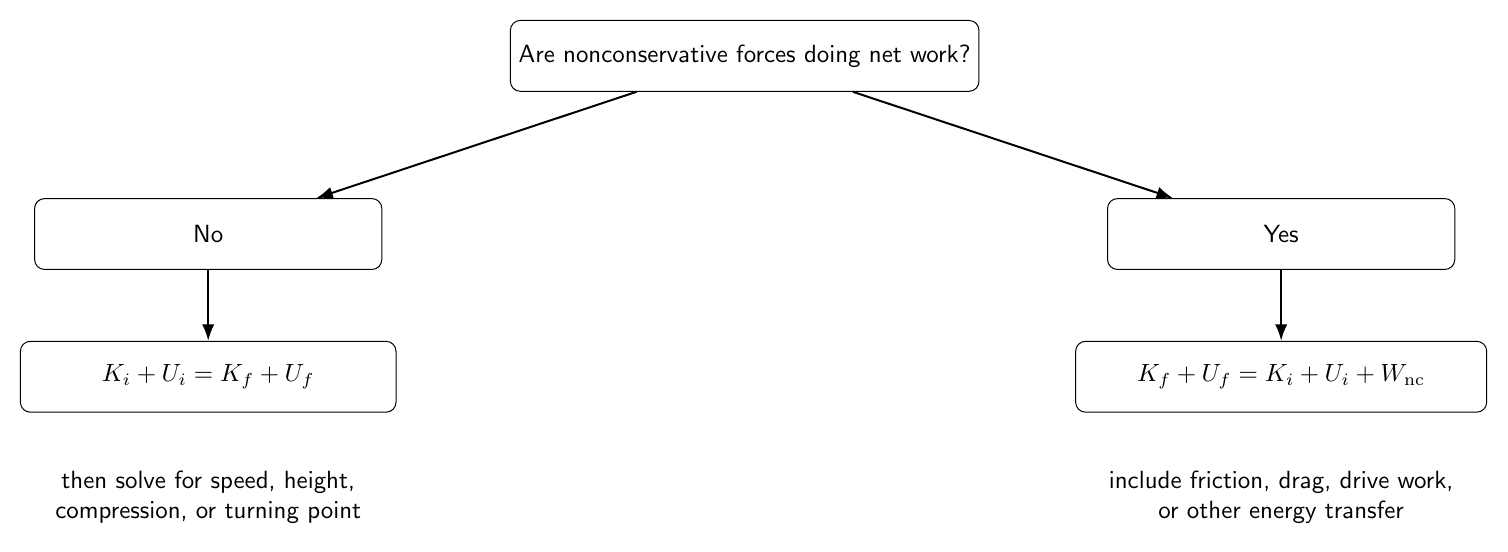
If nonconservative forces do net work,

|--------------------------|
|Kf + Uf  = Ki + Ui + Wnc. |
----------------------------
(2)

PIC

Figure 1. A compact energy-method decision tree. First decide whether nonconservative work is present, then write the appropriate initial-to-final energy equation.

1 High-value GRE facts

  1. Mechanical energy is K + U.
  2. If only conservative forces do work, K + U is constant.
  3. A Normal force can be large and still do zero work.
  4. On a frictionless track under gravity, speed depends on vertical height change, not path length.
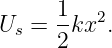
  5. In a spring system,
          1
Us =  -kx2.
      2
    (3)

  6. At a turning point,
    K  = 0,     E =  U.
    (4)

  7. Allowed motion requires E ≥ U(x).
  8. If nonconservative work is present,
    Wnc  = ΔEmech.
    (5)

  9. Mechanical energy can decrease while total energy remains conserved.
  10. The zero of potential energy can be chosen for convenience.

Part I: Original GRE-style problems

Problem 1: falling object

A particle is dropped from rest through a vertical distance h. Neglect air resistance. Its speed after falling distance h is

  1. √ ---
  gh
  2. √ ----
  2gh
  3. gh
  4. 2gh
  5. g∕h

Problem 2: upward launch

A particle is launched vertically upward at speed v0. Neglect air resistance. The maximum height above the launch point is

  1. v0∕g
  2. v02∕g
  3. v02∕(2g)
  4. 2v02∕g
  5. g∕(2v02)

Problem 3: spring launch

A spring of constant k is compressed by distance x and launches a mass m on a frictionless horizontal surface. The speed when the spring reaches equilibrium is

  1. x∘ -----
  k ∕m
  2. x∘ -----
  m ∕k
  3. ∘kx--∕m-
  4. kx∕m
  5. kx2∕m

Problem 4: turning point

At a turning point in one-dimensional conservative motion,

  1. U = 0
  2. K = E
  3. K = 0
  4. F = 0
  5. U < 0

Problem 5: allowed region

A particle has conserved mechanical energy E in a one-dimensional potential U(x). Which positions are classically allowed?

  1. only where U < 0
  2. only where U = 0
  3. where U ≤ E
  4. where U ≥ E
  5. all positions

Problem 6: frictional loss

A block begins with mechanical energy 100 J. Kinetic friction does −30 J of work. The final mechanical energy is

  1. 30 J
  2. 70 J
  3. 100 J
  4. 130 J
  5. 3000 J

Problem 7: normal force

A block slides along a fixed frictionless track. The normal force is everywhere perpendicular to the instantaneous displacement. Its work is

  1. positive
  2. negative
  3. zero
  4. equal to the change in gravitational potential energy
  5. path dependent and nonzero

Problem 8: energy at a point

A 2.0 kg particle has total mechanical energy 18 J and potential energy 10 J at some point. Its speed is

  1. 2.0 m∕s
  2. 2.8 m∕s
  3. 4.0 m∕s
  4. 8.0 m∕s
  5. 9.0 m∕s

Problem 9: spring oscillator energy

A spring-mass oscillator has amplitude A. At displacement x = A∕2, the kinetic energy is what fraction of the total mechanical energy?

  1. 1∕4
  2. 1∕2
  3. 3∕4
  4. 1
  5. 3∕2

Problem 10: same height on a track

A block moves frictionlessly under gravity along a track. It passes two points at the same height. Its speeds at those points are

  1. always different
  2. equal
  3. zero
  4. proportional to the local slope of the track
  5. impossible to compare

Problem 11: nonconservative accounting

A particle’s kinetic energy increases by 20 J while its potential energy increases by 5 J. The net nonconservative work is

  1. −25 J
  2. −15 J
  3. +15 J
  4. +20 J
  5. +25 J

Problem 12: gravitational binding

For Newtonian gravity with U(∞) = 0, a system with negative total mechanical energy is

  1. necessarily unbound
  2. at the escape threshold
  3. bound
  4. impossible
  5. moving with zero speed

Part II: Complete worked solutions

Solution 1

Use Conservation of Mechanical Energy:

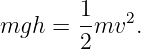
mgh  = 1-mv2.
       2
(6)

Cancel m:

     1- 2
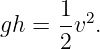
gh = 2 v .
(7)

Therefore

    ∘  ----
v =    2gh.
(8)

Answer: (B).

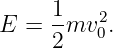
Solution 2

At launch,

E  = 1mv2  .
     2    0
(9)

At maximum height,

v = 0,
(10)

so

E  = mghmax.
(11)

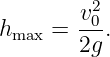
Thus

        v20-
hmax =  2g.
(12)

Answer: (C).

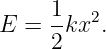
Solution 3

Initially,

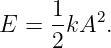
E  = 1-kx2.
     2
(13)

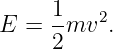
At equilibrium,

Us =  0
(14)

and

E  = 1mv2.
     2
(15)

Set them equal:

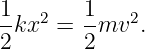
1kx2 =  1mv2.
2       2
(16)

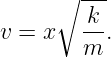
Therefore

      ∘ ---
         k
v = x   --.
        m
(17)

Answer: (A).

Solution 4

At a turning point,

v = 0.
(18)

Therefore

K  = 0.
(19)

Answer: (C).

Solution 5

Since

K =  E − U,
(20)

and kinetic energy must satisfy

K  ≥ 0,
(21)

we require

E −  U ≥ 0.
(22)

Therefore

U ≤  E.
(23)

Answer: (C).

Solution 6

Use

Wnc  = ΔEmech.
(24)

Thus

Ef −  Ei = − 30J.
(25)

Therefore

Ef =  100 − 30 = 70 J.
(26)

Answer: (B).

Solution 7

The normal force is perpendicular to the displacement:

N  ⋅ dr = 0.
(27)

Therefore its work is zero.

Answer: (C).

Solution 8

The kinetic energy is

K =  E − U  = 18 − 10 = 8 J.
(28)

Use

     1    2
K  = --mv  .
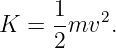
     2
(29)

Thus

    1       2
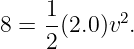
8 = --(2.0 )v .
    2
(30)

Therefore

v2 = 8,     v = 2.83m ∕s.
(31)

Answer: (B).

Solution 9

The total energy is

     1   2
E  = 2-kA .
(32)

At

     A
x =  --,
     2
(33)

the potential energy is

U = 1-
2k(   )
  A-
   22 (34)
= 1
--
8kA2. (35)

Thus

K = E − U (36)
= 1
--
2kA2 −1
--
8kA2 (37)
= 3-
8kA2. (38)

Therefore

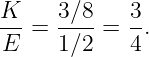
K    3∕8    3
--=  ----=  -.
E    1∕2    4
(39)

Answer: (C).

Solution 10

At equal heights,

Ug
(40)

is equal.

Since total mechanical energy is constant, the kinetic energies are also equal.

For the same mass, equal kinetic energy means equal speed.

Answer: (B).

Solution 11

Use

Wnc =  ΔK  + ΔU.
(41)

Therefore

Wnc  = 20 + 5 = 25 J.
(42)

Answer: (E).

Solution 12

With

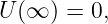
U (∞ ) = 0,
(43)

an object at infinity with nonnegative kinetic energy has

E  ≥ 0.
(44)

If

E  < 0,
(45)

the system cannot reach infinite separation.

Therefore the motion is bound.

Answer: (C).

2 GRE checklist

Before writing Newton’s second law, check whether energy gives a shorter route.

  1. Identify the initial and final states.
  2. Choose a convenient potential-energy reference.
  3. Write all relevant kinetic and potential-energy terms.
  4. Decide whether nonconservative work is zero.
  5. If yes, use Ki + Ui = Kf + Uf.
  6. If no, use Kf + Uf = Ki + Ui + Wnc.
  7. On a potential graph, use K = E − U and turning points from E = U.
  8. Check that every kinetic energy is nonnegative.

References

References

[1]   J. R. Taylor, Classical Mechanics, University Science Books, 2005.

[2]   D. Kleppner and R. Kolenkow, An Introduction to Mechanics, 2nd ed., Cambridge University Press, 2014.

[3]   OpenStax, University Physics, Volume 1, Rice University, 2016.


"GRE Physics Companion: Conservation of Mechanical Energy" is owned by bloftin.
(view preamble)
View style:
Other names:  M03-06G
Also defines:  mechanical energy, conservation of mechanical energy, turning point
Keywords:  GRE physics, mechanical energy, conservation of energy, kinetic energy, potential energy, spring energy, gravity, turning points, potential-energy diagram, nonconservative work

This object's parent.

Cross-references: graph, Conservation of Mechanical Energy, kinetic energy, oscillator, total mechanical energy, displacement, kinetic friction, positions, equilibrium, mass, resistance, particle, potential energy, motion, system, speed, Normal, energy, tree, net work, forces, work, conservative forces, relation, acceleration

This is version 1 of GRE Physics Companion: Conservation of Mechanical Energy, born on 2026-10-03.
Object id is 1382, canonical name is GREPhysicsCompanionConservationOfMechanicalEnergy.
Accessed 8 times total.

Classification:
Physics Classification: 45.20.Dd (Newtonian mechanics)
 45.50.-j (Dynamics and kinematics of a particle and a system of particles)
Pending Errata and Addenda
None.
Discussion
Style: Expand: Order:

No messages.

Interact
rate | post | correct | update request | add example | add (any)