Electromagnetic Waves and Wavelength: Frequency, Propagation, and Spectral Description
Electromagnetic radiation can be described classically as propagating electric and magnetic
fields.
The most important quantities for describing a simple electromagnetic wave include:
- amplitude;
- wavelength;
- frequency;
- period;
- phase;
- propagation speed;
- direction of propagation;
- polarization.
For astronomy, optics, radio-frequency engineering, and photometry, wavelength and frequency are
especially important because they provide the coordinate used to describe an electromagnetic
spectrum.
A central relation is
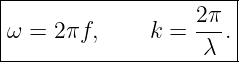
where v is the phase speed of the wave in the medium, f is ordinary frequency, and λ is wavelength
in that medium.
In vacuum,
where
exactly in SI.
This article develops the physical meaning of these quantities and connects the general language of
wave mechanics to the electromagnetic spectrum, blackbody radiation, and the spectral quantities
used later in astrophysical photometry.
1 Where this article fits in PhysicsLibrary
Several existing PhysicsLibrary articles approach light from complementary directions.
The article Electromagnetic Radiation gives a broad overview of light as an electromagnetic wave
and as photons.
The article Electromagnetic Spectrum organizes electromagnetic radiation into astronomical bands
such as radio, infrared, visible, ultraviolet, X-ray, and gamma-ray radiation.
The electromagnetic-wave sequence beginning with EM01 develops the field language needed to
represent quantities such as
The Wave Mechanics sequence develops wavelength, frequency, phase, Wavenumber, and traveling
waves in a general setting.
The present article serves as a bridge among those topics.
Its central progression is
This bridge becomes especially important when a later photometry article writes a quantity as a
function of wavelength, such as
Before interpreting such a function, one must understand precisely what the wavelength coordinate
means.
2 A field that varies in space and time
An electromagnetic wave is not a material object oscillating up and down as it moves
forward.
Instead, the electric and magnetic fields vary with position and time.
A simple plane electromagnetic wave propagating in the positive z direction can be written
schematically as
together with
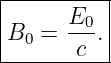
For a vacuum plane wave,
The Electric Field, magnetic field, and propagation direction are mutually perpendicular:
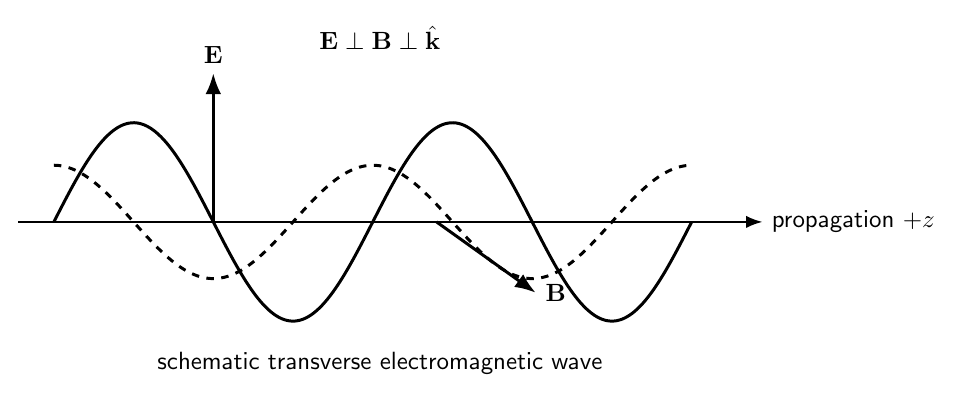
Figure 1. In a simple vacuum plane wave the electric and magnetic fields are transverse to the
propagation direction and to each other.
3 What wavelength means
Freeze time at some instant t = t0.
The wave then becomes a spatial pattern:
The wavelength λ is the smallest positive spatial distance over which the complete wave pattern
repeats.
For a sinusoidal wave,
Examples include:
- crest to next crest;
- trough to next trough;
- one upward zero crossing to the next upward zero crossing;
- any point to the next point with the same field value and the same spatial phase.
Mathematically,
Wavelength is a distance.
Its SI unit is the meter:
Useful electromagnetic wavelength units include:
| 1 mm | = 10−3 m, | (15)
|
| 1 μm | = 10−6 m, | (16)
|
| 1 nm | = 10−9 m. | (17) |
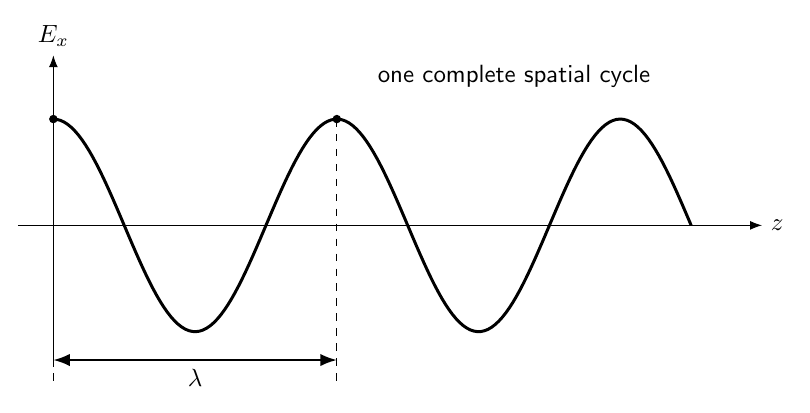
Figure 2. Wavelength is a spatial period. It is measured between equivalent phase points in
neighboring cycles, not merely between any two locations having the same field value.
4 What frequency means
Now hold position fixed at
The wave becomes a time history:
The period T is the time required for one complete cycle:
Frequency is the number of cycles per unit time:
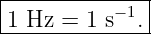
The SI unit is the hertz:
Astronomy and spectroscopy often use the Greek letter ν for ordinary frequency:
This article uses f when discussing general wave mechanics and ν when emphasizing astronomical
spectral notation.
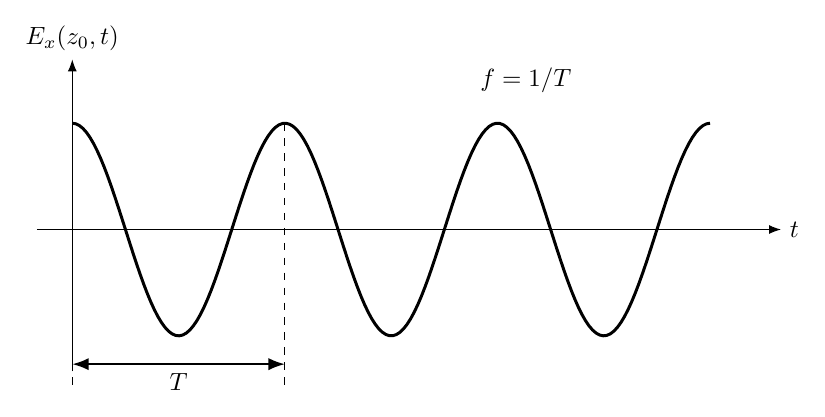
Figure 3. Frequency is a temporal quantity measured at one location. Wavelength is a spatial
quantity measured at one instant.
5 Wavelength and frequency are different kinds of repetition
Wavelength and period are analogous, but they are not the same quantity.
Wavelength answers
Period answers
Frequency then answers
The distinction between spatial and temporal repetition is essential.
A wave can have a very short wavelength but a very high frequency because the pattern
propagates rapidly.
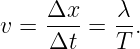
6 Deriving the wave-speed relation
Suppose a wave crest moves at constant speed v.
During one period T, the crest advances by exactly one wavelength:
Therefore
Since
we obtain
This equation is a kinematic relation.
It connects the spatial repetition scale, temporal repetition rate, and propagation speed.
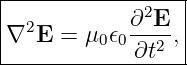
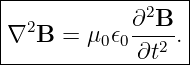
7 Electromagnetic waves in vacuum
Maxwell’s Equations in empty space imply wave equations of the form
and
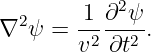
Compare these with the standard three-dimensional wave equation
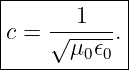
The vacuum propagation speed is therefore
Thus vacuum electromagnetic waves satisfy
This is one of the central connections between Electromagnetism and wave mechanics.
8 Angular frequency and wavenumber
Ordinary frequency counts cycles per second.
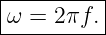
Angular frequency measures phase advance in radians per second:
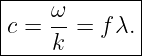
Likewise, wavelength describes meters per spatial cycle, while angular wavenumber measures phase
advance in radians per meter:
The sinusoidal phase is then
For a vacuum electromagnetic wave,
The Wave Mechanics articles on phase and wavenumber develop these quantities in greater
detail.
9 Phase difference and path length
Wavelength is also the natural length scale for phase.
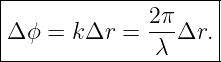
If two otherwise identical waves travel paths differing by
the corresponding phase difference is
Therefore:
| Δr | = λ | |  | Δϕ | = 2π, | (42)
|
| Δr | =  | |  | Δϕ | = π, | (43)
|
| Δr | =  | |  | Δϕ | =  . . | (44) |
This relation appears throughout interference, diffraction, antennas, interferometry, and coherent
signal processing.
10 Example 1: visible-light wavelength to frequency
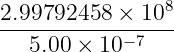
Consider vacuum wavelength
Then
| f | =  | (46)
|
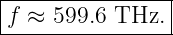
| =  | (47)
|
| ≈ 5.996 × 10¹⁴ Hz. | (48) |
Equivalently,
Visible wavelengths therefore correspond to extremely rapid electromagnetic oscillations.
11 Example 2: radio frequency to wavelength
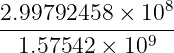
Consider
This is close to the GPS L1 carrier frequency.
The vacuum wavelength is
| λ | =  | (51)
|
| =  | (52)
|
| ≈ 0.1903 m. | (53) |
Thus the wavelength is approximately
The same relation applies across the electromagnetic spectrum.
12 Vacuum wavelength versus wavelength in matter
The relation
always uses the wave speed and wavelength in the same medium.
In vacuum,
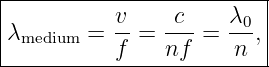
In a material medium, an idealized refractive index can be defined by
Then
At a stationary interface, the wave frequency is determined by the time dependence of the source
and remains continuous across the interface.
Therefore the wavelength changes:
for the idealized case where n is the refractive index at that frequency and
is the vacuum wavelength.
This distinction is important in optics.
When astronomical electromagnetic wavelengths are quoted without qualification, they are
normally understood as vacuum wavelengths or frequencies defined independently of terrestrial
material propagation.
13 Dispersion
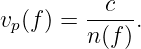
In many materials the refractive index depends on frequency:
Then the phase speed also depends on frequency:
This phenomenon is called dispersion.
Different frequency components of a broadband signal can therefore accumulate different phases or
travel with different group delays.
Dispersion is central in optics, plasma propagation, radio science, and astronomical signal
propagation.
The vacuum relation
remains the clean reference relation for labeling an electromagnetic spectrum.
14 Frequency and wavelength describe the same vacuum spectral coordinate
For vacuum electromagnetic radiation,
Therefore a wavelength and its corresponding frequency contain the same information.
But the mapping reverses order:
and
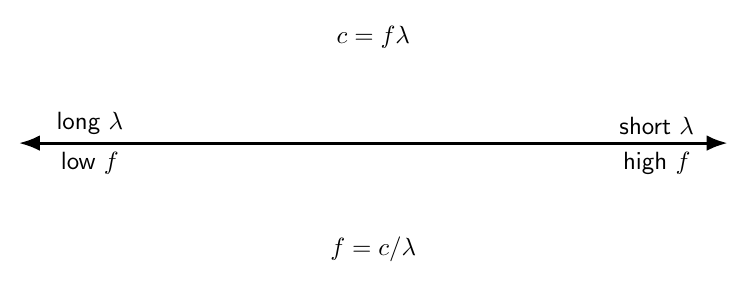
Figure 4. Vacuum wavelength and frequency are reciprocal spectral coordinates connected by the
speed of light. Moving toward shorter wavelength means moving toward higher frequency.
15 The electromagnetic spectrum
The electromagnetic spectrum is the continuous range of electromagnetic frequencies or
wavelengths.
Common descriptive bands include:
- radio;
- microwave;
- infrared;
- visible;
- ultraviolet;
- X-ray;
- gamma ray.
These names are useful classifications, not fundamental discontinuities in the laws of
physics.
A wave does not undergo a sudden change in its basic electromagnetic nature merely because its
wavelength crosses a conventional band boundary.
The same relations
and
continue across the spectrum.
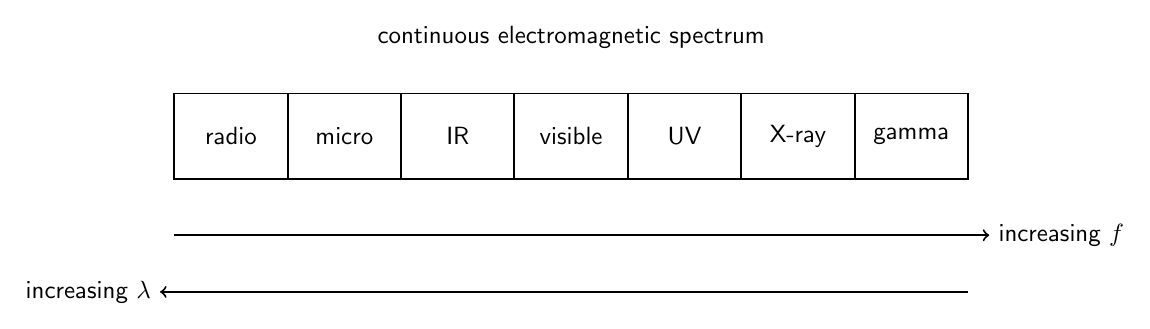
Figure 5. The electromagnetic spectrum is continuous. Conventional band names identify useful
wavelength and frequency ranges rather than distinct kinds of classical electromagnetic field.
16 Approximate wavelength scales
Representative vacuum wavelength scales are:
|
|
|
| Band | Representative wavelength scale | Representative frequency scale |
|
|
|
| Radio | meters to kilometers and beyond | kilohertz to hundreds of megahertz |
| Microwave | meters to millimeters | hundreds of megahertz to hundreds of gigahertz |
| Infrared | millimeters to about 700 nm | hundreds of gigahertz to hundreds of terahertz |
| Visible | about 400 to 700 nm | about 750 to 430 THz |
| Ultraviolet | shorter than visible to tens of nm | above visible frequencies |
| X-ray | roughly nm to hundredths of nm | very high frequency |
| Gamma ray | shorter still | highest frequencies |
|
|
|
The boundaries vary somewhat by discipline.
For quantitative work, the numerical wavelength or frequency is more fundamental than the band
name.
17 Electromagnetic waves and photons
Classical electromagnetic theory describes waves and fields.
Quantum physics describes electromagnetic radiation in terms of photons.
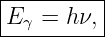
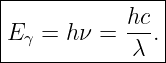
For a photon,
where h is Planck’s constant.
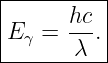
Using
we obtain
Therefore
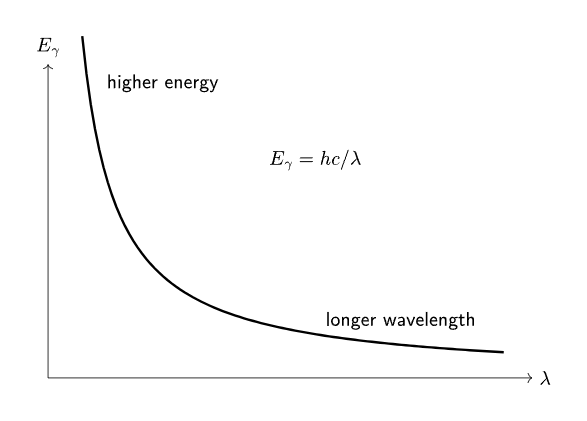
Figure 6. Photon energy increases with frequency and decreases with wavelength. The classical
wavelength coordinate therefore also organizes photon energies.
18 Example 3: photon energy at 500 nm
For
| Eγ | =  | (74)
|
| ≈ 3.973 × 10⁻¹⁹ J. | (75) |
Using
the photon energy is
Thus the same radiation can be characterized by:
| λ | = 500 nm, | (78)
|
| ν | ≈ 5.996 × 10¹⁴ Hz, | (79)
|
| Eγ | ≈ 2.48 eV . | (80) |
These are three linked descriptions of the same spectral location.
19 Monochromatic, narrowband, and broadband radiation
An ideal monochromatic electromagnetic wave has one frequency:
Equivalently, in vacuum it has one wavelength:
No real finite-duration source is perfectly monochromatic, but the approximation can be excellent
for sufficiently narrow spectral lines or stabilized lasers.
A narrowband signal occupies a small interval around a central frequency or wavelength.
A broadband signal contains a substantial range of frequencies or wavelengths.
Starlight is generally broadband.
A blackbody is the canonical broadband thermal spectrum.
This distinction becomes crucial in photometry because a broadband detector or filter does not
measure only one wavelength.
20 A spectrum is a distribution over wavelength or frequency
Suppose an instrument separates incoming radiation according to wavelength.
One can then ask how some measured quantity is distributed across wavelength.
Examples include:
The notation
means that the quantity is expressed per unit wavelength.
Similarly,
means per unit frequency.
This distinction matters because spectral density is not the same thing as an ordinary total
quantity.
A later standalone PhysicsLibrary article will develop spectral flux density carefully.
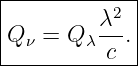
21 Why per-wavelength and per-frequency spectra are not numerically identical
Suppose a total quantity Q is represented either by wavelength or by frequency:
The corresponding infinitesimal amounts must match in magnitude:
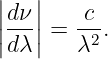
Since
we have
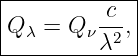
Therefore
or equivalently
This Jacobian factor is fundamental in spectroscopy and photometry.
A spectrum plotted per unit wavelength and the same spectrum plotted per unit frequency can
have different shapes.
22 Blackbody radiation and wavelength
A blackbody spectrum is broadband.
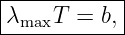
When represented per unit wavelength, Planck’s law can be written
The wavelength at which Bλ reaches its maximum satisfies Wien’s displacement law:
where
Hotter blackbodies therefore peak at shorter wavelengths.
This connects directly to the PhysicsLibrary article on Wien displacement law and the existing
blackbody-temperature example.
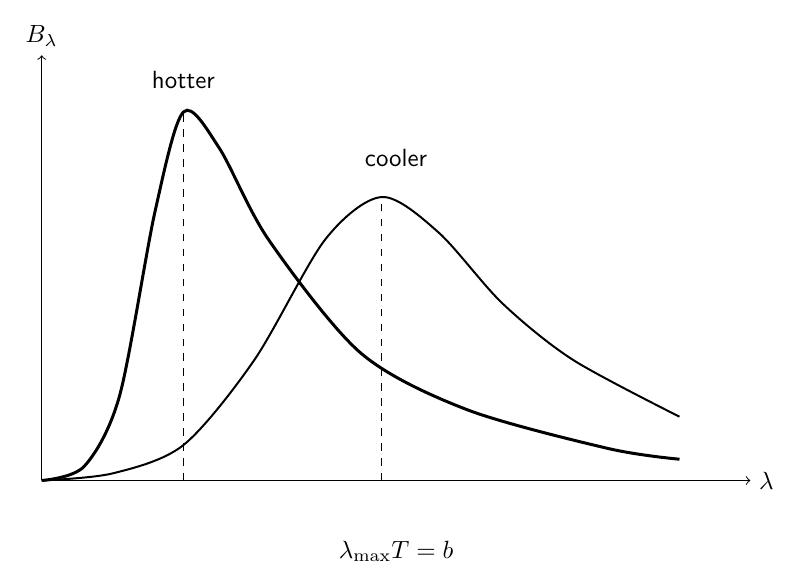
Figure 7. Increasing blackbody temperature shifts the peak of the per-wavelength spectrum
toward shorter wavelength while also increasing the emitted spectral radiance.
23 An important subtlety about spectral peaks
The wavelength-space spectrum
and frequency-space spectrum
represent the same total radiation but use different spectral coordinates.
Because the transformation includes a Jacobian, the maximum of Bλ does not map to the
maximum of Bν simply by applying
to the wavelength of the Bλ peak.
This is not a contradiction.
The two functions describe density per different coordinate interval.
The same issue will appear again when converting between
and
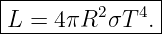
24 From blackbody surface flux to stellar power
A blackbody surface emits a total energy flux
For a spherical star of radius R, the surface area is
Therefore the luminosity is
This is the relation used in the existing PhysicsLibrary example on calculating the power of a
star.
The present article supplies part of the conceptual bridge:
25 Wavelength is not color
Visible color is related to the spectral response of the human visual system.
A single visible wavelength can be associated with a spectral color under suitable viewing
conditions, but most physical light sources contain many wavelengths.
An astronomical broadband color such as
is not one wavelength.
It is constructed from measurements through two broad response bands.
Thus one should distinguish:
The PhysicsLibrary article on color in astrophysics develops this distinction further.
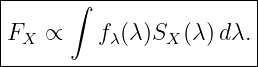
26 Bridge to photometric passbands
A telescope and detector generally do not respond equally to every wavelength.
Let
represent the response of a photometric band X.
If the incoming spectrum is described by a spectral flux density
then a schematic band signal has the form
The point of the present article is not yet to derive the exact photometric calibration
convention.
Instead, notice what wavelength is doing:
The next conceptual steps are therefore:
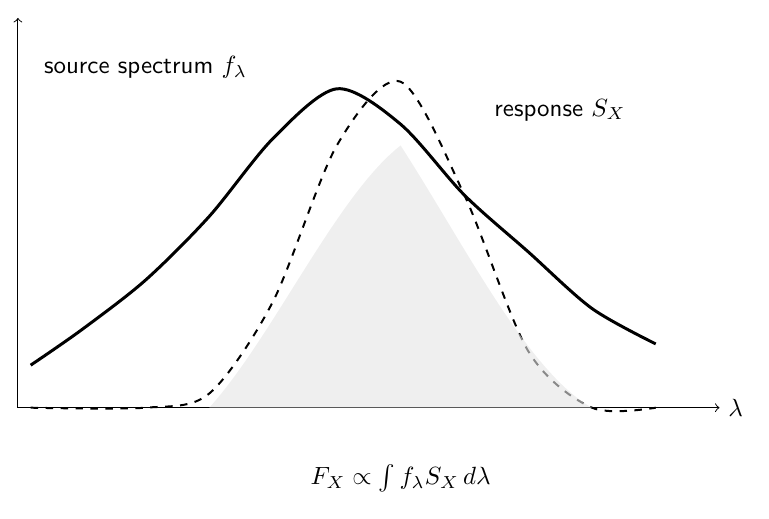
Figure 8. A broadband measurement samples a range of wavelengths. The detected contribution
depends both on the source spectrum and on the wavelength-dependent system response.
27 Common wavelength-frequency conversions
For vacuum radiation,
Useful conversion scales include:
| 1 GHz | ↔0.2998 m, | (111)
|
| 100 GHz | ↔2.998 mm, | (112)
|
| 1 THz | ↔299.8 μm, | (113)
|
| 500 THz | ↔599.6 nm. | (114) |
These conversions are particularly useful when moving between radio engineering, infrared
astronomy, and optical astronomy.
28 Common mistakes
- Treating wavelength as a time instead of a distance.
- Treating frequency as a propagation speed.
- Using c = fλ inside a material without replacing c by the appropriate phase speed.
- Assuming frequency changes when a wave crosses a stationary material interface.
- Forgetting that wavelength changes when phase speed changes but frequency remains
fixed.
- Confusing ordinary frequency f with angular frequency ω.
- Confusing wavelength λ with angular wavenumber k = 2π∕λ.
- Treating electromagnetic-spectrum band boundaries as sharp changes in physical law.
- Assuming a broadband source has one unique wavelength.
- Treating photometric color as identical to wavelength.
- Assuming a spectrum per unit wavelength is numerically identical to a spectrum per
unit frequency.
- Converting the peak of a per-wavelength spectrum into the peak of a per-frequency
spectrum merely by using ν = c∕λ.
- Forgetting that photon energy increases as wavelength decreases.
- Assuming the amplitude of the electric field is itself an energy.
29 Connections to other PhysicsLibrary articles
This article connects directly to the existing article Electromagnetic Radiation, which provides the
broader wave and photon picture.
It connects to Electromagnetic Spectrum, which classifies astronomical radiation by wavelength and
frequency.
It connects to Electromagnetism and the EM series, where Maxwell’s equations produce
electromagnetic wave propagation.
It connects to EM01, where a one-dimensional traveling wave is generalized into a vector field such
as
It connects to the Wave Mechanics articles on oscillation in time, wavelength, phase, wavenumber,
traveling waves, and wave speed.
It connects to Wien displacement law through
It connects to the blackbody-temperature example by turning a measured peak wavelength into a
temperature.
It connects to the stellar-power example through
Finally, it prepares for the next photometric concepts:
30 Summary
An electromagnetic wave is a propagating time-dependent electric and magnetic field.
Wavelength is its spatial period:
Period is one complete temporal cycle:
Frequency is
Wave speed connects the spatial and temporal descriptions:
In vacuum,
Angular frequency and angular wavenumber are
Photon energy is
The electromagnetic spectrum is a continuous distribution that can be labeled by wavelength or
frequency.
This provides the foundation for describing an astronomical source with spectral quantities such
as
and for integrating those quantities through wavelength-dependent photometric response
functions.
References
References
[1] D. J. Griffiths, Introduction to Electrodynamics, 4th ed., Cambridge University Press,
2017.
[2] S. J. Ling, J. Sanny, and W. Moebs, University Physics, Volume 2, OpenStax, 2016.
[3] R. P. Feynman, R. B. Leighton, and M. Sands, The Feynman Lectures on Physics,
Volume II, Addison-Wesley, 1964.
[4] F. S. Crawford, Jr., Waves, Berkeley Physics Course, Volume 3, McGraw-Hill, 1968.
[5] E. Hecht, Optics, 5th ed., Pearson, 2017.
[6] G. B. Rybicki and A. P. Lightman, Radiative Processes in Astrophysics, Wiley, 1979.
[7] B. W. Carroll and D. A. Ostlie, An Introduction to Modern Astrophysics, 2nd ed.,
Pearson, 2007.













![[λ ] = m.](https://images.physicslibrary.org/cache/objects/1437/make4ht/ElectromagneticWavesAndWavelengthFrequencyPropagationAndSpectralDescription13x.png)