
|
|
|
|||||||
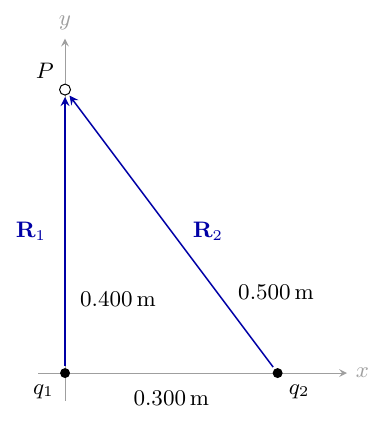
The observation point is P at r = (0, 0.400) m. First find the electric field at P. Then place a −2.00 nC test charge there and find the electric force on it. Give both vectors in components and report their magnitudes and directions. Assume the source configuration stays fixed and use ke = 8.98755 × 10⁹ N m2∕C2.
Figure 1. Both separation vectors point from a source to P. The open circle marks the observation point before the probe is placed. Predict first. The field from positive q1 points up at P. The field from negative q2 points toward q2, down and right. Predict the sign of the horizontal field component. To decide the vertical sign, compare the upward contribution with the downward component.
2 Solution
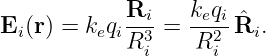
2.1 Calculate the field from each sourceLet Ri = r − ri and Ri = |Ri|. The source charge qi supplies the sign. The probe charge does not enter the expression for the field from source i at P:
The source-to-observer separations are
Substitute the charges in coulombs:
The second field reverses the direction of its displacement vector and points toward the negative source.
2.2 Add the fields at the observation pointThe two vertical contributions partly cancel:
The resulting field and its magnitude are
Both components are positive, so arctan(Ey∕Ex) = 31.8∘ above the positive x axis.
2.3 Apply the field to the negative probeWith qt = −2.00 × 10⁻⁹ C,
In micronewtons the result is  Its magnitude is 0.203 μN. Both components are negative, so the direction is 31.8∘ below the negative x axis, or 211.8∘ measured counterclockwise from +x.
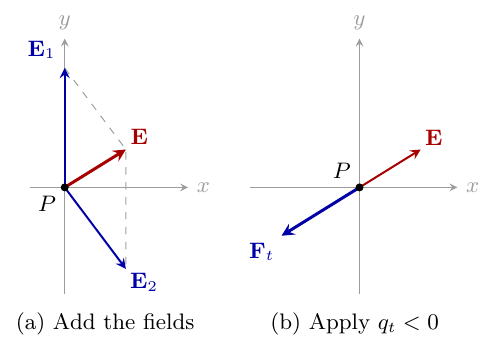
Figure 2. The field arrows in (a) use one scale. Panel (b) compares directions for quantities with different units. Checks. Every field contribution has units of N∕C. Multiplying by coulombs gives newtons. As an independent force check, the negative probe is attracted toward q1 and repelled away from q2. The first force is straight down and the second is up and left. Their sum points left and down, as found above. Changing the sign of the probe reverses its force and leaves the source field unchanged under the fixed-source assumption.
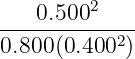
3 Try a variationKeep the geometry and q1 fixed. What value of q2 makes the total field at P point exactly along +x? What force does the original negative probe feel in that case? Solution. For Ey = 0, the vertical component from q2 must equal the negative of the field from q1. Cancel ke to get
Only source 2 contributes to Ex. The ratio of its component magnitudes is 0.600∕0.800, so Ex = (0.600∕0.800)(168.5166 N∕C) = 126 N∕C to three significant figures. Multiplying the unrounded value by −2.00 nC gives Ft = −0.253 μN x. Cancelling the y components has left a nonzero field. Continue. Use ES01E1 (EM05E1) for more practice, or revisit ES01E2 to compare the force-first calculation. Return to the ES00 overview.
References
"Electric Field at an Off-Axis Point" is owned by bloftin.
This object's parent. Cross-references: units, vector, displacement, magnitudes, vectors, force, test charge, electric field, observation point, charges, source charges There is 1 reference to this object. This is version 1 of Electric Field at an Off-Axis Point, born on 2026-11-26. Object id is 1599, canonical name is ElectricFieldAtAnOffAxisPoint. Accessed 9 times total. Classification:
|
|
|
|
Pending Errata and AddendaNone.
|
DiscussionNo messages.
|
Interact |

 (0
 (
 +

 =
 =