|
|
|
|||||||
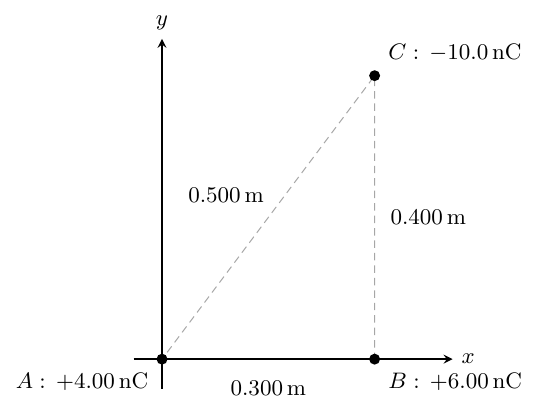
Find the net electric force on A from the other charges. Report its Cartesian components, magnitude, and direction. Use ke = 8.98755 × 10⁹ N m2∕C2 and 1 nC = 10−9 C.
Figure 1. The charges and their separations. The dashed diagonal joins A and C. All force vectors in the calculation act at A. Predict first. Both A and B are positive, so B pushes A to the left. The negative C attracts A up and to the right. Therefore the net vertical component is positive. Which horizontal component wins?
2 Solution
2.1 Choose the target and form the source-to-target vectorsFor a source j acting on A, define RA←j = rA − rj and RA←j = |RA←j|. Coulomb’s law is
Here RA←j = RA←j∕RA←j is dimensionless. First construct each vector from its source to the target. The sign of qAqj then determines whether the force follows that direction or reverses it. For B the separation vector and its unit vector are  For C the corresponding quantities are 
2.2 Calculate each signed force in SI unitsUse 1 μN = 10−6 N. For B, the product q AqB is positive:
For C, the product is negative:
The two negative entries in RA←C become positive after multiplication by the negative scalar. This agrees with attraction toward C.
2.3 Add components and recover the directionAdding the two vectors gives
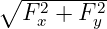
Thus the net force in three significant figures is  The magnitude is
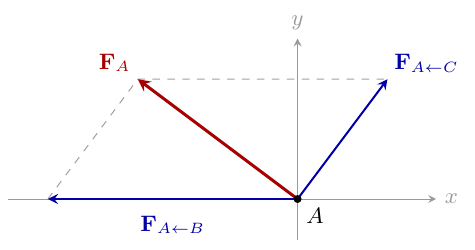
Figure 2. The solid arrows are the two forces and their sum, drawn at a common scale. The dashed lines complete the parallelogram. Checks. The factor keqAqj∕R2 has units of newtons. The downward and leftward directions of R A←C point from C to A, so the attractive force on A should point the other way. The magnitude of the net force lies between the difference and the sum of the two individual magnitudes: 0.959 μN ≤ 1.92 μN ≤ 3.83 μN.
3 Try a variationChange qC to +10.0 nC and keep everything else fixed. Predict the new quadrant. Then find the new net force and angle. Solution. Only the force from C reverses. Its new components are (−0.862805,−1.150406) μN. Adding the unchanged force from B gives (−3.259485,−1.150406) μN, or (−3.26,−1.15) μN to three significant figures. The magnitude is 3.46 μN and the direction is 19.4∘ below the negative x axis. Both components now point into the third quadrant. Continue. In ES01E3, use the same geometry to add fields at an observation point, then calculate what a probe charge feels. Return to the ES00 overview.
References
"Electric Force on One Charge in a Triangle" is owned by bloftin.
This object's parent. Cross-references: observation point, units, solid, scalar, unit vector, vector, Coulomb's law, vectors, magnitude, charge, force There is 1 reference to this object. This is version 1 of Electric Force on One Charge in a Triangle, born on 2026-11-26. Object id is 1598, canonical name is ElectricForceOnOneChargeInATriangle. Accessed 9 times total. Classification:
|
|
|
|
Pending Errata and AddendaNone.
|
DiscussionNo messages.
|
Interact |



 N

 N
 = 1