1 What Kepler actually received from Tycho
A useful historical correction should be made at the outset. Kepler did not open a copy of
Astronomia Nova and there discover Tycho Brahe’s measurements. The causal direction was the
reverse. Kepler sought access to Tycho’s superior observations, joined Tycho’s circle in Prague
around 1600, and worked on the Mars problem using the observational material before and after
Tycho’s death in 1601. Kepler also helped bring Tycho’s Astronomiae instauratae progymnasmata
into print in 1602 and continued the Mars analysis afterward. The Smithsonian history of Tycho’s
Mechanica summarizes this succession and explicitly credits the precision of Tycho’s
measurements as the observational basis from which Kepler obtained his first two planetary
laws.[5]
Thus the historical sequence is

Figure 1. The observational and theoretical chain. The 1609 book is a published stage in the
chain, not the place where Kepler first obtained Tycho’s data.
Tycho’s importance was not simply that he had “more data.” His program sought angular accuracy
on the order of one minute of arc and required systematic attention to effects such as
atmospheric refraction.[6] In practical reconstruction of Kepler’s Mars work, uncertainties of
roughly two arcminutes are often used as the scale against which discrepancies must be
judged.[7]
2 Where did Kepler actually “read” Tycho’s observations?
It is useful to distinguish three layers of evidence that are often collapsed into the phrase “Tycho’s
data.”
| Layer | What
it
contained | What
Kepler
did
with
it |
| Tycho’s
observing
record | dated
angular
measurements,
instrument
reductions,
and
associated
solar/star
information | inherited
and
worked
with
the
observational
archive
in
Prague |
| Kepler’s
reduced
Mars
data | selected
and
interpolated
observations,
especially
oppositions
referred
to
the
true
Sun | converted
Earth-based
angular
observations
into
constraints
on
heliocentric
Mars
longitude |
| Astronomia
Nova | published
tables,
numerical
examples,
diagrams,
model
tests,
and
narrative
argument | presented
the
reconstruction
by
which
those
observations
were
made
to
discriminate
among
planetary
hypotheses |
For the vicarious-hypothesis stage, a modern reconstruction of Kepler’s procedure identifies twelve
Mars oppositions extracted from groups of Tycho’s observations. Kepler then chose four of those
constraints to determine the four unknown parameters of the circular/equant model
and tested the result against the remaining observations.[7] In other words, even the
numbers printed in Astronomia Nova are often reduced observations: they have already
passed through time interpolation, solar theory, coordinate choices, and geometrical
inference.
This is close to a modern orbit-determination workflow. A detector does not hand the analyst “the
orbit.” It hands over measurements. Those measurements are calibrated, reduced, transformed into
a useful reference frame, and then compared with a dynamical or kinematic model. Kepler’s tools
were seventeenth-century geometry and arithmetic rather than least squares and numerical
integration, but the logical separation between measurement, reduction, and model test is already
visible.
3 Reading the 1609 title page
The title page already tells the reader what kind of book Kepler believed he was writing. Figure 2
is a typographic transcription of the principal lines. It is intentionally not presented as a
photographic facsimile. The original 1609 page can be viewed in the public-domain ETH e-rara and
Smithsonian scans listed in section 13.
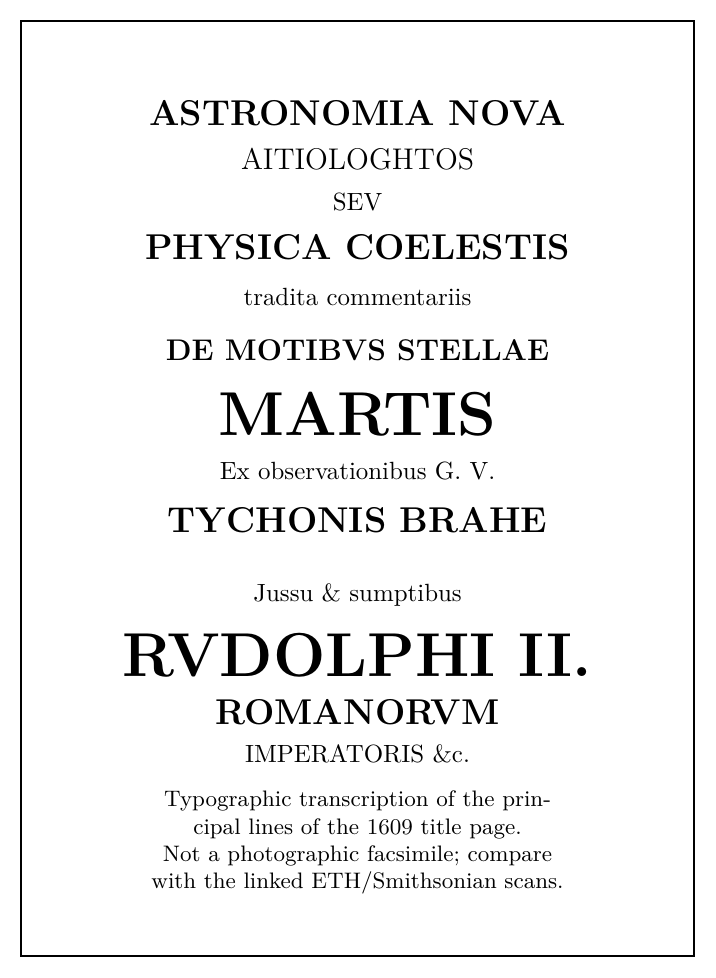
Figure 2. Typographic transcription of the principal lines of the 1609 title page. Compare it with
the photographic facsimiles linked in Section 13.
The most revealing phrases are short enough to examine word by word.
| 1609
wording | Direct
English
rendering |
| Astronomia
Nova
Aitiologetos | A
new
astronomy,
reasoned
from
causes |
| seu
Physica
Coelestis | or
celestial
physics |
| de
motibus
stellae
Martis | on
the
motions
of
the
star
Mars |
| ex
observationibus
G.
V.
Tychonis
Brahe | from
the
observations
of
the
noble
Tycho
Brahe |
The Greek-derived word rendered in Roman letters as Aitiologetos is important. It signals
explanation by causes, not merely a geometrical recipe for predicting where a planet will appear.
Likewise, Physica Coelestis—“celestial physics”—announces Kepler’s ambition to connect orbital
geometry to a physical account of planetary motion. This is one reason historians of Kepler
emphasize the work as a transition from traditional mathematical astronomy toward physical
astronomy.[9, 11]
The line ex observationibus ... Tychonis Brahe is equally striking. Tycho’s observations are
not buried in the acknowledgments; they are part of the advertised foundation of the
work.
4 What an observation of Mars actually gives you
Tycho observed apparent directions on the sky. Those are primarily geocentric angular
data. Kepler wanted the geometry and motion of Mars relative to the Sun. Converting
one into the other is therefore an inverse problem: the observer is moving, the target
is moving, and the desired heliocentric orbit is not directly painted on the Celestial
Sphere.
One particularly valuable geometry occurs near opposition, when the Sun, Earth, and Mars are
approximately aligned. Repeated oppositions strongly constrain the longitude of Mars, but they do
not remove the need for a model of Earth’s own orbit.
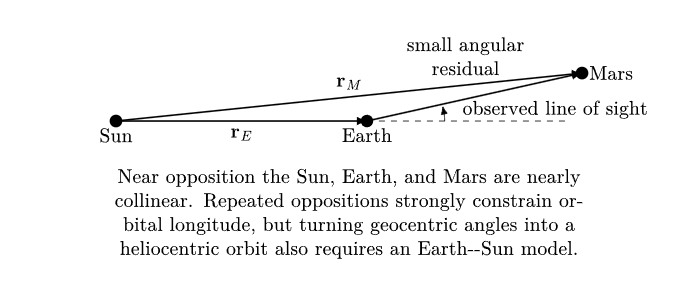
Figure 3. Simplified opposition geometry. Tycho measured apparent directions from Earth. Kepler
had to infer the heliocentric geometry of both Earth and Mars.
In modern vector notation the basic geometry would be summarized as
where rE and rM are heliocentric position vectors and ρM is the geocentric line-of-sight vector to
Mars. Tycho’s instruments constrained the direction of ρM with extraordinary precision for
naked-eye astronomy. Kepler’s problem was to infer the functions rE(t) and rM(t) from many such
directional constraints.
That distinction helps explain why the Mars problem was computationally difficult. An error could
arise from the Mars hypothesis, the adopted Earth-Sun theory, interpolation among observations,
refraction or parallax corrections, or arithmetic. A residual became scientifically useful only
after Kepler had enough independent checks to decide which part of the machinery was
failing.[7]
5 The vicarious hypothesis: a model that was almost too good
A particularly instructive episode is Kepler’s so-called vicarious hypothesis. In a modern
reconstruction of the calculation, Kepler selected four observations from a larger set of opposition
constraints and went through roughly seventy trials to determine the parameters of a
circular/equant construction. When tested against the other opposition longitudes, the model
performed impressively—with discrepancies comparable to the uncertainty of Tycho’s
observations.[7]
That success is methodologically important. Kepler did not reject circular machinery because
it was obviously bad. He rejected it only after a different geometrical check exposed
a discrepancy that could not plausibly be hidden inside Tycho’s observational error
budget.
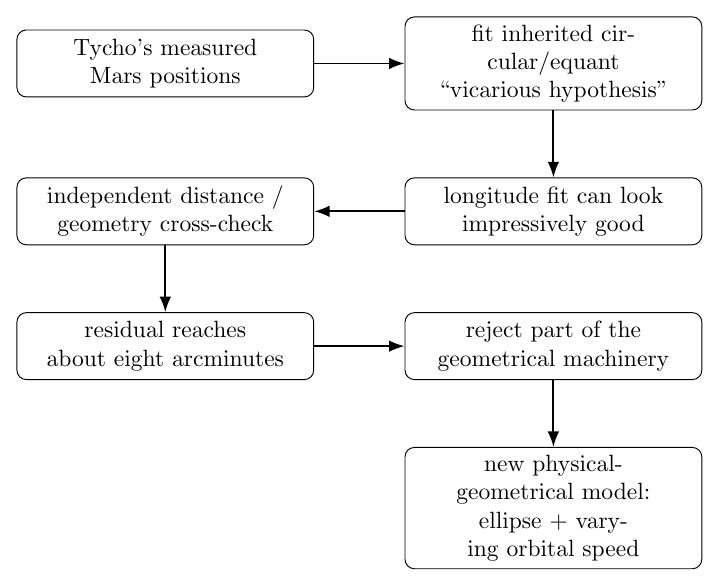
Figure 4. The logical structure of the famous model failure. The eight-minute discrepancy was not
simply the residual of one crude circle fitted to raw points; it emerged after an already
sophisticated model survived one set of checks and failed another.
This distinction is worth preserving because it makes Kepler’s reasoning look much more modern.
A model can interpolate or fit one observable very well and still be physically wrong. Independent
observables and cross-checks are what expose that weakness.
6 The eight minutes of Chapter XIX
Near the end of Chapter XIX, Kepler states the methodological point in unusually memorable
language. The crucial Latin clause is
sola igitur haec octo minuta viam praeiverunt ad totam Astronomiam
reformandam.
A direct translation is:
These eight minutes alone therefore led the way toward reforming the whole of
astronomy.
The passage occurs across pages 113–114 of the 1609 edition; the critical Latin edition likewise
preserves the surrounding argument.[2, 10]
The context matters. Kepler’s surrounding discussion praises Tycho as an exceptionally diligent
observer and explains that an eight-minute discrepancy in Mars could no longer be dismissed. Had
the observational standard still been approximately ten arcminutes, an inherited geometrical
scheme could have been declared adequate. Tycho’s much tighter error scale changed the decision
threshold.[7]
In modern language, Kepler was comparing a model residual to an observational uncertainty.
Schematically,
This is not yet a modern statistical hypothesis test, but the epistemic structure is recognizable.
7 How large is eight arcminutes?
An arcminute is 1∕60 of a degree, so
| 8′ | =  ∘ ∘ | (4)
|
| = 0.133333…∘ | (5)
|
| ≈ 2.327 × 10⁻³ rad. | (6) |
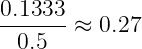
The full Moon is roughly half a degree across, so eight arcminutes are about
of the Moon’s apparent diameter. It is small to the eye but not small compared with a one- to
two-arcminute observational standard.
For angular intuition only, an angle δ𝜃 subtends a transverse scale
At R = 1 AU,
This should not be interpreted as “Kepler misplaced Mars by 348,000 km.” The historical
discrepancy was an angular residual inside a coupled Earth-Mars geometrical model. The
calculation merely conveys the angular scale.
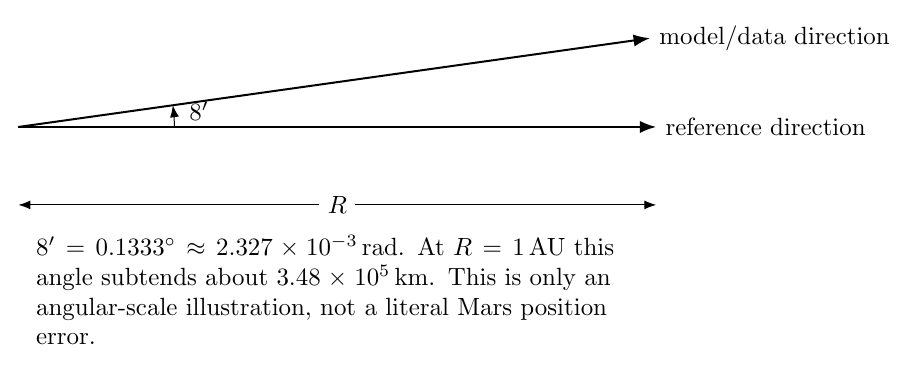
Figure 5. Angular scale of the famous residual. The wedge is exaggerated visually.
8 What the surviving 1609 pages look like
The original book makes the computational character of Kepler’s astronomy immediately visible.
The text is packed with numerical longitudes, dated observations, diagrams, and comparisons
among competing geometrical systems.
Two facsimile pages are especially useful for a PhysicsLibrary reader:
- Page 4 contains Kepler’s famous diagram of the looping geocentric path of Mars, a
compact picture of the apparent motion that any theory had to explain.
- Pages 131–132 display geometrical constructions explicitly labeled for Copernicus,
Ptolemy, and Tycho Brahe. They are an excellent visual reminder that Kepler inherited
several observationally competitive coordinate/geometrical descriptions and was trying
to decide what physical motion lay beneath them.
The facsimile links in Section 13 should be viewed alongside this article. They are more
informative than a modern redrawing because they show how tightly calculation, diagram, dates,
and prose were interwoven on the printed page.
9 From a failed circle to an ellipse
It would be misleading to tell the story as
The actual campaign was longer. Kepler reworked the Earth-Sun orbit, explored how planetary
speed should vary with solar distance, tested multiple geometrical constructions, and struggled
with what he called an oval path before arriving at the ellipse. Astronomia Nova is famous partly
because it preserves many of these false starts rather than hiding them behind a polished
theorem-proof presentation. Modern manuscript study also cautions that the printed narrative
is a crafted reconstruction of the research path, not a literal chronological laboratory
notebook.[8, 7]
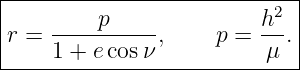
The final geometrical statement is what we now call Kepler’s first law:
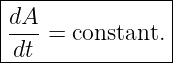
The same book develops the area principle underlying what became Kepler’s second
law:
The Smithsonian’s description of the 1609 volume identifies the work on Tycho’s Mars observations
as the route to these first two laws.[4]
For a modern celestial-mechanics student, the remarkable point is that these laws were discovered
kinematically, before Newton supplied the dynamical law that makes them consequences of a
central inverse-square force.
10 Kepler did not yet have Newton’s gravity
Kepler wanted a physical cause. That ambition is already visible in the words Physica Coelestis.
But his physical mechanism was not Newtonian gravitation. Kepler experimented with ideas
involving a solar motive influence and analogies with magnetism. The decisive Newtonian synthesis
came later.
In modern mechanics the path from Newton to Kepler is short enough to fit on one line. For a
two-body gravitational system,
Because the force is central,
which immediately gives constant areal velocity,
The inverse-square radial equation then yields Binet’s equation
with solution
Thus the ellipse and the area law that Kepler extracted from Tycho’s data became,
in Newton’s theory, consequences of one differential equation. This is the historical
bridge between the observational story in this article and the derivations developed in
CM04–CM06.
11 A modern reading of Kepler’s methodological move
The eight-minute episode remains useful because it illustrates several principles that recur
throughout experimental and computational physics.
11.1 A good fit is not the same as a correct model
The vicarious hypothesis could reproduce important longitudes with striking accuracy. A second
constraint exposed its structural failure. Modern orbit determination works the same way: fitting
one measurement type does not guarantee that a dynamical model will predict another
measurement type correctly.
11.2 Residuals need an uncertainty scale
The number “eight arcminutes” has no methodological meaning by itself. It mattered because
Tycho had changed the credible observational scale. Eight arcminutes against ten-arcminute
astronomy might be tolerable; eight arcminutes against one- to two-arcminute astronomy
demanded an explanation.
11.3 Higher-quality data can invalidate a previously successful theory
Ptolemaic and Copernican circular constructions had been extraordinarily successful as
calculational astronomy. Improved measurement did not make the old mathematics worthless; it
made previously invisible distinctions empirically accessible.
11.4 The anomaly became the discovery
Kepler could have absorbed the discrepancy into an error allowance. Instead he treated it as
information. In that sense, the celebrated eight minutes are an early example of a residual
becoming the clue to new physics.
12 Publication was itself part of the story
The work was substantially developed before 1609. Historical scholarship has shown that
publication was entangled with disputes involving Tycho’s heirs and rights to use and publish
Tycho’s astronomical legacy. James Voelkel argues that these legal contingencies influenced not
only the timing but also aspects of the unusual form of Astronomia Nova.[8] Tufts historical notes
likewise summarize the work as essentially completed years before publication and delayed by
disagreement over credit and access to Tycho’s data.[7]
This matters when reading the book as a source. It is simultaneously a mathematical investigation,
a physical argument, a narrative of discovery, and a document written under constraints about
ownership and attribution of observations.
13 Facsimiles and primary-source reading guide
The following scans are recommended for reading beside this article.
14 Source comparison: what changed between 1609 and modern notation?
Kepler’s pages and a modern celestial-mechanics textbook are describing the same sky but with
very different conceptual tools.
| 1609
problem | Kepler’s
working
language | Modern
translation |
| Observed
Mars
direction | longitude,
opposition,
geometrical
constructions | line-of-sight
unit
vector
from
a
moving
observer |
| Competing
planetary
systems | Ptolemaic,
Copernican,
Tychonic
hypotheses | alternative
coordinate/kinematic
models
with
testable
predictions |
| Unequal
orbital
speed | solar
distance
rules
and
area
reasoning | angular
momentum
conservation
and
dA∕dt = h∕2 |
| Noncircular
Mars
path | oval/ellipse
emerging
from
residuals
and
geometry | Keplerian
conic
r = p∕(1 + e cos ν) |
| Eight-minute
discrepancy | unacceptable
disagreement
with
Tycho | residual
exceeds
credible
measurement
uncertainty |
| Physical
cause | celestial
physics,
solar
motive
ideas | gravitational
acceleration
−μr∕r3 |
The continuity is as important as the difference. Kepler did not possess vector calculus, differential
equations in modern form, or Newton’s laws. Yet the core scientific operation—confront a
mathematically definite model with measurements accurate enough to discriminate among
alternatives—is immediately recognizable.
15 A machine-readable Mars data set for Julia
A historical article becomes much more useful for self-study if the numerical material can be
loaded directly into a modern language. The companion file
tycho_kepler_mars_oppositions.csv
contains twelve opposition entries transcribed from a modern reconstruction of Kepler’s Mars
material in Mazer’s Table 7.1.[12] The first ten rows span 1580–1600 and belong to the Tycho-era
observational sequence; the last two rows, 1602 and 1604, occur after Tycho’s death and are
retained because Kepler’s printed investigation continued beyond the inherited Tycho
set.
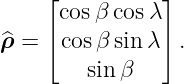
The CSV deliberately separates the zodiac form of the longitude from a modern 0∘–360∘ ecliptic
longitude. For example,
means
North ecliptic latitude is stored as positive and south latitude as negative.
| Year | λ (deg) | β (deg) | Period |
| 1580 | 66.473889 | 1.666667 | Tycho-era |
| 1582 | 106.925000 | 4.100000 | Tycho-era |
| 1585 | 141.602778 | 4.536111 | Tycho-era |
| 1587 | 175.716667 | 3.683333 | Tycho-era |
| 1589 | 214.383333 | 1.212500 | Tycho-era |
| 1591 | 266.716667 | -4.000000 | Tycho-era |
| 1593 | 342.266667 | -6.033333 | Tycho-era |
| 1595 | 47.516667 | 0.133333 | Tycho-era |
| 1597 | 92.466667 | 3.550000 | Tycho-era |
| 1600 | 128.633333 | 4.513889 | Tycho-era |
| 1602 | 162.450000 | 4.166667 | post-Tycho |
| 1604 | 198.619444 | 2.433333 | post-Tycho |
A second file,
kepler_ch08_ch10_mars_times.csv,
places side by side the reduced mean-opposition times quoted in Chapter VIII and the underlying
observation times summarized from Chapter X in a modern Kepler study guide.[13] This second
table is pedagogically useful because it shows that a datum used in a planetary model is not
necessarily identical to a single telescope-free observing entry: interpolation and reduction separate
the two layers.
15.1 Do not confuse the CSV with Tycho’s raw notebooks
The machine-readable files are intentionally labeled as a historical reconstruction. They are not a
direct digital export of Tycho’s instrument notebooks. By the time a longitude appears in Kepler’s
calculation it may already embody interpolation to opposition, solar theory, coordinate reduction,
and other corrections. That distinction is part of the physics lesson: modern orbit determination
likewise separates sensor measurements from reduced observables and from estimated dynamical
states.
16 Julia exercise: turn the historical angles into vectors
The companion script
kepler_tycho_mars_observations.jl
loads the CSV with CSV.jl and DataFrames.jl. For each ecliptic longitude λ and latitude β, it
forms the unit line-of-sight direction
This is deliberately a direction vector, not a heliocentric Mars position vector: the historical
angular observation does not by itself provide the Mars–Sun distance.
The script also verifies the zodiac-to-360∘ conversion, computes angular separations between
successive tabulated directions, writes a derived vector CSV, and evaluates the famous
eight-arcminute scale in radians. If Plots.jl is installed it produces an ecliptic-plane direction
plot and a latitude-versus-year plot.
A minimal Julia session is
import Pkg
Pkg.add(["CSV", "DataFrames", "Plots"])
include("kepler_tycho_mars_observations.jl")
The most important interpretive warning is that plotting these angles does not reproduce Kepler’s
ellipse automatically. To reconstruct heliocentric positions one also needs the Earth–Sun
geometry and the reduction procedure Kepler used to turn geocentric directions into orbital
constraints. This is exactly why Astronomia Nova is hundreds of pages rather than one scatter
plot.
17 Companion files
For a saved PhysicsLibrary object, upload the following files to the object’s filebox using these
exact filenames. The links below then resolve through PhysicsLibrary’s filebox mechanism.
18 Summary
The 1609 Astronomia Nova is best read as a meeting point of observation, geometry, and an
emerging demand for physical causes. Its title page gives Tycho Brahe’s observations explicit
billing. Its body shows Kepler repeatedly forcing inherited models to answer to those observations.
The famous eight-minute discrepancy is memorable not because eight is a magical number, but
because Tycho had made the observational uncertainty small enough that eight minutes could no
longer be dismissed.
The historical lesson can be written compactly as
For celestial mechanics, the story then continues one step further:
References
References
[1] J. Kepler, Astronomia nova aitiologetos, seu Physica coelestis, tradita commentariis
de motibus stellae Martis, ex observationibus G. V. Tychonis Brahe, Heidelberg: G.
Voegelin, 1609. ETH-Bibliothek Zürich, Rar 4482. DOI: 10.3931/e-rara-558.
[2] J. Kepler, Gesammelte Werke, vol. 3, Astronomia Nova, ed. M. Caspar, Munich: C.
H. Beck, 1937. See Chapter XIX and the discussion corresponding to pp. 113–114 of
the 1609 edition.
[3] J. Kepler, New Astronomy, trans. W. H. Donahue, 2nd ed., Santa Fe: Green Lion
Press, 2015.
[4] Smithsonian Libraries and Archives, Astronomia nova aitiologetos digital edition,
1609, DOI: 10.5479/sil.126675.39088002685477.
[5] Smithsonian Libraries, “Astronomiae instauratae mechanica by Tycho Brahe:
Introduction,” digital history essay and facsimile collection.
[6] K. P. Moesgaard, “Refraction in Tycho Brahe’s Small Universe,” Proceedings of IAU
Symposium 133, discussion of Tycho’s one-arcminute observational aim.
[7] G. E. Smith, Kepler’s Astronomia Nova and the Orbit of Mars, Philosophy 167
course notes, Tufts University Digital Library, archival teaching notes.
[8] J. R. Voelkel, “Publish or Perish: Legal Contingencies and the Publication of Kepler’s
Astronomia nova,” Science in Context, vol. 12, no. 1, pp. 33–59, 1999.
[9] B. Stephenson, Kepler’s Physical Astronomy, Princeton: Princeton University Press,
1994.
[10] A. J. Apt, The Reception of Kepler’s Astronomy in England: 1596–1650, D.Phil.
thesis, University of Oxford, 1982; discussion of Chapter XIX and the eight-minute
passage.
[11] P. Gabor, “It’s All Greek: About Three of Kepler’s Book Titles, Part II: Astronomia
Nova Aitiologetos,” Vatican Observatory, 2020.
[12] A. Mazer, Shifting the Earth: The Mathematical Quest to Understand the Motion of
the Universe, Hoboken: Wiley, 2011, Table 7.1 (Mars observations at opposition).
[13] Thomas Aquinas College, Sophomore Mathematics: Other Useful Information on
Mars that Kepler Employs, study material accompanying readings from Kepler’s New
Astronomy; Chapter VIII and Chapter X date-time summaries.

![[parent]](https://images.physicslibrary.org/images/uparrow.png)