If you go on a camping trip or live far from city lights, your view of the sky on a clear night is
pretty much identical to that seen by people all over the world before the invention of the
telescope. Gazing up, you get the impression that the sky is a great hollow dome with you at the
center (Figure 1), and all the stars are an equal distance from you on the surface of the dome.
The top of that dome, the point directly above your head, is called the zenith, and
where the dome meets Earth is called the horizon. From the sea or a flat prairie, it is
easy to see the horizon as a circle around you, but from most places where people live
today, the horizon is at least partially hidden by mountains, trees, buildings, or smog.
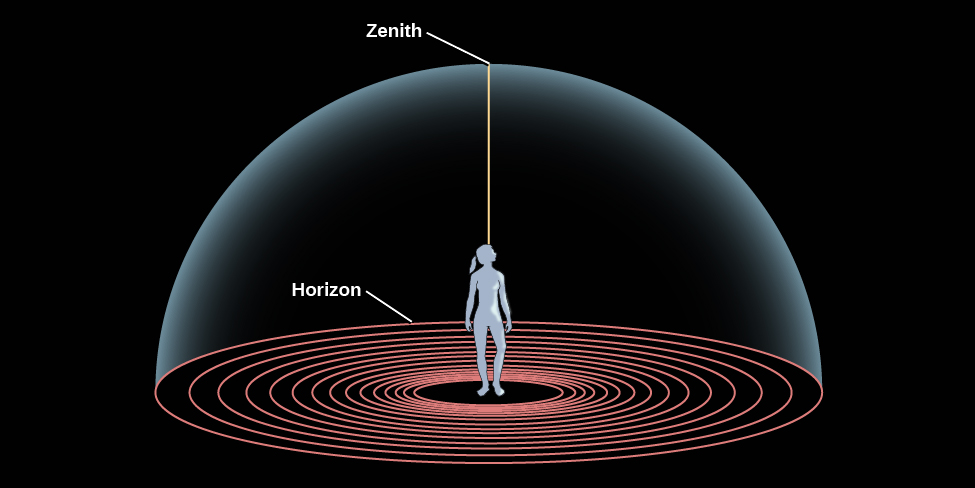
Figure 1. The Sky around Us.
If you lie back in an open field and observe the night sky for hours, as ancient shepherds and
travelers regularly did, you will see stars rising on the eastern horizon (just as the Sun and Moon
do), moving across the dome of the sky in the course of the night, and setting on the western
horizon. Watching the sky turn like this night after night, you might eventually get the idea
that the dome of the sky is really part of a great sphere that is turning around you,
bringing different stars into view as it turns. The early Greeks regarded the sky as just
such a celestial sphere (Figure 2). Some thought of it as an actual sphere of
transparent crystalline material, with the stars embedded in it like tiny jewels.
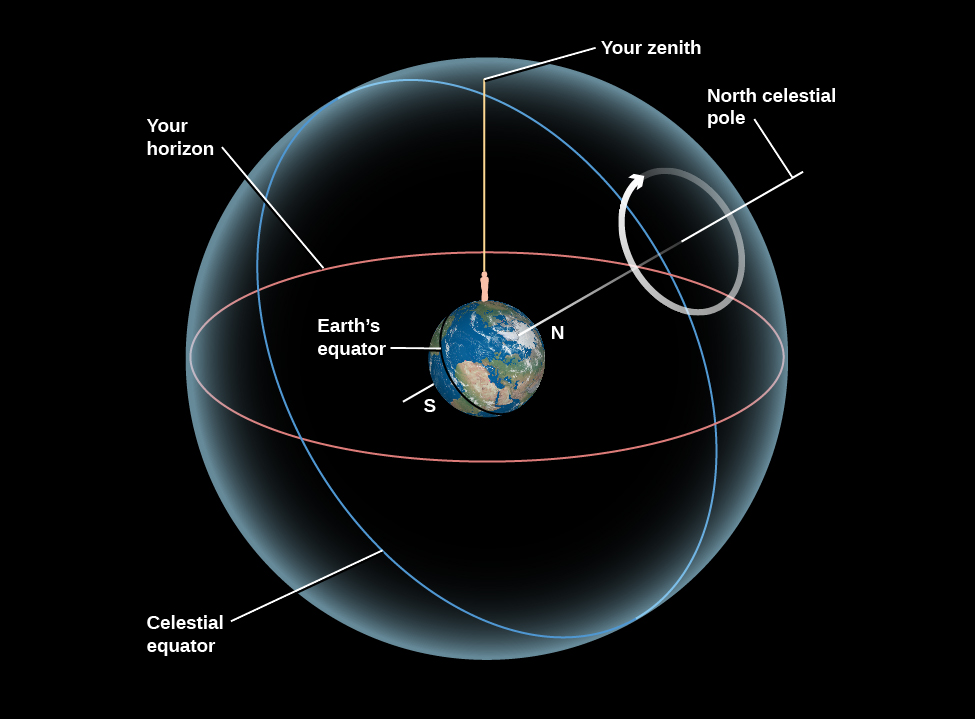
Figure 2. Circles on the Celestial Sphere. Here we show the (imaginary) celestial sphere
around Earth, on which objects are fixed, and which rotates around Earth on an axis. In reality,
it is Earth that turns around this axis, creating the illusion that the sky revolves around us. Note
that Earth in this picture has been tilted so that your location is at the top and the North Pole is
where the N is. The apparent motion of celestial objects in the sky around the pole is shown by
the circular arrow.
Today, we know that it is not the celestial sphere that turns as night and day proceed, but rather
the planet on which we live. We can put an imaginary stick through Earth’s North and South
Poles, representing our planet’s axis. It is because Earth turns on this axis every 24 hours that we
see the Sun, Moon, and stars rise and set with clockwork regularity. Today, we know that these
celestial objects are not really on a dome, but at greatly varying distances from us in space.
Nevertheless, it is sometimes still convenient to talk about the celestial dome or sphere
to help us keep track of objects in the sky. There is even a special theater, called a
planetarium, in which we project a simulation of the stars and planets onto a white dome.
As the celestial sphere rotates, the objects on it maintain their positions with respect to one
another. A grouping of stars such as the Big Dipper has the same shape during the course of the
night, although it turns with the sky. During a single night, even objects we know to have
significant motions of their own, such as the nearby planets, seem fixed relative to the stars. Only
meteors, brief ”shooting stars” that flash into view for just a few seconds, move appreciably with
respect to other objects on the celestial sphere. (This is because they are not stars at all. Rather,
they are small pieces of cosmic dust, burning up as they hit Earth’s atmosphere.) We can use the
fact that the entire celestial sphere seems to turn together to help us set up systems for keeping
track of what things are visible in the sky and where they happen to be at a given
time.
This article is a derivative work of the creative commons share alike with attribution in
[1].
References
[1] Fraknoi, Andrew, David Morrison, and Sidney Wolff. The Sky Above. In Astronomy
2e. Houston, Texas : OpenStax, 2022. The Sky Above
