The Compton effect represents another confirmation of the photon theory, and a refutation of the
wave theory. One observes it (Compton, 1924) in the scattering of X-rays by free (or weakly
bound) electrons. The wavelength of the scattered radiation exceeds that of the incident radiation.
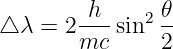
The difference △λ varies as a function of the angle 𝜃 between the direction of propagation of the
incident radiation and the direction along which one observes the scattered Light, according to
Compton’s formula:
where m is the rest mass of the electron. One notes that △λ is independent of the incident
wavelength. Compton and Debye have shown that the Compton effect is a simple elastic
collision between a photon of the incident light and one of the electrons of the irradiated
target.
In order to discuss this corpuscular interpretation it is convenient to state a few properties of
photons which derive directly from Einstein’s hypothesis. Since they possess the velocity c,photons
are particles of zero mass. The momentum p and the energy 𝜖 of a photon are thus connected by
the relation
Consider a plane, monochromatic light wave
u is a unit vector in the direction of propagation, λ is the wavelength, v the frequency: λv = c. In
accordance with Einstein’s hypothesis, this wave represents a stream of photons of energy hv. The
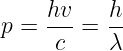
momentum of these photons is evidently directed along u and its absolute value, according to (2),
is equal to
This relation is a special case of the relation of L. de Broglie. It is often convenient to introduce the
angular frequency ω = 2πv and the wave vector k = (2π∕λ)u of he plane wave. The connecting
relations are then written:
The corpuscular theory of the Compton effect consists in writing down that the total energy and
momentum are conserved in the elastic collision between the incident photon and the electron. Let
p,p′ be the initial and final momenta of the photon, respectively, P′ the recoil momentum of the
electron after collision (Figure 1).
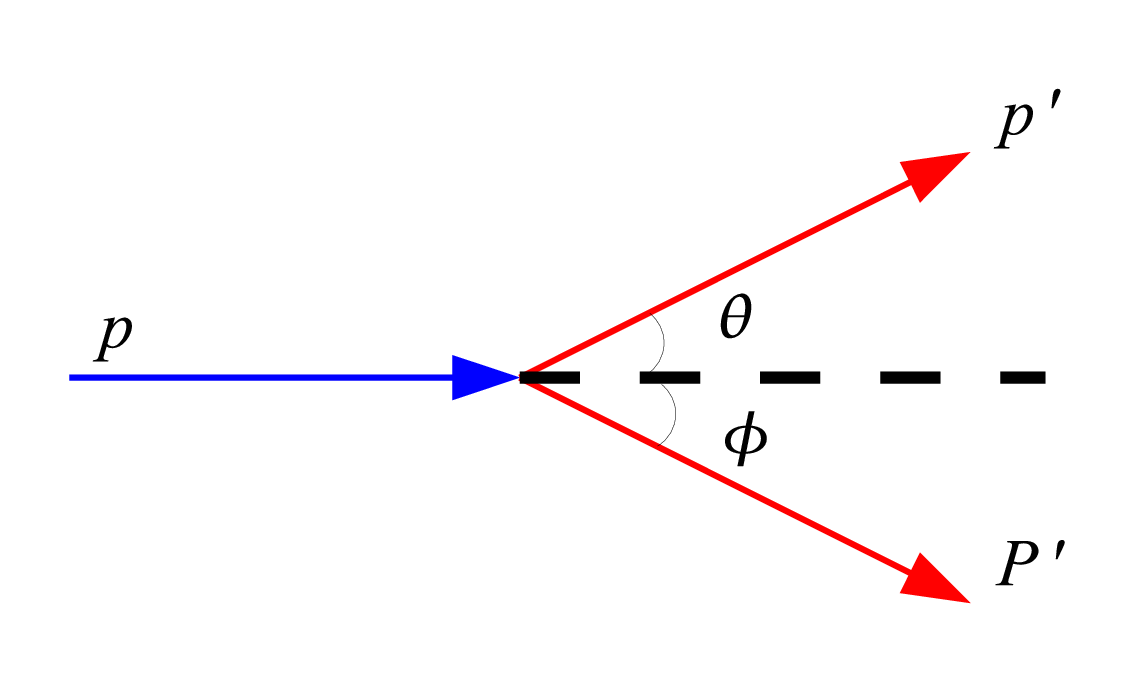 Figure 1: Compton collision of a photon with an electron at rest
The conservation equations are written
According to these equations the collision is completely defined once the initial conditions and the
direction of emission of the scattered photon are known. Taking into account the relations in (3),
one can easily deduce the Compton formula which is thus explained theoretically. Since the
first work of Compton, all the other predictions of this theory have been confirmed
experimentally. The recoil electrons have been observed and the law of their energy variation as a
function of the angle of emission ϕ is just the one which one derives from equations (4).
Coincidence experiments have shown that the scattered photon and electron are emitted
simultaneously, and that the correlation between the emission angles 𝜃 and ϕ agrees with the
theory.
0.1 References
[1] Messiah, Albert. ”Quantum mechanics: volume I.” Amsterdam, North-Holland Pub. Co.; New
York, Interscience Publishers, 1961-62.
This entry is a derivative of the Public domain work [1].


![[ ( u-⋅ r )]
exp 2πi λ − vt](https://images.physicslibrary.org/cache/objects/579/make4ht/ComptonEffect2x.png)