Kinetic energy is energy associated to motion. The kinetic energy of a mechanical system is the
work required to bring the system from its ‘rest’ state to a ‘moving’ state. When exactly a system
is considered to be ‘at rest’ depends on the context: a stone is usually considered to be at rest
when its centre of mass is fixed, but in situations where, for example, the stone undergoes a change
in temperature the movement of the individual particles will play a role in the energetic description
of the stone.
Kinetic energy is commonly denoted by various symbols, such as Ek, Ekin, K, or T (the
latter is the convention in Lagrangian mechanics). The SI unit of kinetic energy, like
that of all sorts of energy, is the joule (J), which is the same as kg m2∕s2 in SI base
units.
Energy associated to motion in a straight line is called translational kinetic energy. For a
particle or rigid body with mass m and velocity v, the translational kinetic energy
is
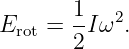
Kinetic energy associated to rotation of a rigid body is called rotational kinetic energy. It depends
on the moment of inertia I of the body with respect to the axis of rotation. When the
body rotates around that axis at an angular velocity ω, the rotational kinetic energy
is
In special relativity, the total energy of an object of mass m moving in a straight line with speed v
is
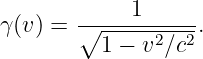
where c is the speed of light and γ(v) is the Lorentz factor:
In particular, the rest energy of this object (obtained by setting v = 0) is equal to mc2. The kinetic
energy is therefore
For values of v much smaller than c, this expression becomes approximately equal to  mv2, the
kinetic energy from classical mechanics. This can be checked by expanding γ(v) in a Taylor series
around v = 0:
mv2, the
kinetic energy from classical mechanics. This can be checked by expanding γ(v) in a Taylor series
around v = 0:
Substituting this into the expression for the kinetic energy gives the following expansion:
When v approaches the speed of light, the factor γ(v) goes to infinity. This is one way of seeing
why objects with positive mass can never reach a speed c: an infinite amount of work would be
required to accelerate the object to this speed.