Effective Potential and Radial Motion in Central Gravity
The gravitational two-body problem is a central force problem.
Once angular momentum is conserved, the planar motion can be separated into:
- radial motion, which changes the separation r,
- angular motion, which changes the polar angle 𝜃.
The effective-potential method absorbs the angular part of the kinetic energy into an effective
radial potential.
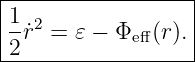
This reduces the orbital problem to a one-dimensional energy equation for
The method is useful for:
- locating periapsis and apoapsis,
- identifying allowed and forbidden radial regions,
- understanding the angular-momentum barrier,
- finding circular orbits,
- testing circular-orbit stability,
- distinguishing radial from nonradial motion.
1 Velocity in plane polar coordinates
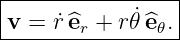
For planar motion,
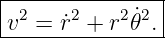
Therefore
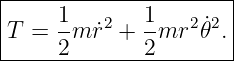
The kinetic energy is
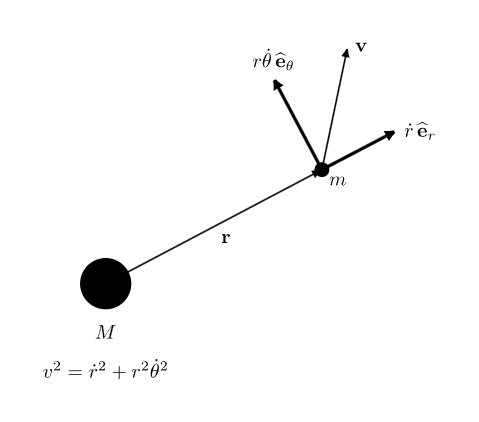
Figure 1. The velocity separates into radial and transverse components. The effective-potential
method uses angular-momentum conservation to replace the transverse kinetic-energy term by a
function of radius.
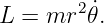
2 Angular momentum in a central force
For a central force,
Therefore angular momentum is conserved.
For planar motion,
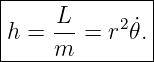
Define the specific angular momentum
Thus
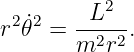
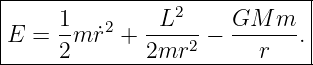
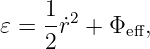
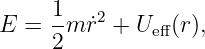
3 Energy with angular momentum
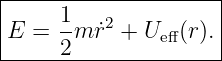
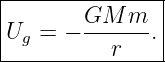
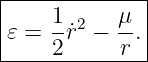
The gravitational mechanical energy is
Use
Then
Therefore
The entire radial problem is now contained in one equation.
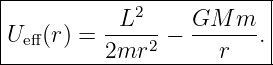
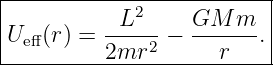
4 The effective potential
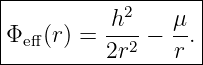
Define
Then
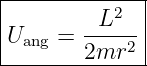
The effective potential contains two terms:
and
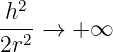
The first term is positive and diverges as
when
The second term is the ordinary gravitational potential energy.
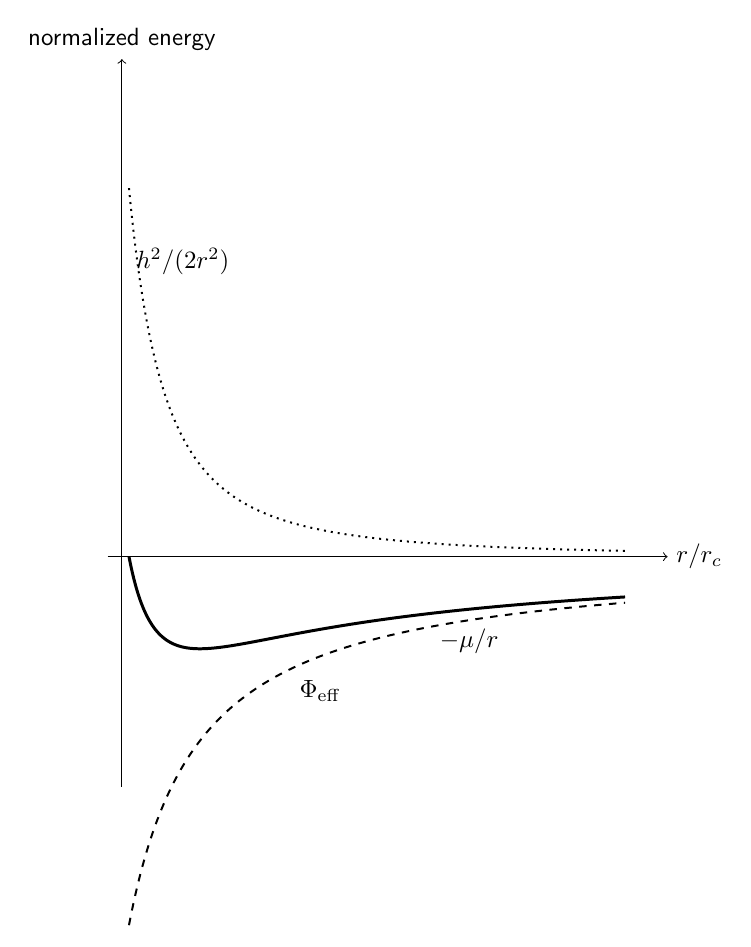
Figure 2. The effective potential is the sum of a positive angular-momentum term proportional to
1∕r2 and the negative gravitational term proportional to −1∕r. Their competition produces a
minimum.
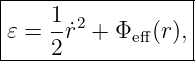
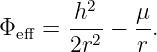
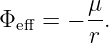
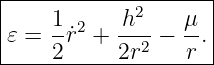
5 Specific effective potential
Divide the energy equation by
Using
and
we obtain
where
The units of
are
the same as specific orbital energy.
6 The angular-momentum barrier
When
as
Thus
This is often called the centrifugal barrier or angular-momentum barrier.
It is not an additional physical gravitational interaction.
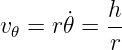
It arises because conservation of angular momentum forces the transverse speed
to grow as the radius decreases.
Consequently the transverse kinetic energy grows as
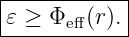
7 Radial kinetic energy
From
the radial kinetic energy per unit mass is
Therefore
Since
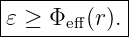
the allowed radial region must satisfy
Regions where
are forbidden by energy conservation.
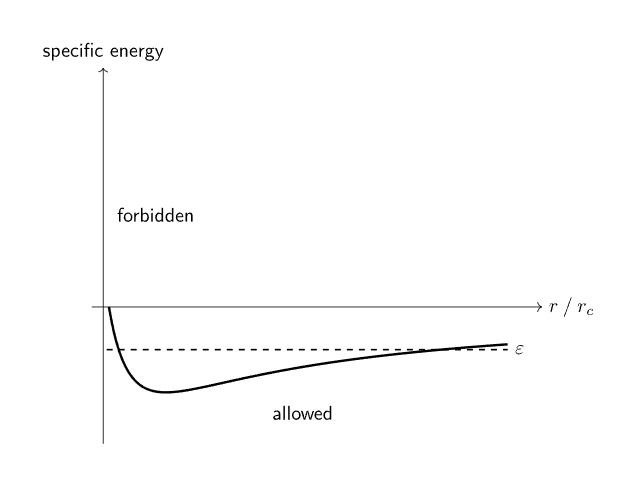
Figure 3. Radial motion is allowed only where the horizontal specific-energy level lies on or above
the effective-potential curve. Intersections of the two are radial turning points.
8 Radial turning points
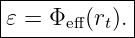
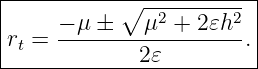
A radial turning point occurs when
Therefore
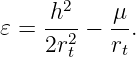
Substituting,
Multiply by
For
the roots are
Only positive real roots are physical radii.
9 Bound nonradial motion
For
and negative energy above the effective-potential minimum, there are two positive turning
radii:
The smaller radius
is periapsis.
The larger radius
is apoapsis.
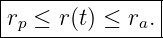
The radial coordinate oscillates between these values:
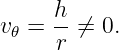
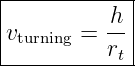
At each radial turning point,
but the transverse speed is generally nonzero.
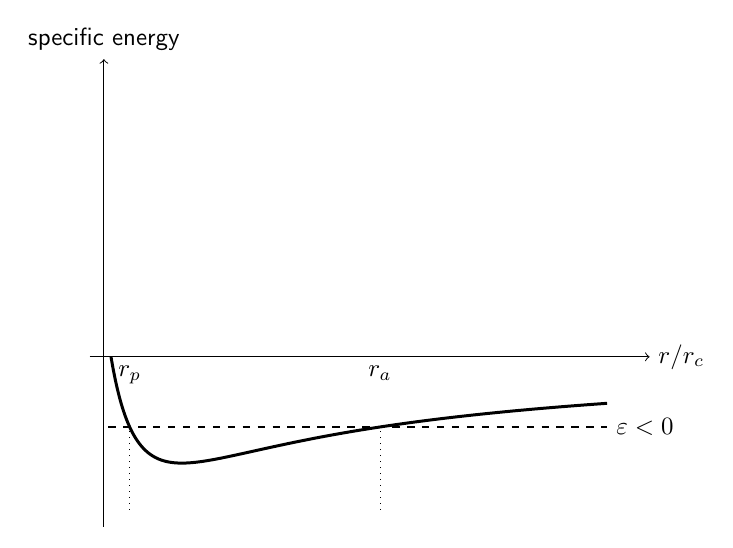
Figure 4. A negative-energy level above the effective-potential minimum intersects the curve
twice. These intersections give periapsis and apoapsis for bound nonradial motion.
10 Zero-energy turning point
For
the turning-point equation becomes
Thus the finite radial turning point is
The other radial limit is
This is the parabolic escape threshold.
11 Positive-energy motion
For
there is one positive finite turning point.
It is the periapsis of an unbound trajectory.
As
so
approaches a nonzero value after the transverse speed has fallen toward zero.
The complete orbit is hyperbolic in the ideal inverse-square problem.
12 Circular orbit as an effective-potential equilibrium
A circular orbit has constant radius:
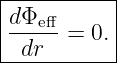
Therefore it occurs at an extremum of the effective potential:
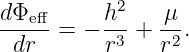
Differentiate:
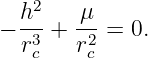
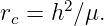
Set this equal to zero:
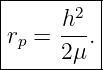
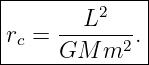
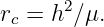
Hence
In terms of total angular momentum,
13 Circular-orbit speed from the effective potential
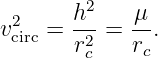
Since
the circular condition
gives
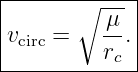
Therefore
The effective-potential method therefore reproduces the circular-orbit condition derived directly
from centripetal acceleration.
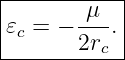
14 Energy of the circular orbit
Evaluate the effective potential at
Using
| Φeff(rc) | =  −  | (71)
|
| = − . | (72) |
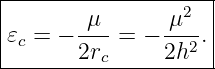
Therefore
This is the minimum possible energy for a fixed nonzero
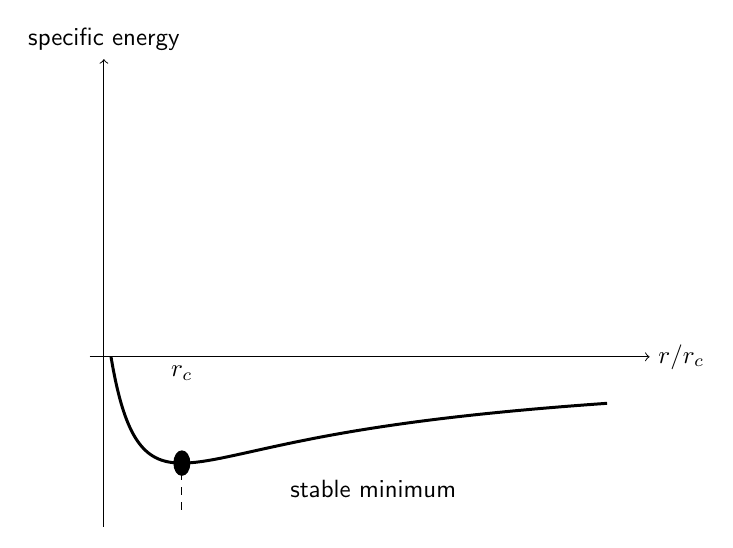
Figure 5. For fixed nonzero angular momentum, the circular orbit occurs at the minimum of the
effective potential. Energies below this minimum are impossible for that value of angular
momentum.
15 Stability of the circular orbit
An extremum is stable if the effective potential has a local minimum.
Differentiate again:
At
with
Thus the Newtonian circular orbit is stable against sufficiently small radial perturbations at fixed
angular momentum.
16 Small radial oscillations about a circular orbit
Let
Near the minimum,
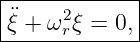
The radial motion is approximately harmonic:
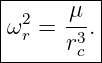
with
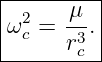
The circular orbital angular frequency also satisfies
Therefore
for Newtonian inverse-square gravity.
This equality is closely related to the closed nature of Keplerian ellipses.
17 Radial equation of motion
The effective potential also gives the radial force equation.
Since
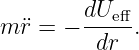
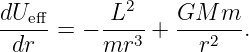
the effective radial force is
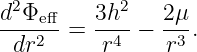
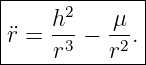
Differentiate:
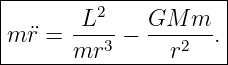
Therefore
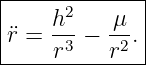
Divide by
18 Relation to the polar-coordinate acceleration equation
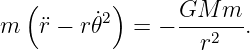
The radial acceleration in polar coordinates is
Newton’s radial equation is
Using
we recover
Thus the effective-potential equation is not introducing a new force law.
It is a reformulation of the original Newtonian equations using the conserved angular
momentum.
19 Changing angular momentum changes the barrier
For fixed central mass, the effective potential is
Increasing
raises the small-radius barrier.
It also moves the circular-orbit minimum outward:
Thus larger angular momentum makes close approach more difficult for a trajectory with the same
energy.
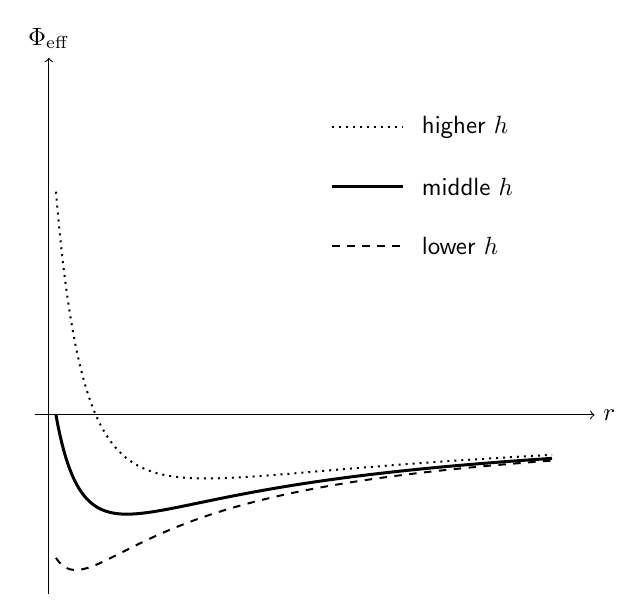
Figure 6. Increasing specific angular momentum raises the small-radius barrier and shifts the
effective-potential minimum to a larger circular-orbit radius.
20 Special case: zero angular momentum
If
then
There is no angular-momentum barrier.
The energy equation becomes
Pure radial infall can therefore reach
in the ideal point-mass model.
The singularity reflects the idealized Newtonian point source.
For a physical extended body, the interior gravitational field must replace the point-mass
field.
21 Radial versus nonradial turning points
For
a turning point with
also has total speed
For
a radial turning point has
but
Therefore
for nonradial motion.
This is why periapsis and apoapsis are not points where the orbiting body stops.
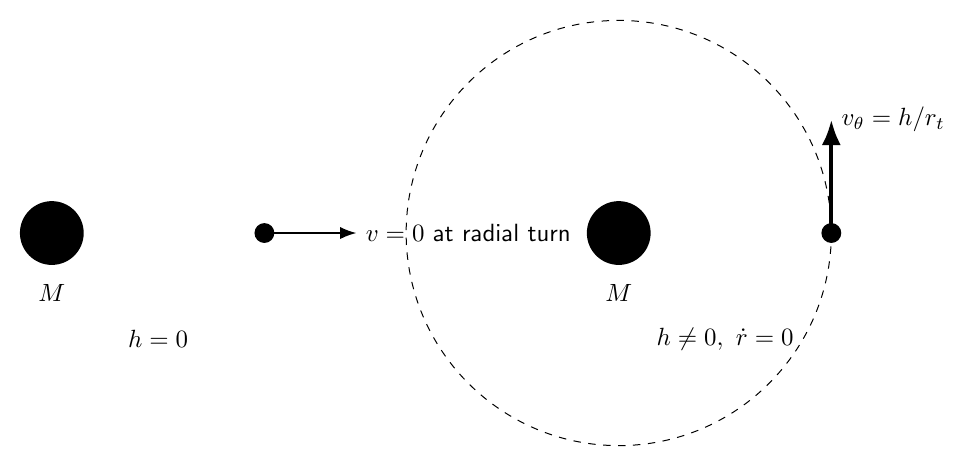
Figure 8. A radial turning point means ṙ = 0. With zero angular momentum the total speed is
zero, but with nonzero angular momentum the transverse speed remains finite.
22 Example 1: Earth orbit from a turning point
Take Earth’s gravitational parameter as
Suppose at
the velocity is purely tangential with magnitude
Because
this radius is a radial turning point.
The specific angular momentum is
| h | = r0v0 | (114)
|
| = 5.60 × 10¹⁰ m2∕s. | (115) |
The specific energy is
| 𝜀 | =  v02 −  | (116)
|
| ≈−2.494 × 10⁷ J∕kg. | (117) |
Since the energy is negative, the orbit is bound.
23 Example 1 continued: the second turning point
The turning-point equation is
One root is the known turning radius
The second positive root is
Thus the radial coordinate oscillates between approximately
and
Because the tangential speed at
is larger than the circular speed there, that turning point is the periapsis.
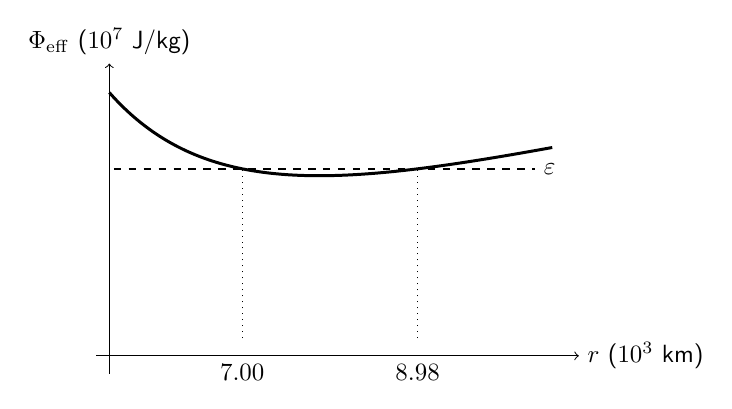
Figure 7. In the numerical Earth example, the specific-energy level intersects the effective
potential at two radii. The smaller is periapsis and the larger is apoapsis.
24 Example 2: circular orbit for a specified angular momentum
Suppose
about Earth.
Then
| rc | =  | (125)
|
| ≈ 6.27 × 10⁶ m. | (126) |
The circular specific energy is
| 𝜀c | = − | (127)
|
| ≈−3.18 × 10⁷ J∕kg. | (128) |
For that fixed
no motion is possible with
25 Dimensionless form
It is useful to normalize radius by the circular-orbit radius
Define
Since
the effective potential becomes
Thus
The minimum occurs at
with value
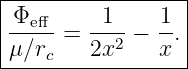
This universal curve describes all Newtonian gravitational effective potentials with nonzero angular
momentum after suitable scaling.
26 Discriminant and existence of turning points
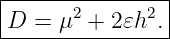
The quadratic turning-point equation has discriminant
Real turning points require
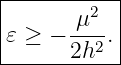
Therefore
But
is exactly the minimum circular-orbit energy.
Thus the algebraic condition for real turning points is the same as the effective-potential
requirement that the energy lie at or above its minimum.
27 Three energy regimes at fixed nonzero angular momentum
For fixed
- At the minimum energy, the two turning points coincide and the orbit is circular.
- For negative energy above the minimum, there are two finite turning radii and the
motion is bound.
- For zero energy, there is one finite periapsis and the outer limit is infinity.
- For positive energy, there is one finite periapsis and unbound outward motion is allowed.
The effective-potential graph displays all four cases without solving the full orbit equation.
28 What the effective potential does not determine
The effective potential determines the radial dynamics for a given
and
It does not by itself give
or the geometric shape of the orbit.
To obtain the trajectory in the orbital plane, one must combine:
- angular-momentum conservation,
- the radial dynamics,
- the relation between r and 𝜃.
The next articles develop that connection.
29 Common mistakes
- Treating the angular-momentum term as a new physical gravitational force.
- Forgetting that Ueff is used for radial motion at fixed angular momentum.
- Confusing total angular momentum L with specific angular momentum h = L∕m.
- Using h2∕(2r) instead of h2∕(2r2).
- Forgetting the negative sign of the gravitational term.
- Allowing motion in a region where 𝜀 < Φeff.
- Assuming a radial turning point means total speed is zero.
- Forgetting that periapsis and apoapsis have nonzero tangential speed when h≠0.
- Using the quadratic turning-point formula without checking for positive real roots.
- Forgetting that a circular orbit occurs at an extremum of the effective potential.
- Finding the extremum but failing to test stability with the second derivative.
- Assuming the effective potential has a small-radius barrier when h = 0.
- Using the radial-collision result for a physical extended body all the way to r = 0.
- Confusing the circular-orbit radius h2∕μ with the turning radius for arbitrary energy.
- Assuming the effective potential alone gives the full orbit shape r(𝜃).
30 Practice exercises
- Derive the polar-coordinate kinetic energy for planar motion.
- Starting from angular-momentum conservation, derive the effective potential.
- Derive the specific effective potential in terms of h and μ.
- Show that radial motion is allowed only where 𝜀 ≥ Φeff.
- Derive the quadratic equation for radial turning points.
- Analyze the number of positive turning points for negative, zero, and positive energy.
- Derive the circular-orbit radius rc = h2∕μ.
- Derive the circular-orbit energy 𝜀c = −μ2∕(2h2).
- Show that the circular orbit is stable by evaluating the second derivative.
- Derive the small-radial-oscillation frequency about a circular orbit.
- Recover the radial equation r = h2∕r3 − μ∕r2 from U
eff.
- Explain why no angular-momentum barrier exists for h = 0.
- Reproduce the Earth turning-point example with r0 = 7000 km and v0 = 8.00 km/s.
- Reproduce the circular-orbit example for h = 5.00 × 10¹⁰ m2∕s.
- Derive the dimensionless effective-potential curve 1∕(2x2) − 1∕x.
31 Summary
For planar motion in Newtonian central gravity,
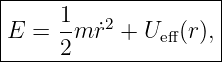
The conserved energy can be written
with
Per unit mass,
Allowed radial motion requires
Radial turning points satisfy
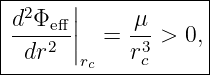
The circular orbit occurs at the effective-potential minimum:
with
For Newtonian inverse-square gravity,
so the circular orbit is radially stable.
The effective-potential method converts a two-dimensional central force problem into a
one-dimensional radial-energy problem while preserving the influence of angular momentum.
References
References
[1] PhysicsLibrary, M07-05, Orbital Energy, Escape Speed, and Bound versus Unbound
Motion.
[2] PhysicsLibrary, M04-08, Conservation of Angular Momentum and Central Force
Motion.
[3] PhysicsLibrary, M01-10, Polar-Coordinate Particle Kinematics.
[4] J. R. Taylor, Classical Mechanics, University Science Books, 2005.
[5] D. Kleppner and R. Kolenkow, An Introduction to Mechanics, 2nd ed., Cambridge
University Press, 2014.