Physics Library
 An open source physics library
Encyclopedia | Forums | Docs | Random  

[parent] GRE Physics Companion: Principal Axes and Principal Moments of Inertia

(Example)

GRE Physics Companion: Principal Axes and Principal Moments of Inertia

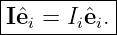
Principal axes satisfy

|----------|
-Iˆei =-Iiˆei.
(1)

In the principal-axis basis,

|------------------|
-I =-diag-(I1,I2,I3).-
(2)

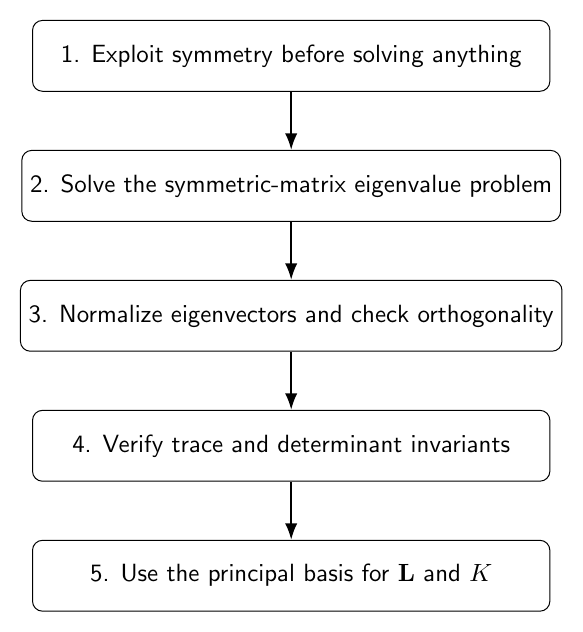
PIC

Figure 1. A compact strategy for principal-axis problems: exploit symmetry first, solve the eigenvalue equation, normalize eigenvectors, verify orthogonality, and check the diagonalization with tensor invariants.

1 High-value GRE facts

  1. Principal axes are eigenvectors of the inertia tensor.
  2. Principal moments are its eigenvalues.
  3. A real symmetric inertia tensor has real eigenvalues and orthogonal eigenvectors.
  4. products of inertia vanish in principal coordinates.
  5. Distinct principal moments imply orthogonal principal axes.
  6. Repeated principal moments make the corresponding principal directions nonunique.
  7. Rotating exactly about a principal axis gives L ∥ ω.
  8. Principal moments are stationary values of the scalar moment of inertia over axis direction.
  9. trace and determinant are unchanged by orthogonal diagonalization.
  10. In principal coordinates, rotational kinetic energy contains no cross terms.

Part I: Original GRE-style problems

Problem 1: eigenvector meaning

A unit vector e is a principal axis of inertia if

  1. Ie = 0
  2. Ie is perpendicular to e
  3. Ie = Ipe
  4. det I = 0
  5. all tensor entries are equal

Problem 2: diagonal principal basis

In a principal-axis basis, the inertia tensor

  1. is antisymmetric
  2. is diagonal
  3. has only off-diagonal entries
  4. must equal the identity matrix
  5. has zero trace

Problem 3: orthogonality

Two principal moments are distinct. Their principal-axis eigenvectors are

  1. parallel
  2. orthogonal
  3. necessarily equal
  4. both zero
  5. complex

Problem 4: two-dimensional eigenvalues

For

    [ 5   − 2]
I =            ,
     − 2   8
(3)

the principal moments are

  1. 3 and 10
  2. 4 and 9
  3. 5 and 8
  4. 6 and 7
  5. −4 and 9

Problem 5: invariant check

For the tensor in Problem 4, the determinant equals

  1. 13
  2. 20
  3. 32
  4. 36
  5. 40

Problem 6: angular momentum

If a body rotates exactly about principal axis 2 with angular speed ω, then

  1. L = I2ωe2
  2. L = I1ωe1
  3. L is perpendicular to ω
  4. L = 0
  5. L has arbitrary direction

Problem 7: kinetic energy

In principal coordinates, the rotational kinetic energy is

  1. 1
2(I1 + I2 + I3)(ω1 + ω2 + ω3)2
  2. 1
2(I1ω12 + I 2ω22 + I 3ω32)
  3. I1I2I3
  4. 1
2|L|2
  5. I1 + I2 + I3

Problem 8: axisymmetric body

An axisymmetric body has

I1 = I2 ⁄= I3.
(4)

Which statement is correct?

  1. no principal axes exist
  2. only one principal direction exists
  3. every direction in the 1-2 eigenspace is principal
  4. every direction in three-dimensional space is principal
  5. I3 must be zero

Problem 9: spherical inertia

If

I1 = I2 = I3 = I0,
(5)

then

  1. no direction is principal
  2. only coordinate axes are principal
  3. every direction is principal
  4. angular momentum is always zero
  5. kinetic energy is always zero

Problem 10: extremum property

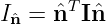
The stationary values of

      T
Inˆ=  ˆn Iˆn
(6)

subject to

|ˆn| = 1
(7)

occur when

  1. n is an eigenvector of I
  2. n = 0
  3. I = 0
  4. det I = 0 only
  5. the tensor is antisymmetric

Problem 11: thin disk

For a thin uniform disk about its center,

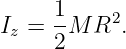
I =  1M R2.
 z   2
(8)

Each diameter has principal moment

  1. 1
8MR2
  2. 1
4MR2
  3. 1
2MR2
  4. MR2
  5. 2MR2

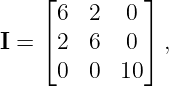
Problem 12: numerical 3D tensor

For

    ⌊         ⌋
      6  2   0
I = ⌈ 2  6   0⌉ ,
      0  0  10
(9)

the three principal moments are

  1. 2, 6, 10
  2. 4, 8, 10
  3. 6, 6, 10
  4. 4, 6, 12
  5. 2, 8, 12

Part II: Complete worked solutions

Solution 1

A principal axis is an eigenvector direction:

Iˆe = Ipˆe.
(10)

Answer: (C).

Solution 2

Principal-axis coordinates diagonalize the symmetric inertia tensor. Answer: (B).

Solution 3

Distinct eigenvalues of a real symmetric matrix have orthogonal eigenvectors. Answer: (B).

Solution 4

The characteristic equation is

0 = (5 − Ip)(8 − Ip) − 4 (11)
= Ip2 − 13I p + 36 (12)
= (Ip − 4)(Ip − 9). (13)

Thus the principal moments are

4,     9.
(14)

Answer: (B).

Solution 5

det I = (5)(8) − (− 2)2 = 40 − 4 = 36.
(15)

Answer: (D).

Solution 6

If

ω  = ωˆe2,
(16)

then

L =  I2ωˆe2.
(17)

Answer: (A).

Solution 7

In principal coordinates the tensor is diagonal, so no cross terms appear:

     1
K  = --(I1ω21 + I2ω22 + I3ω23).
     2
(18)

Answer: (B).

Solution 8

A repeated eigenvalue has a multidimensional eigenspace. Every direction in that eigenspace is an eigenvector with the same principal moment. Answer: (C).

Solution 9

If

I = I01,
(19)

then

Iˆn =  I0ˆn
(20)

for every direction. Answer: (C).

Solution 10

Using a Lagrange multiplier gives

Iˆn =  λˆn.
(21)

Thus stationary directions are eigenvector directions. Answer: (A).

Solution 11

For a planar disk,

I = I  + I .
z    x    y
(22)

Rotational symmetry gives

I =  I .
 x    y
(23)

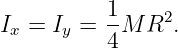
Hence

Ix = Iy = 1-M R2.
          4
(24)

Answer: (B).

Solution 12

The z direction gives eigenvalue 10.

For the in-plane block,

[6  2]
       ,
 2  6
(25)

the eigenvalues are

6 − 2 = 4,     6 + 2 = 8.
(26)

Thus the principal moments are

4,    8,     10.
(27)

Answer: (B).

2 GRE checklist

  1. Treat principal-axis problems as symmetric-matrix eigenvalue problems.
  2. Use geometry and symmetry before doing algebra.
  3. Distinct principal moments give orthogonal principal axes.
  4. Normalize eigenvectors before building the transformation matrix.
  5. Check trace and determinant before accepting the result.
  6. Remember that repeated moments make principal directions nonunique within the degenerate eigenspace.
  7. Rotation exactly about a principal axis gives L ∥ ω.
  8. In principal coordinates, energy and angular momentum component formulas become diagonal.

References

References

[1]   J. R. Taylor, Classical Mechanics, University Science Books, 2005.

[2]   H. Goldstein, C. Poole, and J. Safko, Classical Mechanics, 3rd ed., Addison-Wesley, 2002.

[3]   K. R. Symon, Mechanics, 3rd ed., Addison-Wesley, 1971.


"GRE Physics Companion: Principal Axes and Principal Moments of Inertia" is owned by bloftin.
(view preamble)
View style:
Other names:  M05-10G
Also defines:  principal axis, principal moment of inertia, principal-axis basis
Keywords:  GRE physics, principal axes, principal moments, inertia tensor, eigenvalues, eigenvectors, diagonalization, rigid body, rotational kinetic energy, angular momentum

This object's parent.

Cross-references: formulas, energy, symmetric matrix, kinetic energy, angular momentum, speed, matrix, identity, tensor, unit vector, rotational kinetic energy, determinant, trace, moment of inertia, scalar, products of inertia, inertia tensor
There are 3 references to this object.

This is version 1 of GRE Physics Companion: Principal Axes and Principal Moments of Inertia, born on 2026-10-17.
Object id is 1483, canonical name is GREPhysicsCompanionPrincipalAxesAndPrincipalMomentsOfInertia.
Accessed 7 times total.

Classification:
Physics Classification: 45.40.-f (Dynamics and kinematics of rigid bodies)
 45.20.Dd (Newtonian mechanics)

Pending Errata and Addenda

None.

Discussion

No messages.

Interact