|
|
|
|||||||
and
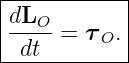
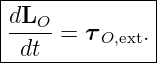
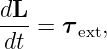
For a particle system with central internal forces,
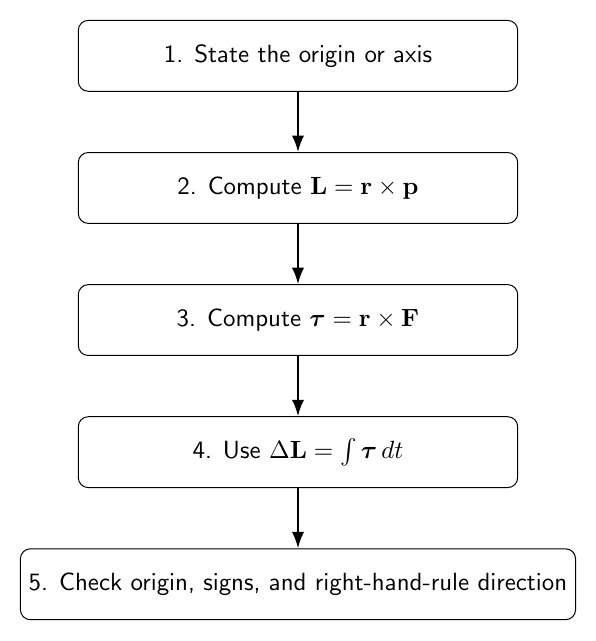
Figure 1. A compact strategy for angular-momentum problems. State the origin, compute cross products or perpendicular lever arms, then connect torque to the change in angular momentum.
1 High-value GRE facts
Part I: Original GRE-style problems
Problem 1: perpendicular motionA particle has momentum magnitude p and moves along a line whose perpendicular distance from the origin is b. Its angular-momentum magnitude about the origin is
Problem 2: radial motionA particle moves directly away from the origin. Its angular momentum about the origin is
Problem 3: torqueA force F acts parallel to the position vector r. The torque about the origin is
Problem 4: angular impulseA constant torque 5 N m acts for 3 s. The change in angular momentum magnitude is
Problem 5: central forceA particle moves under a central force. Which quantity is necessarily conserved about the force center?
Problem 6: center-of-mass decompositionA system has RCM = 2ex m, total momentum P = 3ey kg m∕s, and LCM = 4ez kg m2∕s. Its angular momentum about the origin is
Problem 7: planar polar motionFor a particle in planar polar coordinates, angular momentum magnitude about the origin is
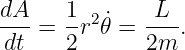
Problem 8: areal velocityFor a particle of mass m with angular momentum magnitude L under a central force, the areal velocity is
Problem 9: origin shiftTwo origins differ by constant vector a. If total linear momentum is zero, then the total angular momentum about the two origins is
Problem 10: internal forcesFor two particles with equal-and-opposite central internal forces, the pair’s total internal torque about any origin is
Problem 11: fixed-axis rigid bodyA rigid body rotates about a fixed z axis. Its axial angular momentum is
Problem 12: zero external torqueIf the net external torque on a particle system is zero and internal torques cancel, then
Part II: Complete worked solutions
Solution 1Use the perpendicular-distance form:
Answer: (B).
Solution 2Radial motion has r parallel to p, so
Answer: (D).
Solution 3If F is parallel to r,
Answer: (C).
Solution 4
Answer: (C).
Solution 5A central force gives zero torque about its center, so angular momentum is conserved. Answer: (B).
Solution 6
Answer: (D).
Solution 7
Answer: (C).
Solution 8
Answer: (B).
Solution 9Use
If P = 0, the two angular momenta are identical. Answer: (B).
Solution 10The pair torque is
For a central force, the two vectors are parallel, so the cross product is zero. Answer: (A).
Solution 11For fixed-axis rotation,
Answer: (C).
Solution 12From
zero external torque implies constant total angular momentum. Answer: (C).
2 GRE checklist
References
References
"GRE Physics Companion: Angular Momentum of Particle Systems" is owned by bloftin.
This object's parent. Cross-references: Vector Identity, center of mass, total linear momentum, vector, velocity, mass, polar coordinates, total momentum, position, speed, kinetic energy, linear momentum, position vector, acceleration, magnitude, momentum, rigid body, motion, force, angular impulse, total angular momentum, angular momentum, cross products, internal forces, system, particle, relations This is version 1 of GRE Physics Companion: Angular Momentum of Particle Systems, born on 2026-10-04. Object id is 1401, canonical name is GREPhysicsCompanionAngularMomentumOfParticleSystems. Accessed 8 times total. Classification:
|
|
|
|
Pending Errata and AddendaNone.
|
DiscussionNo messages.
|
Interact |
![[parent]](https://images.physicslibrary.org/images/uparrow.png)