Angular Momentum of Particle Systems
Linear momentum measures translational motion:
Angular momentum measures how that motion is distributed about a chosen point.
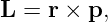
For a particle at position r relative to an origin O, with linear momentum p, define the angular
momentum about O as
For a Newtonian particle,
Its magnitude is
where 𝜃 is the angle from r to p.
Angular momentum is a vector. Its direction is determined by the right-hand rule.
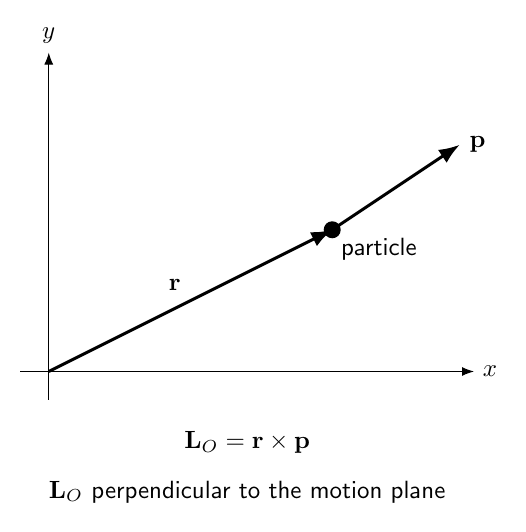
Figure 1. Particle angular momentum about O is the cross product LO = r × p. Its direction is
perpendicular to the plane containing r and p.
1 Angular momentum depends on the chosen origin
Linear momentum of a particle does not depend on the coordinate origin.
Angular momentum generally does.
If the position vector changes, then
changes even when p is unchanged.
The subscript O is therefore important.
Whenever angular momentum is used, the reference point or axis should be stated.
2 Magnitude and perpendicular distance
The magnitude
can be rewritten using the perpendicular distance from the origin to the line of motion.
Define
Then
This form is often geometrically clearer than the full cross product.
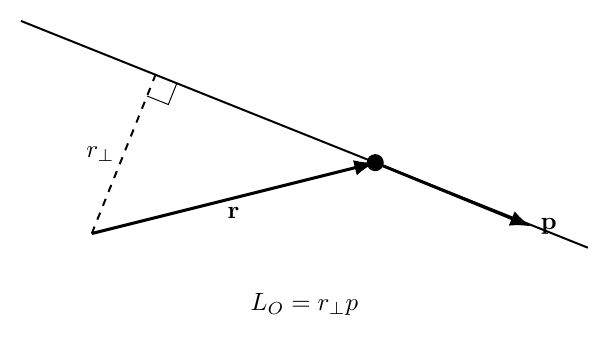
Figure 2. The angular-momentum magnitude can be written LO = r⊥p, where r⊥ is the
perpendicular distance from the origin to the particle’s line of motion.
3 Units and dimensions
Since
the SI unit is
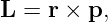
The dimensions are
Angular momentum is not energy, even though both frequently contain products of mass, length,
and velocity.
4 Cartesian components
Let
| r | = xex + yey + zez, | (12)
|
| p | = pxex + pyey + pzez. | (13) |
Then
so
| Lx | = ypz − zpy, | (15)
|
| Ly | = zpx − xpz, | (16)
|
| Lz | = xpy − ypx. | (17) |
For planar motion in the xy plane,
and therefore
5 Example 1: particle angular momentum
A 2.0 kg particle is at
and moves with
Its momentum is
Therefore
| LO | = (3ex + 4ey) × (10ex) | (23)
|
| = 40 | (24)
|
| = −40ez kg m2∕s. | (25) |
Thus
The negative z direction is consistent with the clockwise sense of the motion about the
origin.
6 Torque
Torque about the same origin is
Its magnitude is
where ϕ is the angle from r to F.
Torque is the rotational analogue of force in the angular-momentum equation.
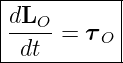
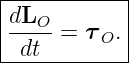
7 Derivation of the angular-momentum equation for one particle
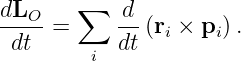
For a particle,
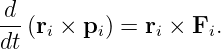
Differentiate:
 | =  × p + r × × p + r × | (30)
|
| = v × mv + r × F. | (31) |
Because
the first term vanishes.
Therefore
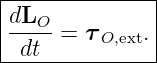
for a particle when O is fixed in an inertial frame.

Figure 3. Torque changes angular momentum: τO = dLO∕dt about a fixed inertial origin.
8 Zero torque and constant angular momentum
If
then
Hence
This means both:
- the magnitude of LO remains constant,
- its direction remains constant.
A zero torque about one point does not imply zero torque about every point.
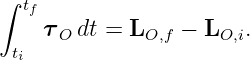
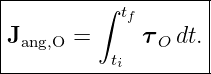
9 Angular impulse
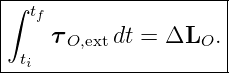
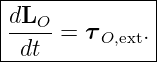
Integrate the torque equation from ti to tf:
Define the angular impulse
Then
This is the angular counterpart of
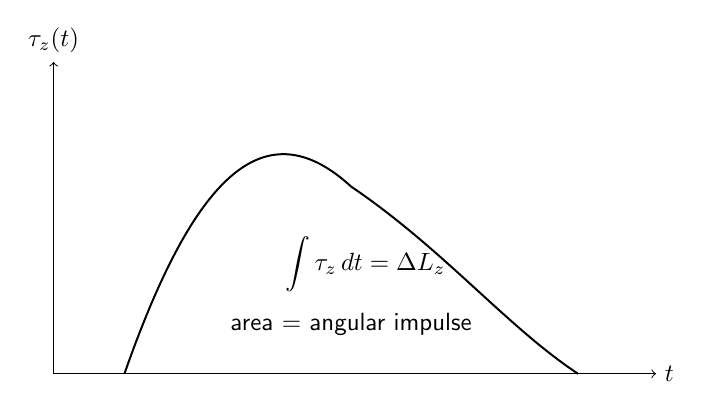
Figure 7. The area under a torque-versus-time curve is angular impulse, equal to the change in
angular momentum about the chosen origin.
10 Example 2: constant torque
A particle has initial angular momentum
A constant torque
acts for
The angular impulse is
Since
the final angular momentum is
11 Angular momentum of a particle system
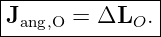
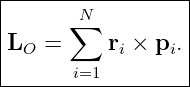
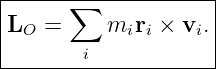
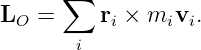
For N particles, define total angular momentum about O:
Equivalently,
Each particle contributes angular momentum about the same chosen origin.
12 Rate of change for a particle system
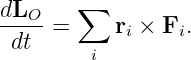
Differentiate the total:
For each particle,
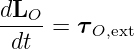
Thus
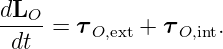
Separate external and internal forces:
13 Cancellation of internal torques
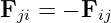
For a pair of particles i and j,
by Newton’s third law.
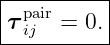
The pair’s internal torque about O is
| τijpair | = r
i × Fij + rj × Fji | (54)
|
| = (ri − rj) × Fij. | (55) |
If the internal force is central, meaning
then
Thus ordinary central Newtonian internal forces produce no net internal torque.
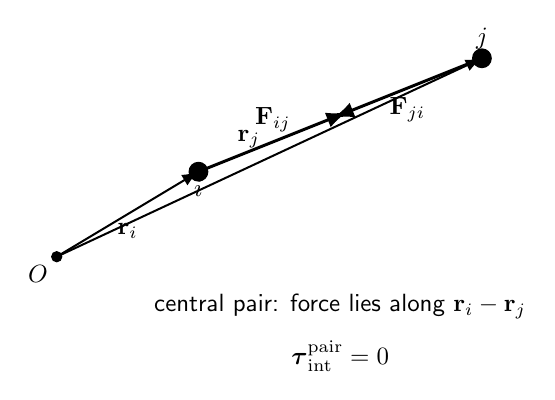
Figure 4. Equal-and-opposite central internal forces act along the line joining two particles, so
their torques cancel in the total angular-momentum balance.
14 System angular-momentum equation
When internal torques cancel,
Integrating,
If the net external torque about O vanishes,
This is the system-level conservation law developed further in M04-08.
15 Important caveat about internal-force cancellation
Equal-and-opposite internal forces are not enough by themselves to guarantee zero pair torque
about an arbitrary origin.
The pair torque is
It vanishes when the force lies along the line joining the particles.
Thus the familiar particle-system result
assumes the ordinary Newtonian central-force model for internal interactions, or a more complete
description in which all relevant angular momentum is included.
16 Center of mass decomposition
Let
and
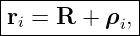
Write each particle position as
where ρi is measured from the center of mass.
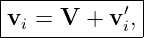
Similarly,
where
The center of mass definitions imply
| ∑
imiρi | = 0, | (68)
|
| ∑
imivi′ | = 0. | (69) |
Now expand
| LO | = ∑
i(R + ρi) × mi(V + vi′) | (70)
|
| = R × MV + ∑
iρi × mivi′. | (71) |
Therefore
The first term is the orbital angular momentum of the center of mass about O.
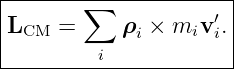
The second term is angular momentum about the center of mass:
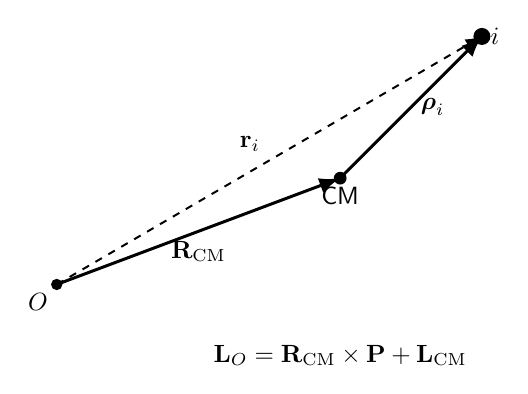
Figure 5. Total angular momentum about O separates into center of mass orbital angular
momentum plus angular momentum measured about the center of mass.
17 Physical meaning of the decomposition
The decomposition
separates two different motions:
- motion of the system as a whole around the origin,
- motion of particles relative to the center of mass.
A system can therefore have:
- nonzero orbital angular momentum but no internal rotation,
- zero orbital angular momentum but nonzero internal angular momentum,
- both at the same time.
18 Example 3: translating and spinning system
Suppose a compact system of total mass
has center of mass position
and center of mass velocity
Its orbital angular momentum about the origin is
| Lorb | = RCM × MVCM | (78)
|
| = (2ex) × (12ey) | (79)
|
| = 24ez kg m2∕s. | (80) |
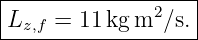
If its internal angular momentum about the center of mass is
then
19 Change of origin
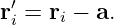
Let O′ be displaced from O by a constant vector a:
Then
| LO′ | = ∑
i(ri − a) × pi | (84)
|
| = LO − a ×∑
ipi. | (85) |
Therefore
Angular momentum about different origins differs by a term involving total linear momentum.
If
then angular momentum is the same about all origins related by a constant displacement.
20 Central force and angular momentum
Suppose a particle experiences a central force:
Then F is parallel or antiparallel to r.
Therefore
Hence
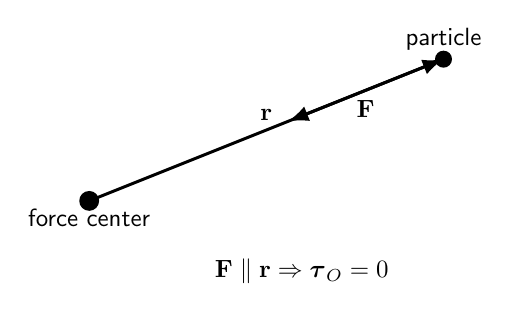
Figure 6. A central force points along the radius vector, so its torque about the force center is
zero and angular momentum about that center is conserved.
21 Planar motion under a central force
If
is constant in direction, both r and v remain perpendicular to the same fixed vector
L.
Therefore the motion remains in a plane perpendicular to L.
Thus central-force motion is planar.
This result is fundamental in orbital mechanics.
22 Angular momentum in polar coordinates
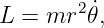
For planar motion,
Then
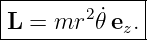
| L | = m × ×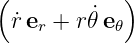 | (93)
|
| = mr2𝜃 . . | (94) |
Hence
The radial velocity does not contribute because
23 Areal velocity
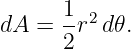
During time dt, the radius vector sweeps an approximate triangular area
Therefore
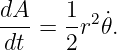
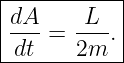
Using
we obtain
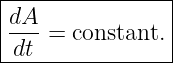
If angular momentum is conserved,
This is the mechanical basis of Kepler’s equal-areas law.
24 Example 4: orbital angular momentum
A satellite of mass
moves instantaneously perpendicular to its radius vector at
| r | = 7.0 × 10⁶ m, | (103)
|
| v | = 7.5 × 10³ m∕s. | (104) |
Because
the angular-momentum magnitude is
| L | = mrv | (106)
|
| = (500)(7.0 × 10⁶)(7.5 × 10³). | (107) |
Thus
25 Bridge to rigid body angular momentum
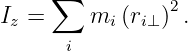
For a collection of particles forming a rigid body, angular momentum is still
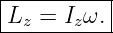
For rotation about a fixed axis z,
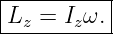
The z component becomes
| Lz | = ∑
imiri⊥vi | (111)
|
| = ∑
imi 2ω. 2ω. | (112) |
Define
Then
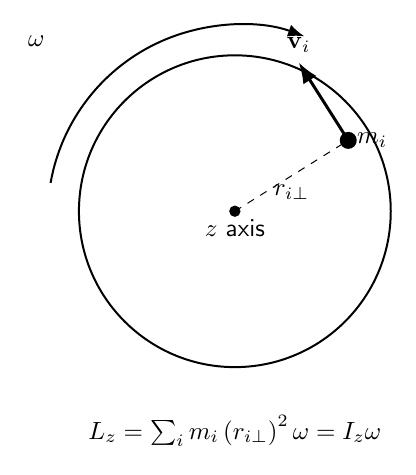
Figure 8. For fixed-axis rotation of a rigid body, summing particle angular momenta gives the
axial relation Lz = Izω.
26 Why L = Iω requires care
For fixed-axis rotation about a symmetry or principal axis, the scalar relation
is often sufficient.
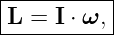
For general three-dimensional rigid body motion, however, angular momentum need not be parallel
to angular velocity.
The correct vector relation is
where I is the inertia tensor.
That full rigid body treatment belongs later in the rotational-dynamics sequence.
27 Angular momentum versus linear momentum
Linear momentum is
Angular momentum about O is
Thus angular momentum combines:
- translational momentum,
- geometry relative to a chosen origin.
A particle can have:
- nonzero linear momentum but zero angular momentum about a point on its line of
motion,
- nonzero linear momentum and nonzero angular momentum about another point,
- zero linear momentum and therefore zero particle orbital angular momentum.
28 Common mistakes
- Treating angular momentum as a scalar when its direction matters.
- Forgetting to state the origin about which angular momentum is computed.
- Using L = rp without the sin 𝜃 factor when r and p are not perpendicular.
- Confusing torque with angular momentum.
- Assuming zero net force implies zero net torque.
- Assuming zero torque about one point implies zero torque about every point.
- Forgetting that internal torque cancellation requires the appropriate central-force
structure in the particle model.
- Mixing angular momentum about the center of mass with angular momentum about
a laboratory origin.
- Forgetting the orbital term RCM × P.
- Using L = Iω as a general Vector Identity for arbitrary three-dimensional rigid body
motion.
- Forgetting that central force means force along the radius vector from the force center.
- Confusing angular impulse with ordinary linear impulse.
- Forgetting that a particle moving radially has zero angular momentum about the force
center even if its speed is nonzero.
29 Practice exercises
- A particle has r = (2ex + 3ey) m and p = (4ex − 1ey) kg m∕s. Find LO.
- A 3.0 kg particle moves at 5.0 m∕s along a straight line whose perpendicular distance
from the origin is 2.0 m. Find the angular-momentum magnitude about the origin.
- Derive dLO∕dt = τO for a particle about a fixed inertial origin.
- A constant torque of 6 N m acts for 0.50 s. Find the angular impulse.
- Show that the internal torque of a central Newton’s-third-law force pair vanishes.
- Derive the total system equation dLO∕dt = τO,ext under the central internal-force
assumption.
- Derive
- A system has RCM = 4ex m, total momentum P = 3ey kg m∕s, and LCM = 2ez kg m2∕s. Find
LO.
- Show how angular momentum changes when the origin is shifted by a constant vector
a.
- Prove that a central force produces zero torque about the force center.
- Derive L = mr2𝜃 for planar polar motion.
- Derive the areal-velocity relation dA∕dt = L∕(2m).
- Explain why a particle moving directly toward the origin has zero angular momentum about
that origin.
- For fixed-axis rigid body rotation, derive Lz = Izω from the particle definition of angular
momentum.
- Explain why the general vector relation for a rigid body is L = I ⋅ω rather than simply
L = Iω.
30 Summary
For a particle,
Its magnitude is
Torque is
About a fixed inertial origin,
For a particle system with central internal forces,
The total angular momentum separates as
For a central force,
For fixed-axis rigid body rotation,
M04-08 develops conservation of angular momentum and central-force motion in greater
depth.
References
References
[1] J. R. Taylor, Classical Mechanics, University Science Books, 2005.
[2] D. Kleppner and R. Kolenkow, An Introduction to Mechanics, 2nd ed., Cambridge
University Press, 2014.
[3] K. R. Symon, Mechanics, 3rd ed., Addison-Wesley, 1971.
[4] H. Goldstein, C. Poole, and J. Safko, Classical Mechanics, 3rd ed., Addison-Wesley,
2002.
[5] OpenStax, University Physics, Volume 1, Rice University, 2016.










![|----------------|
-[L]-=-M-L2T-−-1.-|](https://images.physicslibrary.org/cache/objects/1400/make4ht/AngularMomentumOfParticleSystems10x.png)