GRE Physics Companion: Degrees of Freedom in Mechanics
This entry is the GRE-oriented companion to M00-07. The core article develops the mechanics
meaning of degrees of freedom, constraints, generalized coordinates, and configuration space. Here
the emphasis is rapid recognition and counting.
1 Fast counting strategy
For standard GRE-style mechanics problems, use the following order:
- Count the coordinates before constraints.
- Identify only independent constraints.
- For regular holonomic constraints, use
- Check whether the system is a familiar special case such as a particle on a curve, planar rigid
body, or spatial rigid body.
- Do not count velocities as additional configuration degrees of freedom.

Figure 1. GRE-speed triage for ordinary degree-of-freedom counting problems.
Useful counts to recognize immediately are
and
2 Common GRE traps
- A coordinate representation can use more numbers than the physical number of degrees
of freedom.
- A constraint removes a degree of freedom only if it is independent of the other
constraints.
- position and velocity are both needed for a dynamical state, but velocity does not add
configuration degrees of freedom.
- A four-component unit quaternion represents only three rotational degrees of freedom
because of its normalization constraint.
- A coordinate that is cyclic in a Lagrangian still represents a degree of freedom.
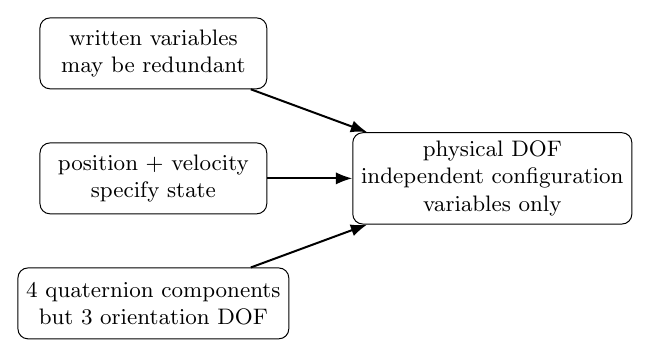
Figure 2. High-frequency GRE traps: written variables, state variables, and physical degrees of
freedom are not the same count.
3 Worked GRE example 1: particle on a sphere
A particle moves on the surface of a sphere of fixed radius R. How many degrees of freedom
describe its configuration?
Start with Cartesian coordinates (x,y,z), so
The spherical surface imposes one independent constraint,
Therefore
A convenient coordinate pair is (𝜃,ϕ).
GRE shortcut: a particle confined to a smooth two-dimensional surface has two local
configuration degrees of freedom.
4 Worked GRE example 2: position plus quaternion
A rigid spacecraft is represented numerically by three Cartesian position coordinates and a
four-component unit quaternion for orientation. How many physical configuration degrees of
freedom are present?
The position contributes three degrees of freedom. The quaternion has four components but
obeys
Thus it contains only three independent orientation parameters. Therefore
The answer is not seven. The numerical representation is redundant because of the unit-norm
constraint.
5 GRE-speed questions
M00-07G-Q01
Two point masses move in a plane and are connected by a rigid massless rod of fixed length. How
many configuration degrees of freedom does the system have?
(A) 2 (B) 3 (C) 4 (D) 5
M00-07G-Q02
Five independent particles move freely in three-dimensional space. The system has how many
configuration degrees of freedom?
(A) 5 (B) 10 (C) 15 (D) 30
M00-07G-Q03
A mechanical system has three configuration degrees of freedom. In the usual Hamiltonian
formulation, what is the dimension of its phase space?
(A) 3 (B) 4 (C) 6 (D) 9
M00-07G-Q04
A simple pendulum is described using Cartesian bob coordinates (x,y) with the constraint
x2 + y2 = L2. The number of configuration degrees of freedom is
(A) 0 (B) 1 (C) 2 (D) 3
M00-07G-Q05
Which statement is correct for a free rigid body in three-dimensional space?
(A) It has three degrees of freedom because its center of mass has three coordinates.
(B) It has four degrees of freedom because a quaternion has four components.
(C) It has six degrees of freedom: three translational and three rotational.
(D) It has nine degrees of freedom because a rotation matrix has nine entries.
6 Answers and brief rationales
- Q01: B. Four planar particle coordinates minus one fixed-distance constraint gives
three.
- Q02: C. Each free particle contributes three, so f = 3N = 15.
- Q03: C. Standard phase space has coordinates (qi,pi) and therefore dimension 2f = 6.
- Q04: B. Two coordinates minus one independent geometric constraint leaves one degree
of freedom.
- Q05: C. Numerical orientation representations may be redundant, but physical
orientation has three independent parameters.
7 Test-day summary
For ordinary GRE mechanics questions, the most useful mental rule is
Do not confuse that count with the number of written symbols or with the number of variables
required to specify the full dynamical state.
References
[1] J. R. Taylor, Classical Mechanics, University Science Books, 2005.
[2] J. B. Marion and S. T. Thornton, Classical Dynamics of Particles and Systems, 5th
ed., Brooks/Cole, 2004.
[3] PhysicsLibrary, M00-07: Degrees of Freedom in Mechanics, core companion article.

![[parent]](https://images.physicslibrary.org/images/uparrow.png)











