Volume Integral: Definition, Geometry, Density, and Physical Applications
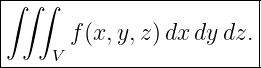
A volume integral extends integration to a three-dimensional region.
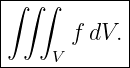
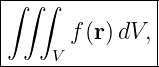
Its most basic form is
where:
- V is a three-dimensional region;
- f(r) is a scalar field defined throughout that region;
- dV is an infinitesimal volume element.
Volume integrals are fundamental because many physical quantities are distributed throughout
space rather than concentrated on a line or surface.
Examples include:
- mass distributed through a solid body;
- Electric Charge distributed through a volume;
- internal or electromagnetic energy density;
- probability density in quantum mechanics;
- source density in field equations;
- moments of inertia and center of mass;
- total divergence inside a region.
A useful physical interpretation is
1 From sums to volume integrals
Divide a region V into many small subvolumes
Choose a point ri in each subvolume.
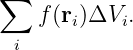
A Riemann sum is
As the largest subvolume dimension approaches zero, the sum approaches the volume
integral:
This definition makes clear that dV represents a geometrically small volume over which the field is
approximately constant.
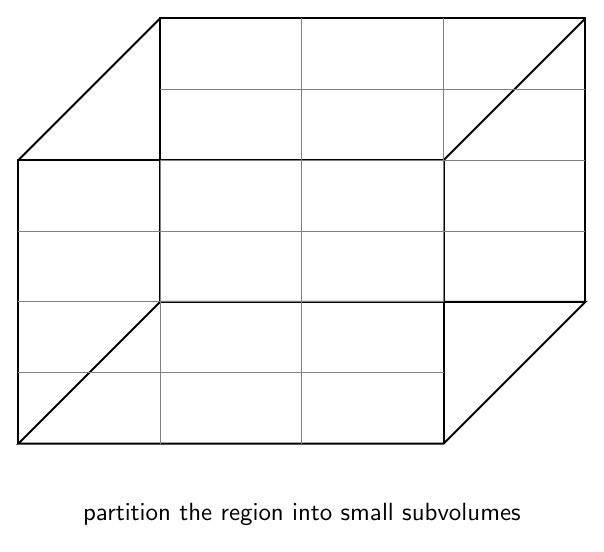
Figure 1. A volume integral is the limit of a sum over increasingly small subvolumes that fill the
three-dimensional region.
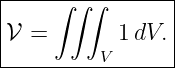
2 Volume itself as an integral
Setting
gives
Thus the geometric volume of a region is itself the simplest volume integral.
This parallels:
for curve length and
for surface area.
3 Cartesian coordinates
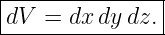
In Cartesian coordinates,
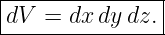
A small rectangular box has side lengths
Therefore
A Cartesian triple integral is
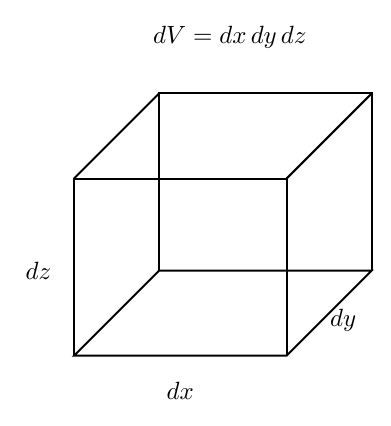
Figure 2. In Cartesian coordinates the local volume element is a rectangular box with volume dx
times dy times dz.
4 Iterated integrals
Under suitable regularity conditions, a triple integral can be evaluated as nested one-dimensional
integrals.
For a rectangular box,
we may write
The order may often be changed, provided the bounds are transformed consistently.
For more complicated regions, one or more limits depend on the outer variables.
5 Example 1: volume under a paraboloid
Find the volume bounded by
and the plane
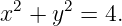
The intersection satisfies
Using cylindrical coordinates in the horizontal plane,
Then
| 𝒱 | = ∫
02π ∫
02 ∫
04−r2
r dz dr dϕ | (13)
|
| = 2π ∫
02r(4 − r2) dr | (14)
|
| = 2π![[ ]
2r2 − 1r4
4](https://images.physicslibrary.org/cache/objects/1435/make4ht/VolumeIntegral19x.png) 02 02 | (15)
|
| = 8π. | (8) |
This example already hints that the volume element changes when coordinates change.
6 Coordinate transformations and the Jacobian
Suppose coordinates (u,v,w) are related to Cartesian coordinates by
A small coordinate box
maps to a small parallelepiped in physical space.
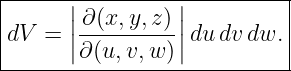
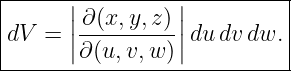
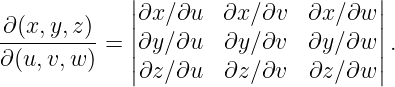
The volume scaling is given by the Jacobian determinant:
The determinant is
The absolute value is used because a volume measure is nonnegative.
7 Geometric form of the Jacobian
Define the coordinate tangent vectors
The small parallelepiped volume is
The scalar triple product is exactly the Jacobian volume scaling.
8 Cylindrical coordinates
Use
| x | = ρ cos ϕ, | (20)
|
| y | = ρ sin ϕ, | (21)
|
| z | = z. | (22) |
The coordinate scale factors are:
- radial length dρ;
- azimuthal arc length ρdϕ;
- vertical length dz.
Therefore
The factor ρ is the cylindrical-coordinate Jacobian.
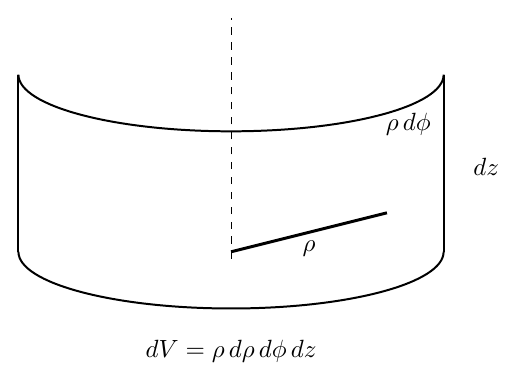
Figure 3. In cylindrical coordinates the azimuthal side of a small volume element has length rho
times d phi, producing the Jacobian factor rho.
9 Example 2: volume of a cylinder
For a cylinder of radius R and height H,
| 0 | ≤ ρ ≤ R, | (23)
|
| 0 | ≤ ϕ < 2π, | (24)
|
| 0 | ≤ z ≤ H. | (25) |
Hence
| 𝒱 | = ∫
0H ∫
02π ∫
0Rρdρdϕdz | (26)
|
| = H(2π) | (27)
|
| = πR2H. | (12) |
10 Spherical coordinates
Use the convention
| x | = r sin 𝜃 cos ϕ, | (28)
|
| y | = r sin 𝜃 sin ϕ, | (29)
|
| z | = r cos 𝜃, | (30) |
where:
| r | ≥ 0, | (31)
|
| 0 | ≤ 𝜃 ≤ π, | (32)
|
| 0 | ≤ ϕ < 2π. | (33) |
The local side lengths are approximately
| dr, | | (34)
|
| r d𝜃, | | (35)
|
| r sin 𝜃 dϕ. | | (36) |
Therefore
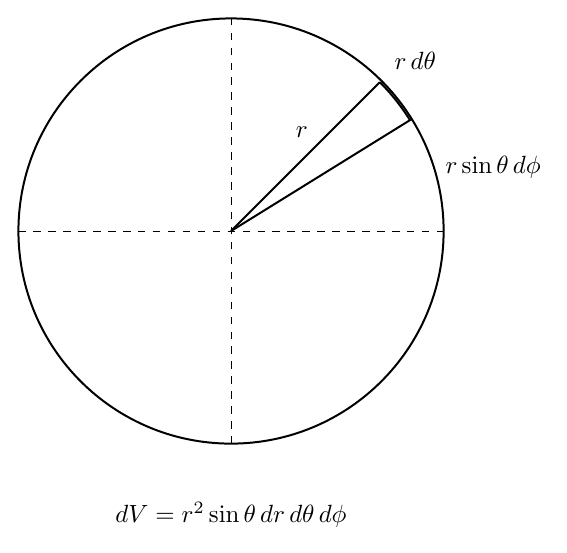
Figure 4. The spherical-coordinate volume element is a small wedge whose three local dimensions
produce the factor r squared times sine theta.
11 Example 3: volume of a sphere
For a sphere of radius R,
| 0 | ≤ r ≤ R, | (37)
|
| 0 | ≤ 𝜃 ≤ π, | (38)
|
| 0 | ≤ ϕ < 2π. | (39) |
Then
| 𝒱 | = ∫
02π ∫
0π ∫
0Rr2 sin 𝜃 dr d𝜃 dϕ | (40)
|
| =    . . | (41) |
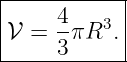
Thus
The familiar sphere-volume formula is therefore a direct triple-integral result.
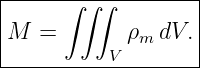
12 Mass from volume density
Let the mass density be
A small volume contains mass
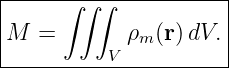
Therefore the total mass is
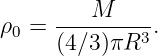
For constant density ρ0,
13 Example 4: nonuniform spherical mass distribution
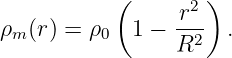
Suppose a sphere of radius R has density
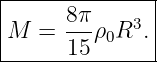
The mass is
| M | = ∫
02π ∫
0π ∫
0Rρ
0 r2 sin 𝜃 dr d𝜃 dϕ r2 sin 𝜃 dr d𝜃 dϕ | (46)
|
| = 4πρ0 ∫
0R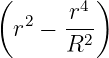 dr dr | (47)
|
| = 4πρ0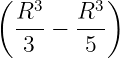 . . | (48) |
Hence
The density vanishes at the surface and reaches ρ0 at the center.
14 Average value over a volume
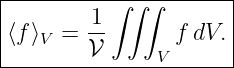
The average value of a scalar field f over a region of volume 𝒱 is
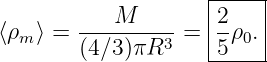
For the density in Example 4,
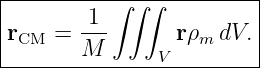
15 Center of mass
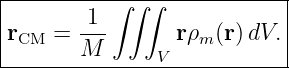
For a continuous body,
Componentwise,
| xCM | =   V xρm dV, V xρm dV, | (49)
|
| yCM | =   V yρm dV, V yρm dV, | (50)
|
| zCM | =   V zρm dV. V zρm dV. | (51) |
Symmetry can eliminate many of these integrals immediately.
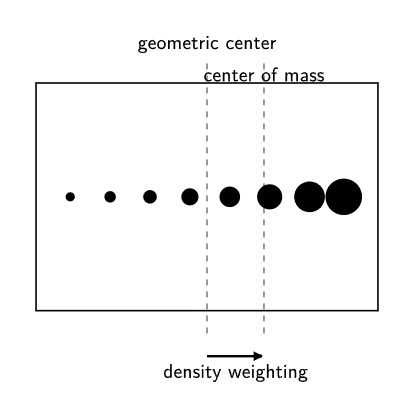
Figure 5. A nonuniform volume density weights some parts of a body more strongly than others
and can shift the center of mass away from the geometric center.
16 Example 5: center of mass of a vertically graded block
Consider the rectangular block
with density
where α > −1.
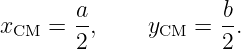
By symmetry,
The mass is
| M | = abρ0 ∫
0H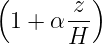 dz dz | (55)
|
| = abρ0H . . | (56) |
The vertical moment is
 V zρm dV V zρm dV | = abρ0 ∫
0Hz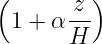 dz dz | (57)
|
| = abρ0H2 . . | (58) |
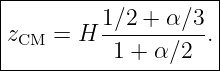
Therefore
For α > 0, the density increases upward and the center of mass lies above H∕2.
17 Moment of inertia
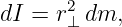
For rotation about a chosen axis, each mass element contributes
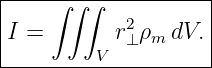
where r⊥ is the perpendicular distance to the axis.
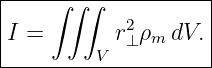
Since
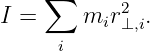
the moment of inertia is
This is the continuum version of
18 Example 6: moment of inertia of a uniform solid sphere
Let the sphere have radius R, mass M, and uniform density
Take the rotation axis to be the z axis.
In spherical coordinates,
Thus
| Iz | =  r2 sin 2𝜃ρ
0r2 sin 𝜃 dr d𝜃 dϕ r2 sin 2𝜃ρ
0r2 sin 𝜃 dr d𝜃 dϕ | (64)
|
| = ρ0![[∫ R ]
r4dr
0](https://images.physicslibrary.org/cache/objects/1435/make4ht/VolumeIntegral67x.png) ![[∫ π ]
sin3𝜃 d𝜃
0](https://images.physicslibrary.org/cache/objects/1435/make4ht/VolumeIntegral68x.png) ![[∫ 2π ]
dϕ
0](https://images.physicslibrary.org/cache/objects/1435/make4ht/VolumeIntegral69x.png) . . | (65) |
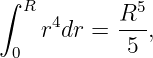
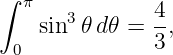
Using
and
we obtain
| Iz | = ρ0  2π 2π | (68)
|
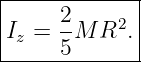
| =  ρ0R5. ρ0R5. | (69) |
Substitute the uniform density:
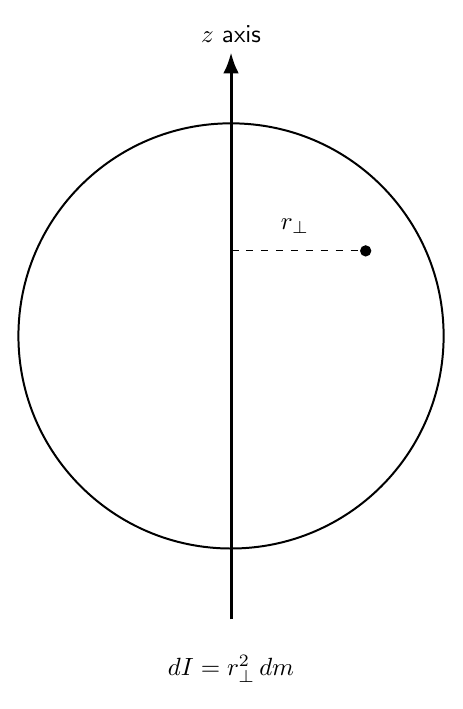
Figure 6. The moment of inertia weights each volume element by the square of its perpendicular
distance from the rotation axis.
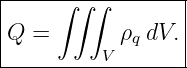
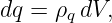
19 Electric charge from volume charge density
Let
be a volume charge density.
Then
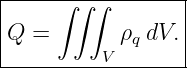
and the total charge is
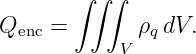
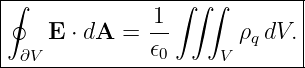
This source integral appears directly in Gauss’s Law through
Then
The volume integral supplies the enclosed source; the surface integral measures its outward electric
flux.
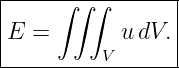
20 Energy density
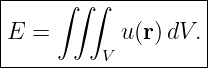
If a physical system has energy density
then the total energy is
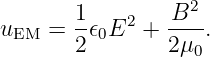
For the electromagnetic field in vacuum,
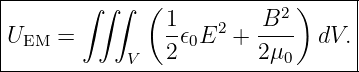
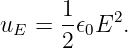
Thus
21 Example 7: energy stored in a parallel-plate capacitor
Consider an ideal parallel-plate capacitor with plate area A, separation d, and approximately
uniform electric field E between the plates.
The electric-energy density is
The field-filled volume is
Therefore
Since
we obtain
| U | =  𝜖0 𝜖0 Ad Ad | (79)
|
| =   V 2. V 2. | (80) |
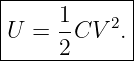
For an ideal parallel-plate capacitor,
Hence
The familiar circuit formula is therefore also a volume integral of field-energy density.
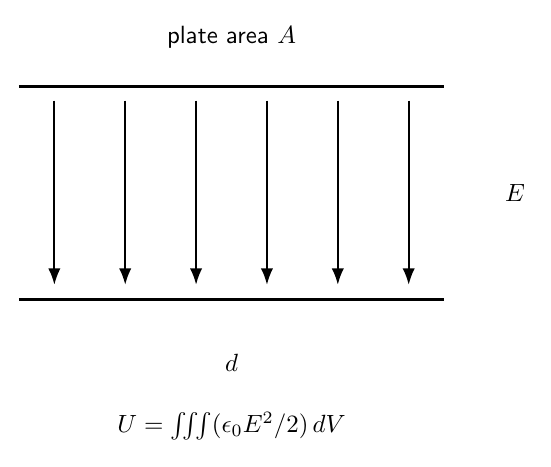
Figure 7. The energy of an ideal capacitor can be interpreted as electromagnetic energy
distributed throughout the volume between its plates.
22 Probability density in quantum mechanics
For a normalized three-dimensional wavefunction,
the probability density is
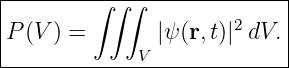
The probability of finding the particle in region V is
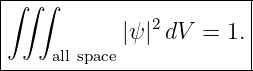
Normalization requires
Thus the same mathematical structure used for mass density and charge density also appears in
quantum probability.
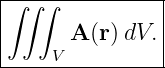
23 Vector-valued volume integrals
A vector field can also be integrated over a volume:
This is understood componentwise:
The center of mass formula is an important example because it integrates the vector position r
weighted by scalar mass density.
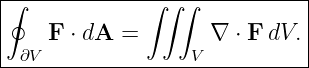
24 The divergence theorem as a bridge between volume and surface integrals
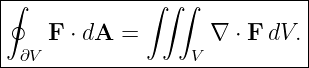
The divergence theorem states
It converts a flux through the boundary into a volume integral of the local source-like
quantity
This theorem is one of the deepest connections between the surface-integral and volume-integral
articles.
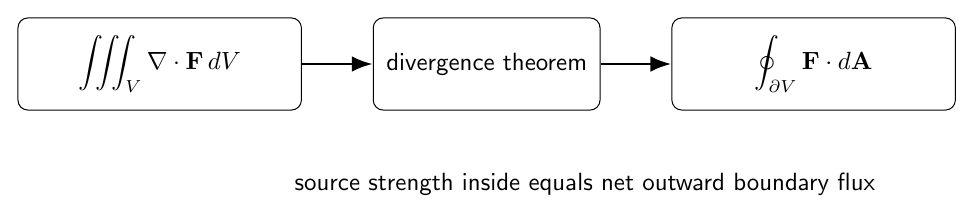
Figure 8. The divergence theorem equates a boundary surface flux with a volume integral of
divergence throughout the enclosed region.
25 Example 8: divergence theorem on a sphere
Let
Then
For a sphere of radius R,
 V ∇⋅ FdV V ∇⋅ FdV | = 3 | (88)
|
| = 4πR3. | (32) |
On the spherical boundary,
so
| ∮
∂V F ⋅ dA | = R(4πR2) | (90)
|
| = 4πR3. | (33) |
The volume and surface calculations agree exactly.
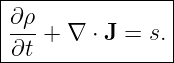
26 Local conservation laws
Many conservation laws can be written in differential form as
Here:
- ρ is a volume density of a conserved or tracked quantity;
- J is its flux;
- s is a local source term.
Integrate over a fixed volume:
Using the divergence theorem,
This says:
This structure appears in mass conservation, charge conservation, energy conservation, fluid
dynamics, and transport theory.
27 Choosing the best coordinates
Coordinate choice is often the difference between a simple integral and a difficult one.
Use Cartesian coordinates when:
- the region is box-like;
- boundaries are planes aligned with coordinate axes;
- the integrand is simple in x, y, and z.
Use cylindrical coordinates when:
- the geometry is rotationally symmetric about an axis;
- circles or cylinders appear naturally;
- the integrand depends on x2 + y2.
Use spherical coordinates when:
- the geometry is centered on a point;
- spheres or cones appear;
- the integrand depends primarily on r.
A coordinate system should match the symmetry of both the region and the field whenever
possible.
28 Dimensional checks
A volume integral should have dimensions equal to the integrand times volume.
For mass density,
so
For energy density,
so
For charge density,
so
Dimensional analysis is a powerful way to catch missing Jacobian factors.
29 Common mistakes
- Using dxdy dz after changing to cylindrical or spherical coordinates.
- Forgetting the cylindrical Jacobian factor ρ.
- Forgetting the spherical Jacobian factor r2 sin 𝜃.
- Confusing density per unit volume with total quantity.
- Integrating over the wrong geometric region.
- Using constant bounds when the actual boundary depends on another coordinate.
- Mixing the cylindrical radius ρ with a physical density symbol without defining
notation clearly.
- Forgetting that the Jacobian appears because coordinate cells have different physical
volumes.
- Treating center of mass as an unweighted geometric average when density is
nonuniform.
- Using total distance from the origin instead of perpendicular distance to the rotation
axis in a moment-of-inertia integral.
- Confusing a volume integral with a surface flux integral.
- Applying the divergence theorem without a closed boundary.
- Forgetting units and thereby missing a dimensional error.
30 Connections to other PhysicsLibrary articles
The volume integral connects directly to mass:
It connects to charge:
It connects to energy:
It connects to center of mass:
It connects to rotational mechanics:
It connects to the surface-integral article through
31 Summary
A volume integral adds a field throughout a three-dimensional region:
In Cartesian coordinates,
In cylindrical coordinates,
In spherical coordinates,
For a general coordinate transformation,
The central physical pattern is
This single structure produces mass, charge, energy, probability, center of mass, moments of
inertia, and the volume side of the divergence theorem.
References
References
[1] J. Stewart, Calculus: Early Transcendentals, Cengage Learning.
[2] H. M. Schey, Div, Grad, Curl, and All That, W. W. Norton.
[3] J. E. Marsden and A. J. Tromba, Vector Calculus, W. H. Freeman.
[4] G. B. Arfken, H. J. Weber, and F. E. Harris, Mathematical Methods for Physicists,
Academic Press.
[5] D. J. Griffiths, Introduction to Electrodynamics, 4th ed., Pearson, 2013.
[6] J. R. Taylor, Classical Mechanics, University Science Books, 2005.




















![ρm (r) [kg m− 3].](https://images.physicslibrary.org/cache/objects/1435/make4ht/VolumeIntegral33x.png)






![ρq(r) [C m −3]](https://images.physicslibrary.org/cache/objects/1435/make4ht/VolumeIntegral76x.png)
![−3
u(r) [Jm ],](https://images.physicslibrary.org/cache/objects/1435/make4ht/VolumeIntegral81x.png)














![−3
[ρm ] = kg m ,](https://images.physicslibrary.org/cache/objects/1435/make4ht/VolumeIntegral112x.png)
![[ρm dV ] = kg.](https://images.physicslibrary.org/cache/objects/1435/make4ht/VolumeIntegral113x.png)
![[u ] = J m −3,](https://images.physicslibrary.org/cache/objects/1435/make4ht/VolumeIntegral114x.png)
![[u dV ] = J.](https://images.physicslibrary.org/cache/objects/1435/make4ht/VolumeIntegral115x.png)
![[ρq] = C m − 3,](https://images.physicslibrary.org/cache/objects/1435/make4ht/VolumeIntegral116x.png)
![[ρq dV ] = C.](https://images.physicslibrary.org/cache/objects/1435/make4ht/VolumeIntegral117x.png)