0.1 Vector
A vector is a quantity which is considered as possessing direction as well as magnitude.
In mathematics and especially in physics there are two different kinds of quantities that are often
used. Consider, for example, mass, time, density, temperature, force, displacement of a point,
velocity, and acceleration. Of these quantities some can be represented adequately by a single
number: temperature, by degrees on a thermometer; time, by years, days, or seconds; mass and
density, by numerical values which are wholly determined when the unit of the scale is fixed.
On the other hand the remaining quantities are not capable of such representation.
Force to be sure is said to be of so many Newtons; velocity, of so many meters per
second. But in addition to this each of them must be considered as having direction
as well as magnitude. A force points North, South, East, West, up, down, or in some
intermediate direction. The same is true of displacement, velocity, and acceleration. No scale of
numbers can represent them adequately. It can represent only their magnitude, not their
direction.
A scalar is a quantity which is considered as possessing magnitude but no direction. The positive
and negative numbers of ordinary algebra are the typical scalars. For this reason the ordinary
algebra is called scalar algebra, which is different from vector algebra.
0.2 Representation of a vector
Vectors are usually denoted in boldface, as A or A. Vectors are usually depicted as arrows, as
illustrated below:
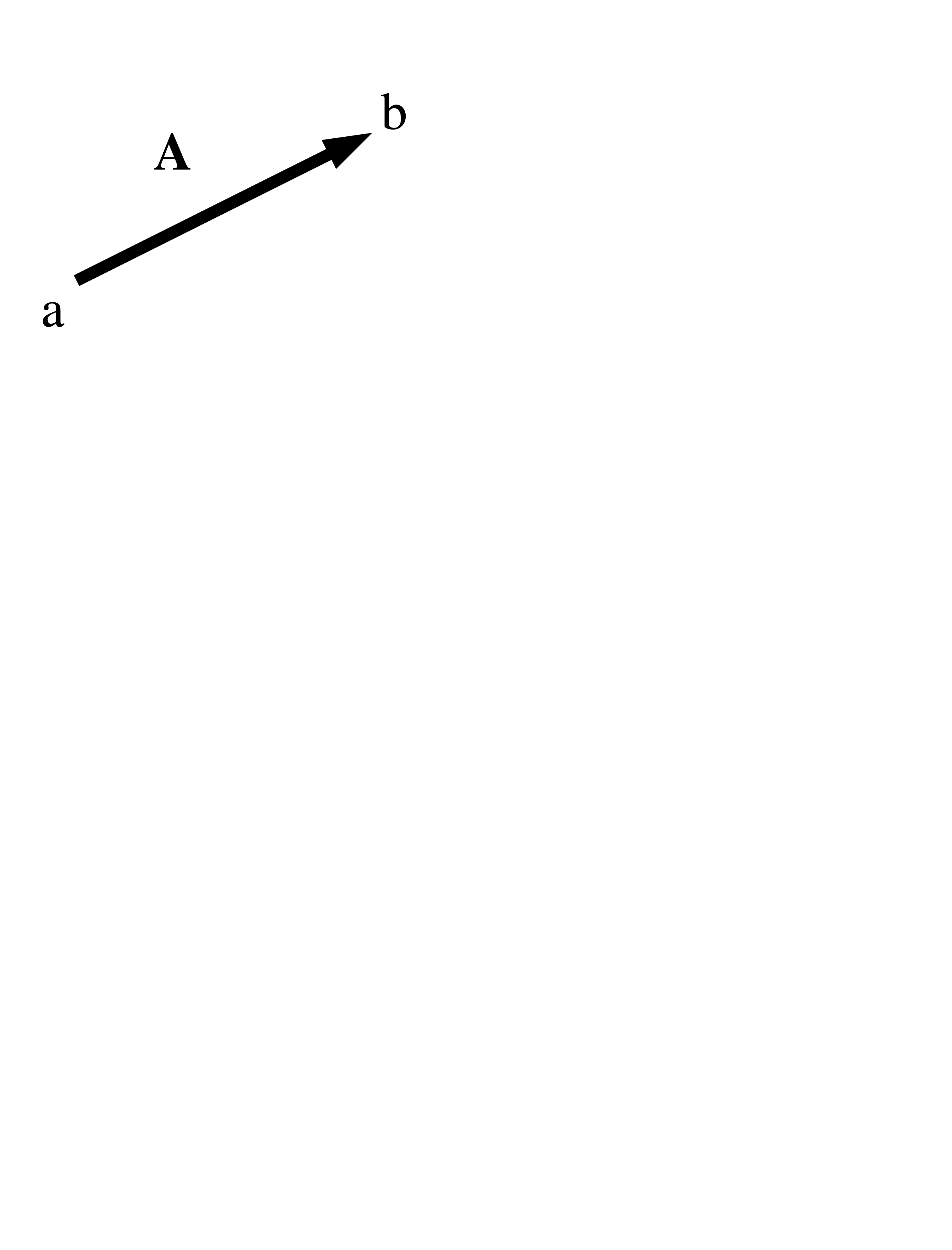
Figure 1. A vector arrow.
Here the point a is called the tail, base, start, or origin; point b is called the head, tip, endpoint, or
destination. The length of the arrow represents the vector’s magnitude, while the direction in
which the arrow points represents the vector’s direction.
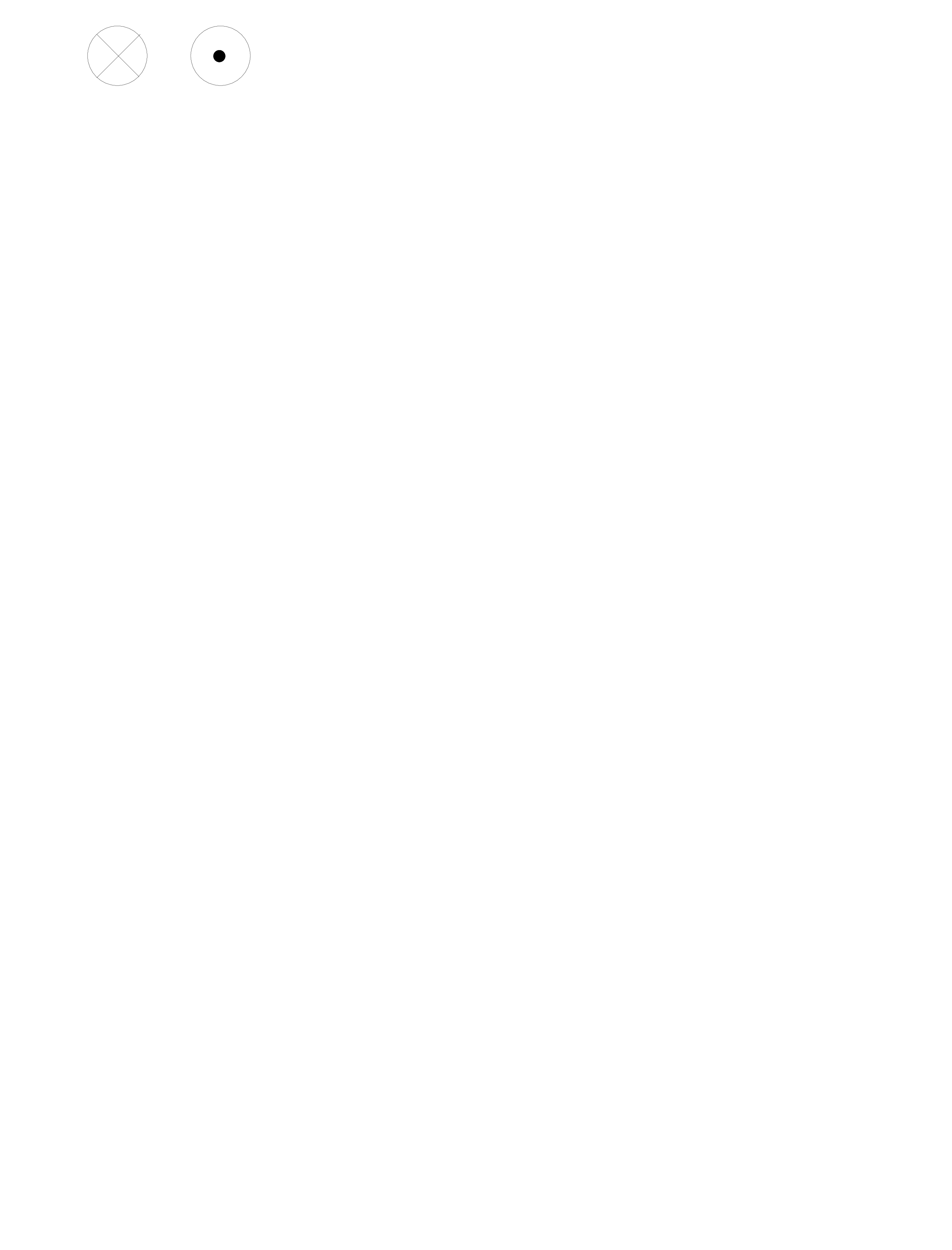
On a two-dimensional diagram, sometimes a vector perpendicular to plane of the diagram is
desired. These vectors are commonly shown as small circles. A circle with a dot at its center
indicates a vector pointing out of the front of the diagram, towards the viewer. A circle with a
cross inscribed in it indicates a vector pointing into and behind the diagram. These
can be thought of as viewing the tip an arrow front on and viewing the vanes of an
arrow from the back. Vectors pointing into (left) and out of (right) the plane are shown
below:
The graphical representation may be too cumbersome in calculations, so we use various
mathematical notations. Vectors in a n-dimensional Euclidean space can be represented as a linear
combination of n mutually perpendicular unit vectors. In this article, we will consider R3 as an
example. In R3, we usually denote the unit vectors parallel to the x-, y- and z-axes by î, ĵ and
k respectively. Any vector A in R3 can be written as A = Axî + Ayĵ + Azk with real numbers
Ax, Ay and Az, which are uniquely determined by A . Sometimes A is then also written as a
3-by-1 or 1-by-3 matrix:
A = 
A = 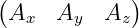
A free vector is determined only by magnitude and direction and may be translated
parallel to itself. In mechanics, however, some vector quantities are attached to a point or
line of action; a force applied to a rigid body is a familiar example where location can
matter.
A modern mathematical viewpoint regards vectors in elementary mechanics as elements of
Euclidean vector spaces such as ℝ2 or ℝ3.
0.3 References
[1] Wilson, E. ”Vector Analysis.” Yale University Press, New Haven, 1913.
[2] Louis Brand, Vectorial Mechanics, John Wiley & Sons, New York, 1930, Chapter I, “Vector
Algebra.” The original 1930 edition
This entry is a derivative of the Public domain work [1] and [2] and the Vector article from
Wikipedia, the Free Encyclopedia. Authors of the orginial article include: Stevenj, Wshun,
Tarquin, Michael Hardy and Patrick.
