Tangential-Normal Particle Kinematics
Tangential-normal coordinates, also called path coordinates, describe particle motion using
directions tied directly to the trajectory rather than to a fixed coordinate grid. At each point on a
smooth path, one unit vector points tangent to the motion and another points toward the local
center of curvature.
This viewpoint is especially useful when the shape of the path is known and the speed along that
path is known or can be found. The velocity then lies entirely in the tangent direction, while the
acceleration naturally separates into a tangential part that changes speed and a normal part that
changes direction.
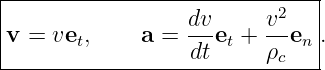
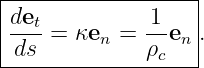
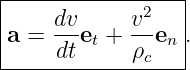
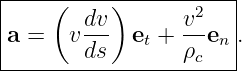
The central result is
where ρc is the local radius of curvature. The subscript c is used here to distinguish radius of
curvature from the cylindrical coordinate ρ used in M01-11.
1 Arc length as the path coordinate
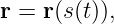
Let the trajectory be described by a position vector
where s is arc length measured along the path. By definition of arc length,
This motivates the unit tangent vector
The tangent vector points in the direction of increasing s.
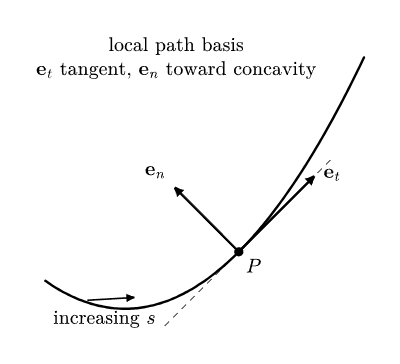
Figure 1. Local tangential-normal basis attached to a smooth trajectory. The unit tangent et
points along increasing arc length, while en points toward the local center of curvature.
2 Velocity in path coordinates
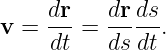
Because
the chain rule gives
Using the tangent vector definition,
Since  is the scalar speed v,
Thus path coordinates encode an important geometric fact automatically: the velocity is always
tangent to the trajectory.
3 Curvature
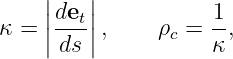
Although et has unit magnitude, its direction generally changes as the particle moves along a
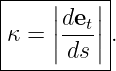
curved path. The rate at which the tangent direction changes with arc length defines the
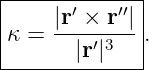
curvature
The radius of curvature is
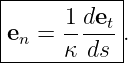
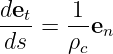
The principal unit normal is defined by
Therefore
The normal direction points toward the local center of curvature.
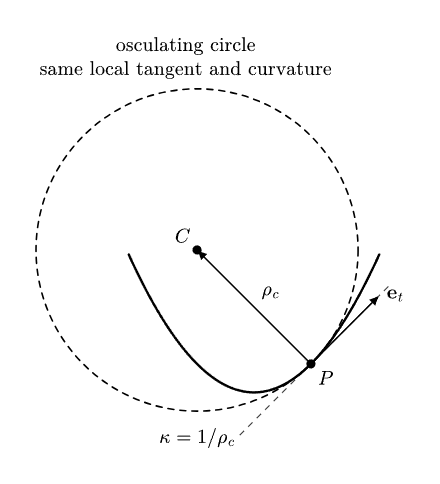
Figure 2. Curvature measures how rapidly the unit tangent rotates with arc length. The
osculating circle has radius ρc = 1∕κ and shares the trajectory’s local tangent and curvature.
4 Derivation of the acceleration formula
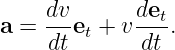
Differentiate the velocity
The product rule gives
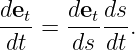
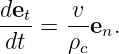
Apply the chain rule to the tangent-vector derivative:
Since
and
we obtain
Substitution gives
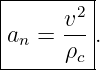
It is customary to define
and
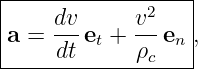
Thus
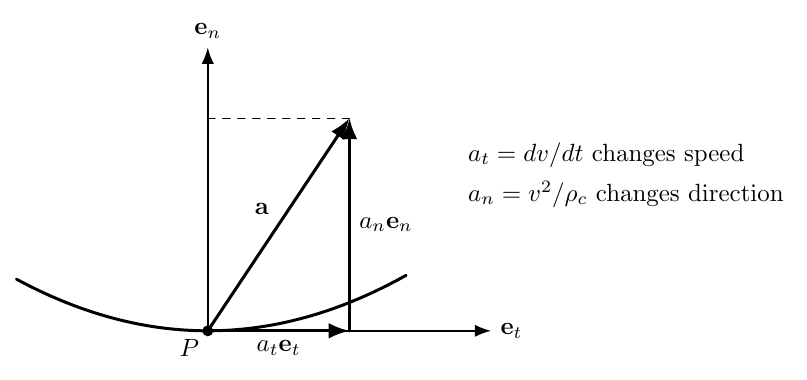
Figure 3. Acceleration in path coordinates separates naturally into a tangential component that
changes speed and a normal component that changes the velocity direction.
5 Physical interpretation
The tangential component
changes the magnitude of the velocity. If at > 0, the particle speeds up. If at < 0, it slows
down.
The normal component
changes the direction of the velocity. It always points toward the local center of curvature. Even if
the speed is constant, an can be nonzero.
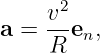
This makes uniform circular motion an immediate special case. For a circle of fixed radius
R,
and if the speed is constant,
Therefore
which is the centripetal-acceleration result of M01-08.
6 Acceleration magnitude and direction
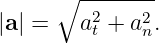
Because et and en are perpendicular,
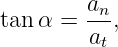
If α is the angle from the positive tangent direction toward the normal direction,
with the quadrant determined by the signs of the components.
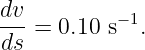
7 Using speed as a function of arc length
Sometimes speed is supplied as a function of path position rather than time:
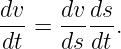
Then
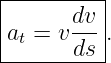
Since ds∕dt = v,
Therefore if v(s) and the path curvature are known,
This form is especially useful in particle dynamics problems where speed is found from energy as a
function of position along a track.
8 Curvature of a planar Cartesian path
If the path is written as
its curvature magnitude is
Hence
This allows path-coordinate acceleration to be computed directly from the geometry of a curve
expressed in Cartesian form.
For a planar parametric path
the curvature can be written
where primes denote differentiation with respect to the parameter u.
9 Three-dimensional extension
For a smooth three-dimensional trajectory, define the binormal unit vector
The three vectors
form the Frenet triad. The trajectory can twist out of the local osculating plane, a behavior
measured by torsion. However, the particle acceleration itself still has only tangential and
principal-normal components:
There is no independent binormal acceleration component for ordinary particle kinematics because
det∕ds lies in the principal-normal direction.
For an arbitrary three-dimensional parameter u,
10 Choosing path coordinates versus polar or Cartesian coordinates
Path coordinates are especially useful when the geometry of the trajectory is already known.
Cartesian coordinates are often preferable when the acceleration components are naturally fixed in
space. Polar or cylindrical coordinates are useful when the geometry is organized around a fixed
origin or axis.
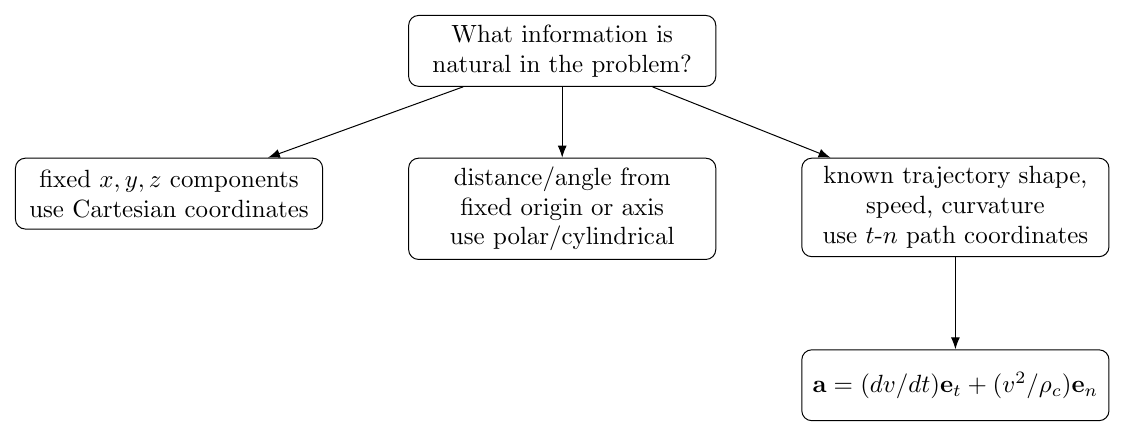
Figure 4. Coordinate-choice guide for particle kinematics. Tangential-normal coordinates are most
natural when the trajectory shape and its local curvature are known.
No coordinate system changes the physics. The goal is to choose a basis that makes the known
information and desired unknowns as simple as possible.
11 Worked example 1: vehicle on a curved road
A vehicle travels along a road whose local radius of curvature is
At one instant its speed is
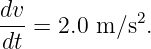
and its speed is increasing at
The tangential component is
The normal component is
Therefore
Its magnitude is
The acceleration points mostly inward because the normal component dominates.
12 Worked example 2: speed prescribed along a path
A particle moves along a known curve whose radius of curvature at s = 20 m is
Its speed is prescribed, with s measured in meters, by
At s = 20 m,
Also,
Therefore
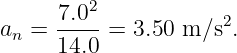
The normal component is
Thus
and
13 Worked example 3: curvature from a Cartesian path
A particle moves along the path
where
At the point x = L, its speed is 4.0 m/s and its speed is increasing at 1.0 m/s2. Find the local
radius of curvature and the tangential-normal acceleration components.
Differentiate the path:
and
At x = L,
Therefore
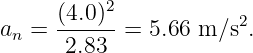
The tangential acceleration is
The normal acceleration is
Hence
The principal normal points toward the concave side of the parabola.
14 Practice problems
- A particle travels at 12 m/s along a path with local radius of curvature 30 m. Its speed
is instantaneously constant. Find at and an.
- A vehicle moves at 10 m/s on a path of radius of curvature 25 m while slowing at 1.5
m/s2. Find a
t, an, and |a|.
- At fixed speed, the radius of curvature doubles. By what factor does the normal
acceleration change?
- At fixed radius of curvature, the speed doubles. By what factor does the normal
acceleration change?
- A particle has v(s) = 3.0 + 0.20s m/s, where s is in meters. At s = 10 m the radius of
curvature is 20 m. Find at, an, and the acceleration magnitude.
- For the path y = x2∕(4L) with L = 1 m, find the radius of curvature at x = 2 m.
- Show that uniform circular motion follows from the tangential-normal formula when v
and ρc = R are constant.
- A helix is parameterized by
with lengths in meters. Show that its curvature radius is 25∕3 m. If a particle moves along
the helix at constant speed 10 m/s, find its acceleration magnitude.
15 Answer check
- at = 0, an = 4.8 m/s2.
- at = −1.5 m/s2, a
n = 4.0 m/s2, |a| = 4.27 m/s2.
- It is halved.
- It increases by a factor of 4.
- v = 5.0 m/s, at = 1.0 m/s2, a
n = 1.25 m/s2, |a| = 1.60 m/s2.
- ρc = 4
 m ≃ 5.66 m.
- at = 0 and an = v2∕R, directed toward the circle center.
- ρc = 25∕3 m and |a| = v2∕ρ
c = 12.0 m/s2.
16 Summary
Tangential-normal coordinates attach the basis directly to the trajectory. The central definitions
are
and
The tangential component changes speed, while the normal component changes direction. This
framework generalizes the centripetal-acceleration idea from circular motion to arbitrary smooth
trajectories and provides a natural final bridge from kinematics into Newtonian particle
dynamics.
References
[1] J. R. Taylor, Classical Mechanics, University Science Books, 2005.
[2] J. B. Marion and S. T. Thornton, Classical Dynamics of Particles and Systems, 5th
ed., Brooks/Cole, 2004.
[3] J. Moore et al., Mechanics Map, Engineering LibreTexts, CC BY-SA 4.0.
[4] PhysicsLibrary, M01-08, Uniform Circular Motion.
[5] PhysicsLibrary, M01-10, Polar-Coordinate Particle Kinematics.














![|-----------′′-----|
|κ = -----|y--|--- .
| [1 + (y′)2]3∕2|
-------------------](https://images.physicslibrary.org/cache/objects/1331/make4ht/TangentialNormalParticleKinematics35x.png)
![|------------------|
| [1 + (y′)2]3∕2 |
|ρc = ------------ .
----------|y′′|-----|](https://images.physicslibrary.org/cache/objects/1331/make4ht/TangentialNormalParticleKinematics36x.png)

![|--------------------|
| -|x′y′′ −-y′x′′|-|
κ = ′2 ′2 3∕2 ,
-----[(x-)-+--(y-)-]----](https://images.physicslibrary.org/cache/objects/1331/make4ht/TangentialNormalParticleKinematics38x.png)




















![[1 + (1)2]3∕2 √ --
ρc = ------------= 2 2L = 2.83 m.
1∕L](https://images.physicslibrary.org/cache/objects/1331/make4ht/TangentialNormalParticleKinematics63x.png)