|
|
|
|||||||
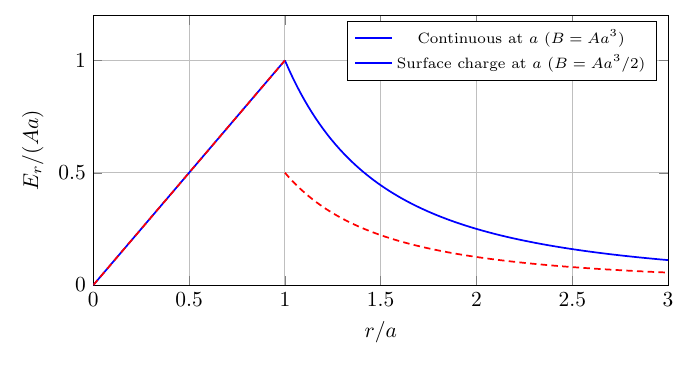
The interior encloses 4π𝜖0Aa3 and the surface contains 4π𝜖 0(B −Aa3). Their sum matches 4π𝜖 0B, the charge inferred by exterior flux. Check. Each recovered density has the expected units. Setting B = Aa3 removes the interface charge and makes the field continuous.
3 Practice variationTake B = 0 with A > 0. Find the sign and amount of the surface charge. Solution. σ = −𝜖0Aa. Its total charge exactly cancels the positive volume charge.
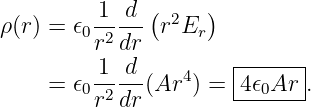
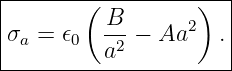
4 Recover local density from thin spherical layersFor a spherical field the flux law gives Qenc(r) = 4π𝜖0r2E r(r). In a smooth open region the shell from r to r + dr adds 4πr2ρ(r) dr, so differentiation and division give ρ(r) = 𝜖 0r−2(r2E r)′. For Ar the derivative is 3Ar2. For B∕r2 the differentiated quantity is the constant B. At an interface the normal-field jump is the outward-side limit minus the inward-side limit with the same Normal. The thin shell enclosing the interface gives
The same result follows from the pillbox. A point charge at the center would require a nonzero limiting flux through arbitrarily small spheres, but r2Ar tends to zero.
5 Worked example 2: reconstruct the potentialWith zero at infinity, the outside potential is B∕r. Take its value B∕a at the interface, and integrate inward:
The finite field jump leaves V continuous. The one-sided radial derivatives at the interface match precisely when B = Aa3. This condition removes the separate surface term while allowing a jump in volume density.
6 Additional worked example 3: a quadratic interior fieldSuppose a spherical field is prescribed by Er = Ar2 for 0 < r < a, where A has units of field per square meter, and by Er = B∕r2 for r > a. Recover the charge distribution. In the interior,
The volume charge is Qvol = 4π ∫ 0a(4𝜖 0Ar)r2dr = 4π𝜖 0Aa4. The surface jump at r = a is
The surface charge is 4πa2σ a = 4π𝜖0(B −Aa4). Adding recovers 4π𝜖 0B, matching the exterior flux. A field continuous at the surface requires B = Aa4.
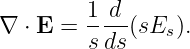
7 Additional worked example 4: infer density in cylindrical symmetryFor an infinite cylindrically symmetric field E = Es(s)s, the divergence is
Take Es(s) = Cs2 for s < a. Then
As a check, calculate the charge per unit length within radius s:
Gauss’s law gives Es = λenc∕(2π𝜖0s) = Cs2, closing the independent check.
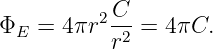
8 Additional worked example 5: point charge hidden by zero ordinary divergenceConsider an exterior radial field E = Cr∕r2 for r > 0. Ordinary differentiation gives ∇⋅ E = 0 at every point with r > 0. But the flux of any sphere centered at the origin is
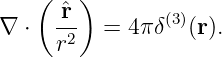
Thus the source is a point charge q0 = 4π𝜖0C at the origin. In the distributional formulation,
It is incorrect to infer a globally charge-free region merely from zero ordinary divergence on the punctured domain r > 0. This is an important warning when interpreting solutions of Laplace’s equation with singularities.
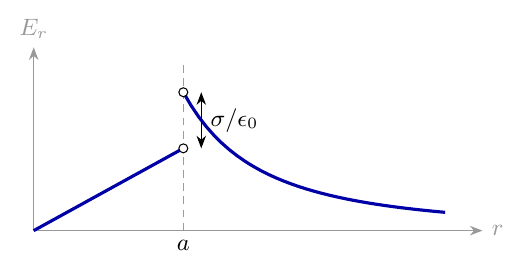
Figure 2. Example radial fields and recovered charge densities. A jump in the one-sided field at a spherical surface represents a surface charge, not a volume-charge spike that can be treated as an ordinary function.
9 More practice with solutionsExercise 3. A spherical field is Er = C∕r for 0 < r < a. Find the volume charge density away from the origin. Solution. ρ = 𝜖0r−2d(Cr)∕dr = 𝜖 0C∕r2. The integrated enclosed charge within radius r is 4π𝜖 0Cr and tends to zero as r → 0, so no additional point charge is required by this field. Exercise 4. For the quadratic interior field, choose B such that no surface charge lies at r = a. Solution. Set the normal jump equal to zero: B∕a2 = Aa2, hence B = Aa4.
10 ExercisesExercise 1. With A > 0, choose B so that the surface charge is twice the total interior charge in magnitude but negative. Solution. Set B − Aa3 = −2Aa3, so B = −Aa3. The external field points inward. Exercise 2. What if an extra C∕r2 term appeared in the interior field? Solution. Its divergence is zero at nonzero r, but its small-sphere flux is 4πC. Gauss’s law would identify a point source 4π𝜖0C at the origin. The interface accounting would also use the updated inner one-sided field.
References
References
"Recovering Volume and Surface Charge from a Radial Field" is owned by bloftin.
This object's parent. Cross-references: magnitude, enclosed charge, function, charge densities, domain, divergence, square, volume density, Normal, volume, units, flux, outward normal, Gauss's Law, regular, charge, volume charge density This is version 1 of Recovering Volume and Surface Charge from a Radial Field, born on 2026-11-28. Object id is 1624, canonical name is RecoveringVolumeAndSurfaceChargeFromARadialField. Accessed 3 times total. Classification:
|
|
|
|
Pending Errata and AddendaNone.
|
DiscussionNo messages.
|
Interact |